November 26, 2025
I’m back in Sydney. My 2-year visa had expired, and the Mandarin Training Center refused to give me another. However, I discovered that I can go back to Taiwan without a visa and study Chinese, though I have to depart in 90 days. I’ll be doing this for, hopefully, some years.
My mother suggested I travel with her by train to Bathurst, where we will meet with my aunt and uncle-in-law who live there, coming back the next day. After exploring options, it turned out that we had to go the next day. My aunt encouraged us, naming two hotels that we could stay at. The first hotel was booked out, but the second (Victoria Hotel) was available. I quickly booked that and the train tickets online.

Above is the map. According to 12Go, “Travelling by train, the distance from Bathurst to Sydney is 109 miles” or 175 kilometers. Going by train takes 3 1/2 hours. First we go through Sydney to Penrith, then go up over the Blue Mountains to Lithgow, then finally go through the Western tablelands to Bathurst.
My mother and I set off from Northbridge at around 6am. The sun was just over the horizon, and the air was refreshingly cool, temperature around the high teens.
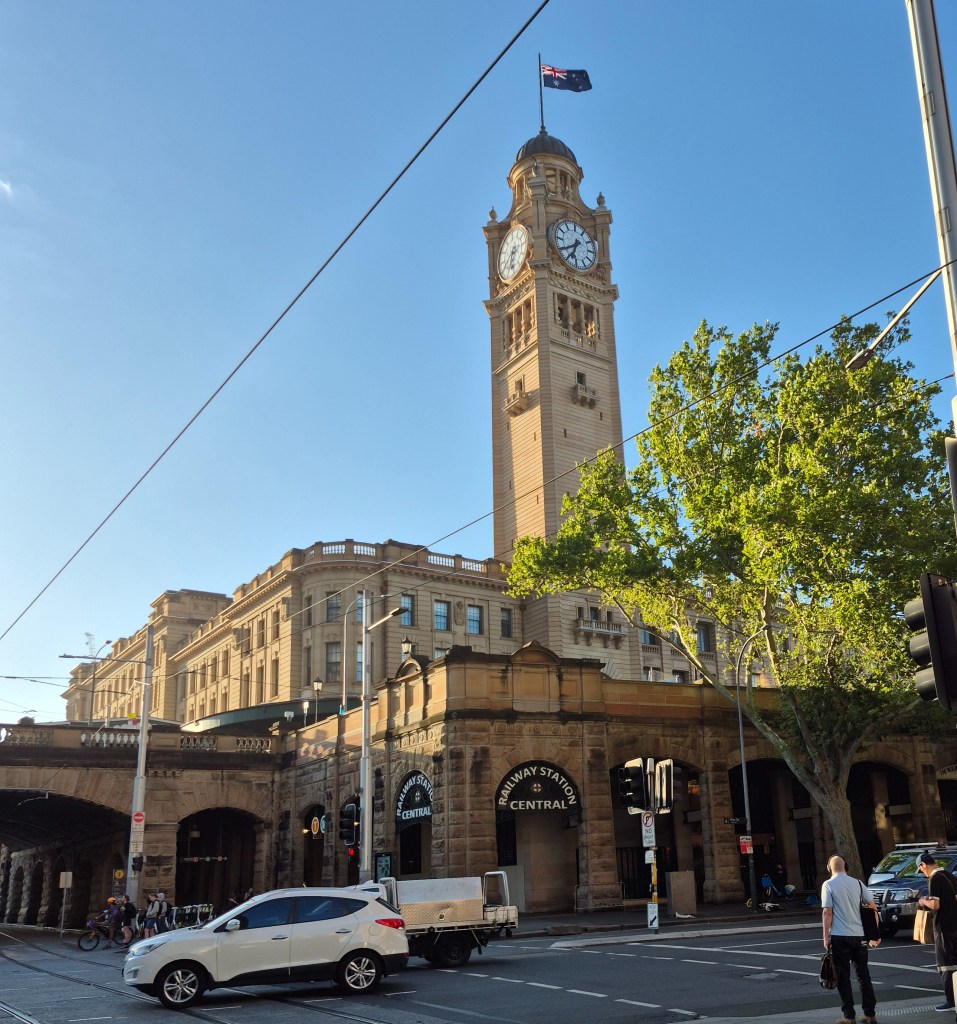
Central Station. Wikipedia said “The station is Australia’s largest and busiest railway station, and is a major transport interchange for NSW TrainLink inter-city rail services, Sydney Trains commuter rail services, Sydney Metro services, Sydney Light Rail services, bus services, and private coach transport services. The station is also known as Sydney Terminal (Platforms 1 to 12). The property was added to the New South Wales State Heritage Register on 2 April 1999. … It recorded 85.4 million passenger movements in 2018 and serves over 250,000 people daily.”

A foundation stone. According to the Dictionary of Sydney, “The first stage of the new station was opened in August 1906… The position of the station at the southern end of the city and its scale made it an instant landmark, with the clock in the tower being used by surrounding neighbourhoods as well as commuters. The station remains the gateway to the Sydney and regional rail system.”

A view under Eddy Avenue, showing the stonework. The escalator to the first floor is just visible to the right.

One level up via the escalator. The entrance to Central Station is the ornate entrance-way to the right. We arrived as a tram (technically, light rail) was just departing.
“The Sydney light rail network … has four passenger routes, the L1 Dulwich Hill, L2 Randwick, L3 Kingsford and L4 Westmead & Carlingford lines. It comprises 58 stops and a system length of approximately 36.7 km (22.8 mi), making it the second largest light rail network in Australia behind the tram system in Melbourne, Victoria.” (Wikipedia)

In the station. The departures noticeboard is centre right. Wikipedia notes “The train shed roof was to be designed to have a central span of 198 ft (60 m) with two sides spans of 78 ft (24 m)…. The roof was to be continuous. This truss and roof configuration was to be based on that of the Union Station, St Louis, visited by Deane in 1894. Such a roof would have rivalled those of the major metropolitan termini in Europe and America. “
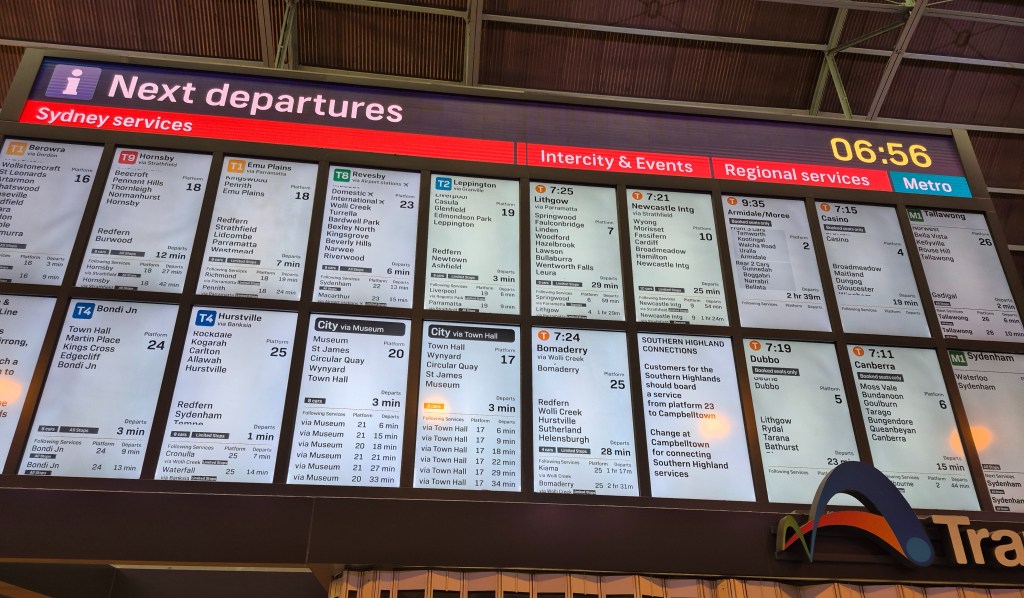
A close-up view of the departures noticeboard. Our train was scheduled to depart at 7:19am, terminating at Dubbo (lower screens, three from right).

There was a memorial to John Witton.
“Upon his arrival to Sydney and appointment as Engineer-in-Chief of NSW Railways in 1856, English railway engineer John Whitton was effectively handed the responsibility of taking a NSW rail network in its infancy and expanding it across NSW. It was Whitton who first conceived of the idea of the Eveleigh Railway Workshops in the 1870s as the centre for the construction and development of the NSW railway system. Despite constant issues with government committees throughout his 35-year career with NSW railways (1856-1890), Whitton successfully implemented several significant and fundamental elements to the expansion and improvement of the NSW rail network and administration, earning him the place in NSW rail memory as the ‘Father of NSW Railways’. Under Whitton’s tenure, the NSW rail network expanded from 37km of track in 1856, to over 3500km by his retirement in 1890. Whitton was also responsible for adoption of a uniform railway track gauge throughout NSW, conversion of locomotive fuel from wood fire to coal to reduce emissions that damaged passenger clothing and property along the rail line, construction of the Blue Mountains line and the Zig Zag Railway at Lithgow, and expansion of the NSW rail to the Queensland and Victorian borders.” (South Everleigh)

Some people sleeping in the station. Guardian Australia has an article on rough sleepers who use Central Station; they are mostly women, as its CCTV cameras and public position means the location is safer than usual.

My mother bought some coffee and snacks from the coffee stall, while I bought it from a shop in the station. She said the coffee was not bad, while mine was too bitter.

An artistic shot from the buffers. Our train, an XPT, was to the left.
From Wikipedia, “New South Wales XPT (short for eXpress Passenger Train)… Based on the British Rail-designed High Speed Train, each XPT set comprises two XP power cars in a push-pull configuration and, between them, from four to seven passenger carriages. … The XPT was procured … in March 1980. The design of the InterCity 125 was substantially modified. … The XPTs are operated under NSW TrainLink, running on long-distance regional and interstate North Coast, Main Western and Main Southern line services throughout New South Wales and interstate into Victoria and Queensland.”

We paid $AUS 22 from Sydney to Bathurst, travelling 2nd class, and concession due to my mother’s age and my disability.
The above clip is a train trip from Sydney to Dubbo, past Bathurst. I recommend you stop viewing the clip when you get to Bathurst, about two-thirds of the way through.

Our train left on time. Here is a photo of Strathfield Station shortly after departing. I photographed the scene sitting at my seat from inside a window, hence the reflection on the glass.
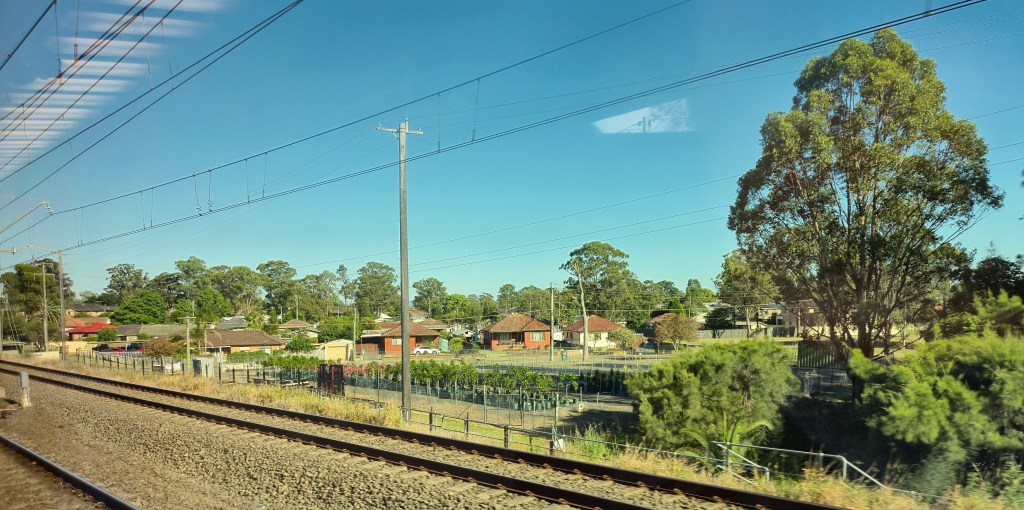
The train went rumbling west, through suburb after suburb, under an immense cloudless sky.
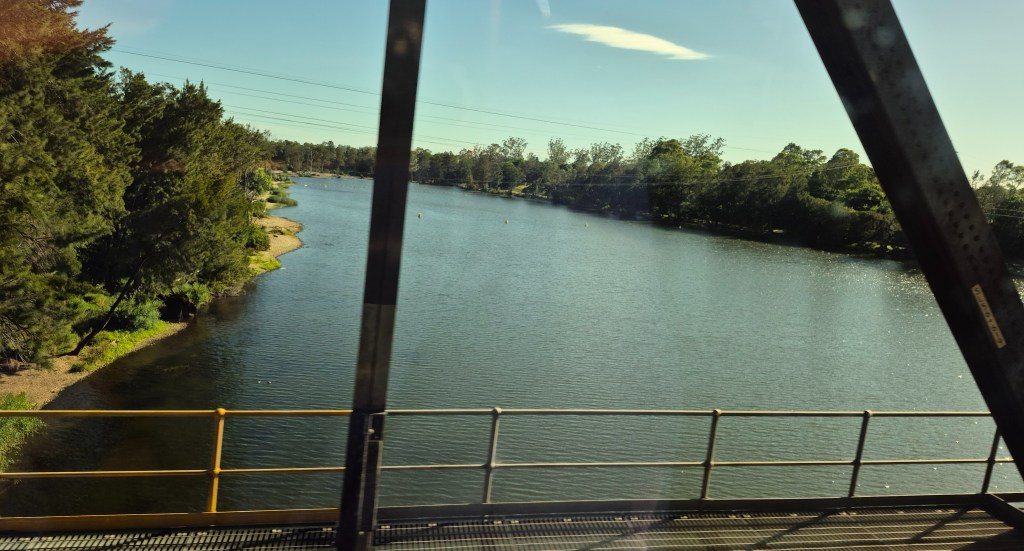
After an hour and a half we crossed the Nepean River at Penrith. The Aboriginal name is Yandhai – I had to look it up.
The river changes its name to the Hawkesbury downstream of the confluence of the Grose River because “When the British colony was established at Sydney in 1788, the Governor, Captain Arthur Phillip, charted the coast 50 km north to the mouth of the Hawkesbury and around 32 km upstream till they were stopped by a waterfall, most likely at Hawkesbury Heights. Phillip named the river after Lord Hawkesbury. ..Meanwhile, Lieutenant Watkin Tench set off to walk inland, west of Sydney. About 60 kilometres (37 mi) inland, at the foot of the Blue Mountains, he discovered a large river which he named Nepean … It took about three years to realise that the Nepean flowed into the Hawkesbury.” (Wikipedia)

Getting close to the Sydney border. The photo was taken around Emu Plains.
According to Wikipedia, “Near Penrith, since 1971 numerous Aboriginal stone tools were found in Cranebrook Terraces gravel sediments deposited by the Nepean River 40,000 to 50,000 years ago, according to repeated, revised and corroborated radiocarbon and thermoluminescence dating. At first when these results were new they were controversial. More recently in 1987 and 2003 dating of the same sediments strata has revised and corroborated these dates”.

We could see the Blue Mountains as a barrier (above). My father told me this is the Lapstone Monocline.
“During the construction of the Great Western Railway it appeared almost impossible to construct a railway line over the Blue Mountains. It was eventually achieved by constructing a line with gradients as steep as 1 in 30 (3.33%), with curves of 8 chain (160 m) radius and the use of a zig-zag at Lapstone.” (Valley Heighs Railway Museum)

The landscape changed to thick bush (above). The trees are mostly eucalyptus, with a dense understorey.

We went through a series of cuttings (above) and tunnels.
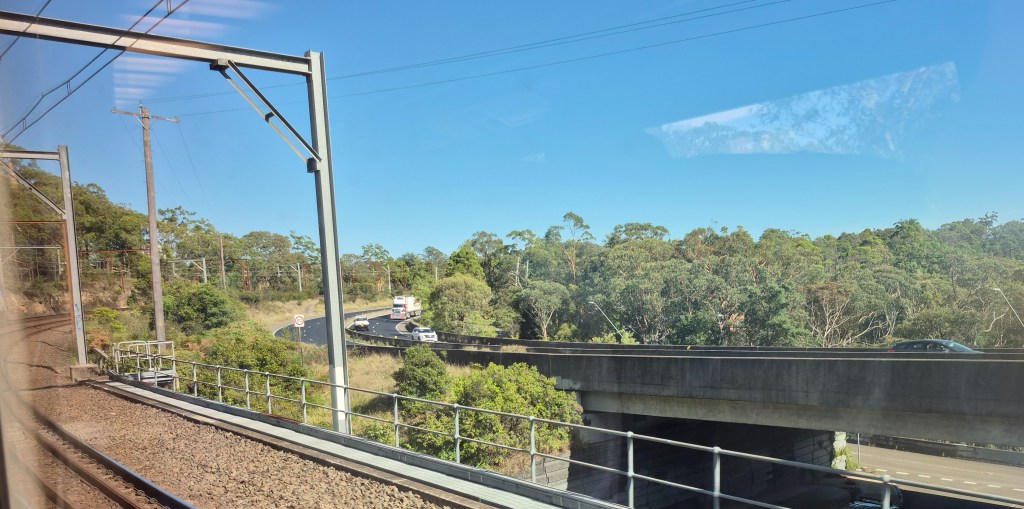
The railway and the motorway, the Great Western Highway, runs parallel through this stretch of the Blue Mountains.
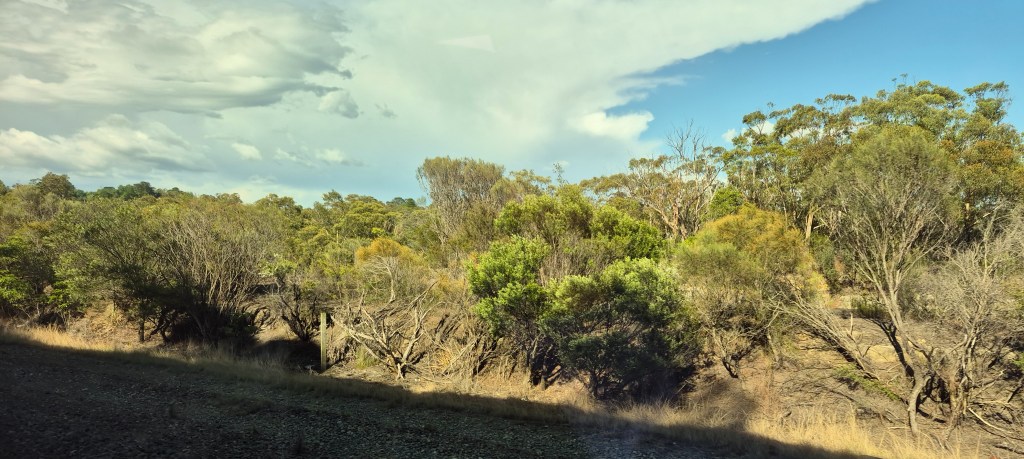
The vegetation changed as we ascended. This was taken near 1000 meters in altitude.
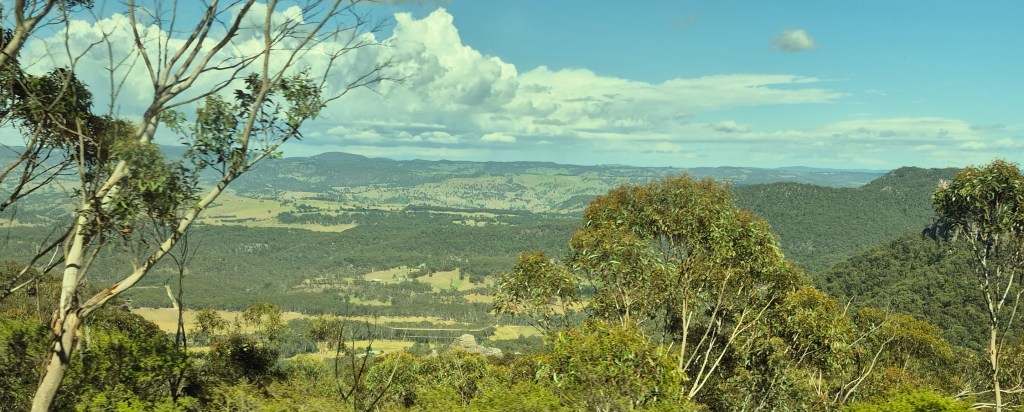
A fine view outside the windows. I think this was the Megalong Valley.
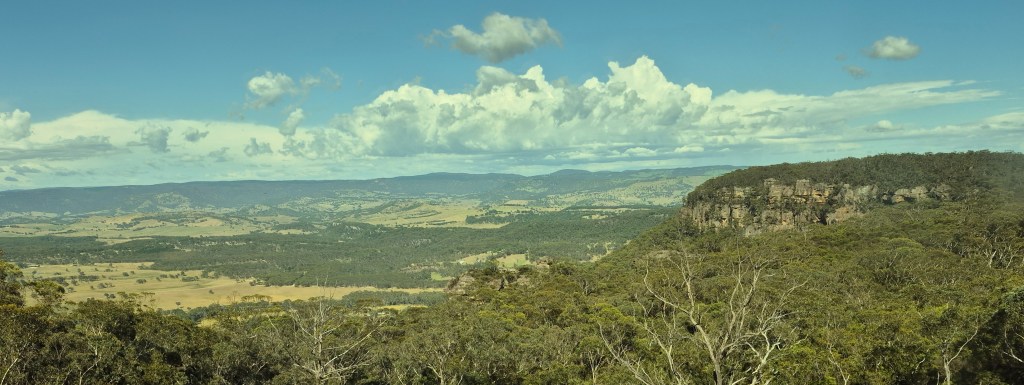
And this maybe is the view towards Little Hartley?

I don’t know what view this is – except it’s majestic.

Coming off the western edge of the Blue Mountains, we went through ten tunnels and numerous defiles, like the one above.

We passed through Lithgow, and the country opened up to hills and rolling plains (above). We were in the western tablelands.
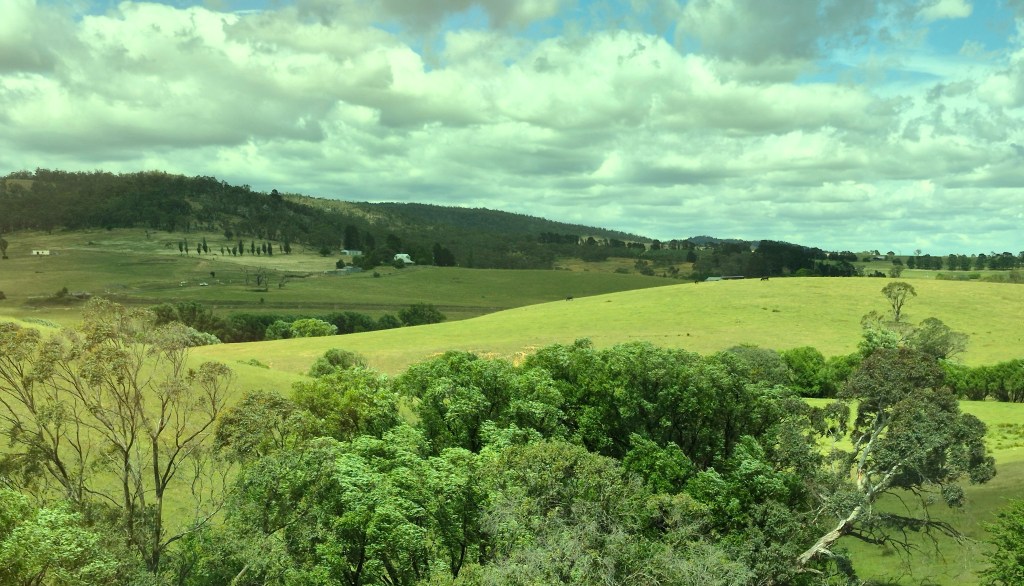
Beautiful scenery in this part of the trip.

This was a photographer’s delight.

I was reminded of a painting I saw in my parents’ home in Sydney, drawing from life.
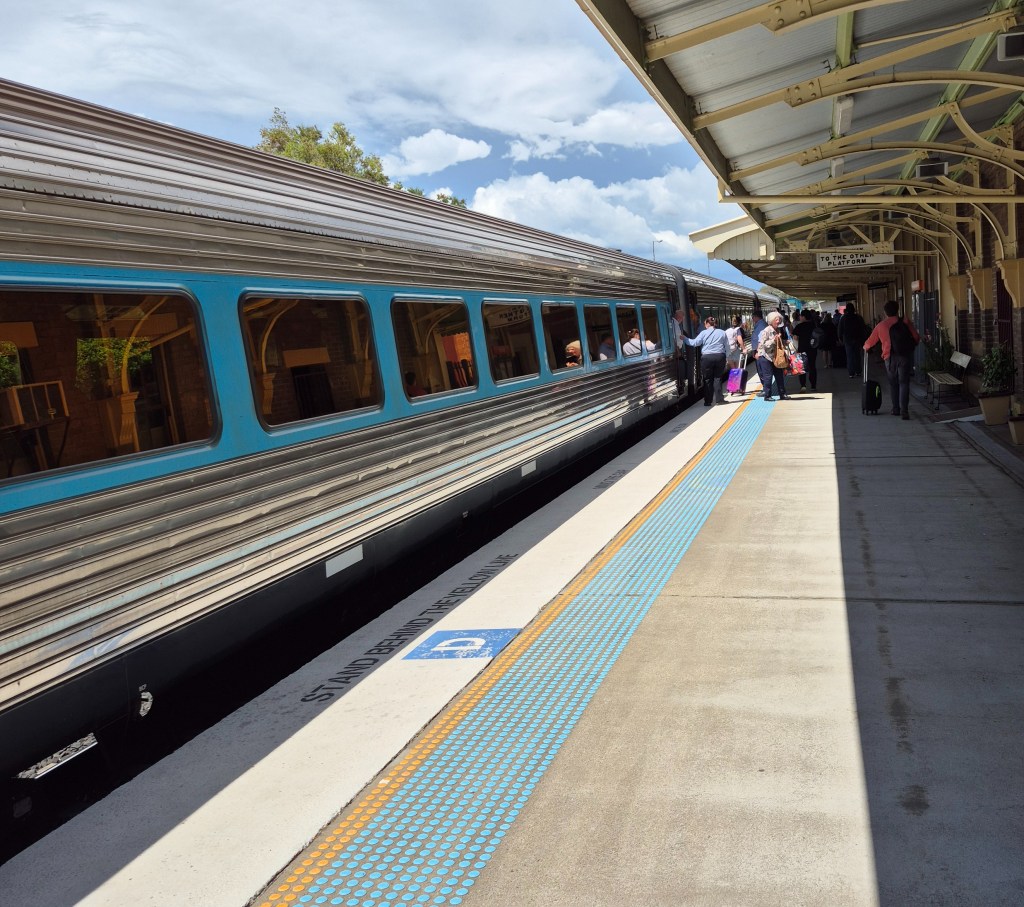
At last, Bathurst Railway Station.

A photo from outside Bathurst Railway Station.
“On 7 May 1815, Governor Macquarie at the terminus of Cox’s Road raised the flag, ordered a ceremonial volley to be fired and proclaimed and named the future town of Bathurst after the Secretary of State for War and the Colonies, Henry Bathurst, 3rd Earl Bathurst. This made Bathurst the first inland settlement in colonial Australia.” (Bathurst Region)
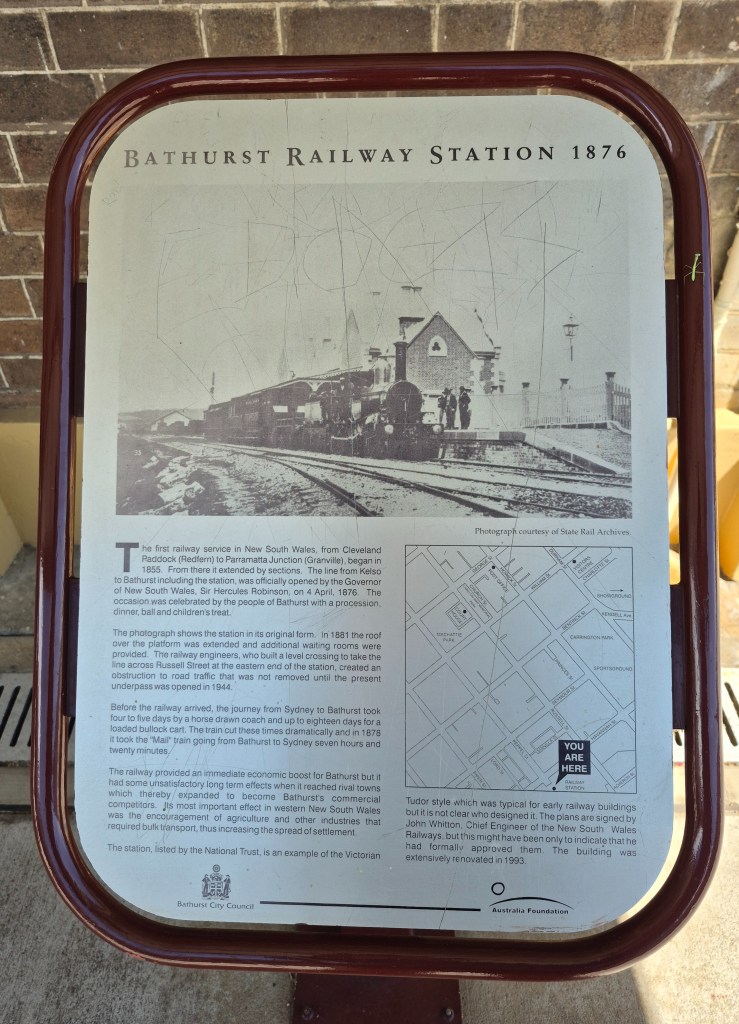
A plaque in Bathurst Railway Station. It reads in part, “The line from Kelso to Bathurst including the station, was officially opened by the Governor of New South Wales, Sir Hercules Robinson, on 4 April, 1876. The occasion was celebrated by the people of Bathurst with a procession, dinner, ball and children’s treat.” At that time, New South Wales was a colony of Britain, not yet a State in the future Australia.

In an open-sided pergola there was a steam train.

A grain mill next to the station.
According to the National Museum Australia, “Bathurst was initially planned as an administrative centre for government officials, soldiers and convicts stationed on the plains west of the Blue Mountains, and as a service centre for the colony’s growing pastoral enterprises. However, as news of the quality of the land spread in Sydney, pastoralists flooded inland and for the next decade a state of armed conflict existed in the region as the Wiradjuri people, led by the warrior Windradyne, resisted the loss of their lands to the settlers. The steady growth of the town was given a tremendous boost in the 1850s when gold was discovered 20 kilometres away at Ophir. The discovery began the Australian gold rushes and Bathurst prospered in the following decades. Today it is still one of the most important inland cities in New South Wales, famous for motor racing, agriculture and as the birthplace of one of Australia’s greatest prime ministers Ben Chifley.”

My mother walking towards the Victoria Hotel, just visible above her, behind the coach.
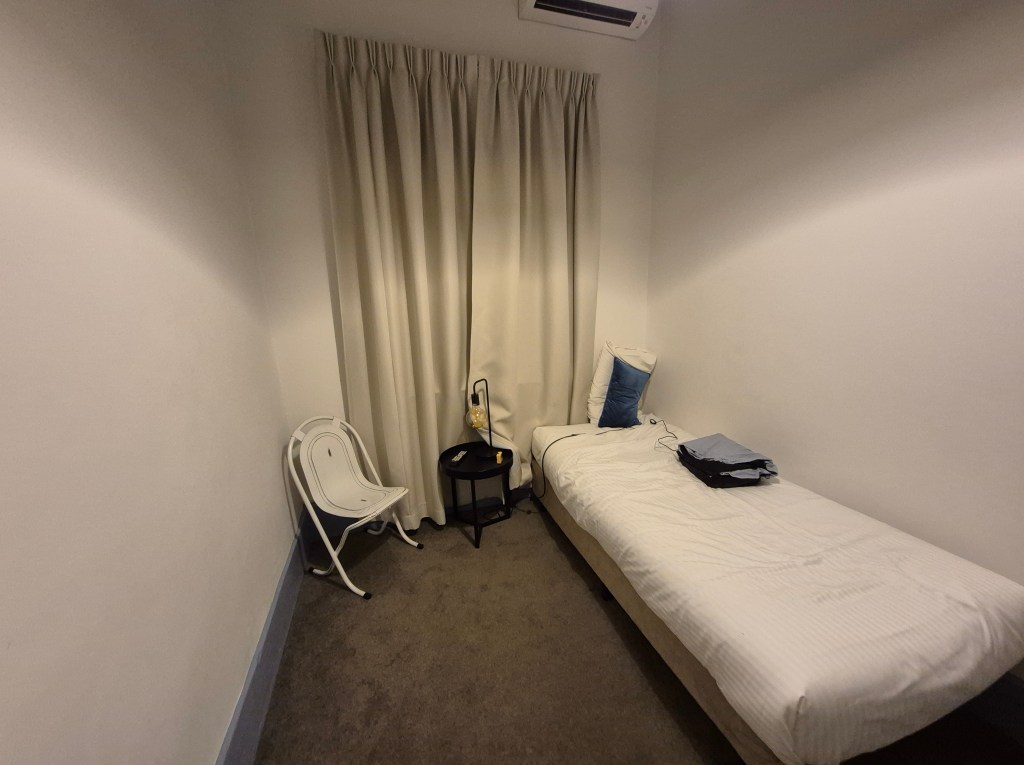
My room at the Victoria Hotel, photographed with my back against the door. The bathrooms were down the hall. My mother had an identical room. At first I considered my room only a bare step up from a prison cell, but the bed was snug, the air-con worked, the station was convenient, and it was only $AUS 87 a night. I think I would stay there again if I had to do something early in the morning.
We met my aunt and uncle-in-law, and went to their house, which is a lovely single-story terrace over a large block. This house, the wide streets, and the setting of the town, created a favourable impression on me. Bathurst has a population of around 45,000 people, but it has a university (Charles Sturt University), Mount Panorama motor racing circuit, and is a regional centre for health, as well as agriculture.

My uncle-in-law took me briefly to see Mount Panorama. On the way we passed an entrance to Charles Sturt University (above).
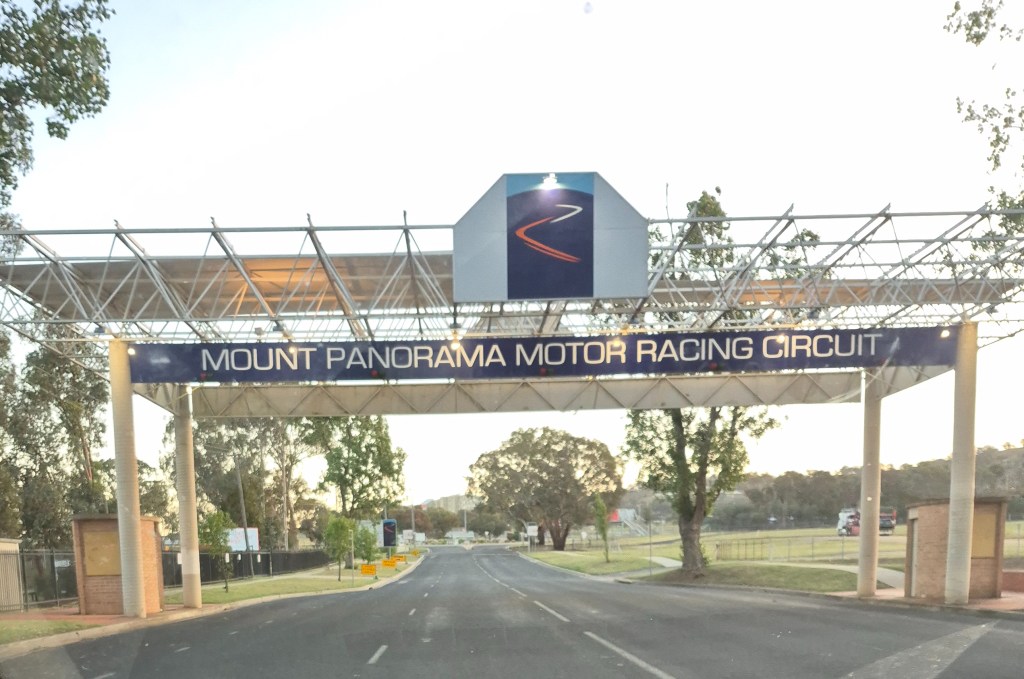
Then we drove under the Mount Panorama motor racing circuit. Bathurst Region stated, “It is situated on a hill with the dual official names of Mount Panorama and Wahluu and is best known as the home of the Bathurst 1000 motor race held each October, and the Bathurst 12 Hour event held each February.”
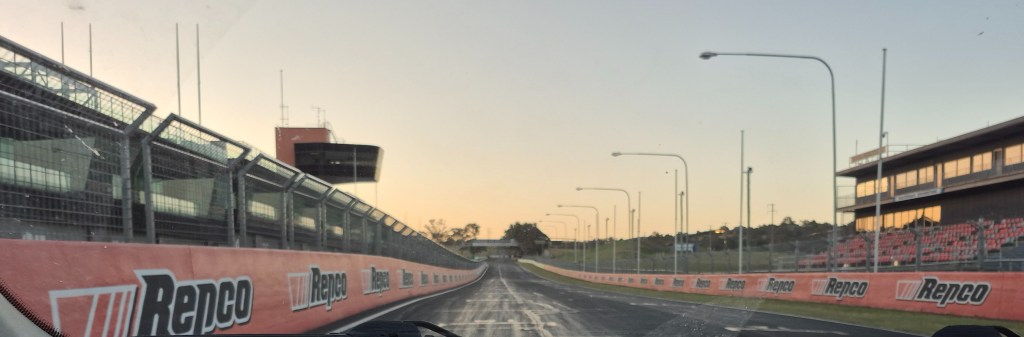
We actually went on the motor racing track!

Unfortunately, an official stopped us from going around the entire track, but I took a great photo including the marvellous view from Mount Panorama, and the caravan park in the foreground.
After spending a night in the Victoria Hotel, which wasn’t as bad as I anticipated, and spending an agreeable day with my aunt and uncle-in-law, we caught the train back to Sydney. I paid for my 2nd-class tickets, though – there was an Aboriginal man sitting a few seats away cursing almost the entire trip.
 Wandering Richard