April 25-28, 2023
I’m back in Taipei, studying one-to-one with Teacher Tseng until my course starts in June. I have a spare week, so I decided to travel to Green Island.
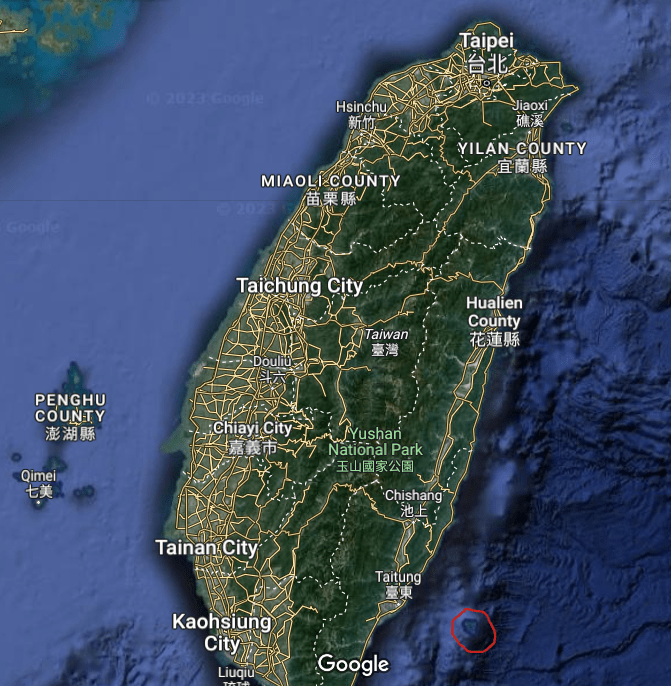
Green Island is the place circled in red in the above map. I travelled via Taidong (in pīnyīn it’s written ‘Táidōng’), but in the map above it’s written as ‘Taitung’. I wrote about that in the webpage titled “Taitung”, but missed that it’s simplified name is 台東, meaning “Fort East”. For comparison, Taipei translates to “Fort North”, Taichung is “Fort Centre”, and Tainan is “Fort South”.
In the entry from 2022 I recounted how I didn’t make it to Green Island. I’m trying again. I thought I wouldn’t actually stay on Green Island, instead coming back the same day.
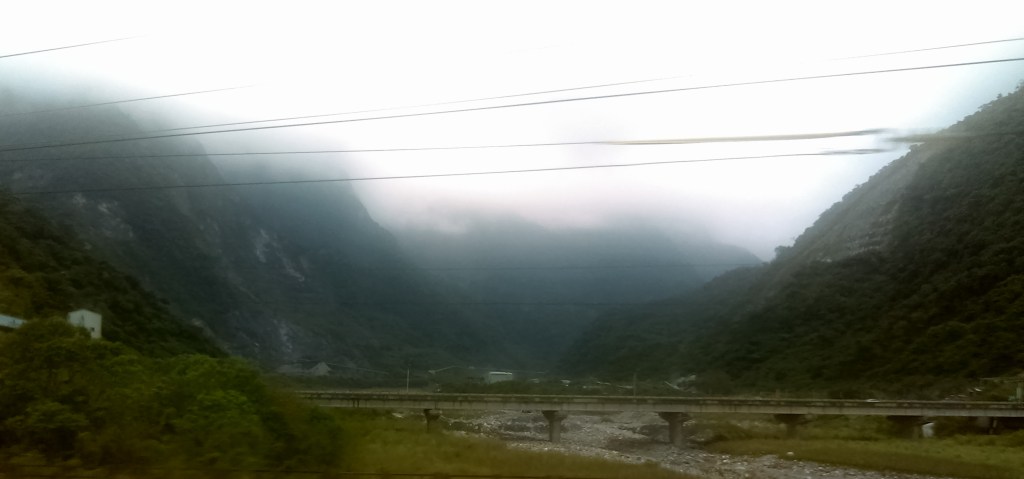
I traveled by train from Taipei to Taidong in 4 1/2 hours, around $AUD 40. The day was overcast with sprinklings of rain. I took the above photo of the mountains near Hualien.
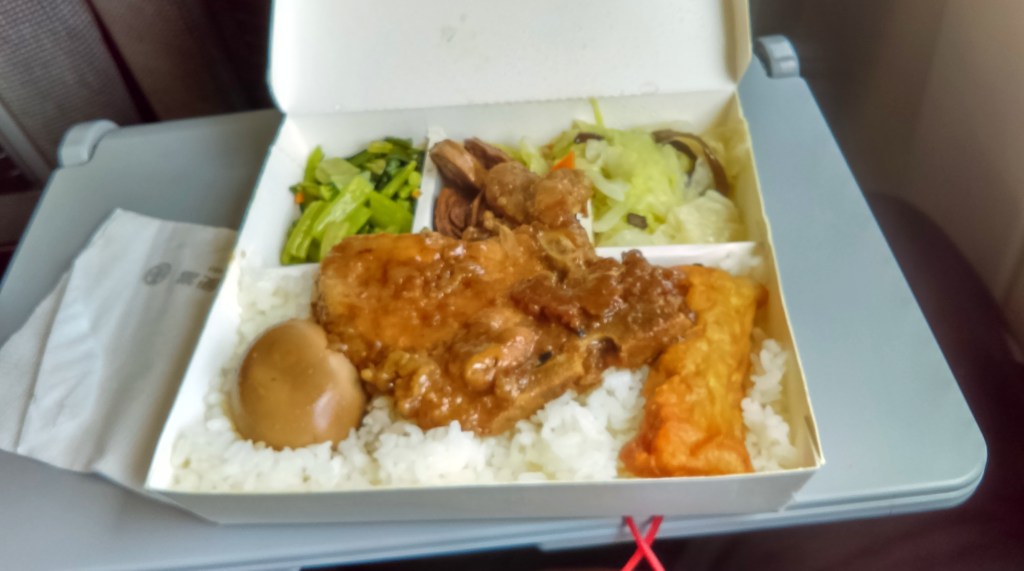
I reserved a meal on the train, for $AUD 4. This was the famous TRA railway bento box (above); a pork chop, cabbage, choi sum, tofu, an egg, and something fried. It was delicious! Full confession: I ate my railway bento without thinking to photograph it first, so this is the one I had on the return trip.

The train ran along the East Rift Valley, 167 kilometers long but only a few kilometers wide, covered here. We crossed into the tropics at Ruisui, about where the picture above was taken. Full confession: this was taken coming back on the train, when the weather was better.
After I disembarked at Taidong, I caught a bus into the town centre and checked in with Melody Hotel. The Chinese name of this hotel is 松夏大飯店, meaning (I think) “Summer Pine Hotel”. Why didn’t they use the translated name?
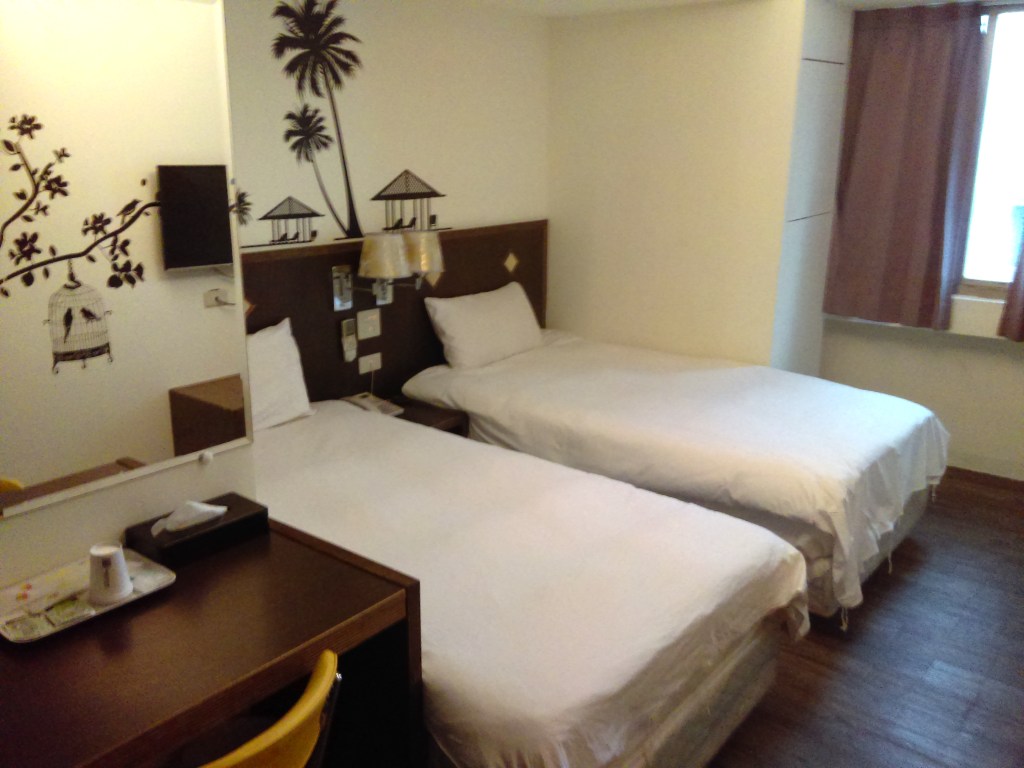
My room, about $AUD 50 a night. The furnishings were rudimentary but functional, including air-conditioning, good wi-fi, and a television. I liked this room.
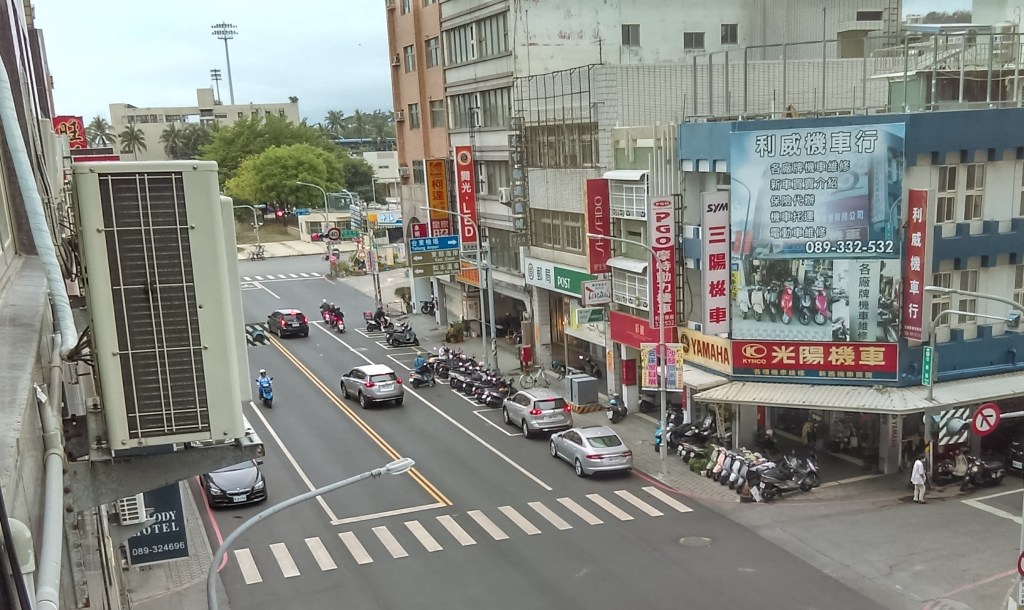
The view out the window. I was on the 4th floor, or the 3rd floor from an Australian viewpoint.

Breakfast was included. The above shows the dining area on the 3rd floor (2nd floor to Australians). Breakfast was set out buffet style, but it was all Taiwanese buffet. I filled up on cabbage, Hokkien noodles, very white-bread toast, and cold milk tea.

The central market was only a block away. The picture above shows freshly-caught fish, but there was also butchers’ stands, fresh vegetables, fresh fruit (different stands from the vegetables), and of course the whole dry-goods area.

There are also betel nut stands:
“Betelnut, areca nut, or what Taipei locals call bing lang (槟榔), has been around for thousands of years and doesn’t look ready to leave soon. The nut grows all over the tropical Pacific, where people chew it medically and recreationally for its natural psychoactive ingredients, the most important being arecoline. Consuming the nut in any of its forms gives the user a warm, stimulating buzz, making it a product of choice with taxi drivers, long-haul truckers, and other workers who rely on the nut to make it through long shifts.”
On April 26th I went to Green Island on a day trip. Green Island is spelled ‘Lǜdǎo’ in pinyin, and written 綠島.
Here is a YouTube clip about Green Island, one of a great number.
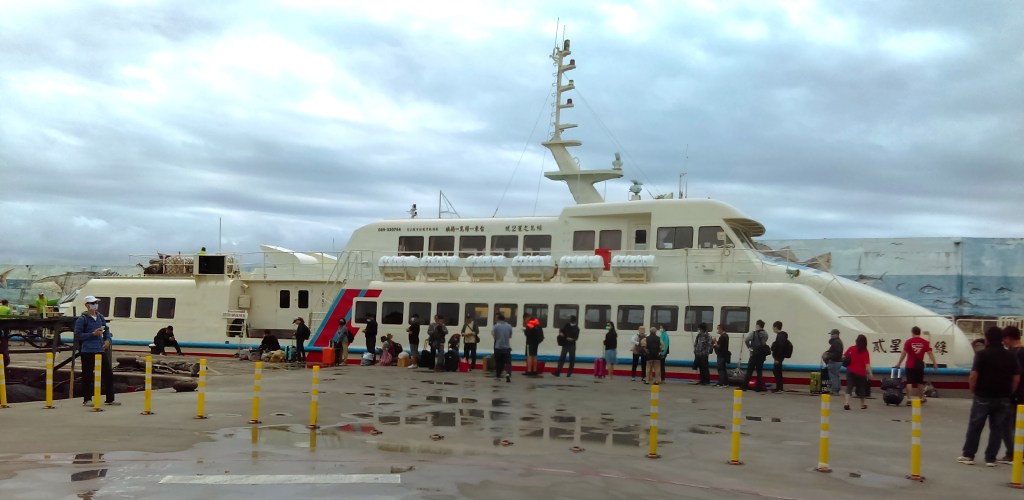
I caught a taxi (about $AUD 12) to the Fugang Fishing Harbor (富岡漁港), where I went last time. That day the ferries were running; I bought tickets, about $AUD 60 return. I snapped the above photo of my ferry and people lining up to board her.

On board the ferry, taken though the porthole, of the distant mountains coming down to the wild sea. The discoloration you see is spray, the water continually lashing the window. The ferry was shuddering like a merry-go-round, repeatedly up and down and rolling. Some people were puking, including a woman just behind me on the way back. I saw now the reasons behind the cancellation of the ferry.
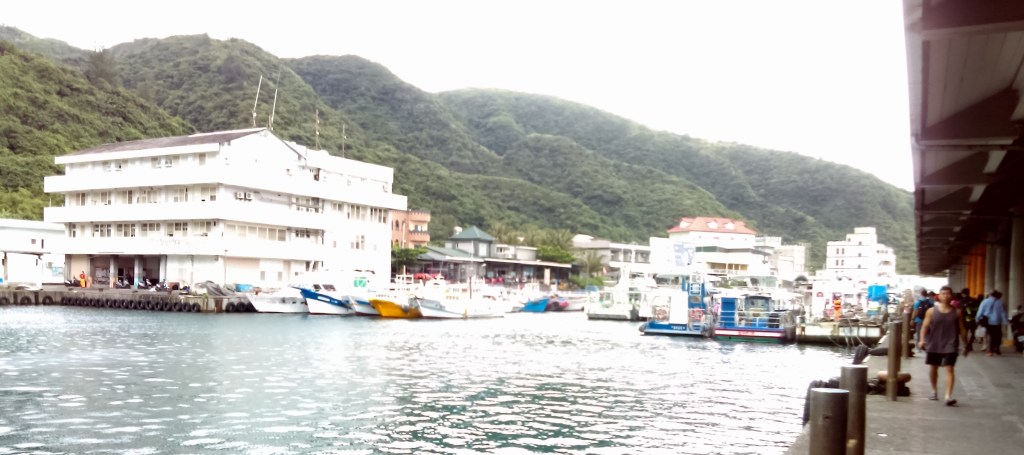
Green Island at last. I’m standing on the pier, the ferry behind me.
As I walked out of the pier, a woman of a certain age came up to me; she spoke no English, but I gathered that she was offering me a motor-scooter. For about $AUD 45 I hired her and her motor-scooter to tour the island

A map of Green Island, from this website.
Taiwan Everything says: “Green Island is a small volcanic island that sits 33km off the east coast of Taiwan’s main island; it is part of Taitung County. This tropical paradise, named after the vivid green foliage that lines its coast and covers its volcanic hills, has an average temperature of 23.5 degrees Celsius, with temperatures rising above 30 degrees during the summer months. With a circumference of about 20km, this lush, verdant island can be circled in just one hour by scooter, which is the most feasible way to travel around. The 16.3km round-island coastal road passes by small caves, takes you along amazing coastal scenery with deserted beaches, and climbs steep lush hills. Tourists are drawn to the island by its crystal-blue waters and green hills. Green Island provides the perfect escape from Taiwan’s crowded cities, with little traffic and no pollution.”
I landed at Nanliao Harbor, and visited Green Island Lighthouse and Oasis “Villa”, on the north of the island.
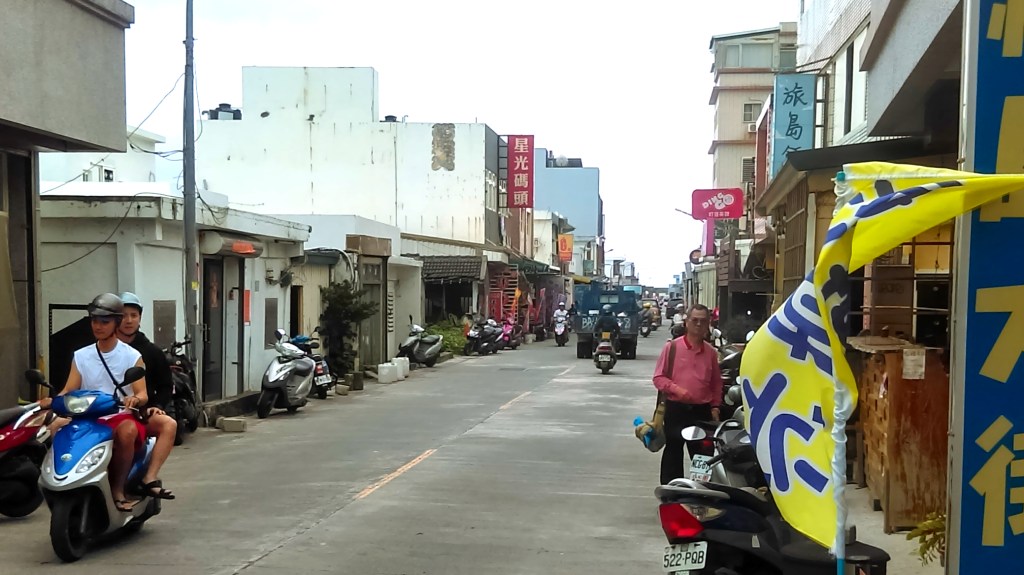
There is a single road that runs around Green Island (above).

There is a wild beauty to Green Island. The above shows a view eastward to Gongguanbi; I’m standing in front of the lighthouse.

Green Island Lighthouse. The wind was very strong. Wikipedia says:
“On 11 December 1937 the Dollar Steamship Company luxury ocean liner SS President Hoover ran aground in a typhoon on a reef at Zhongliao Bay… All 503 passengers and 330 crew survived and were safely brought ashore… Over the next few days the cargo liners SS President McKinley and SS President Pierce took the survivors off the island, helped by boats provided by the Japanese cruiser Ashigara and an Imperial Japanese Navy destroyer… Dollar Lines sold President Hoover‘s wreck to a Japanese salvage company, which spent the next three years breaking her up in situ… In response to the wreck, members of the US public gave money through the American Red Cross for a lighthouse to be built near Zhongliao village… Lyudao or Lüdao Lighthouse was designed by Japanese engineers, built by local islanders in 1938 and is 33.3 metres (109 ft) high.”

General Rock. Taiwan Everything says “The unique rock formation gets its name from its resemblance to a military officer wearing a steel helmet.”

Across the road is Oasis Villa (main entrance above), which despite its name is a prison for political prisoners.
Teacake has a webpage with a similar trip.

A view of the prison wall, with barbed wire on top.
Wikipedia says: “The area used to be the shelter area during the Japanese rule. After martial law in Taiwan was declared in May 1949, many political dissidents were imprisoned on Green Island at Taiwan Lyudao Prison by the government which was built in 1951. Over time, the prisons came to symbolize political suppression. In February 1970, Taiyuan Incident took place as one of an attempt for Taiwan independence movement. Soon the Ministry of National Defense constructed the second prison. Upon its completion, the ministry transferred all of political prisoners throughout Taiwan to this new prison named the Institute of Reform and Training, which was then later renamed to Oasis Villa.”

A view of the exercise area. The characters in red on a white background on the walls are slogans.
Oasis Villa is part of a reckoning with the White Terror and martial law. I passed school children being shown around the prison.
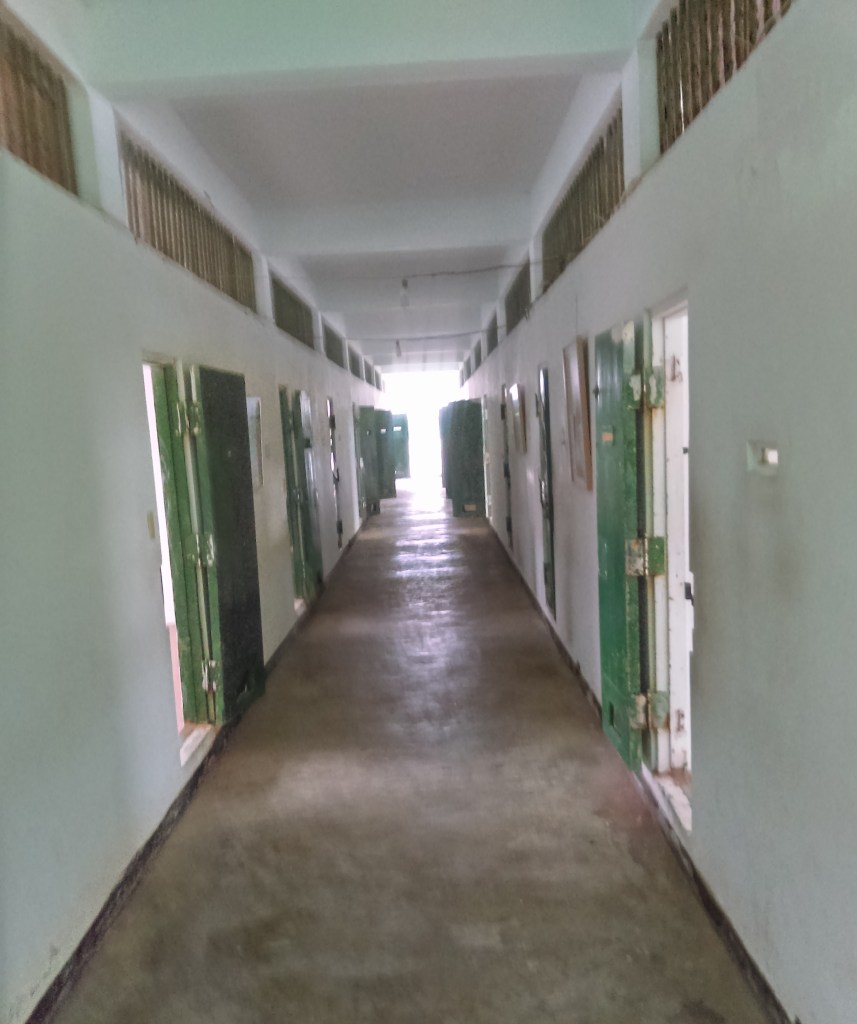
A wing of the prison. There were many signboards in this area giving context and the routine followed by the prisoners. Some prisoners were here decades.

The interior of a cell. I was reminded of my hotel room in Bali – but the cell was home to ten people.
Taiwan is open about its history; “Fear of discussing the White Terror and the February 28 Incident gradually decreased with the lifting of martial law after the 1987 Lieyu massacre, culminating in the establishment of an official public memorial and an apology by President Lee Teng-hui in 1995. In 2008, President Ma Ying-jeou addressed a memorial service for the White Terror in Taipei. Ma apologized to the victims and their family members on behalf of the government and expressed the hope that Taiwan would never again experience a similar tragedy. … Since the lifting of martial law in 1987, the government has set up the 228 Incident Memorial Foundation, a civilian reparations fund supported by public donations for the victims and their families. However, there was never a proper truth and reconciliation commission. Many descendants of victims remain unaware that their family members were victims, while many of the families of victims, especially from Mainland China, did not know the details of their relatives’ mistreatment during the riot.”
 Wandering Richard