February 2-9, 2026
I was in Thailand for two weeks at the end of my trip to Thailand and Cambodia. I wanted to see the Northeast (Isaan) again, so I planned to visit Nong Khai.
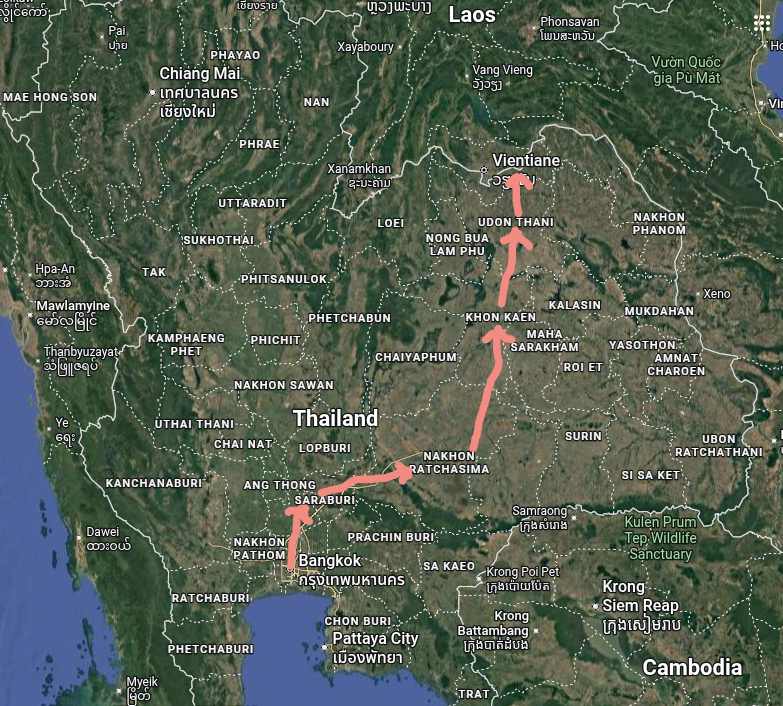
The Google Map above gives an approximation of this train route: from Bangkok through Korat (Nakhon Ratchasima), then Khon Kaen, Udon Thani, and finally to Nong Khai, on the banks of the Mekong River about 16 kilometers from Vientiane, and 624 kilometers from Bangkok. The scheduled duration was almost 9 hours.
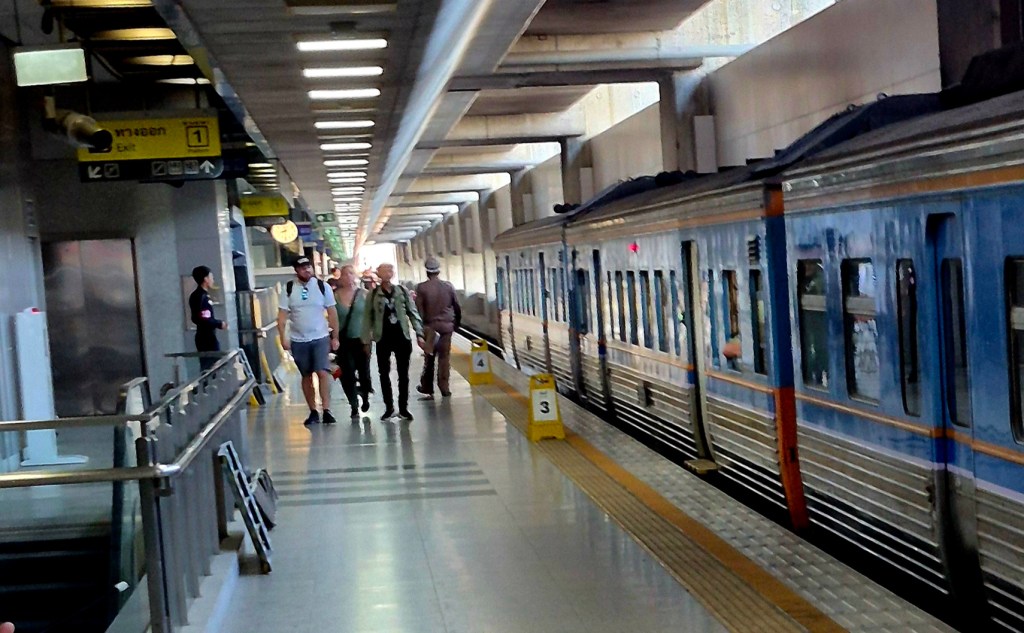
I caught a train from Krung Thep Aphiwat Central Terminal Station (previously known as Bang Sue Grand Station). The Number 75 train to Nong Khai (above) left at 8:45am.
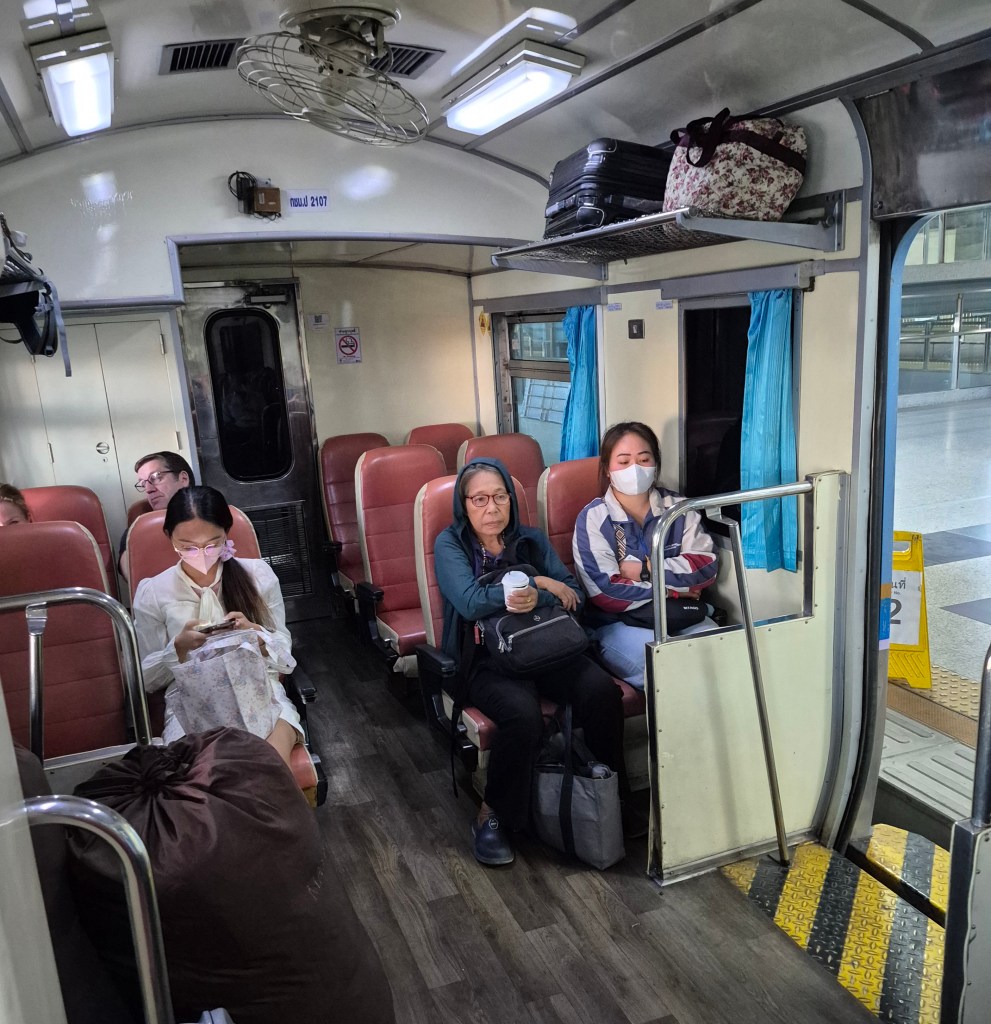
The inside of the (fairly average) carriage (above).
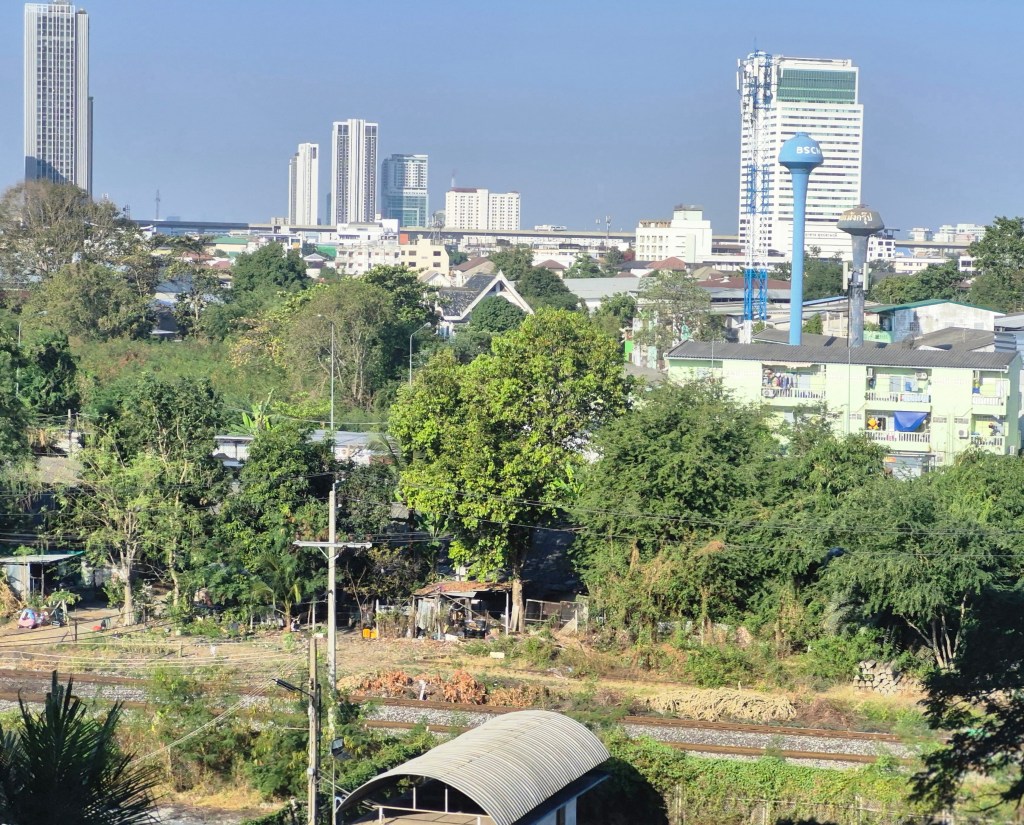
The train rolled past northern Bangkok.
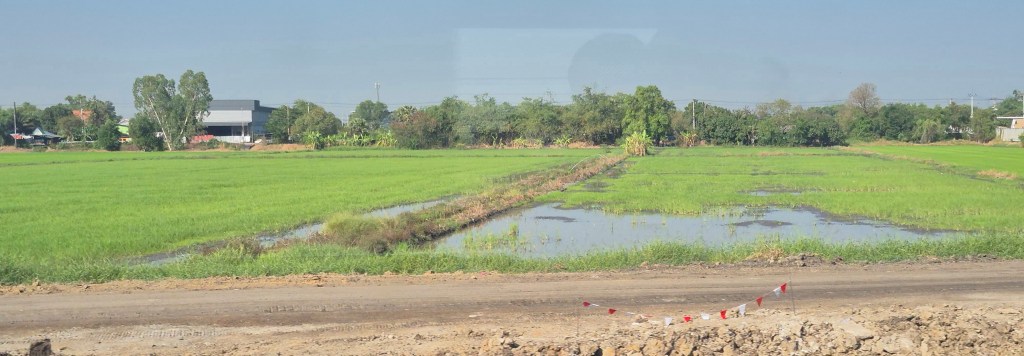
Soon we were deep in the countryside, rattling past early rice-plants (above).
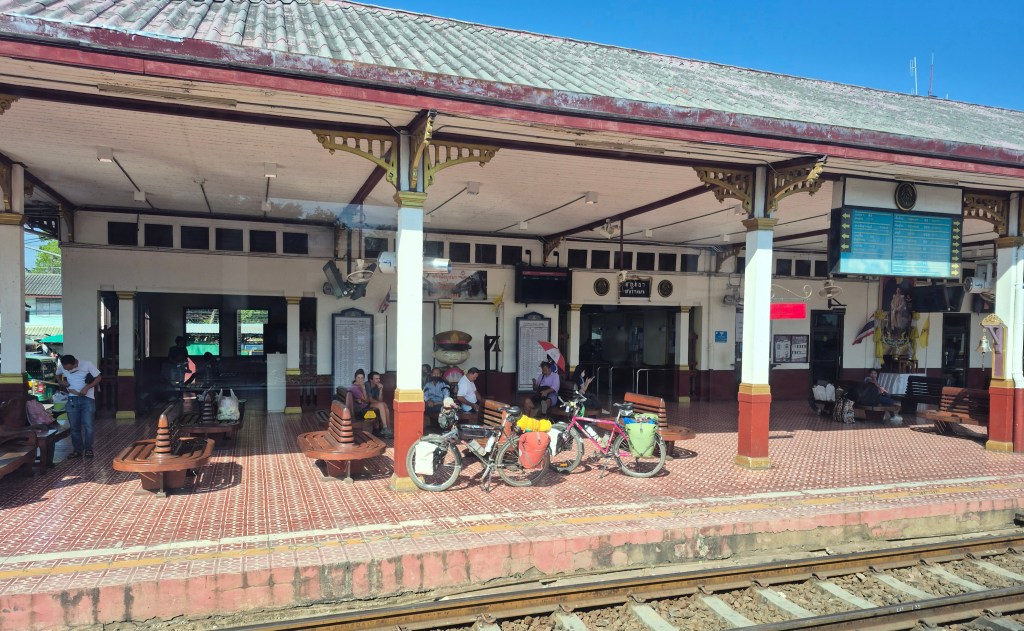
We stopped at a station.
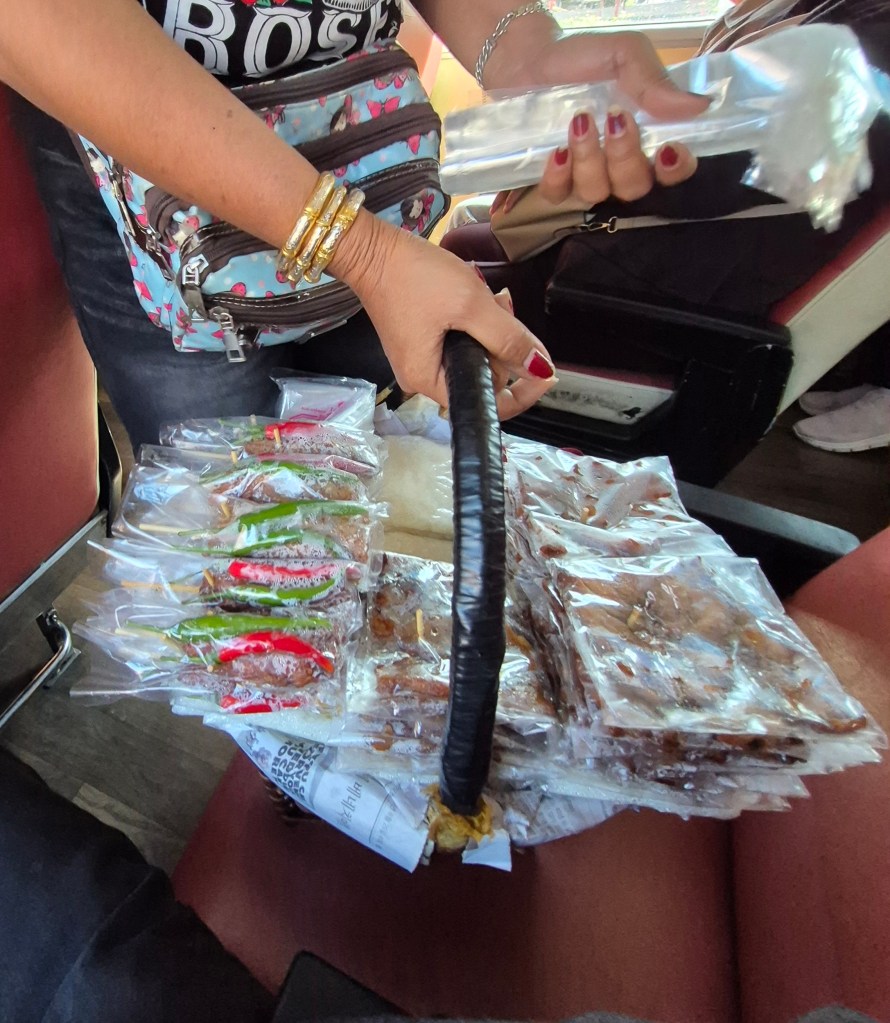
At first there were many vendors on the train, selling water, soft drinks, and snacks (above). A vendor put their basket on the seat beside me; I photographed it, causing the vendor some displeasure.
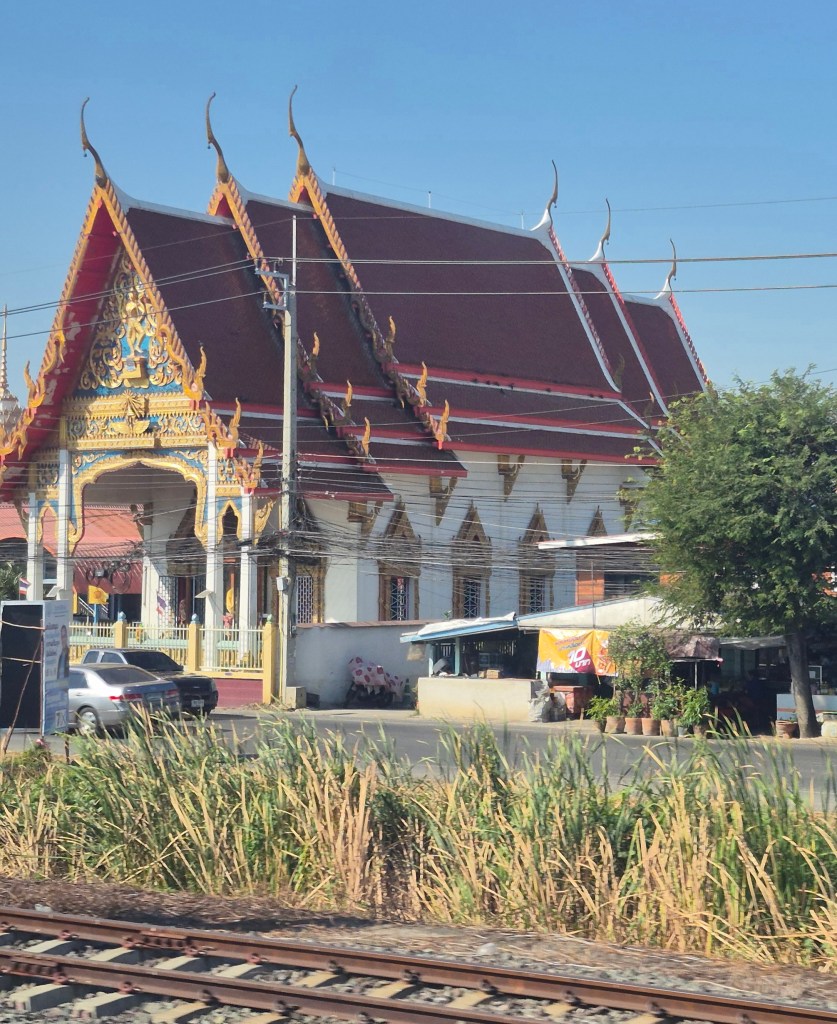
We passed a wat (Buddhist temple) so quickly I just managed to photograph it.
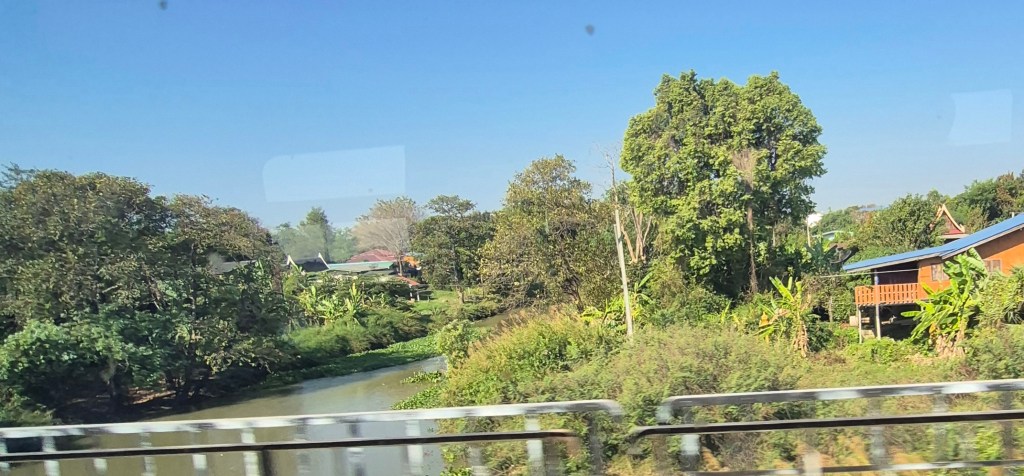
The countryside is stunning (above). Note the reflection caused by me photographing through the closed window.
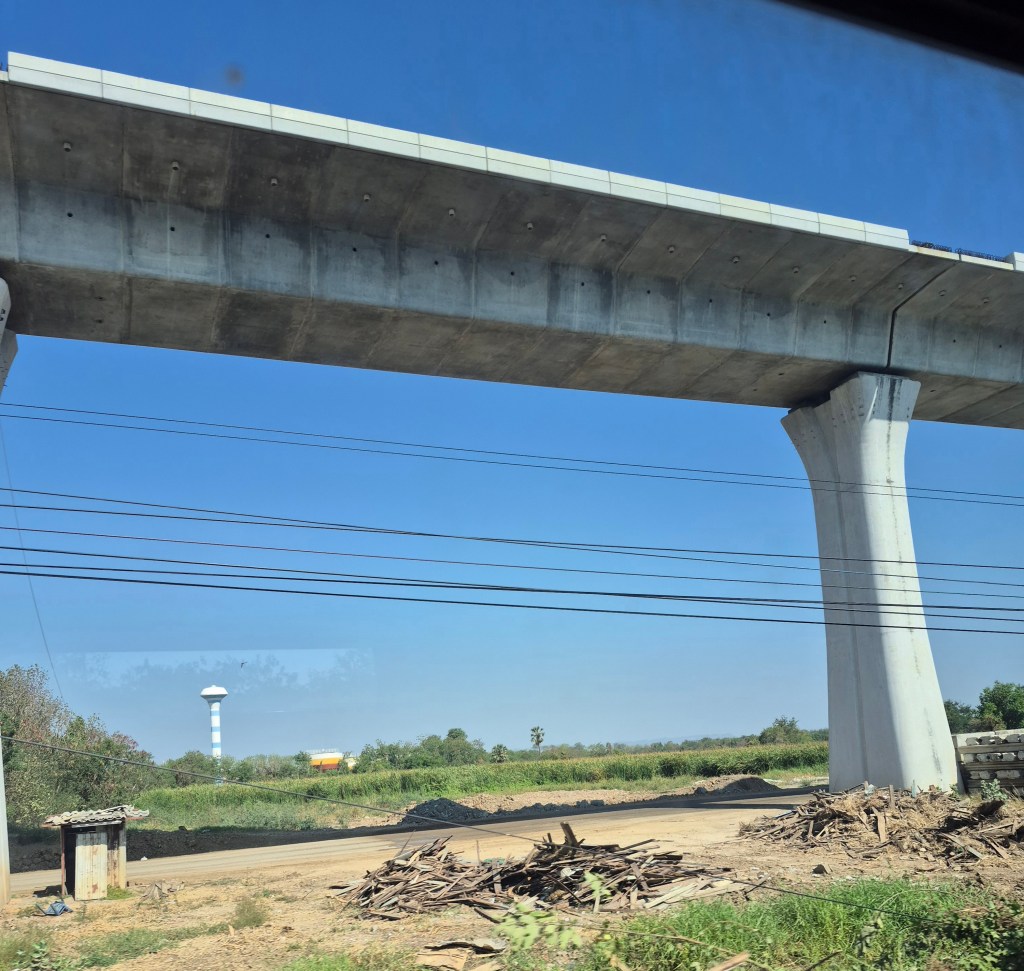
Alongside the railway track there was work building (I think) an elevated railway. Could this be the Thailand-China high speed railway?
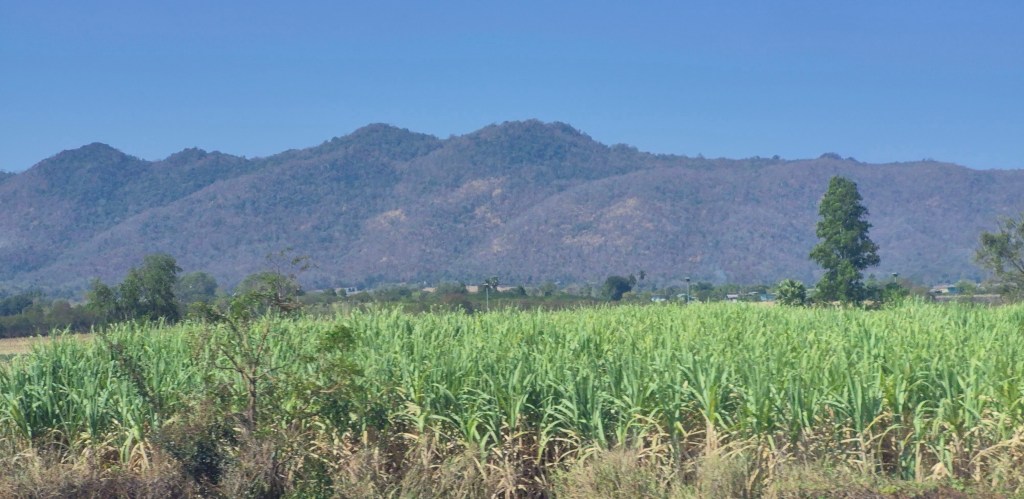
Mountains started to appear.
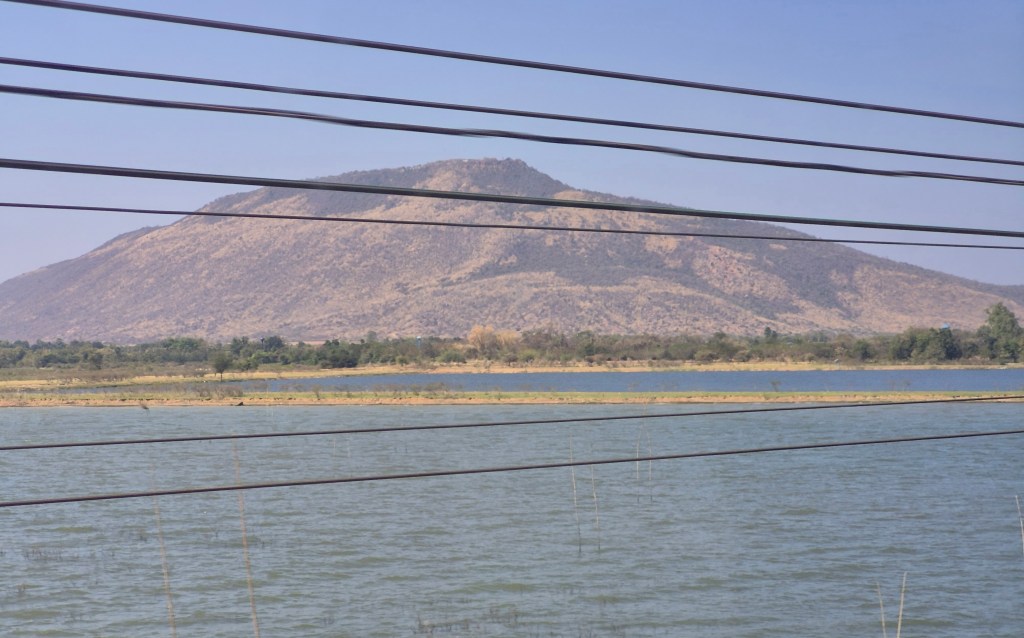
The train crossed the Pasak Chonlasit Dam:
“This trip is nicknamed ‘The Floating Train’ as the highlight is going across a series of viaducts above Pasak Chonlasit Reservoir. At this time of the year, the water is very high, and as you can only see water out of the windows on both sides, it gives the impression that you are floating on water.”
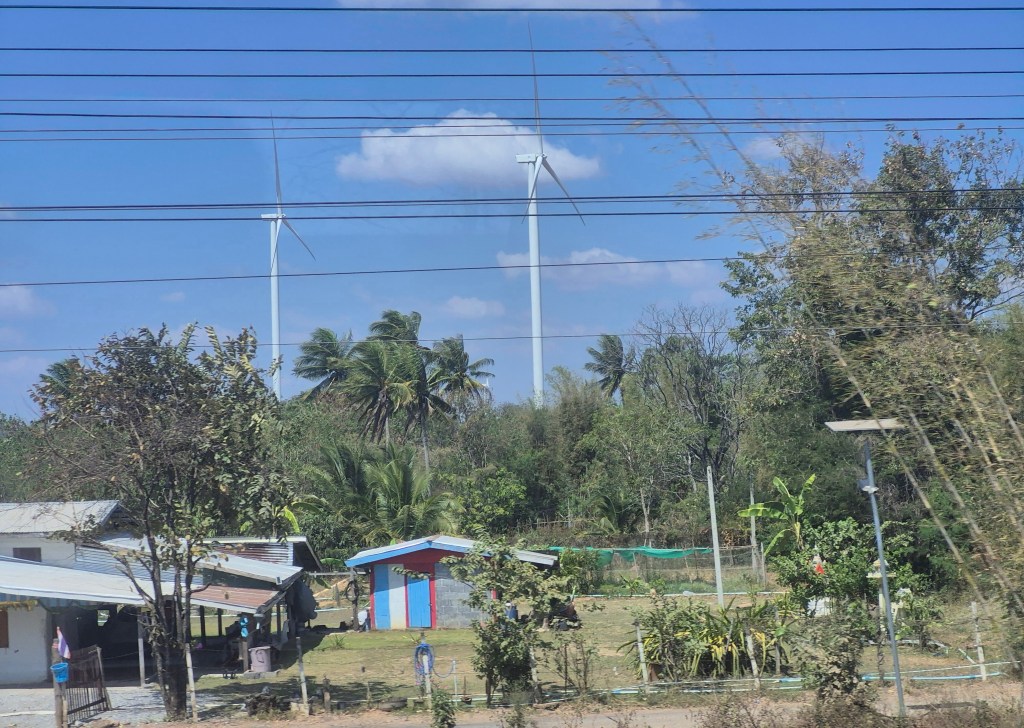
I nodded off in my seat, waking to find we had already passed the Phetchabun Mountains, the primary mountain range bordering the central plains and the Khorat Plateau. We passed some wind turbines (above). The countryside in this place is drier than on the central plains.
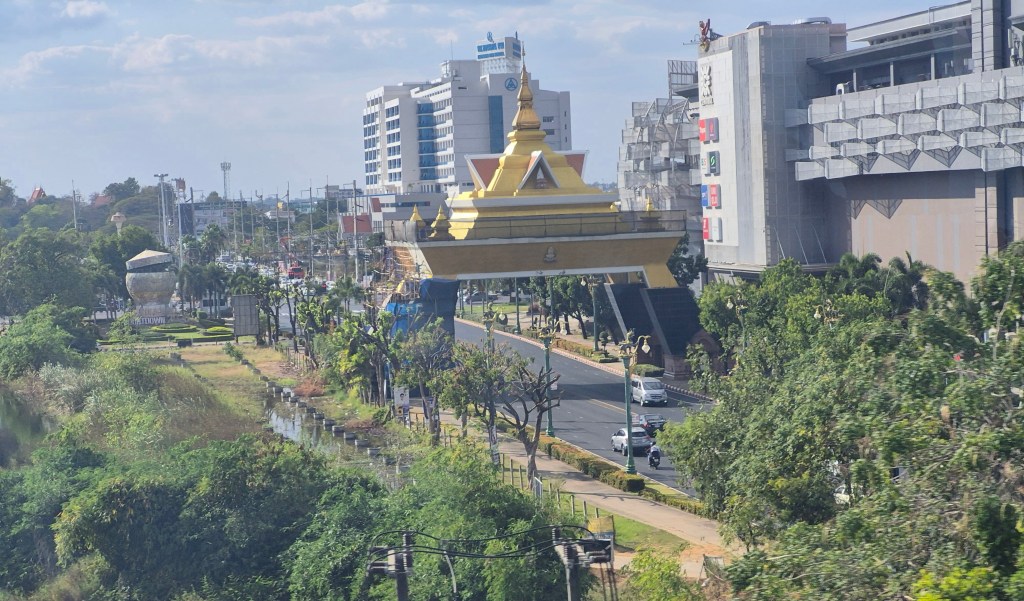
We stopped in a city – I think it was Khon Kaen (entering the city above).
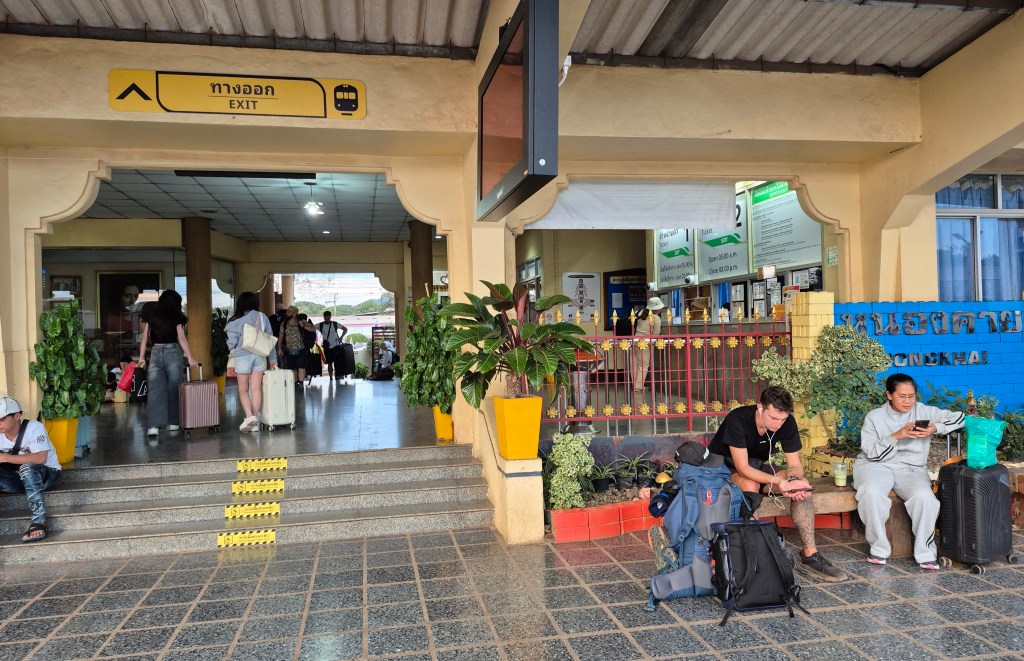
After 9 hours, Nong Khai, at last, in the late afternoon.
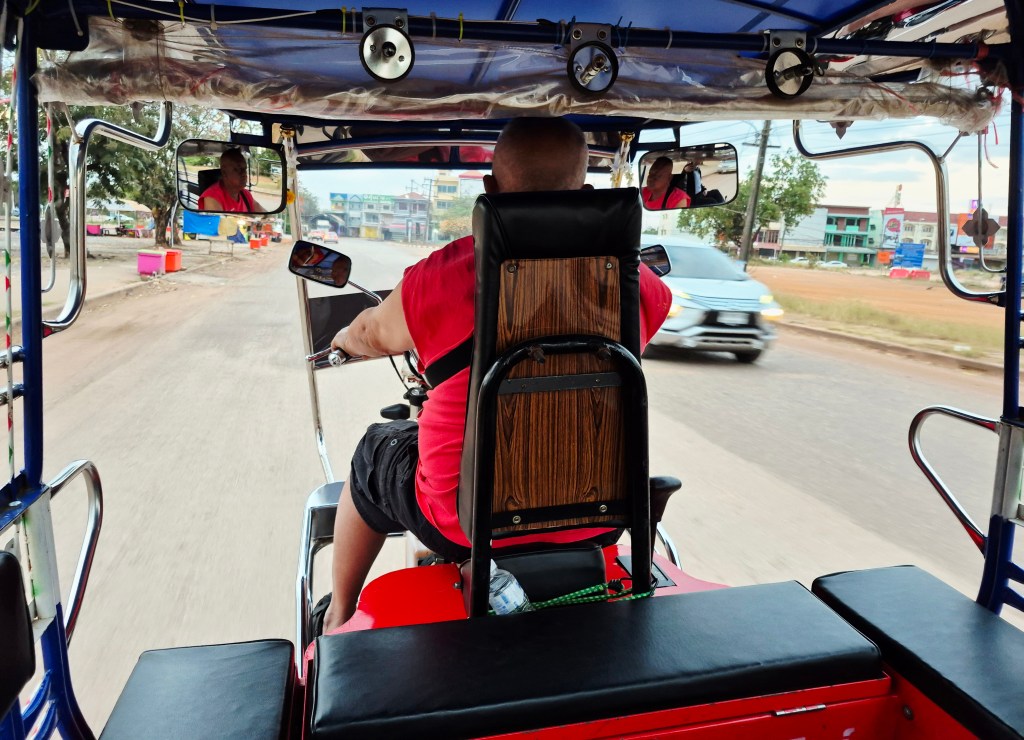
I took a tuk-tuk from the station. It cost me THB 80 ($AUD 4, NTD 80). The tuk-tuks here are of a different type to the ones in Bangkok (above); they have rails running down both sides, and you get into them through the rear.
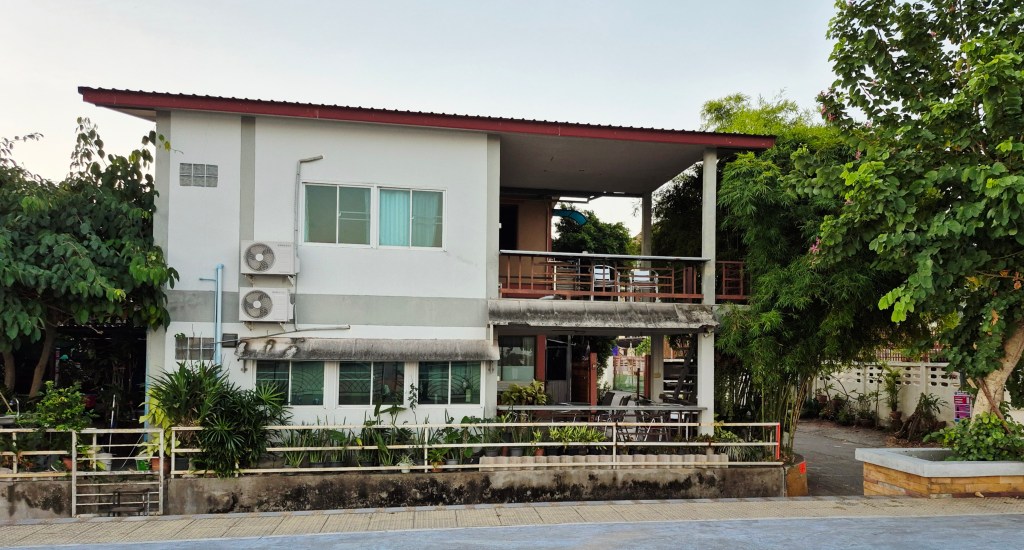
I checked in at The Rim Riverside guest house. My room is set back from the front, up an external flight of steps to the first floor (second floor to the Taiwanese). I took the photo standing on the promenade, the Mekong River behind me.
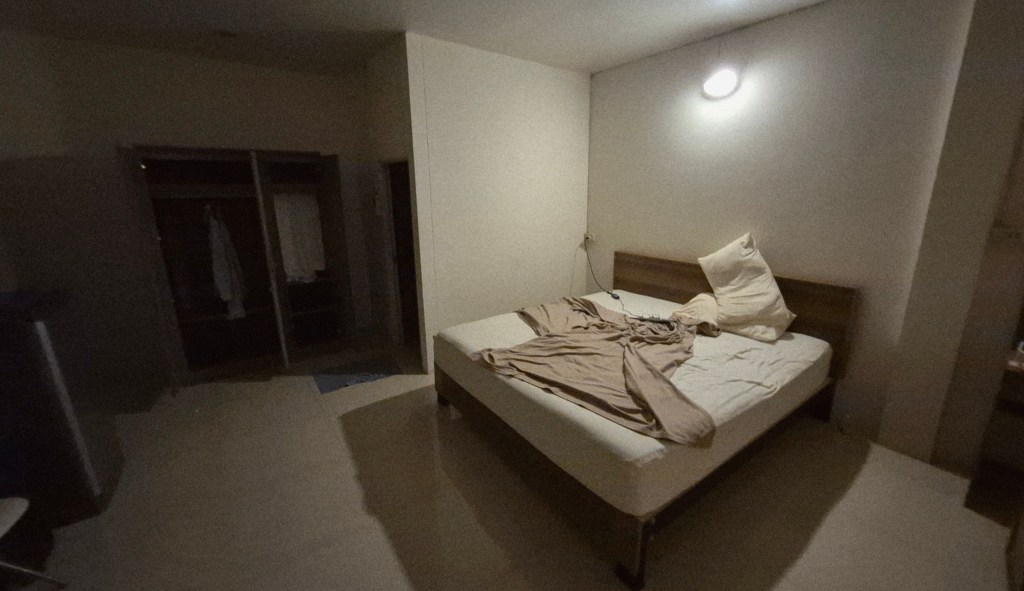
My room. The ensuite is in the middle of the photo, and the air-conditioner was just out of the picture to the left. It was around NTD 625 ($AUD 31 , NTD 625) per night – a bargain!
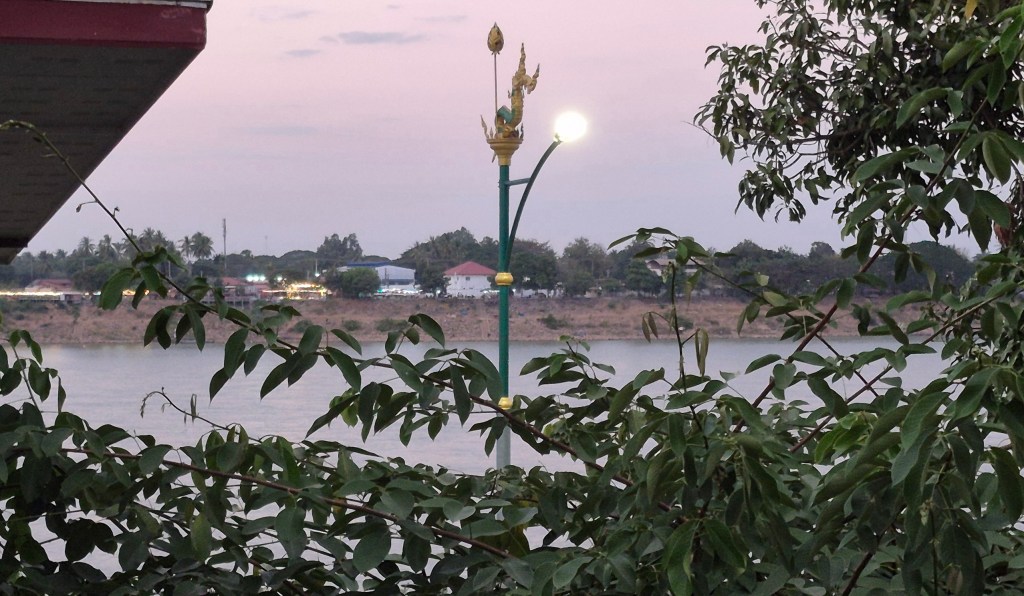
This is the reason I booked the room: the Mekong River. I get an emotional reaction looking at the wide olive-brown stream. I’m standing in my room looking out the big window. On the other side of the river is Laos, the outskirts of Vientiane (pronounced “Weng Chan” or “Vee-ang-jun”).
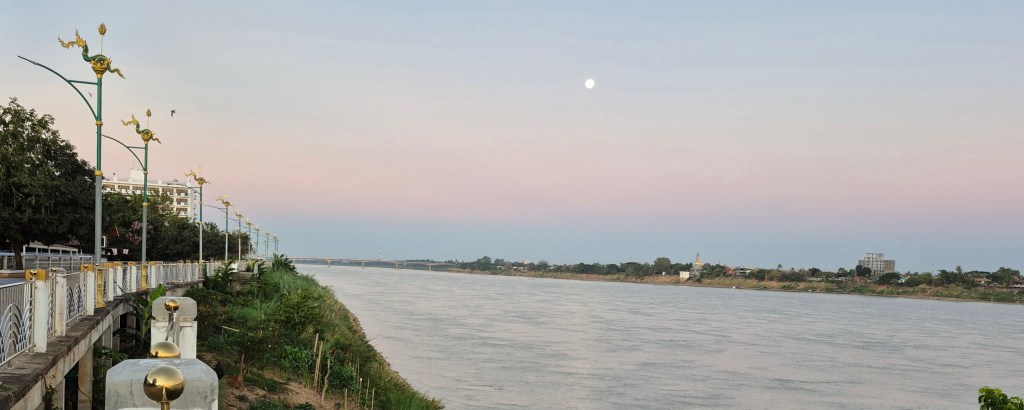
At dusk, looking westwards. The snake-like figures are naga:
“As one of the most significant creatures in Thai culture and Buddhism, the Naga is deeply rooted in folklore, religion, and art. … The stories and beliefs surrounding the creature appear to have originated in India and have since merged with local folklore, becoming well-known Naga in Thailand…. These mythical creatures are serpent-like beings, and they are often depicted as a dragon-like creature, with long bodies, intricate scales, and sometimes, multiple heads.”
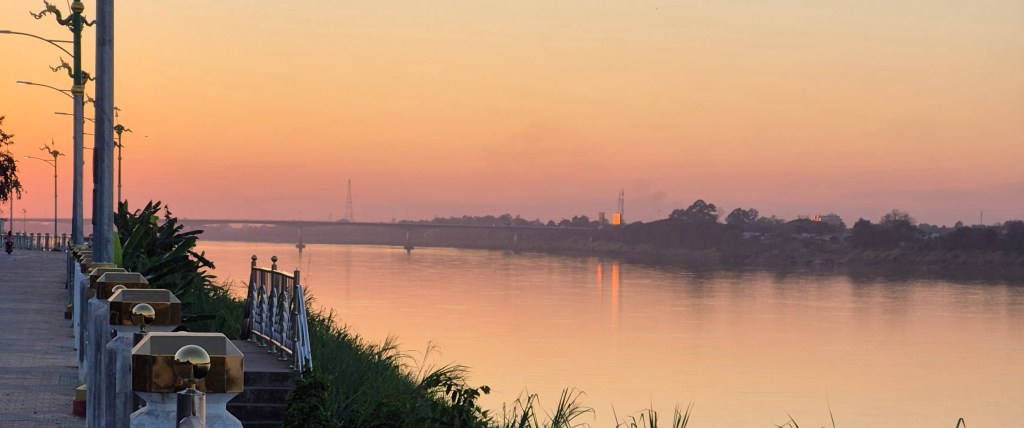
A slightly later photo showing the sunset. The bridge crossing the Mekong River is the First Thai–Lao Friendship Bridge:
“Opened on 8 April 1994, it was the first bridge across the lower Mekong, and the second on the full course of the Mekong. … The cost was about A$42 million, funded by the Government of Australia as development aid for Laos…. The bridge was designed and built by Australian companies as a demonstration of their ability to complete major infrastructure projects in Southeast Asia.”
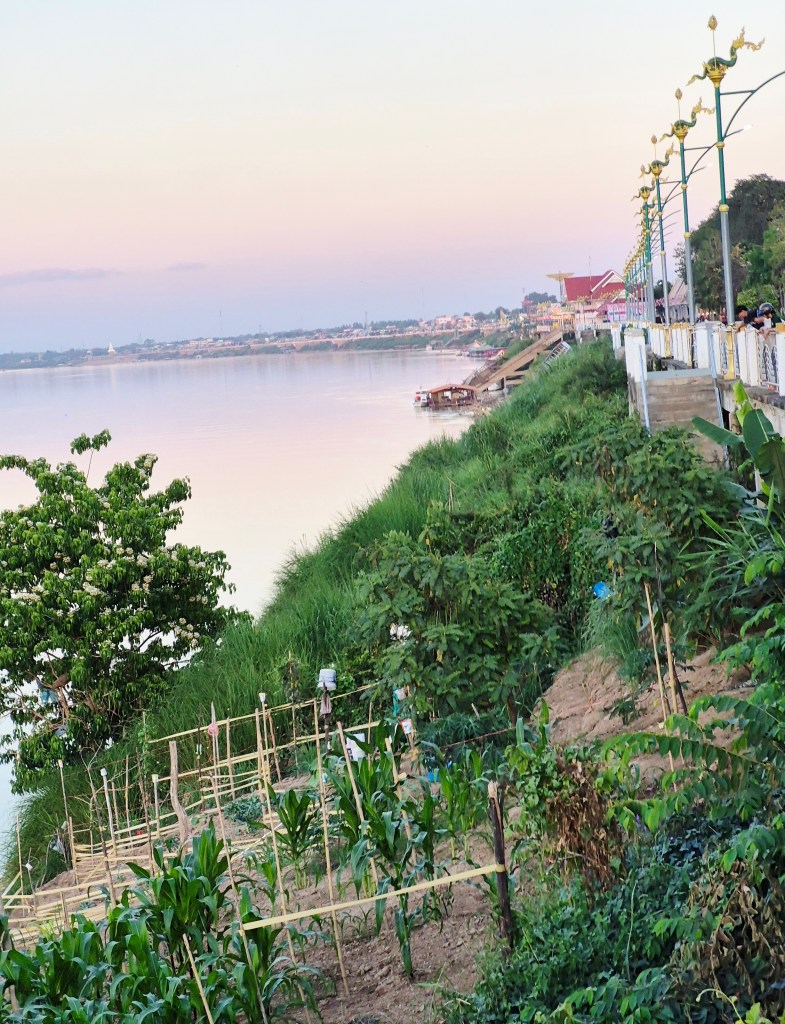
The following morning I was up early and taking photos. In the above photo there is corn growing. In the distance on the far left of the photo is a white temple. It marks where the Sunken Temple stood before sliding into the expanding Mekong River:
“Phra That Klang Nam is believed to have been constructed around 700 years ago on what was then the banks of the river. However, it toppled into the Mekong in 1847 and was submerged completely as the river changed course over the years.”
The Sunken Temple still partially exists in the middle of the river, occasionally coming into view in the dry season when the water is exceptionally low.
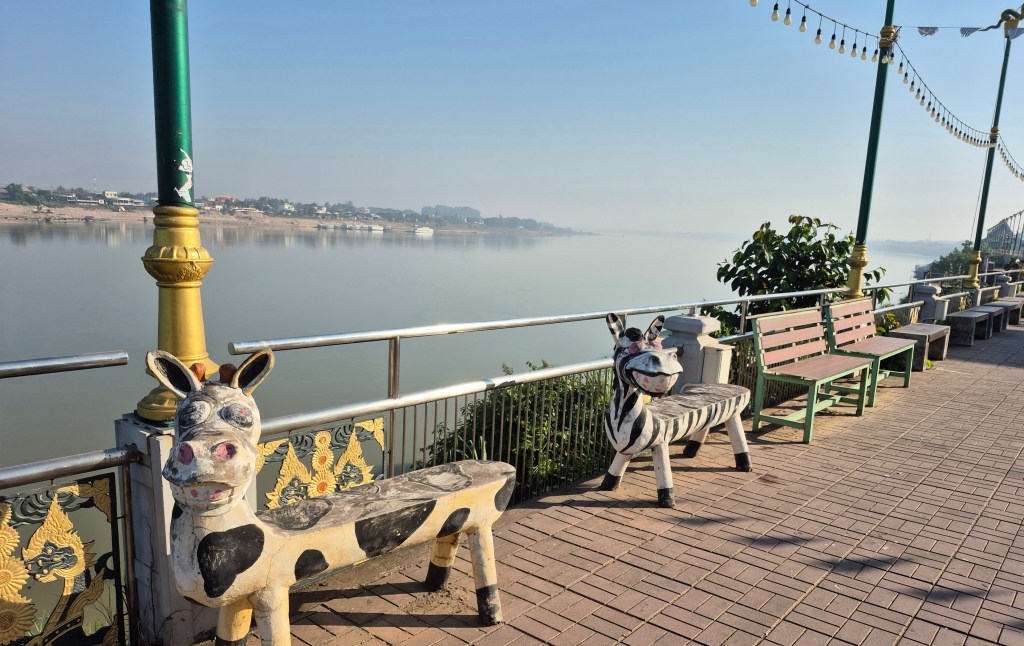
That day there was mist along the river (above). There was a peculiar set of chairs in the form of zebras.
Unfortunately, I had bad food on the train, resulting in me getting diarrhea and feeling off-colour for a few days.
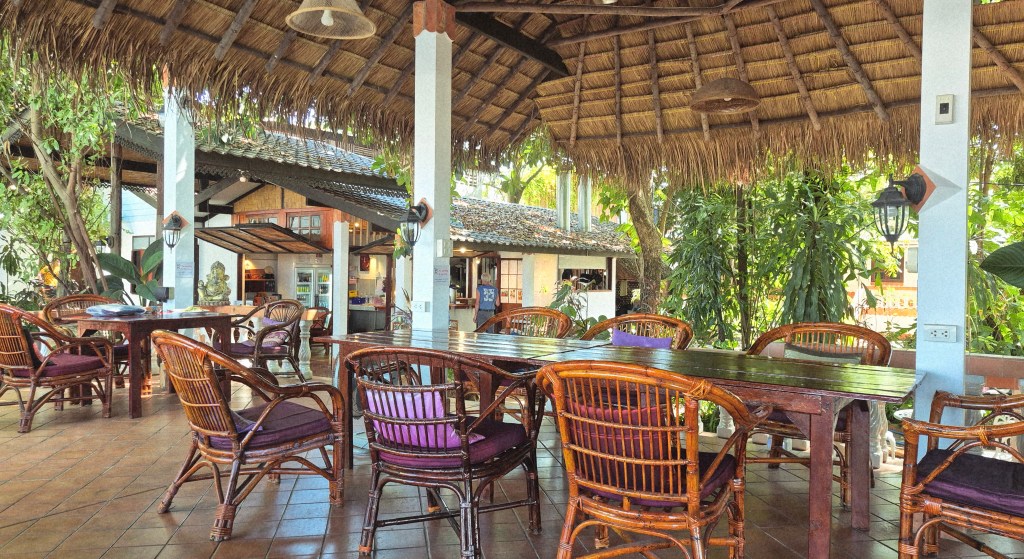
I ended up eating at Mut Mee Garden Guest House (above), a long-running institution. When I first came to Nong Khai in the 1990’s I stayed there. Mut Mee has a website that is full of information, although things have changed since it was set up; the river cruise no longer runs, and the menu has reduced. In the 30 years since I first visited Nong Khai has become a popular place for holidaying Thais, as well as Westerners.
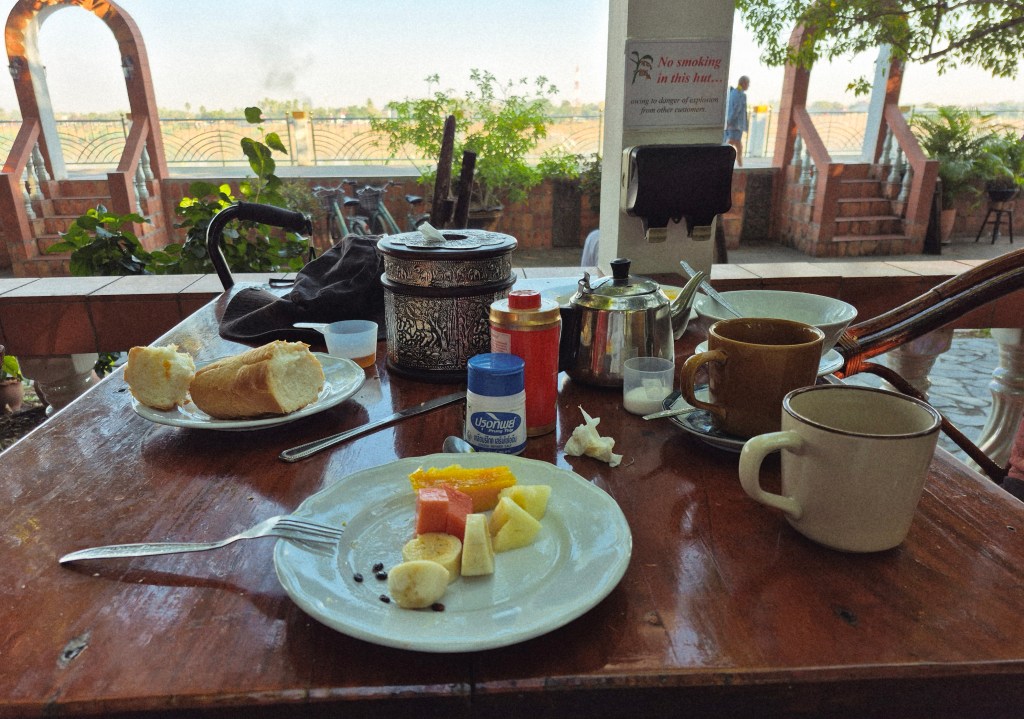
A photo of breakfast: full English, yogurt with fruit, fruit salad, bread with butter and jam, iced coffee, and a pot of tea. It was expensive, but worth it after eating Thai food day after day.
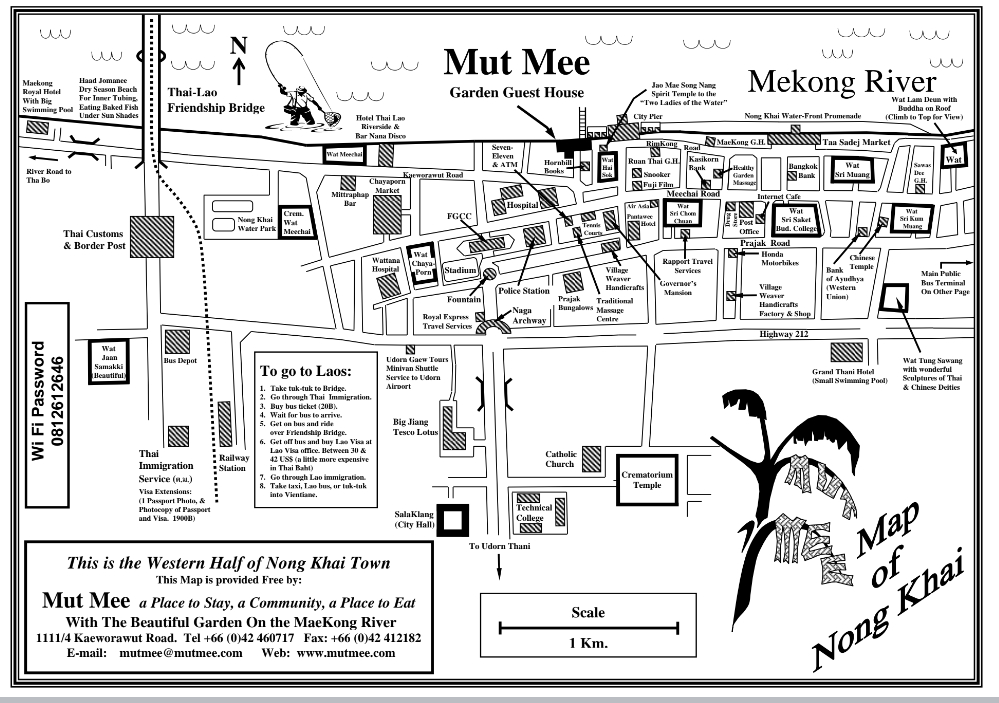
Mut Mee has very extensive information about things to do. There is a map (above) showing sights of interest. Other maps show things around Nong Khai.
There is a YouTube influencer, ปรางค์ไปคนเดียว Pranggoalone, who I subscribed to. It’s very Thai, but I use the auto-translate subtitles to convert her Thai to English. In one episode she took the 3rd-class train to Nong Khai, like me, and stayed in Mut Mee Guest House. It was very interesting getting a Thai lens on travel.
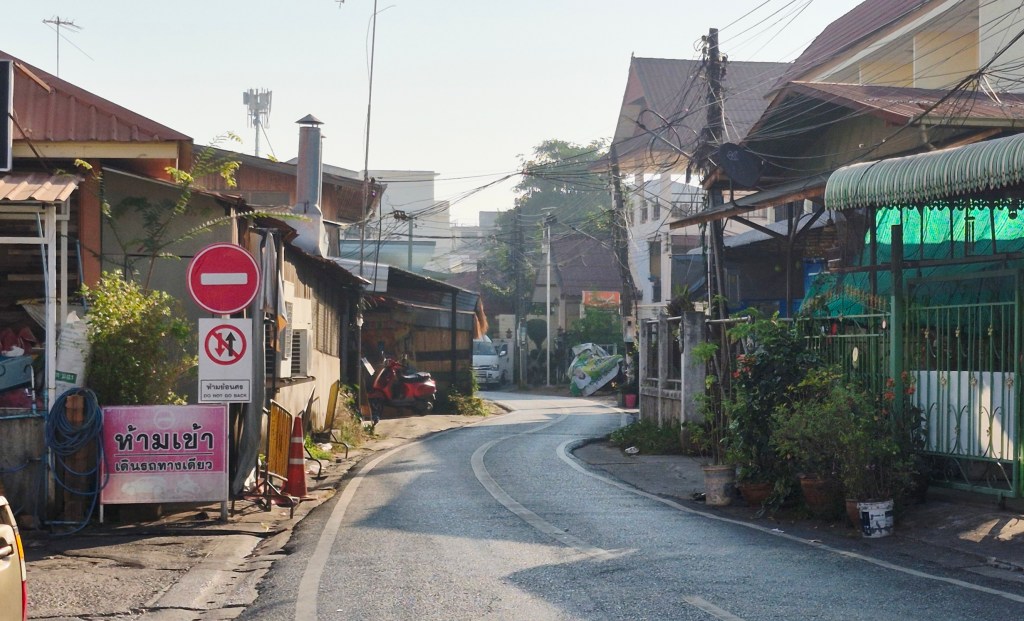
A narrow street near the river.
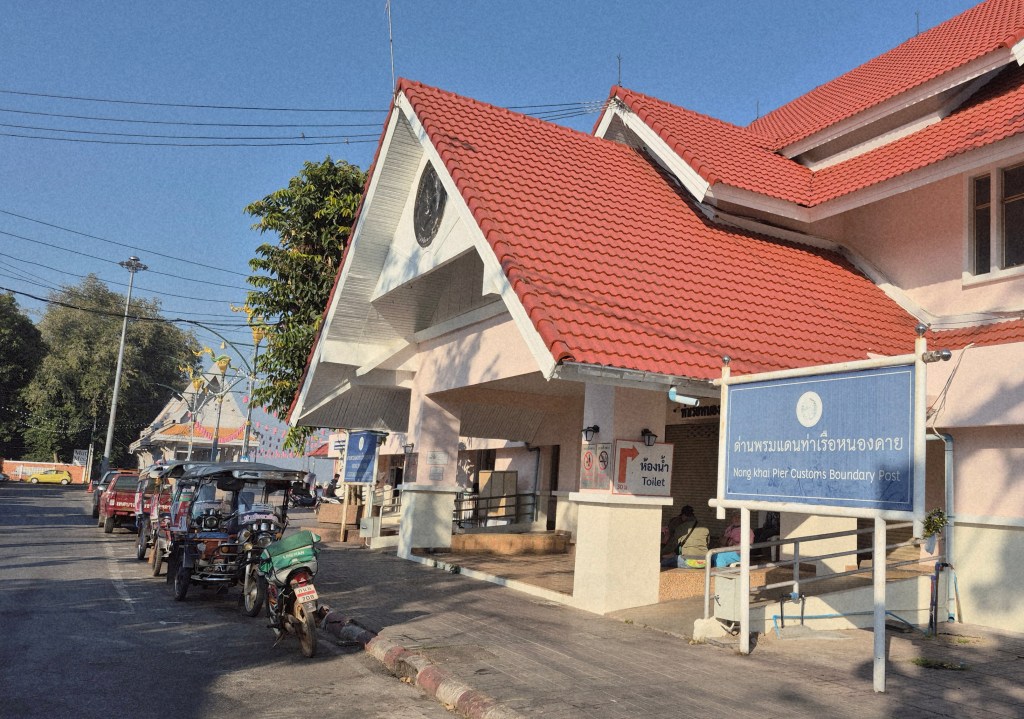
There is the “Nong Khai Pier Customs Boundary Post” on the bank. Presumably Thais can check out of Thailand here, board a boat, and cross the river to Laos. I did a cursory Internet check on whether non-Thais and non-Laos can do the same, but I didn’t find any information on that. Of course foreigners can just use the international crossing at the First Thai–Lao Friendship Bridge just upstream.
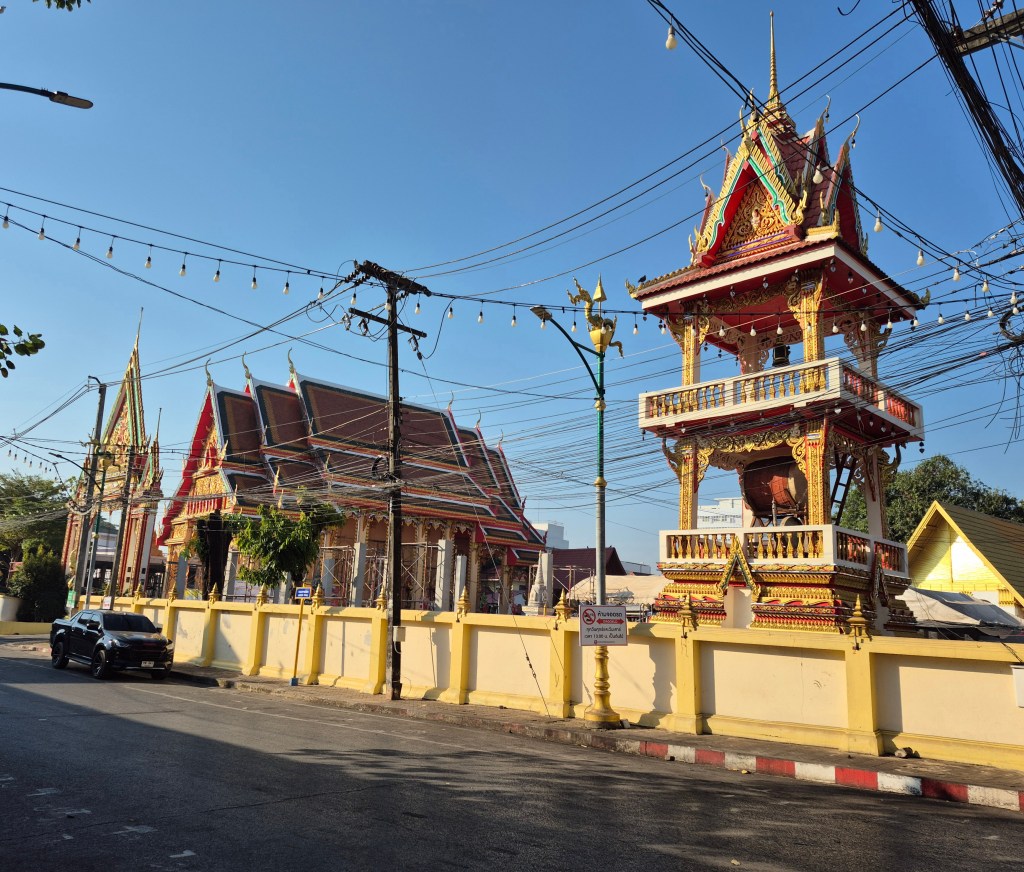
Directly opposite there is Wat Hai Sok. According to Lonely Planet, “It contains the ‘Two Princesses Shrine’ and is a popular place to make offerings before and after crossing the river.”
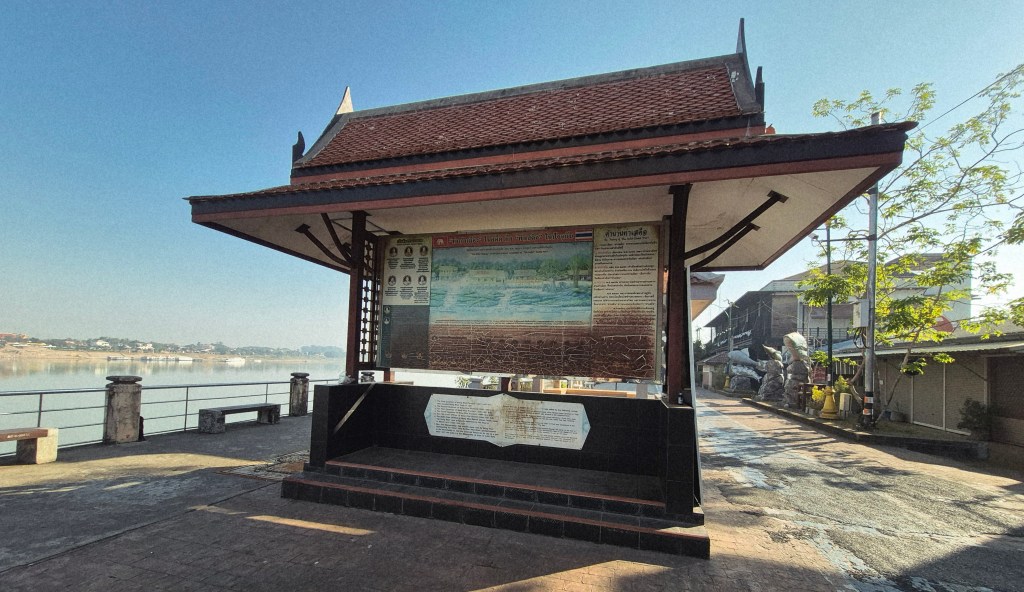
I visited Tha Sadet Market, a long arcade just back from the river. A somewhat dirty sign advertises its presence.
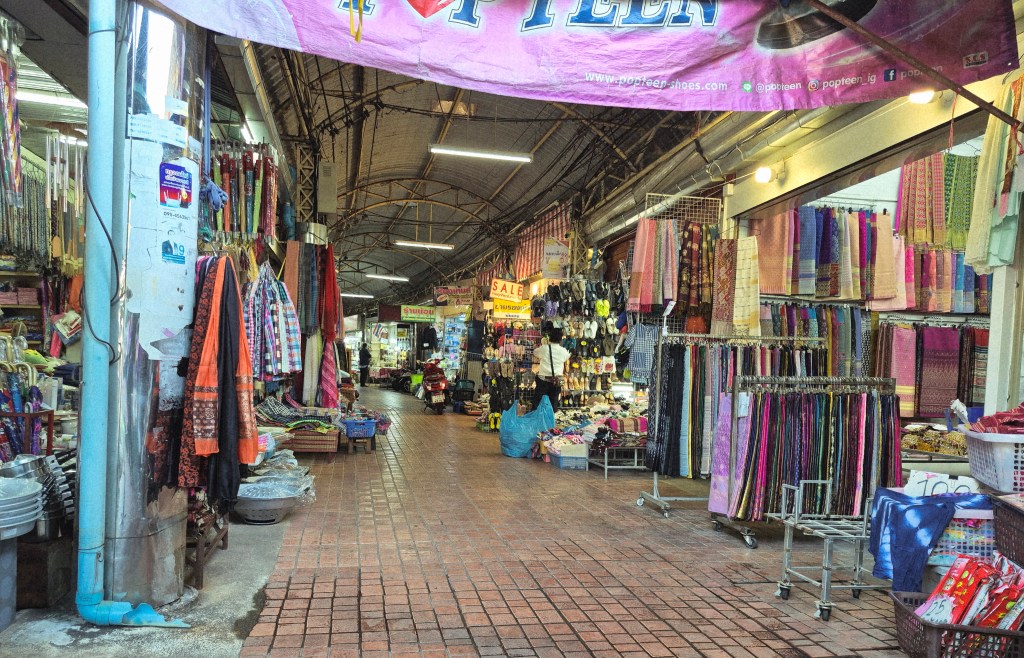
Tha Sadet Market is mostly undercover (above). TripAdvisor advises “Its stalls mainly sell cheap men’s, women’s and children’s clothing and shoes. But there are also stalls selling electronics, tools, household utensils, watches, cameras, glasses and sunglasses, herbs and spices, and ticky-tacky tourist souvenirs. Most of the offerings are pirated, as reflected in the cheap prices. So if you want a Gucci handbag, get one here, but do not pretend it is the Real Mccoy.”
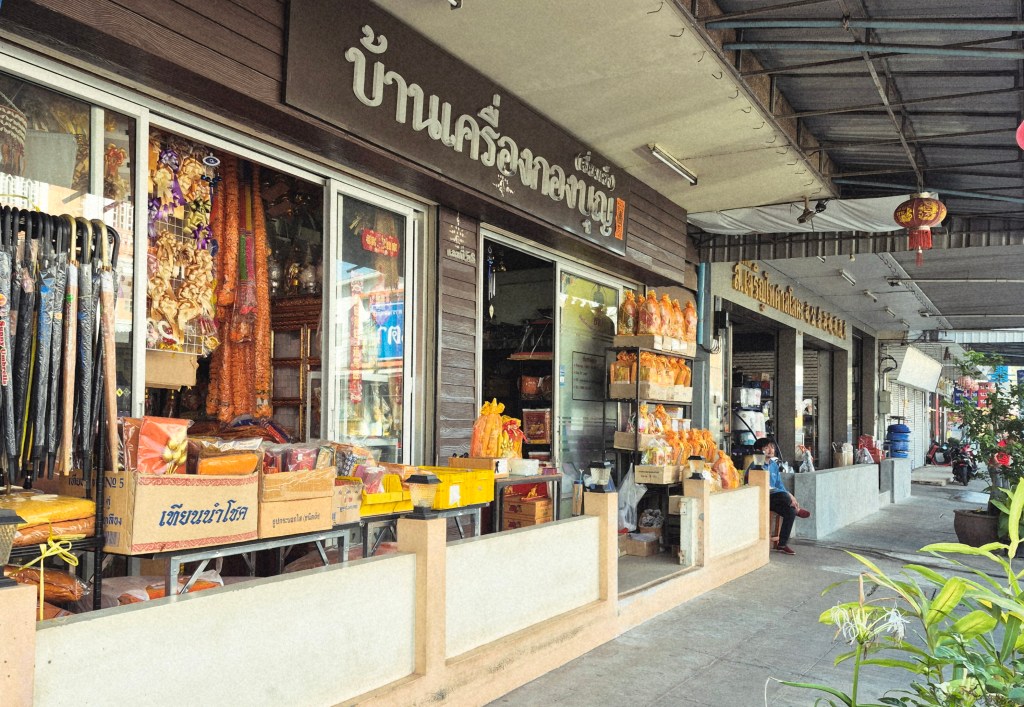
On Meechai Road there was a shop selling donations to monks, amongst other things. Instead of giving food and personal items to monks at the morning alms round, you can buy a bucket of food and give it to the monks instead.
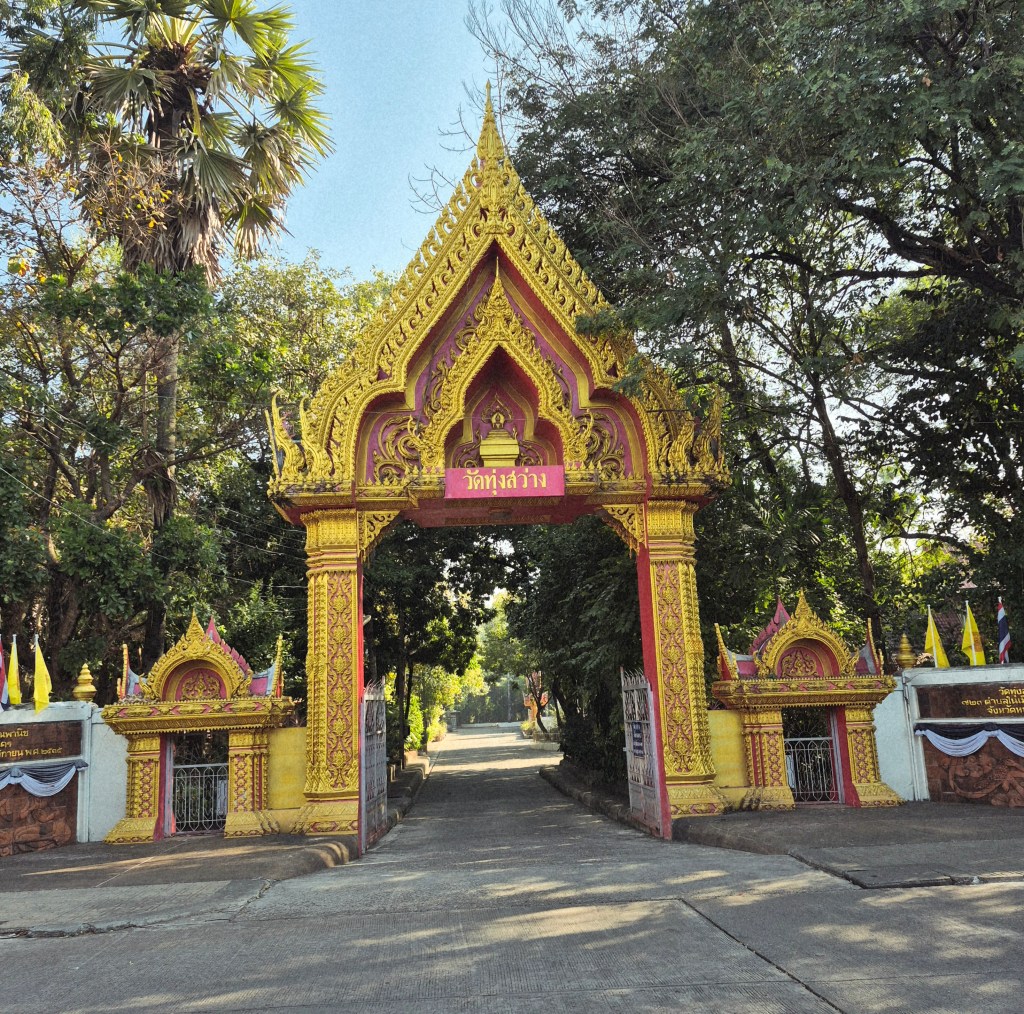
Wanderlog said: “Nestled in the heart of the city, Wat Thung Sawang stands out as a gem among temples. Its charmingly small chapel is adorned with intricate sculptures and detailed porticos that evoke a whimsical atmosphere reminiscent of Alice in Wonderland. The temple features an array of Buddhist deities, each sheltered under their own unique roofs, adding to its enchanting allure. Visitors will find it to be a serene escape from the bustling surroundings, complete with quiet spots perfect for meditation and reflection.”
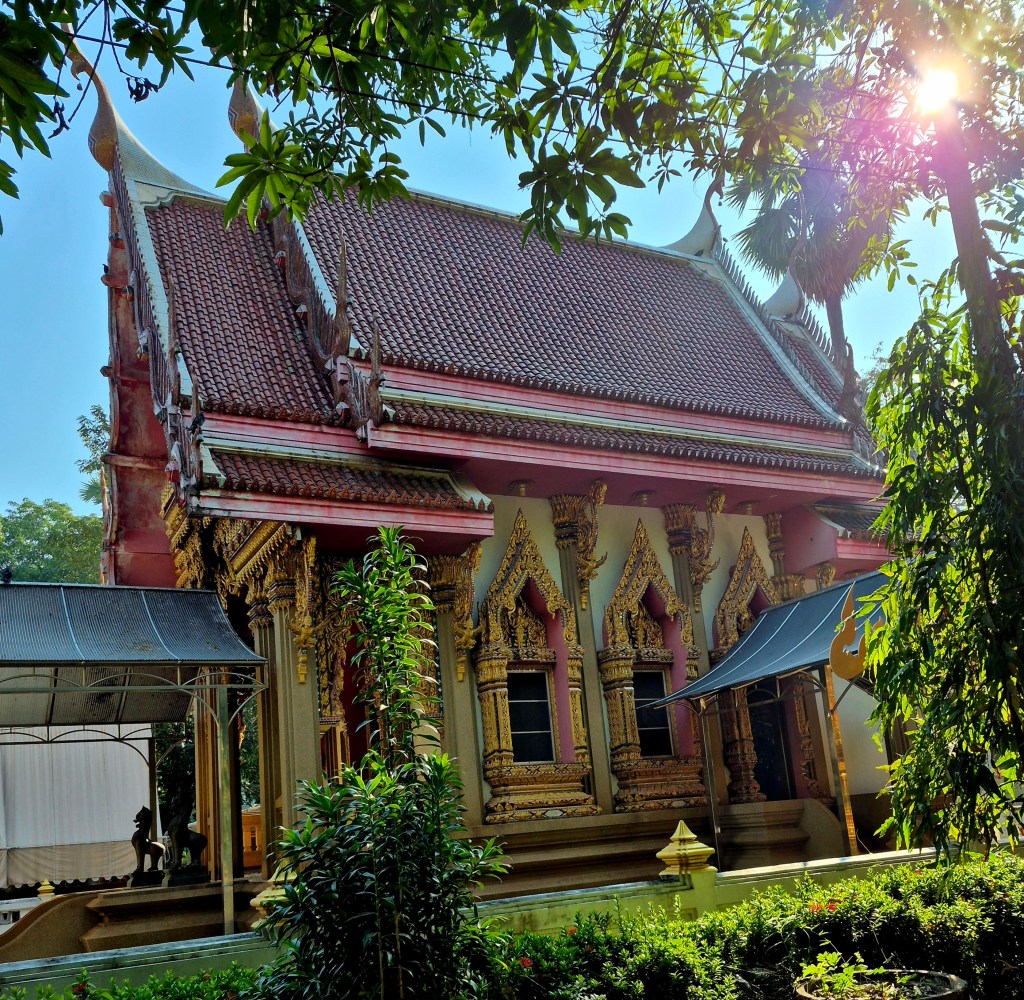
Mut Mee said: “The prize for the prettiest temple would probably go to Wat Tung Sawang. Its tiny but immaculately sculptured chapel with highly detailed porticos, and its collection of Buddhist deities outside, each under its own fanciful little roof, gives it an Alice in Wonderland bizarreness. Even if you’ve seen a lot of temples it’s worth visiting…”
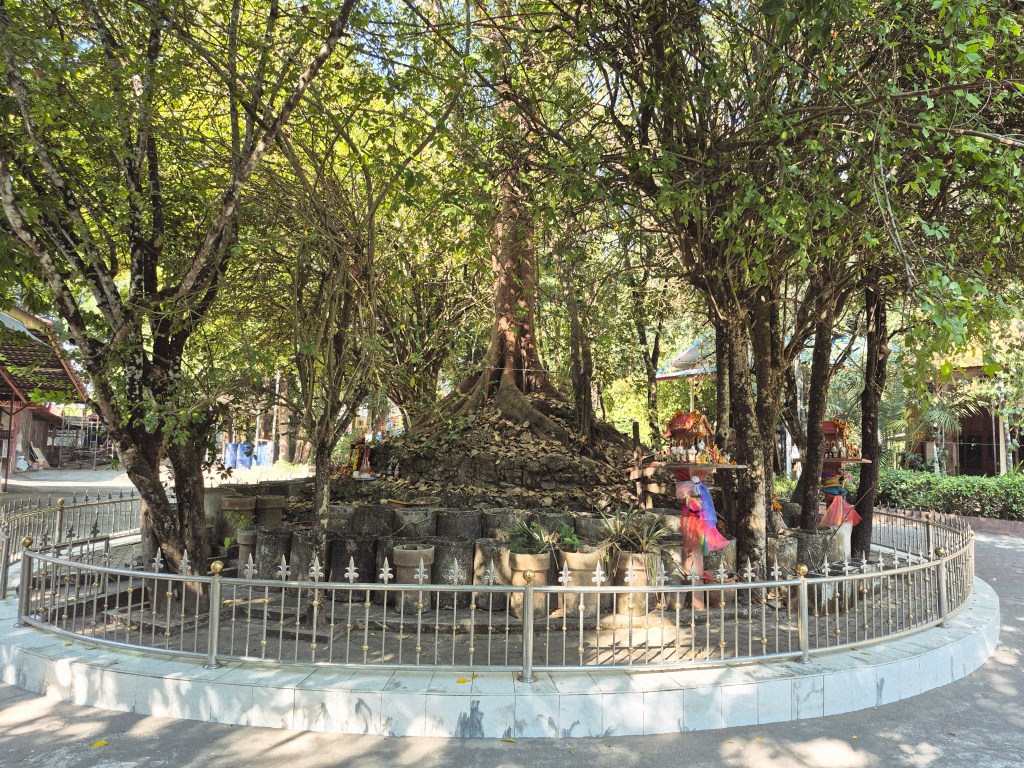
An ancient chedi, and on top, a tree growing upwards. An odd sight.
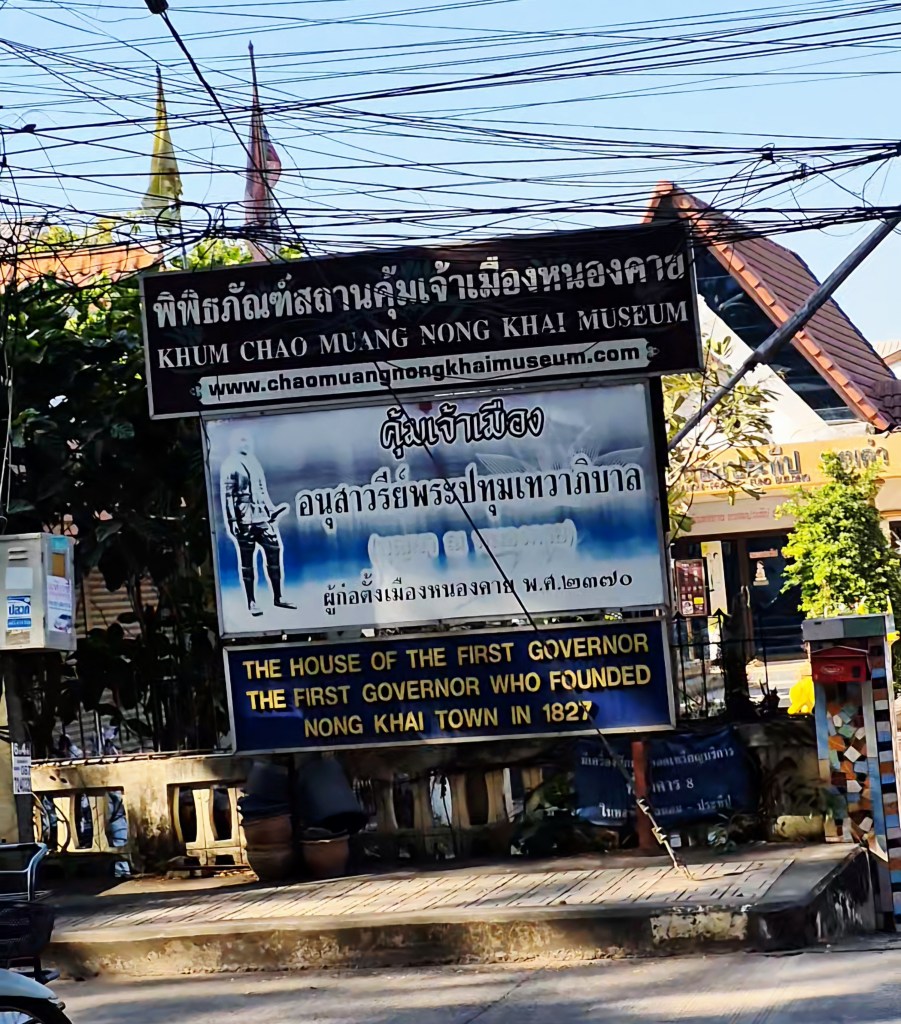
Directly across the street is the Nong Khai Museum, over (as the sign above says) the first governor’s house who founded Nong Khai in 1827.
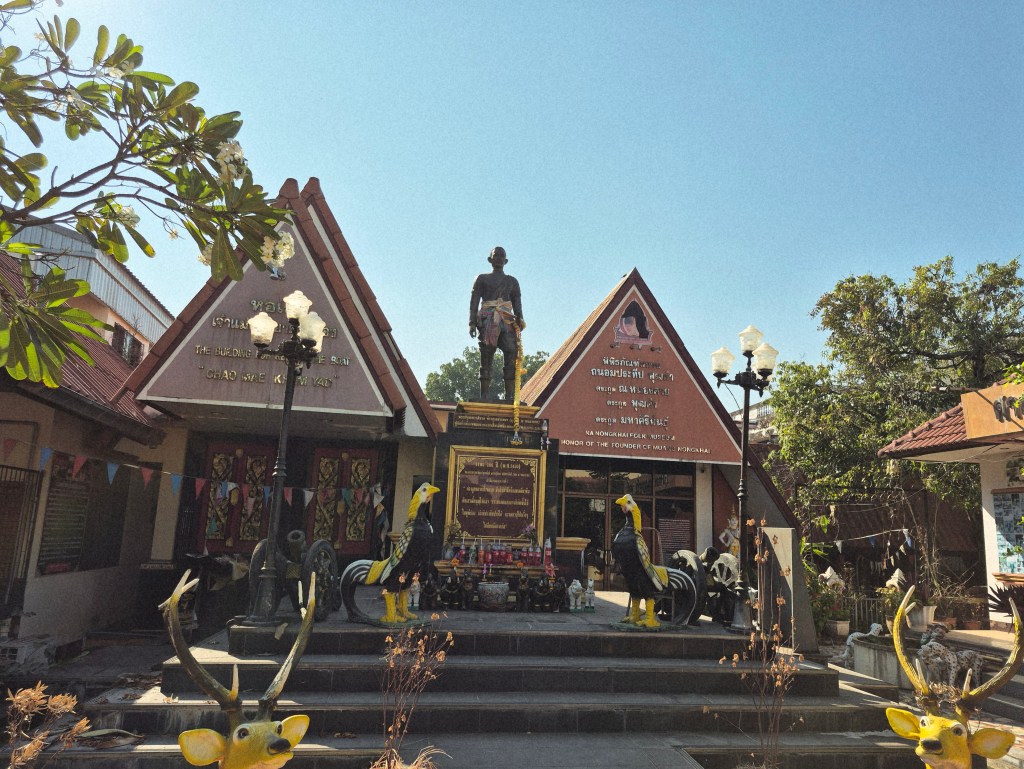
Wanderlog said “Nong Khai Historical Museum may not be the most lavish, but it is conveniently located in the main tourist area. The museum showcases photographs and artifacts that depict the history of Nong Khai. It’s an old museum that provides insight into the city’s past prosperity. Visitors are recommended to explore this place to learn about Nong Khai’s history, making it a nice addition to their travel itinerary.” I didn’t go in.
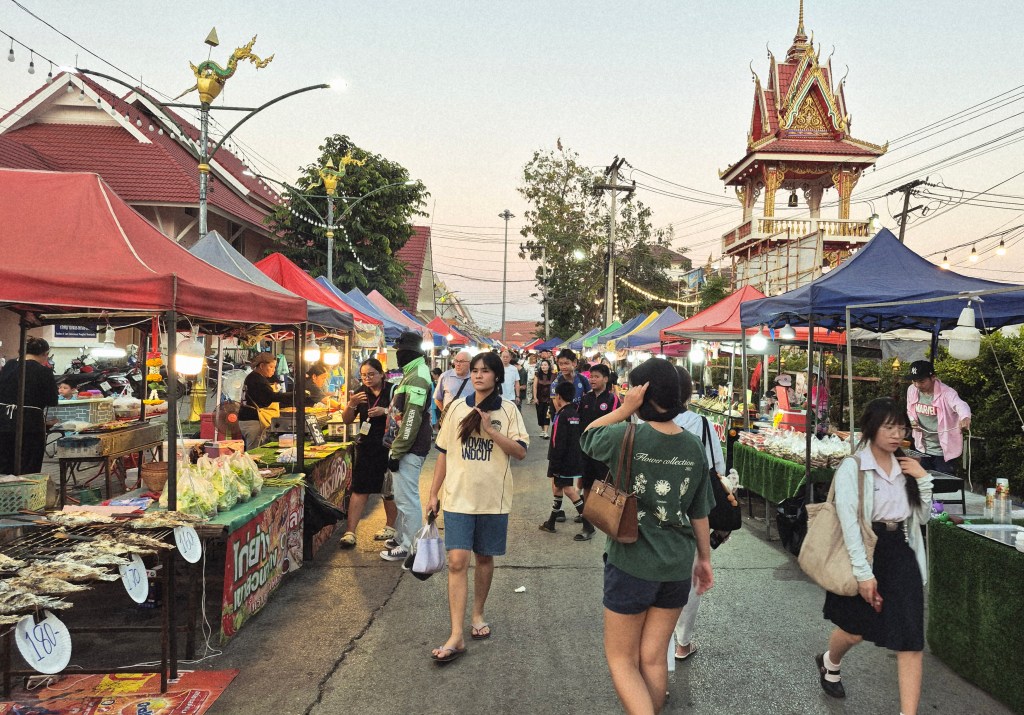
On weekends there is a night market (above) set up near the customs post.
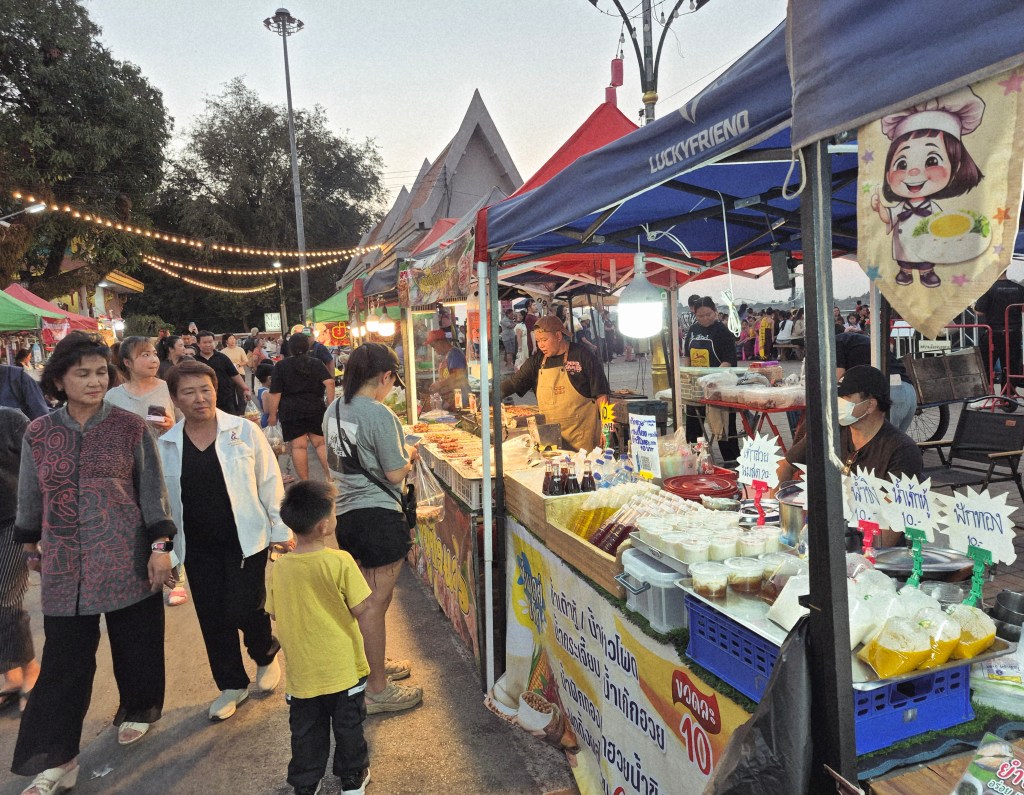
I estimate there are a hundred food stalls, selling everything Isaan.
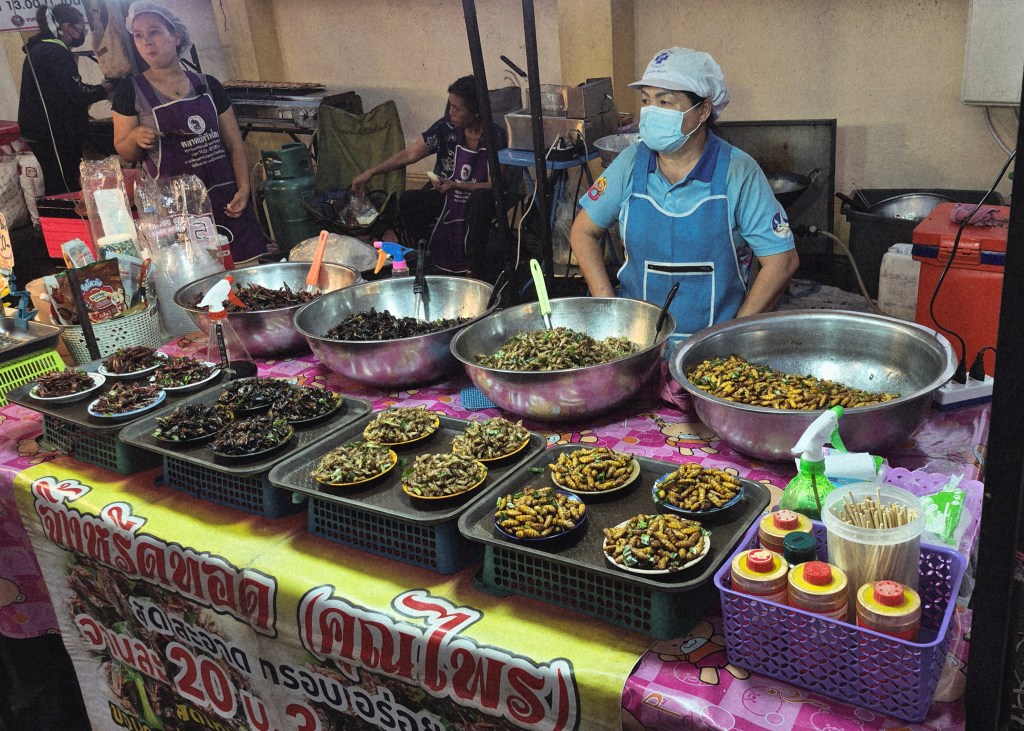
There are stalls selling deep-fried insects (above). On the right there are grubs, on the left deep-fried grasshoppers and crickets.
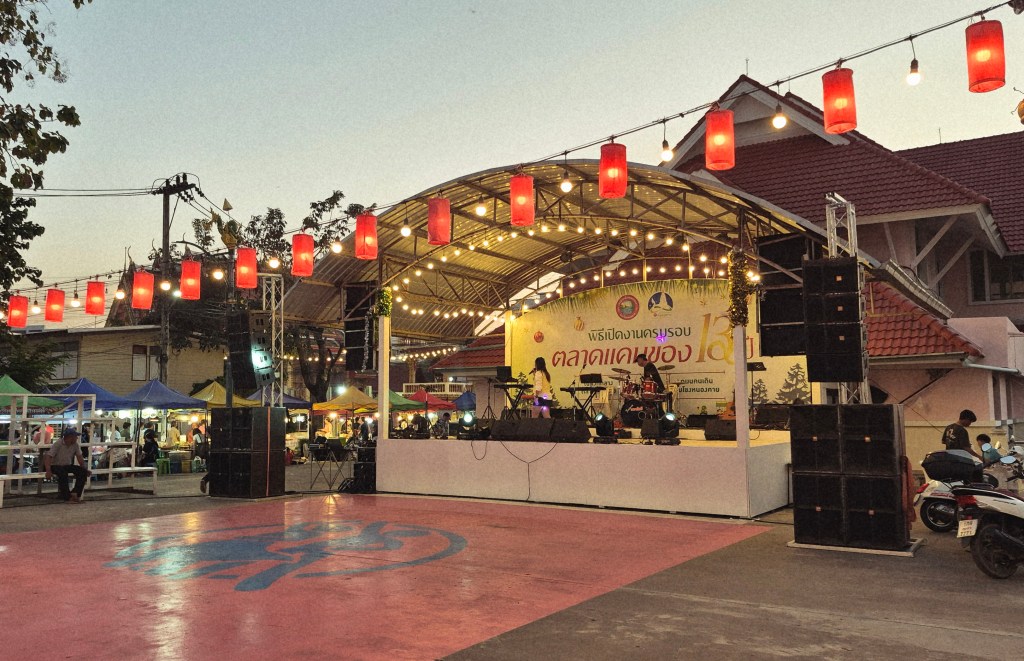
There are two bands with separate stages, allowing them to play different music simultaneously. One stage was a school performance, and one (above) was for adults.
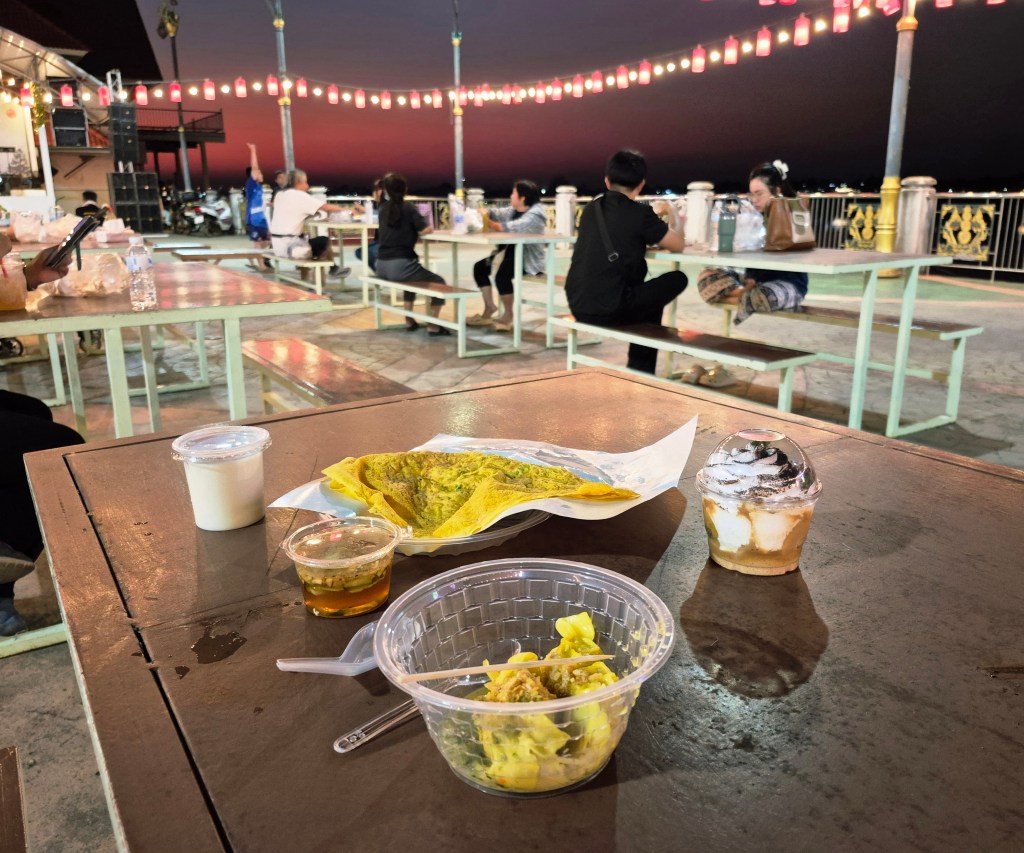
My dinner, eaten with the glow of twilight. The crepe thing was like the Vietnamese Bánh Xèo, with pork and bean sprouts. They were all delicious.
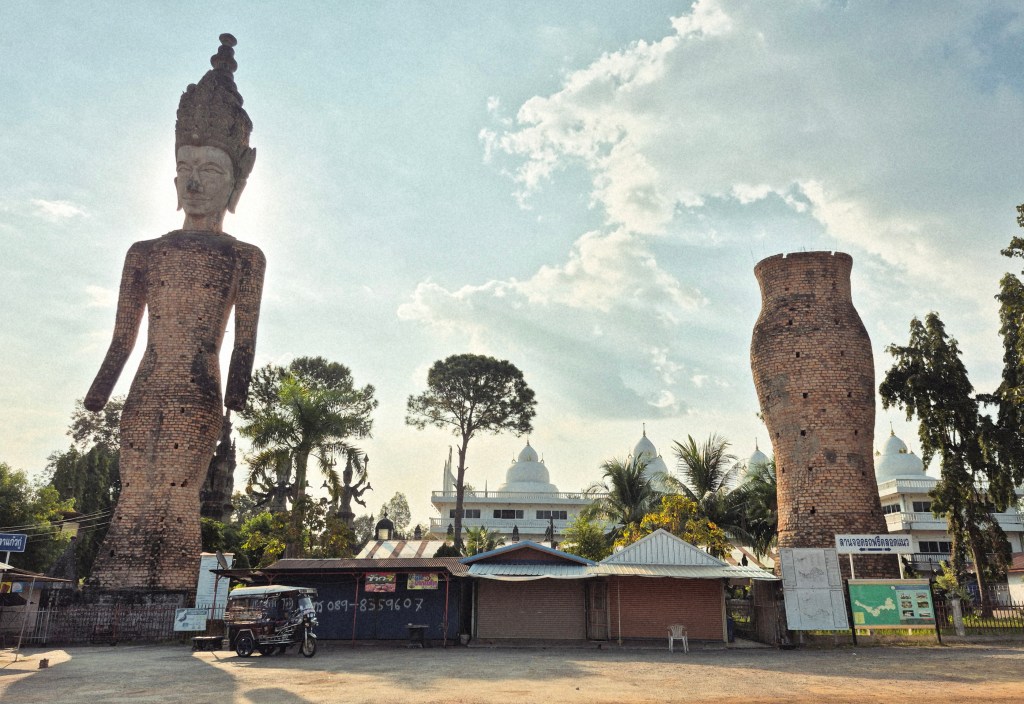
Another morning I went to Sala Kaew Koo. I took the photo at the entrance.
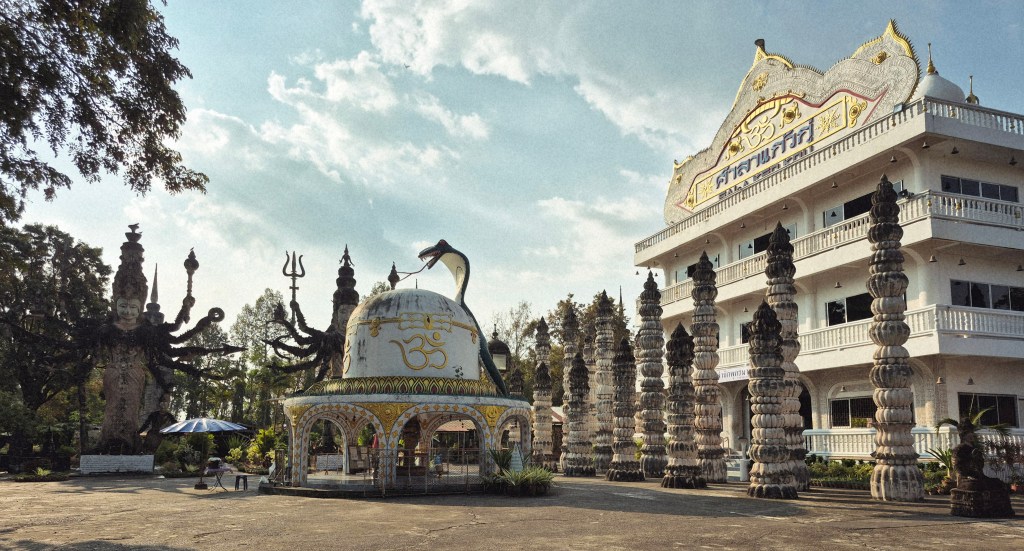
Lonely Planet said “One of Thailand’s most enigmatic attractions, Sala Kaew Ku can’t fail to impress. Built over 20 years by Luang Pu Boun Leua Sourirat, a mystic who died in 1996, the park features a wonderful smorgasbord of bizarre cement statues of Buddha, Shiva, Vishnu and other deities.”
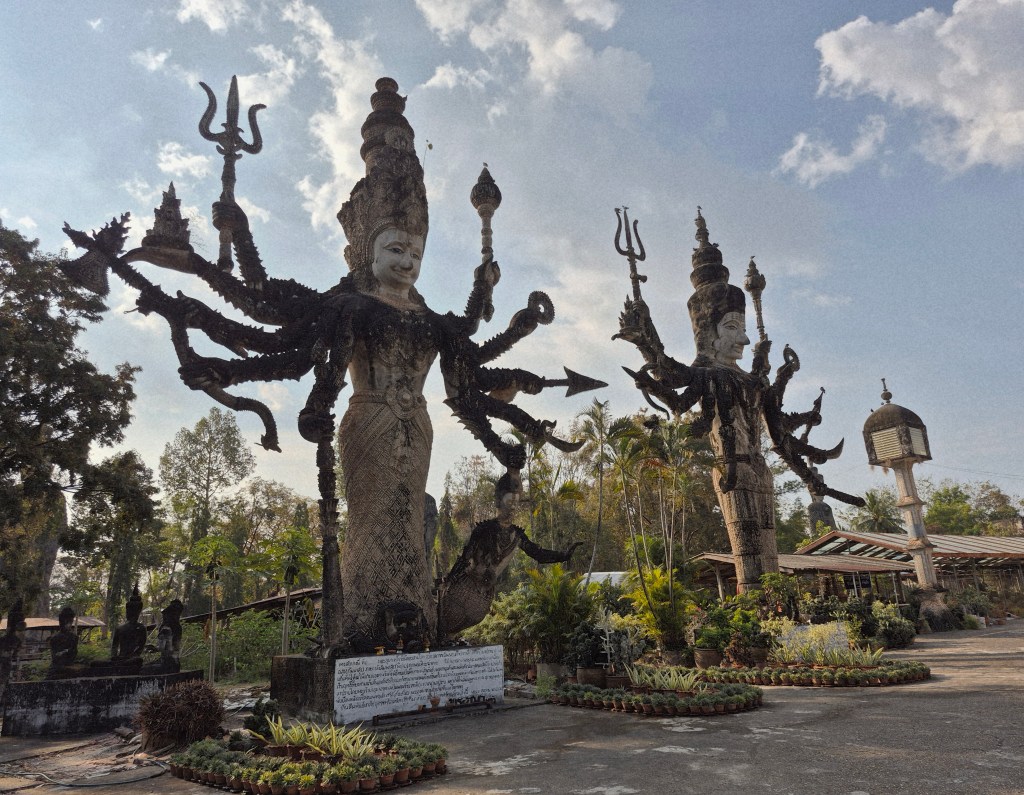
Lonely Planet continued, “As he told his own story, Luang Pu tumbled into a hole as a child and met an ascetic named Kaewkoo who introduced him to the manifold mysteries of the underworld and set him on course to become a Brahmanic-yogi-priest-shaman. Shaking up his own unique blend of Hindu and Buddhist philosophy, Luang Pu developed a large following on both sides of the Mekong in this region. In fact, his original project was on the Lao side of the river, where he had been living until the 1975 communist takeover in Laos.”
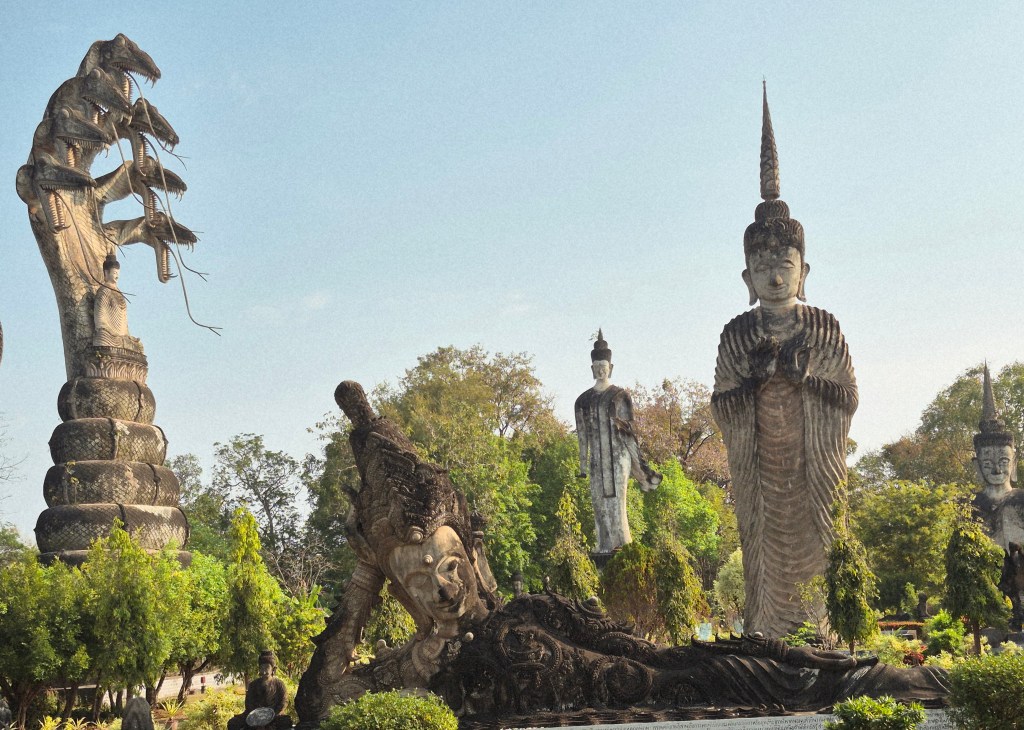
Lonely Planet continued, “Some of the sculptures are quite amusing. If you’re travelling with kids, they’ll enjoy the serene elephant wading through a pack of anthropomorphic dogs (which teaches people to not be bothered by gossip). The tallest sculpture, a Buddha seated on a coiled naga (serpent deity) [above] with a spectacular seven-headed hood, is 25m high. Also not to be missed is the Wheel of Life, which you enter through a giant ‘mouth’. An explanation is available on the back side of the handy map of the sculpture park provided by Mut Mee Garden Guesthouse.”
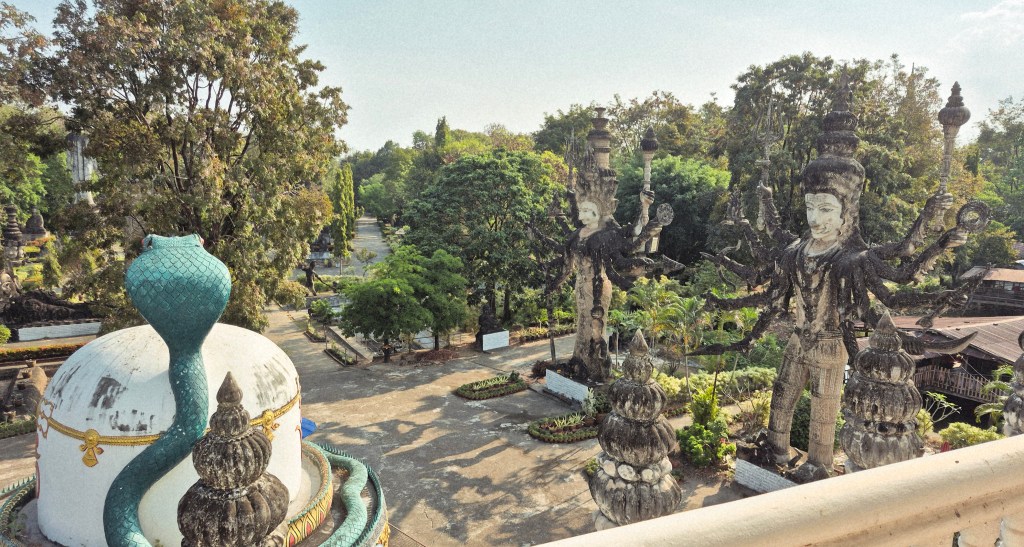
I climbed the stairs of the main shrine building, to take a photo from the 2nd floor (3rd floor to Taiwanese people).
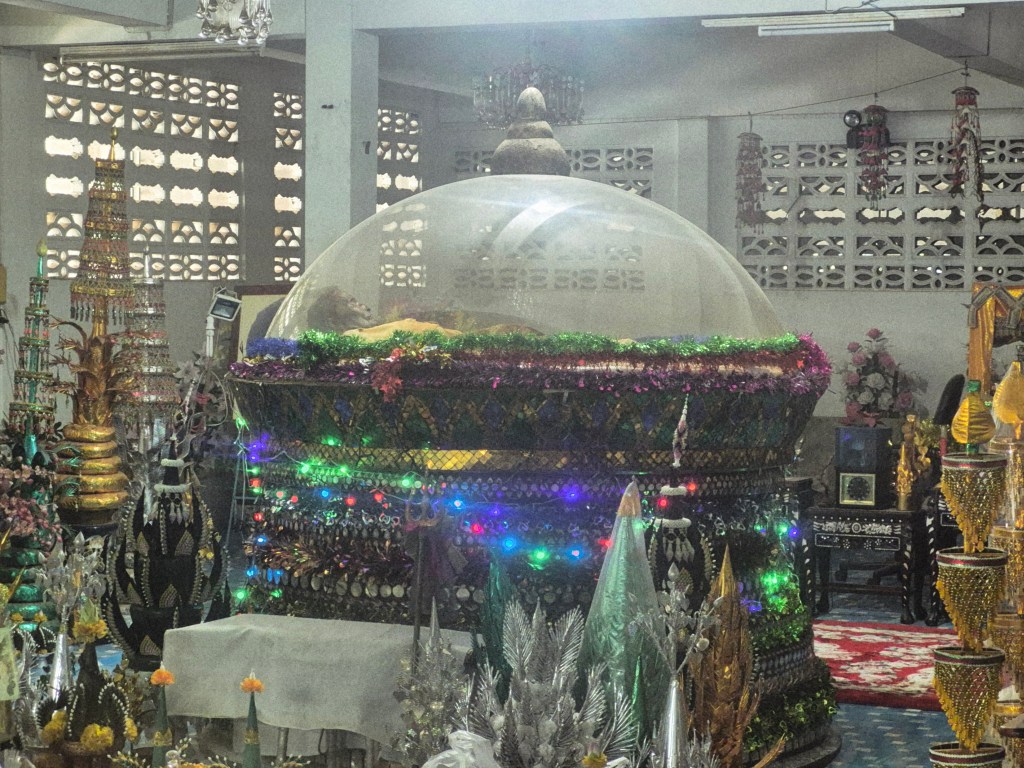
Lonely Planet said “The main shrine building is packed with hundreds of smaller sculptures of various description and provenance, photos of Luang Pu at various stages throughout his life, and his corpse under a glass dome ringed by flashing lights.” That’s his body above. The room was locked, but I took a photo through the glass doors.
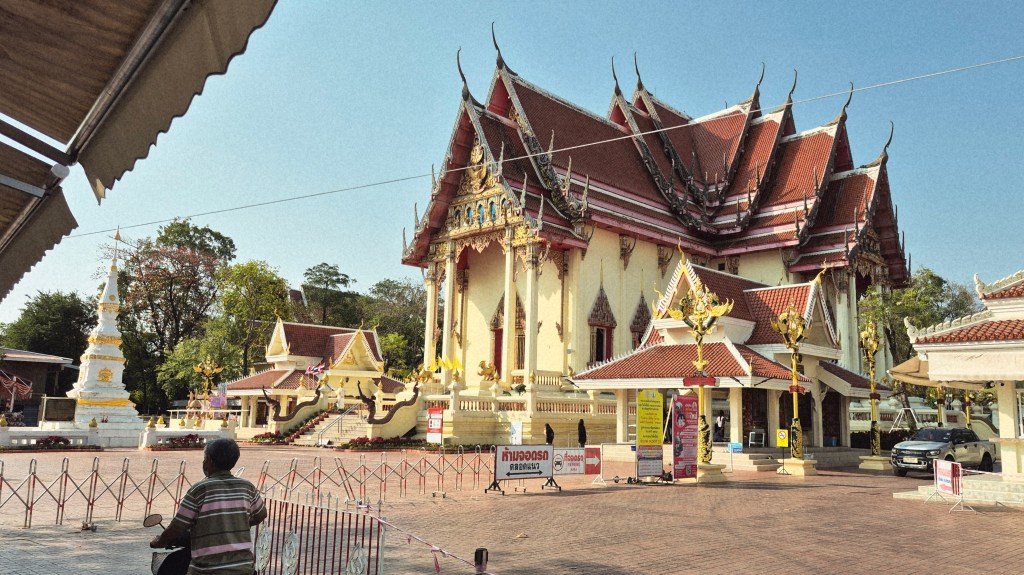
Then I visited Wat Po Chai. “This royal temple is the most important and most sacred of Nong Khai” according to Thailandee.
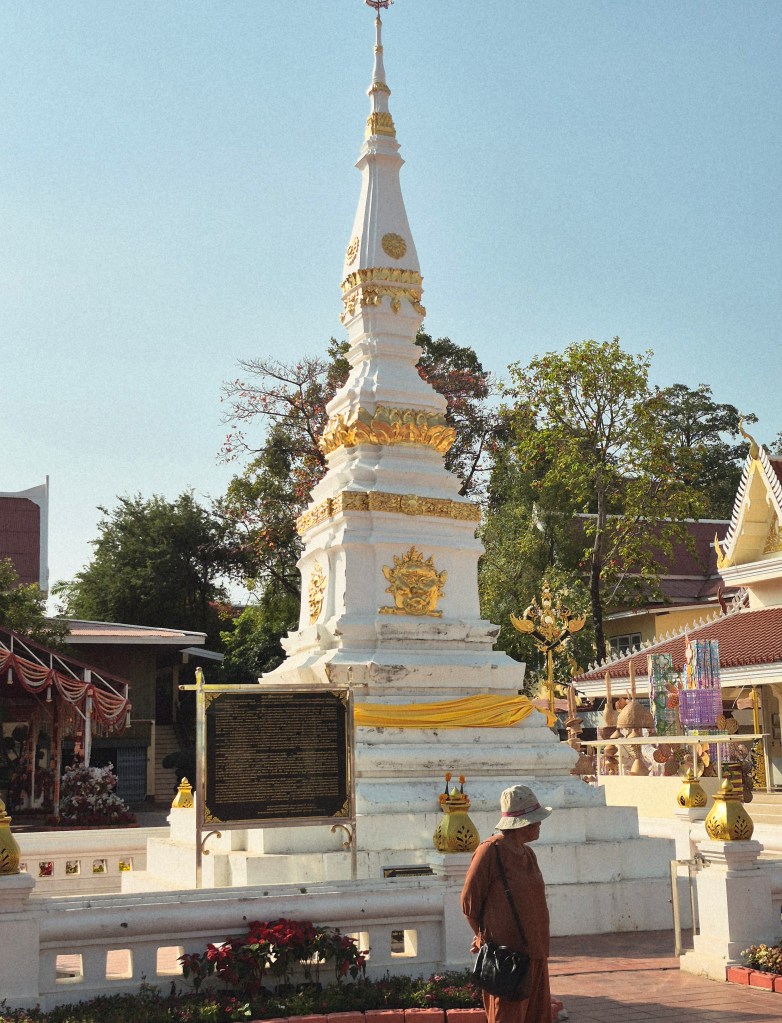
I carefully photographed a chedi (above) under the misapprehension that this is Luang Phra Sai Po. Turns out that it’s a sitting Buddha.
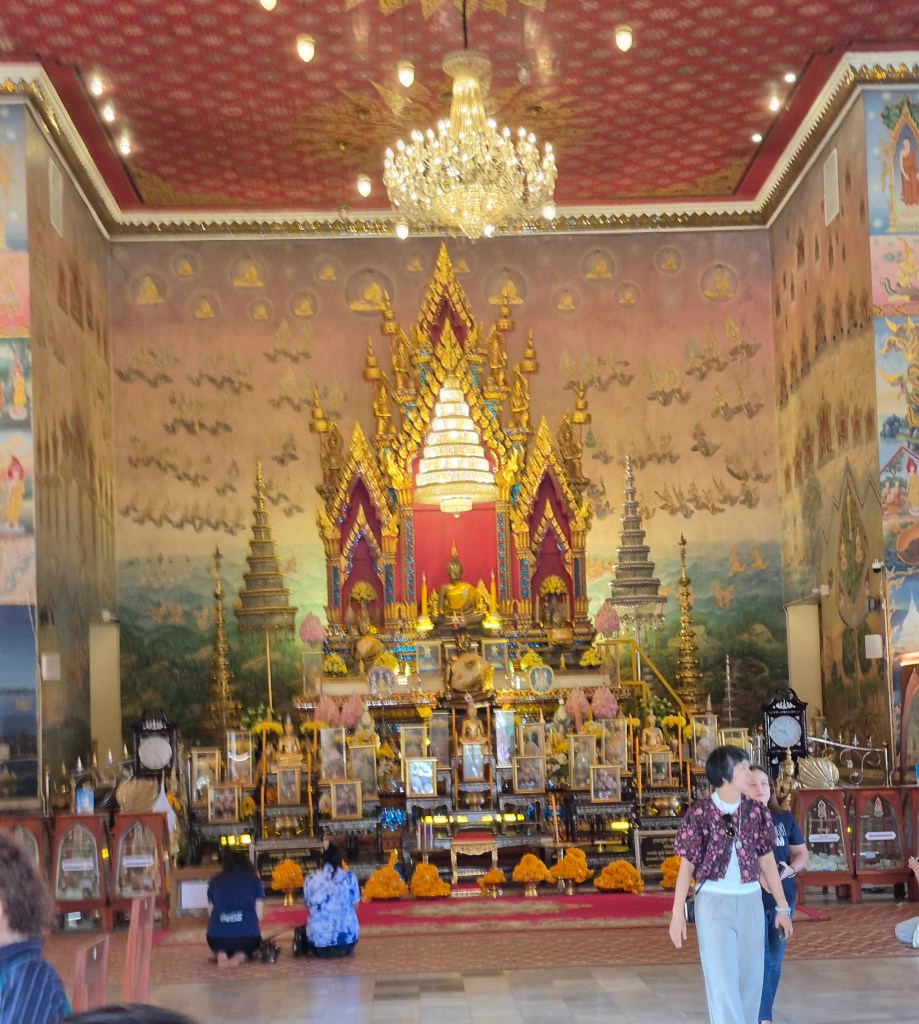
This is the real Luang Phra Sai Po. Lonely Planet said “Luang Po Phra Sai, a large Lan Xang–era Buddha image awash with gold, bronze and precious stones, sits at the hub of Nong Khai’s holiest temple. The head of the image is pure gold, the body is bronze and the ùt·sà·nít (flame-shaped head ornament) is set with rubies. Due to the great number of miracles attributed to it, this royal temple is a mandatory stop for most visiting Thais. Luang Po Phra Sai was one of three similar statues made for each of the daughters of Lao king Setthathirat, and they were taken as bounty after King Rama I sacked Vientiane in 1778. The awesome murals in the hall housing the Buddha image depict their travels from the interior of Laos to the banks of the Mekong, where they were put on rafts. A storm sent one of the statues to the bottom of the river, where it remains today. It was never recovered because, according to one monk at the temple, the naga (which live in the river) wanted to keep it. The third statue, Phra Soem, is at Wat Pathum Wanaram, next to Siam Paragon in Bangkok. Phra Sai was supposed to accompany it, but, as the murals show, the cart carrying it broke down here and so this was taken as a sign that it wished to remain in Nong Khai.”
I really enjoyed my time in Nong Khai, lazing by the Mekong River, eating great meals, and soaking up Isaan culture. I’m going back to Bangkok by the night train.
 Wandering Richard