November 26-28, 2023
The academic semester was over, and I had a little less than a week before starting a new semester. The weather was cooling off, though I was still going without my jacket. Red leaves started appearing on the tree below my window; winter was coming.
I planned to visit Pénghú (澎湖), an archipelago of islands between Taiwan and China.

The above map shows the distance. The Tropic of Cancer runs though Pénghú. I originally intended to travel by train to a port on the west coast and then take a ferry to Pénghú, but the flight from Taipei to Pénghú proved more simple and inexpensive, so I settled on that.
A light rain was falling as I traveled to Songshan Airport, the weather grey and cool, with the temperature around the high teens Celsius. I hadn’t taken a plane before in Taiwan, so I was a bit apprehensive. The MRT had a stop dedicated to the airport, logically called Songshan Airport MRT Station. The entrance to the airport was only steps from the MRT.

The airport was small but new, like Sydney Airport shrunk down to a quarter the size, and I progressed rapidly. The airport authorities were thorough on security, so I spent time unpacking and repacking my person and bag. The above photo is of the gate, while I was waiting for it to open. When the gate opened, instead of an aerobridge we were bussed out to our aircraft.

My aeroplane, an ATR 72-600, in the rain. I took this standing at the door of the bus.
The ATR 72 lined up at the end of the runway, a sudden quick acceleration, then we were zooming rapidly upwards towards the cloud layer. Seems like the ATR 72 has light handling compared to a jet.
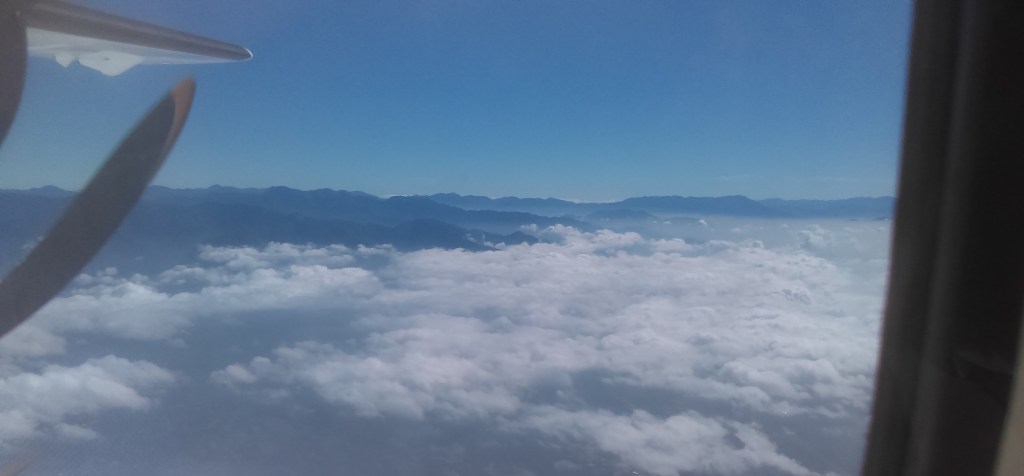
The clouds cleared as we tracked down Taiwan. There were high mountains on the skyline (above).

There were brilliant views from the air, which I failed to catch (above).

The plane made a short crossing over water, then we descended over the archipelago, with many small islands and a few large ones (above).
Wikivoyage says “The wind-scoured landscape is drier than most of Taiwan, with limited farmable land and lots of agave plants and prickly-pear cactuses. Hardy evergreen trees have been planted in many places as windbreaks. Located to the west of the main island of Taiwan, is composed of 90 islets; most are uninhabited.”

We landed at Penghu Airport, which is a dual-use (military and civilian) airport; I saw many bunkers and earthworks as we taxied. The airport is not that different to Songshan Airport, complete with ATR 72s, flying to cities along the Taiwanese west coast. The sun was shining brighly.
Wikivoyage gives a short history of Penghu. In the 9th or 10th centuries in the Song dynasty, Han Chinese from Southeastern Fujian established fishing communities, and in the subsequent Mongol Empire Penghu formally became an area of Fujian Province. around the 15th Century in the middle of Ming Dynasty, the South China Sea became the setting of international trade among Japanese, European navies, and Chinese pirates. The “Ming Empire sent General Shang Zhouzuo (沈有容, 1557-1628) to expel the VOC fleets from Pescadores. This event was recorded in a stone tablet : 「沈有容諭退紅毛番韋麻郎等」 (It means ‘Shang Zhouzuo expelled Wijbrant and his people’); you still can see the stone tablet at Tian-hou Temple (天后宮) in the present Magong City.”

I walked through the airport without stopping and got into a taxi (above). A quick trip to Magong (馬公) cost 315元, about $AUD16.

A shot of my destination, MF Hotel Penghu. Teacher Lu said that the Chinese characters “澎湖和田大飯店” are illuminating; “和田”, meaning “harmonious rice-field”, indicate that it’s a relaxed place, while “大飯店”, literally “great rice shop”, signify that it’s actually a large hotel.
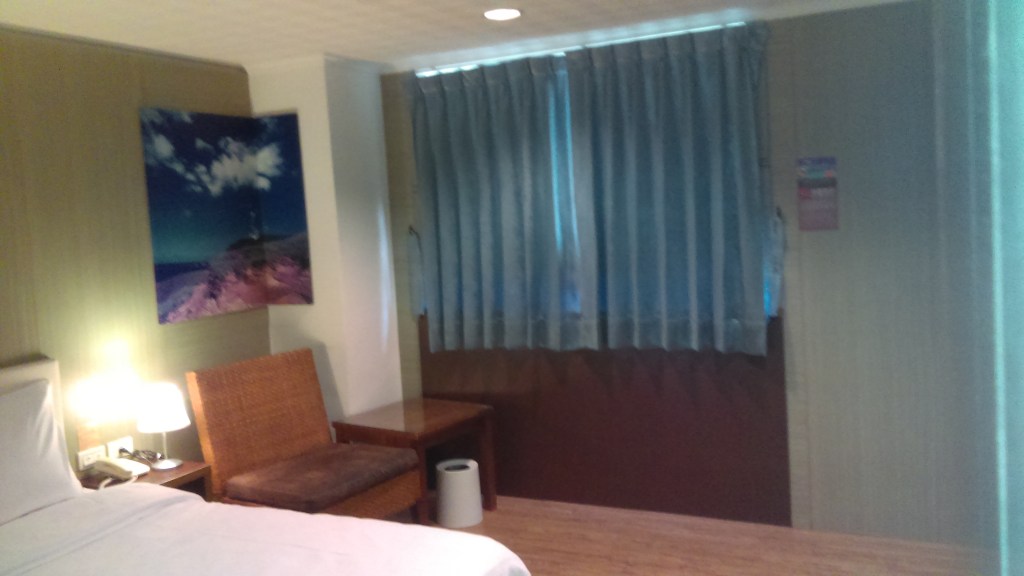
Inside the room. It’s nicer than the photo, tastefully decorated with a flat-screen TV, and thick walls.

The view out the window – very fine, though it’s not captured well here. The room was on the 6th floor, or 5th floor if you are Australian.

I walked around randomly from my hotel. The neighbourhood around the hotel is typical of Magong. I took this photo about three blocks from the hotel. Unfortunately I felt tired from my trip, so I had an early night.
The next day I set out to explore properly.

A man directed me towards Zhongyang Old Street (above) – otherwise I would have gone right past it. Zhongyang Old Street is very narrow, despite being in its day the main street of town. The modern equivalent street runs parallel just a block away.
According to Round Taiwan Round, “The only qualified old street on Penghu Island is the Zhongyang Old Street—”Zhongyang” means “central” in Mandarin. Situated near Four Eyes Well and Penghu Mazu Temple, Zhongyang Old Street can be seen through at a glance, yet red brick pillars and wooden houses still give it a hint of history. The only pity here is the commercial atmosphere that overshadows the historical ambiance, yet that’s why lively cultural creations are introduced to the old street. On the old street, you can find painted floating balls with cat portraits on them, handmade basalt accessories, cactus mille-feuilles, martial art schools, tea shops, Breast Touching Lane (Molu Lane), etc.”

Another view of the same street, near Penghu Tianhou Temple.
According to Taiwan Tourism, “As the earliest commercial district of Penghu, the Zhongyang Street are (sic) featured by a dozen of narrow alleys and lanes built in the Qing and Ming Dynasties … In the past, a family would live at one end of a house and do business at the other. In addition, the narrow alleys and lanes look almost mysterious today. There is even an alley only 6 meters wide. During the Japanese Rule, the Zhongyang Street further expanded into a commercial area nicknamed The Seven Streets and One Market.”
According to Wikipedia, “In the late 1980s, this historical street faced threats from urban development which might divide the street into smaller sections. Some local officials and scholars then launched a project in 1991 to preserve the street and made it a cultural and historical district.”
I found a clip on YouTube about Zhongyang Old Street.
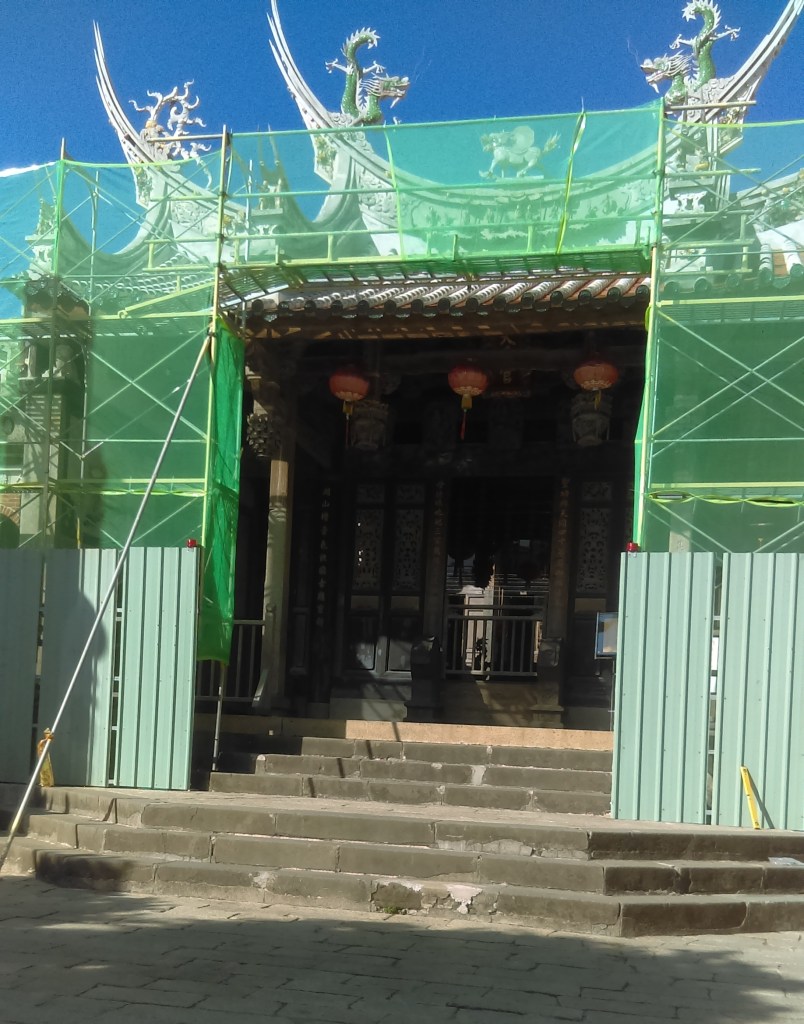
Just along from Zhongyang Old Street is the Penghu Tianhou Temple (澎湖天后宮), the most famous temple in Magong. However it’s hemmed in by scaffolding (above). There are other pictures that do it justice.

Wikipedia says “The Penghu Tianhou Temple is a temple dedicated to the sea goddess Mazu located on Zhengyi Street in Magong City, Penghu, Taiwan. It is usually considered the oldest Mazu temple in Taiwan and, despite differences in characters, is the namesake of the surrounding city of Magong. … The temple claims to be the oldest in Taiwan, possibly dating to the early Ming in the 15th century.” The ‘differences in characters’ refers to the characters being changed in 1920, so the spoken names no longer match in Chinese due to changes in tone.

The temple is made of wood (above). There is a sign saying “天后宮” – Tianhou Temple.
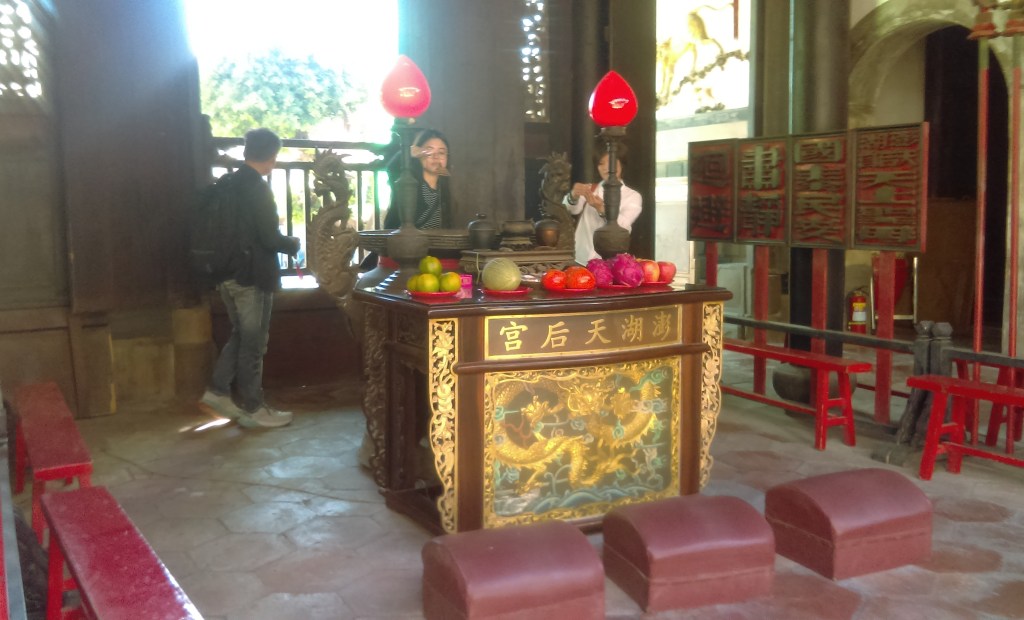
Worshippers praying (above).
Taiwan Tourism said “Penghu Tianhou Temple at Magong was built in 1604. It is Taiwan’s oldest and finest temple. The temple survived for an age of 400 years and has become the worshipping center of Penghu residents. The architecture is the work of famous Tangshan artists. Every part of the temple is made with utmost refined style. Inside the temple are some prized Ching period arts. Its inside out is the extreme artistic presentation of styling and sculpture. There is also a tablet in memory of Yojong Sheng’s success in persuading Dutch invaders to retreat, which is also the earliest tablet found in Taiwan.” Unfortunately I didn’t get to see this tablet.

Close to the Penghu Tianhou Temple is the Four Eyes Well, in a T-intersection (above). The open space is only the size of the average room, hemmed in on all sides with buildings.
Travel King said “Four Eyes Well as its appearance looks like a Four-cavity well situated north-end of the Zhongyang Street in Magong. The well was dug during [the] Ming Dynasty (1592)… This Four Eyes Well is 5.6 meters deep and two meters in diameter. There is a stone slate covering the well opening, leaving four circular openings for people [to] retrieve water, and preventing the people slid[ing] into the well accidently. According to legend, the Four-eyed well remained running even during [droughts], and the water is clear and cool. Now it is the oldest well remain in Magong City.”
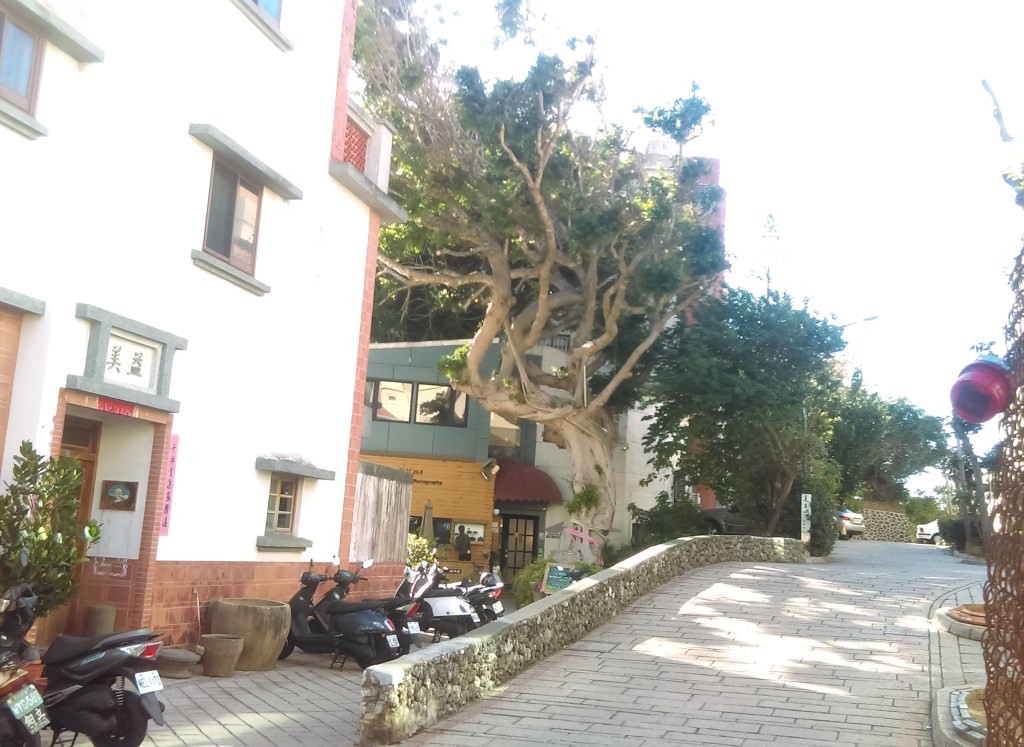
Around the Zhongping Old Street there were many photo opportunities (above). The area looks prosperous and well-cared-for.
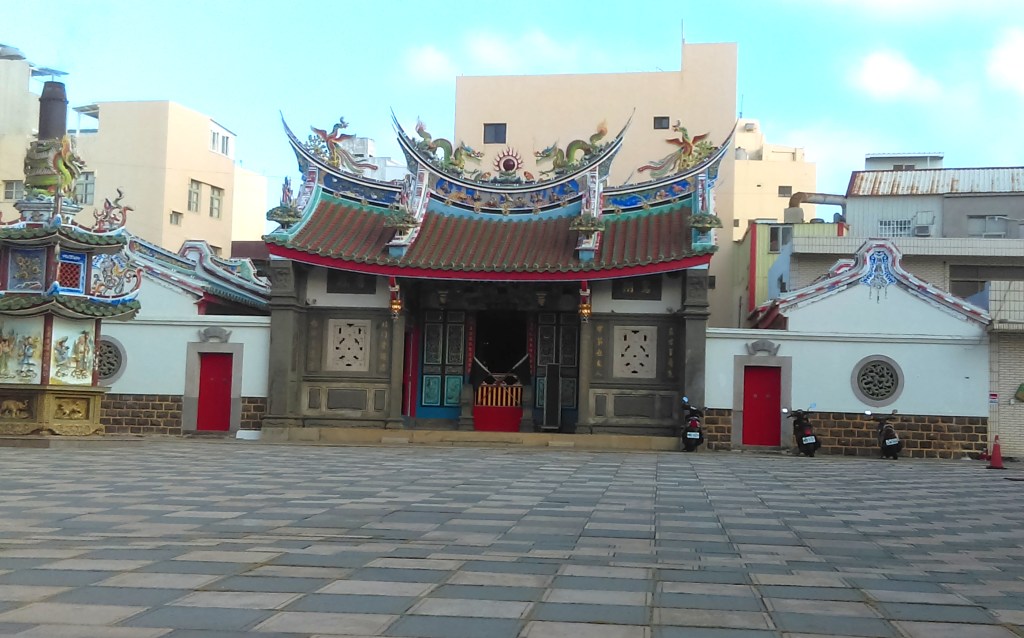
The day before, I had stumbled over this temple just a block away from my hotel. It’s called in Chinese “北極殿”; pinyin Běijí Diàn. According to Wikipedia, Magong Beiji Temple is formerly located in the easternmost area (Dongjia) in Magong.
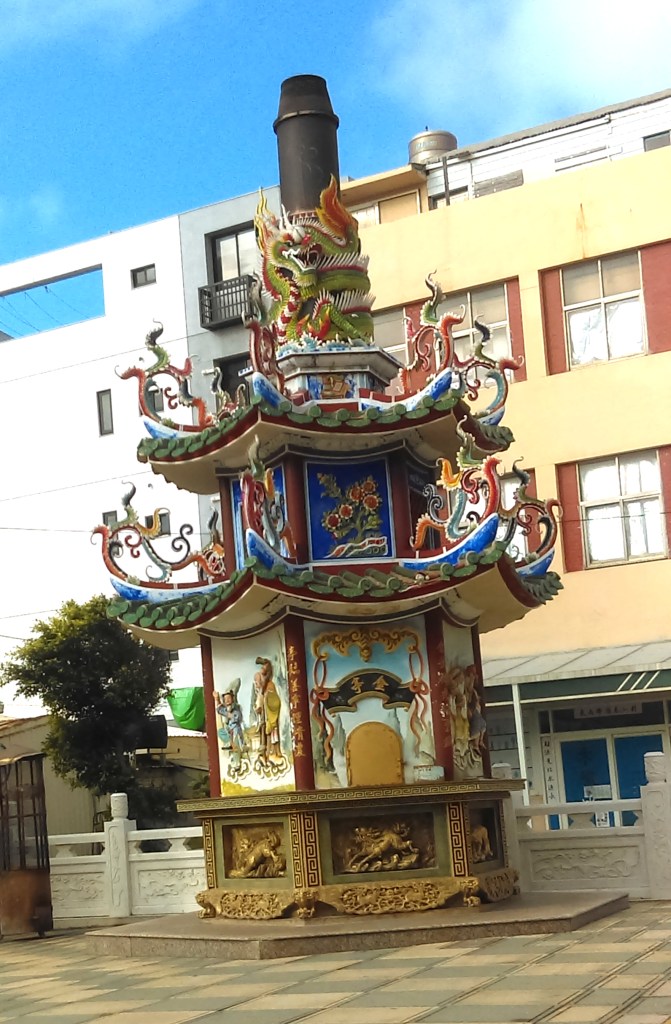
The beautiful crematorium.
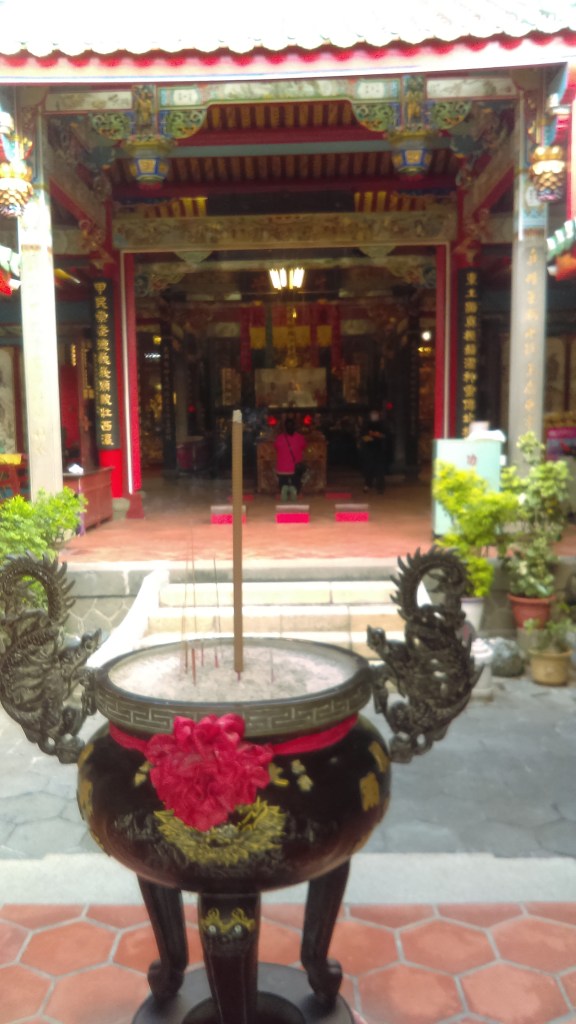
A view of the main altar.
According to Wikipedia, “Beiji Temples mainly serves “Xuan Tian Shang Di (Chinese: 玄天上帝)”, also known as ‘Zhen Wu Shang Di (Chinese: 真武上帝)’ , like other temples in Taiwan, the temple also housed a lot of god statues as well, including Cundi Bodhisattva, Dark Lady, Lord of the Soil and the Ground, Royal Lord and so on.”

A view inside the temple. According to Wikipedia, “The year of establishment is unknown, some said it had existed since the late of Ming dynasty, some said it founded by Zhao Guang (趙廣) in 1690. However, we can confirm that the earliest recording of repair is after 1791 at least.”

A view into the side passage.
My brief stay in Pénghú was over. On the morning of November 28th, I caught a taxi to the airport.
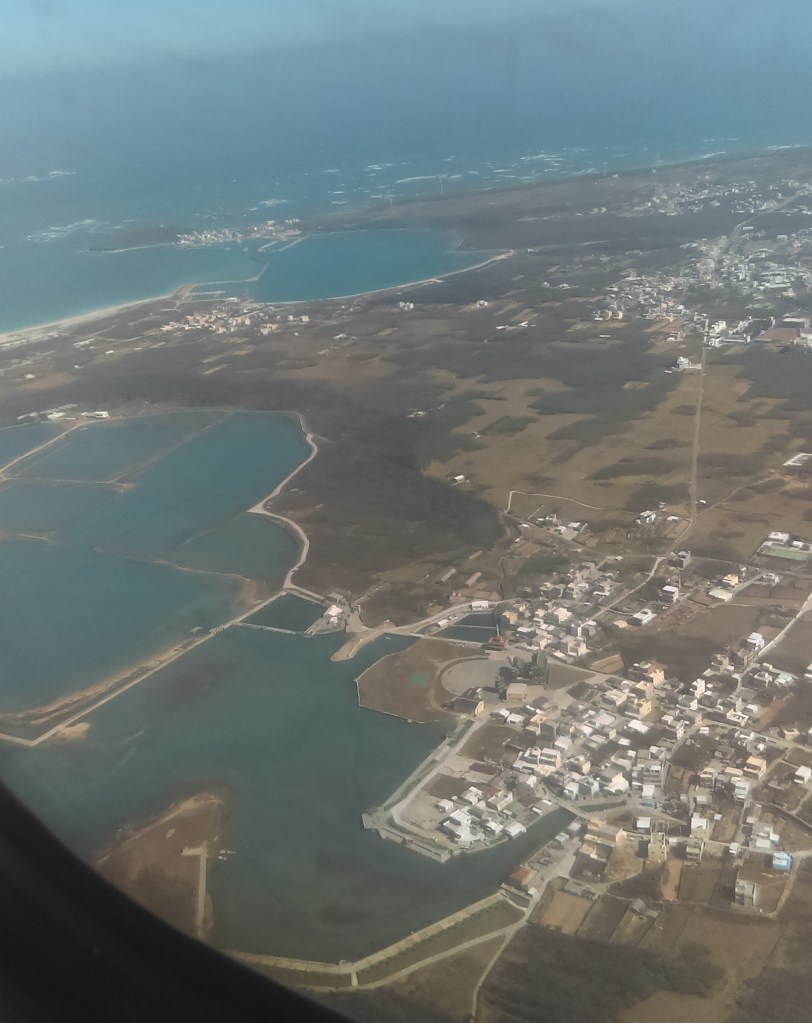
A photo of the archipelago, soon after takeoff.

It was brilliant flying weather. I photographed a view on Taiwan (above) from my window seat. All too soon we landed and I took the MRT home.
 Wandering Richard