January 27, 2025
新年快樂! (xīn nián kuài lè) – Happy Lunar New Year! Last night at midnight I heard fireworks ushering in the New Year on the 29th. I got up from my bed and stood on the balcony over the Xindian valley, watching a few sites lit by fireworks, out of time to the distant bangs.
The Mandarin Training Center was closed this whole week. I met with my mother in a Zoom call to check on her. I planned on making a Wandering Richard webpage, and realized I hadn’t put it in going to a night market. Raohe Street Night Market was a convenient choice, on the end of the Green line at Sōngshān (松山, “Pine Mountain”) Station.
Unfortunately, I picked up a virus on Sunday, the day I meant to go. So I went to bed, and the next night, Monday, January 27, I thought I was recovered enough to go. I underestimated the virus, how it made me feel tired and grumpy for many days afterwards.
Another factor was the weather. When I visited the markets it was in the middle of a cold snap. After I got back from the night market I checked the temperature on my computer and it was 8 degrees Centigrade. I know some of you are scoffing at that, particularly if you live in England. But Taipei is only a few hundred kilometers from the Tropic of Cancer where the tropics begin; in Australia it would be on the central Queensland coast north of Brisbane. Eight degrees are as cold as I’ve known it in Taipei since I moved here in 2019. I wore my puffer jacket when I left for the night market.

Above is the Google Maps version of my route. I will be taking the MRT Green line from Qizhang Station (七張站) to the end of the line at Sōngshān Station. The night market is just a few minutes’ walk.

The obligatory MRT train to the night market. I like riding on trains, something I share with Ben Groundwater’s children.
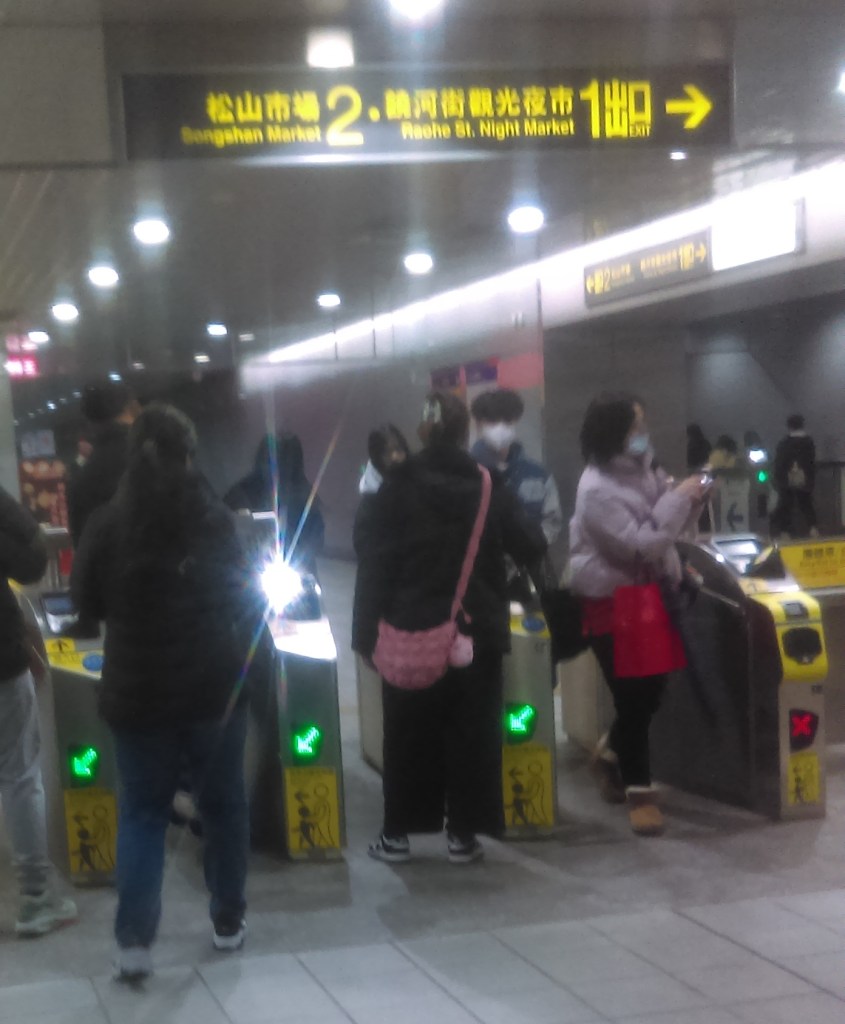
The turn style at Sōngshān Station, with the direction board indicating Raohe Night Market.
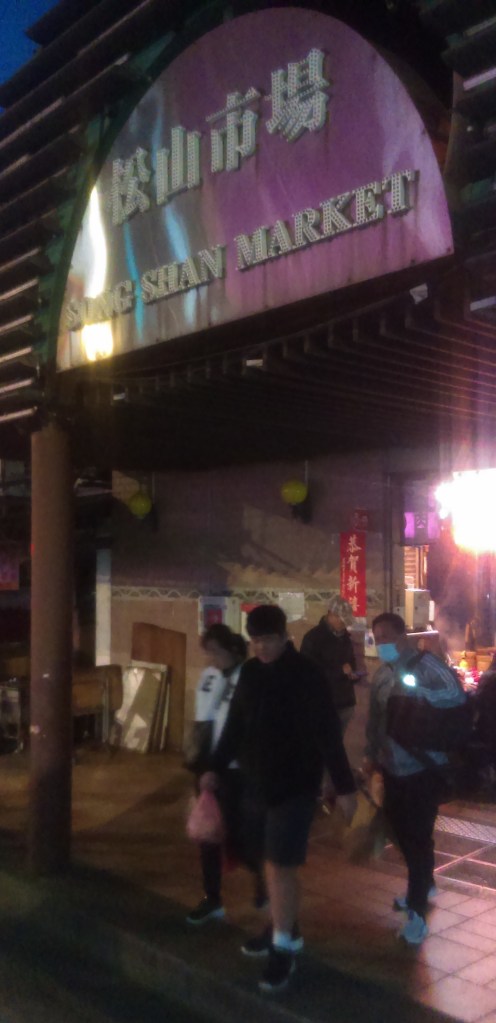
I followed the directions, and found – wait, that’s not it! For a while I wandered aimlessly, retracing my steps.

Then I stumbled on a temple (above).
That’s the Sōngshān Cíyòu Gōng (松山慈祐宮), or Cíyòu Temple. I was worried that I wouldn’t find a YouTube clip dedicated to only the Cíyòu Temple, but I found a couple, one of which is above.

There were more people in the Cíyòu Temple when I was there (above). According to Taiwan: Waves of Wonder, “This temple, built in the mid-18th century, is the cradle of development of the Songshan district. The story goes that a monk once roamed this area, carrying a gilded image of Mazu, Goddess of the Sea, as he begged for alms. One day at Xikou—the old name for this district—the monk came upon a number of people, all Mazu believers, from his old home. Together they planned construction of a temple to honor the goddess, and after raising funds for more than 10 years they were able to realize their dream. Construction started in 1753 and was completed in 1757.”
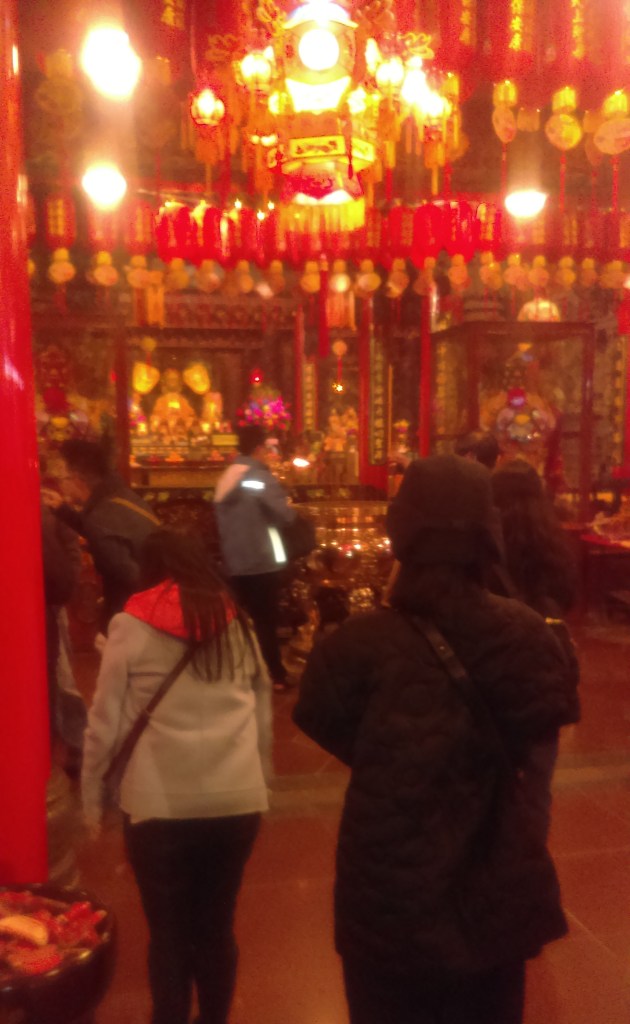
New Taipei City Travel said “The deity statues in the temple, including Mazu, Qianliyen and Shunfenger, have been here for several hundred years. They have witnessed the rise and fall of this place and can stir up visitors’ nostalgia about the old days.”

There was food laid out (above) on long tables, but I didn’t understand the meaning of the offering. Perhaps someone could explain it?

A nice photo of the doors (above).

Moon blocks. According to Gods of Taiwan, “Prayer in Taiwanese Popular Religion is a quite specific and practical affair. It is often used to help the faithful make decisions, be they major or minor, as well as to ask for help from the gods. A prime motivation for a visit to the local temple is to find the answer to a particular question, and to find that answer, adherents will turn to the divination tools of their faith, jiao bei [Moon blocks] … The question also must be phrased very clearly, and due to the binary nature of the jiao bei, must only be answerable with yes or no. The two blocks are then tossed onto the floor, and how they fall will reflect the answer.” There are four different results, either yes, no, undecided, or ‘laughter’ – “interpreted as the gods laughing at the proposition, either because it is a particularly bad idea, because the enquirer has already decided, or the question lacks relevancy in some other way”. Read the article, it gives a great insight into people’s perception of the gods.

The inside of a temple roof. According to Taiwan: Waves of Wonder, “The top of the temple roof is richly ornamented; in addition to human figures, there is also a flying dragon placed there because dragons were believed to have the power to prevent fires. Inside the temple are layer after layer of oil lamps lighted by devotees in the hope that Mazu will grant their wishes. The side altar to the right of the Mazu image enshrines the Earth God, who is protected on either side by flag-gearing Tiger Lords. The side altar to the left is devoted to Zhusheng Niang-niang, the Goddess of Birth. This goddess is normally accompanied by 12 female aides, but here she has 13. The extra aide is Duyu Niang; in life she was a midwife who never accepted money for helping women with childbirth, so after death she was deified because of her kindness and skill.”

The above is a photo I took of an interpretative sign, which is mostly legible. My camerawork is rubbish.
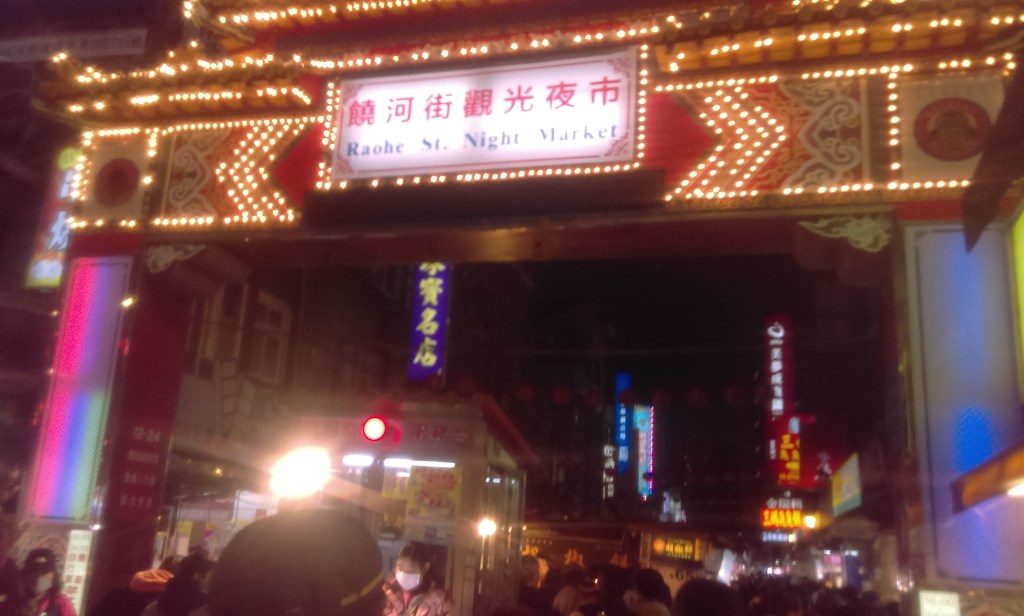
Right next door is the Raohe Street Night Market – in traditional Chinese characters 饒河街觀光夜市, “Raohe Street Tourist Night Market”.
Yellow Productions has a clip on the Raohe Night Market. I like the presenter, he has quirky and interesting things to say.
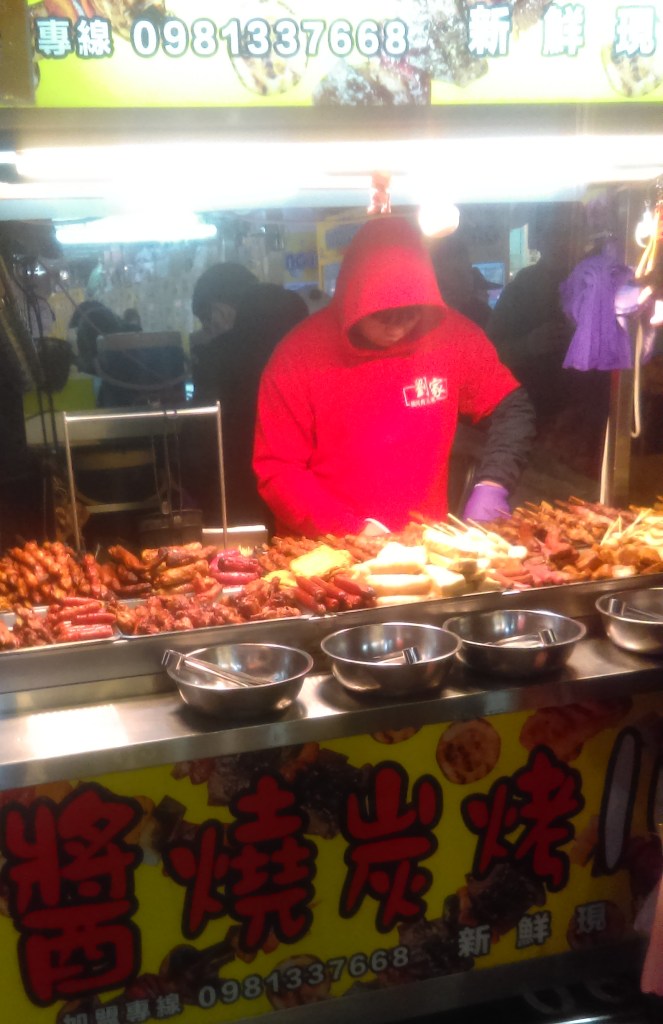
I joined the crowd of people and was moved along by them. Above is a stall in a long double line of stalls in the middle of the street.
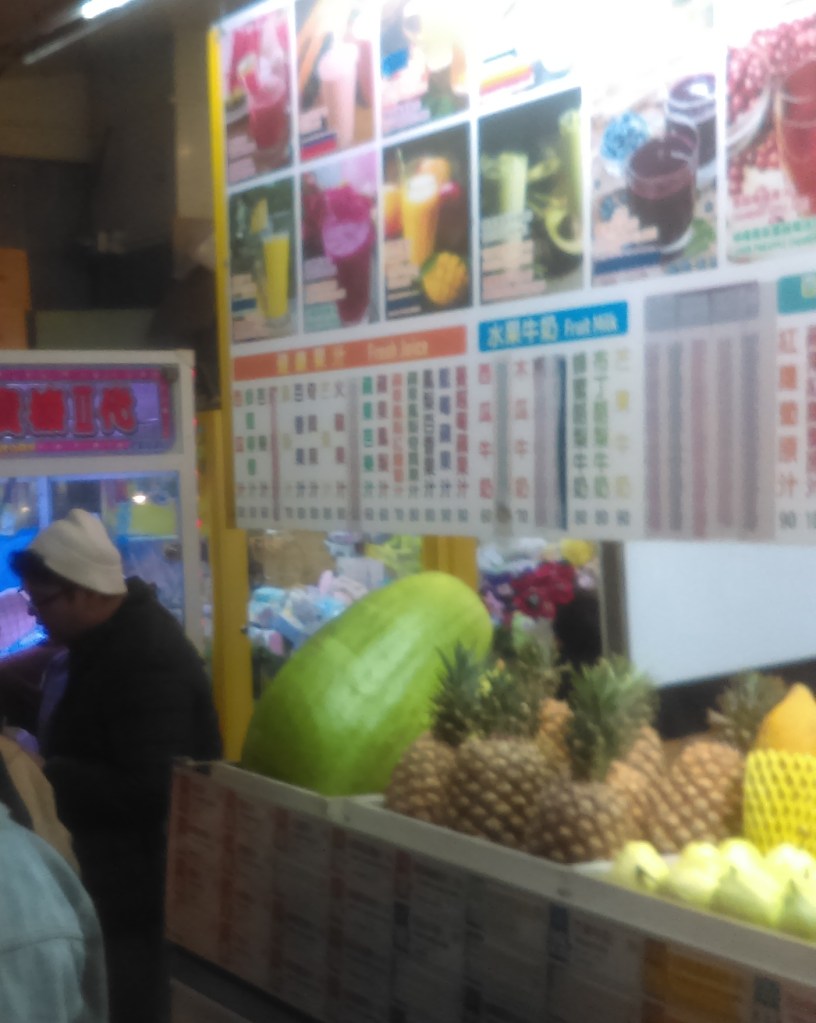
There were many drink stalls (one of which is above). A great idea in summer after a hot and humid day; not so much in winter, with the temperature in single digits.
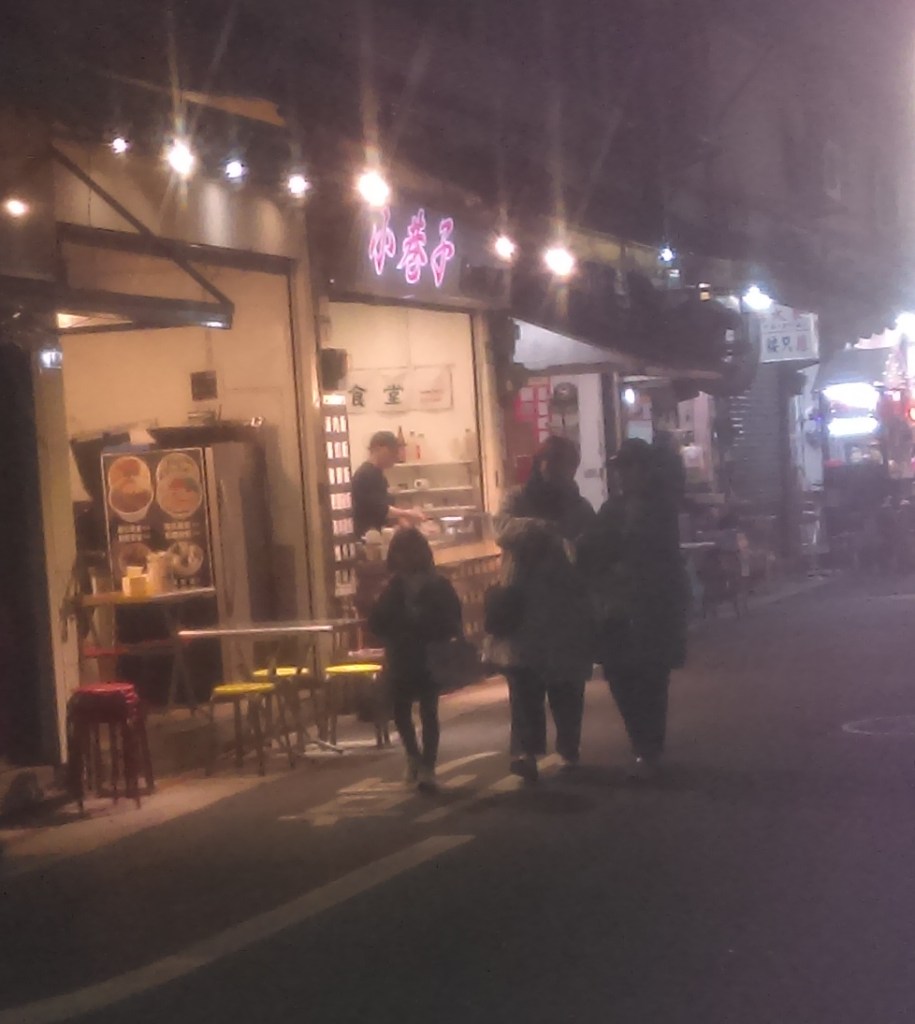
There were quieter streets off the central road (above).

My impression of the night market was crowded, jostling people, and overwhelming noise. I realized I didn’t like it one bit. Of course I had the virus, which shaped my perception quite a bit.
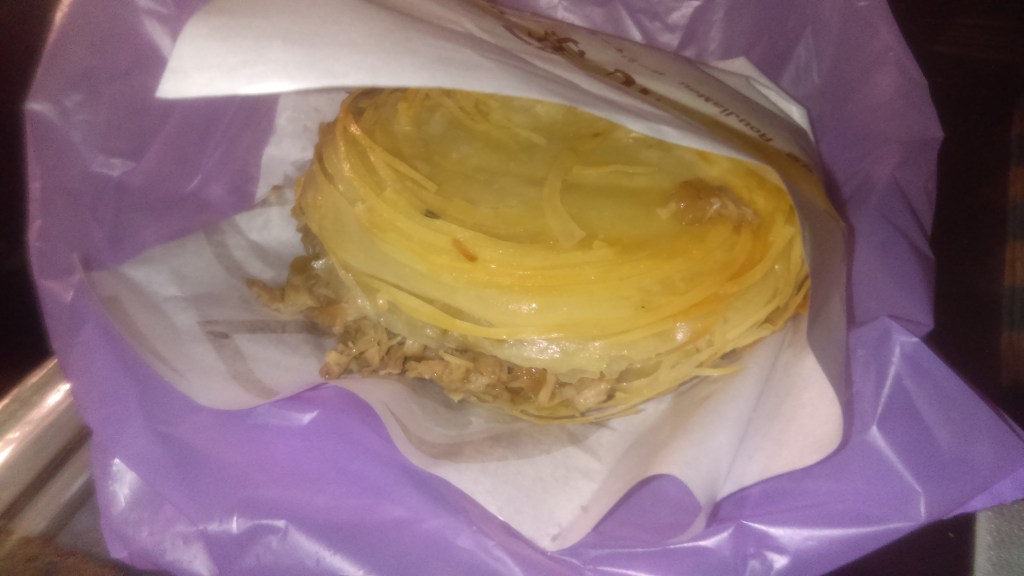
I bought a 刈包, “guàbāo” (above) from a stall. I ate the guàbāo standing, as there wasn’t anywhere to sit down.
From Wikipedia, “Koah-pau or gua bao… or cuapao… also known as a pork belly bun…, bao,… or bao bun, … consists of a slice of stewed meat and condiments sandwiched between flat steamed bread … typically 6–8 centimetres (2.4–3.1 in) in size, semi-circular and flat in form, with a horizontal fold that, when opened, gives the appearance that it has been sliced. The traditional filling for gua bao is a slice of red-cooked pork belly, typically dressed with stir-fried suan cai (pickled mustard greens), coriander, and ground peanuts.” According to the MOFA Taiwan, “In those days of material poverty, pork was a rare treat, so people had the chance to eat gua bao only on special occasions like year-end banquets or when venerating the local earth god. … It was not until the 1970s that gua bao became widespread in the daily lives of ordinary people.”
Finally the cold and the virus overcame me, so I headed for home on the MRT, and went to bed. As I write, three days later, I still feel the virus.
 Wandering Richard