December 7, 2025
On Sunday, I made a last-minute decision to visit the Sydney Fish Markets, as part of my plan to go to sites very popular with tourists.

The itinerary is superimposed over the Google Map above. From Circular Quay, I took the ferry to Pyrmont Bay wharf; caught the light rail to the Fish Markets; then walked to the city to catch the bus home.

At Circular Quay. The previous day was a scorcher, 38 degrees, though very dry. In contrast this day was relatively cool, around 20 degrees. The clouds helped.
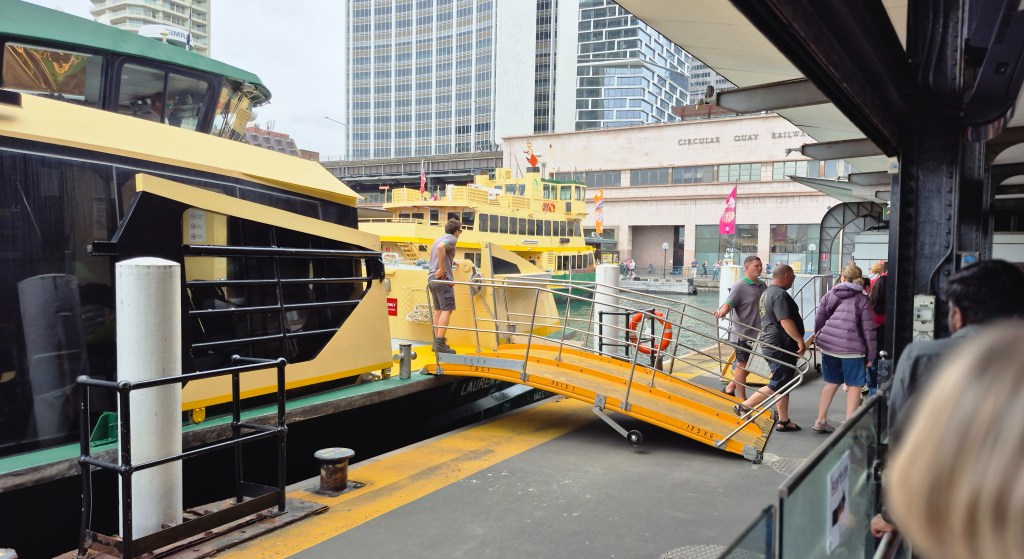
Passengers getting off our ferry.

Our ferry reversed giving me a look at the wharf.

There were many ferries in Circular Quay.

There is docking for cruise liners right next door.
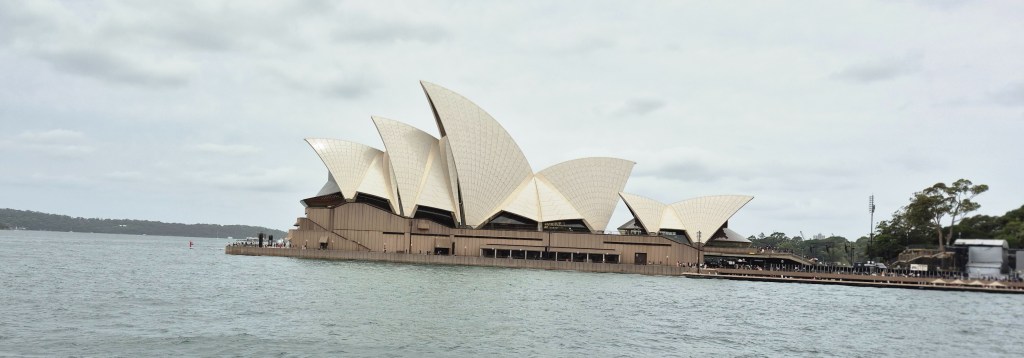
The Sydney Opera House. I went there.
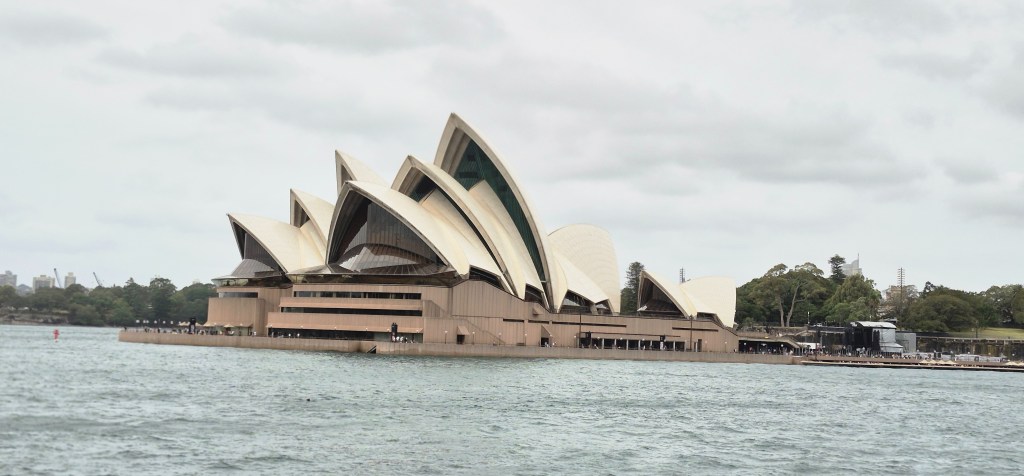
Another view of the Sydney Opera House.

The Sydney Harbour Bridge. I also commented on this.

Close-up of the north side.
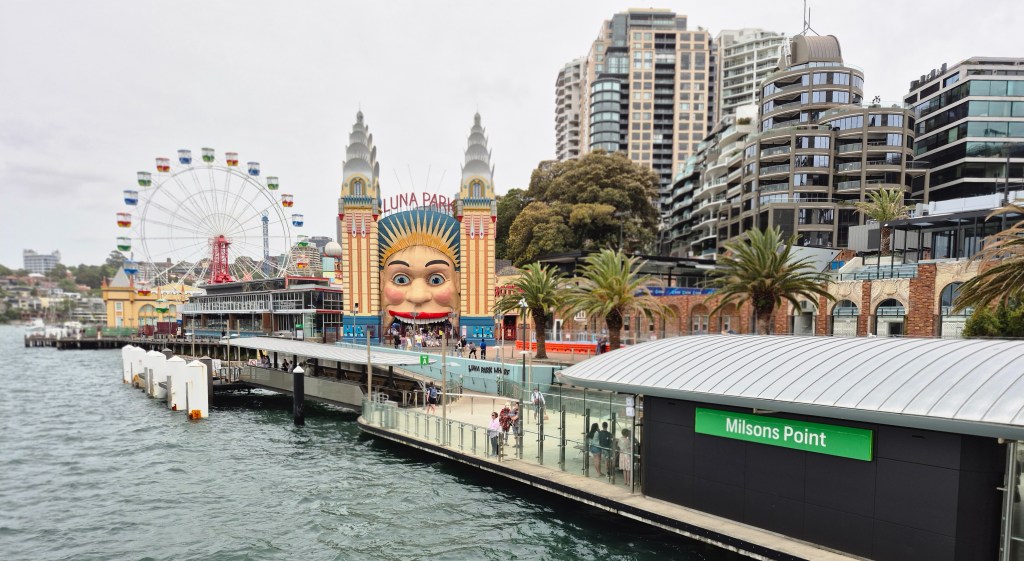
Milson’s Point Wharf, with Luna Park beyond.

“Built in the 1930s, Luna Park is a harbour-side amusement park that still contains traditional midway games and rides.” (TripAdvisor)
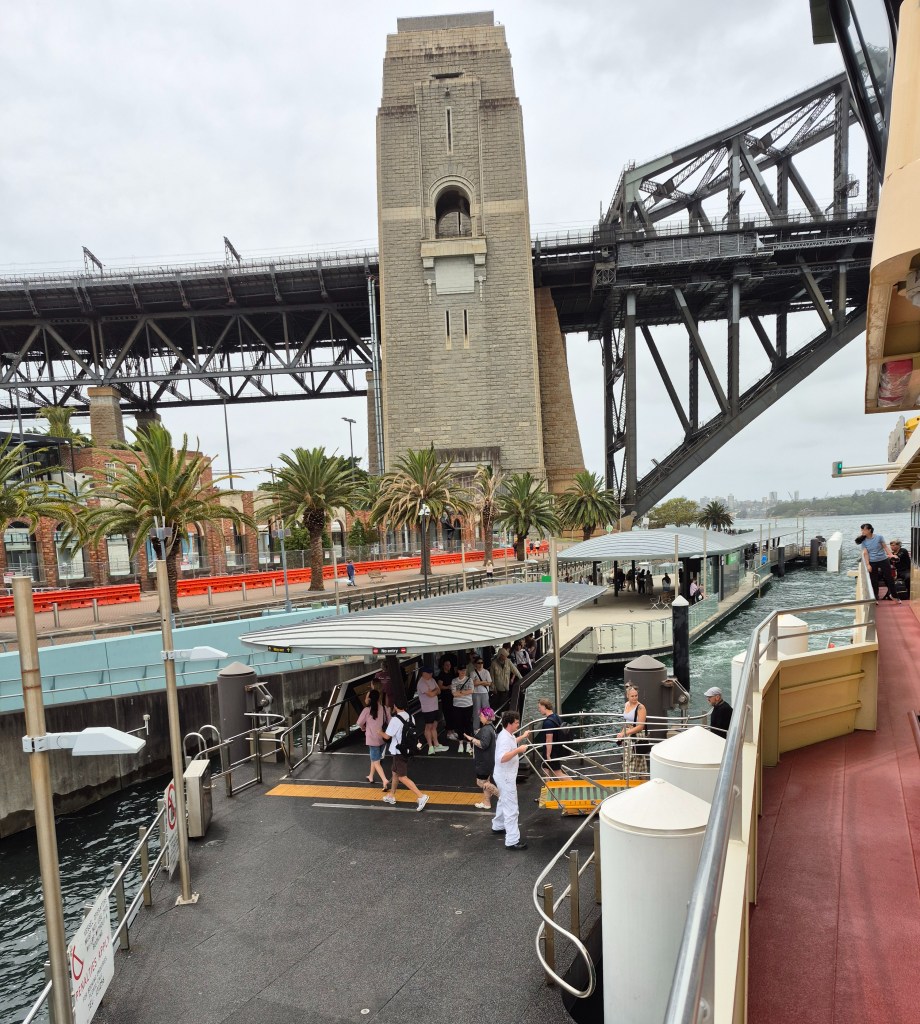
Passengers disembarking, the Sydney Harbour Bridge in the background.

That’s Lavender Bay.
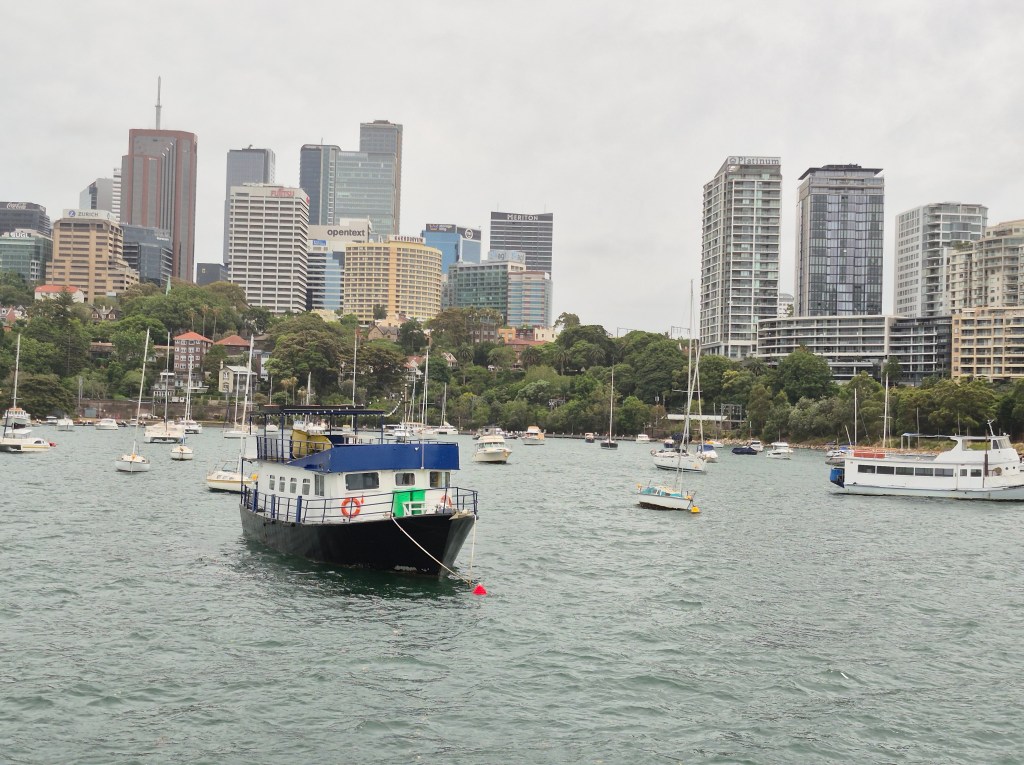
A close-up.
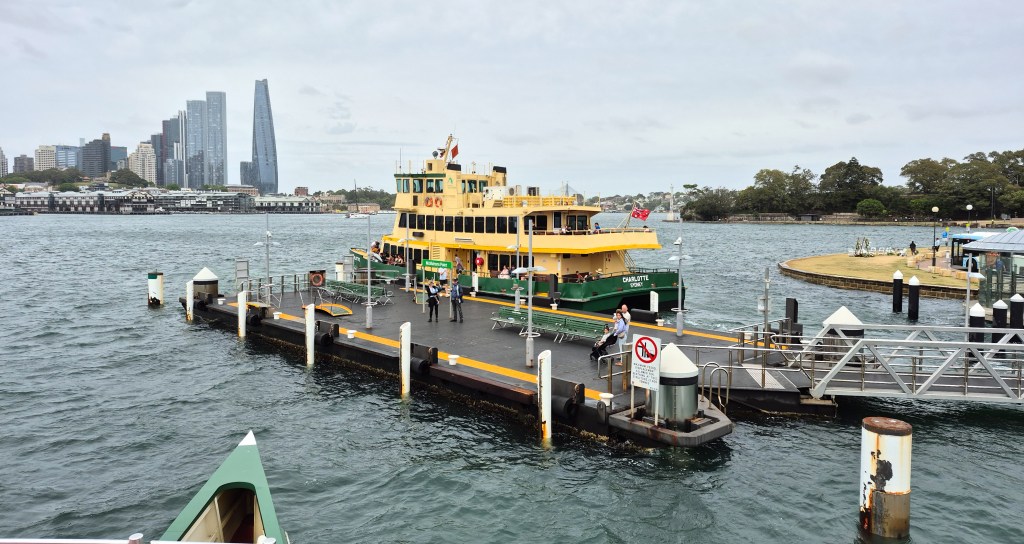
This is Blues Point. The previous ferry was just leaving.

That ferry crossed our bows.

Wikipedia says “Blues Point was named after Billy Blue, a convict who arrived in Sydney on the Minorca on 14 December 1801, transported for stealing a bag of sugar…. Physically imposing, he was described as a ‘strapping Jamaican Negro ‘a very Hercules in proportion’ with a bright eye and a jocular wit’…. He claimed to have served with the British Army in the American War of Independence. When he arrived in 1801 he only had two years of his sentence left and he was soon working on the harbour with boats and selling oysters. His friendly manner and humorous conversation made him popular and he became a notable local character. He married English-born convict Elizabeth Williams in 1805, and in 1807, was the only person licensed to ply a ferry across the harbour.… Governor Macquarie named him “The Old Commodore” and he ran his ferry dressed in a blue naval officers coat and top hat. His ferry service grew to a fleet of 11 vessels, and in 1817, Governor Macquarie granted Billy Blue 80 acres (320,000 m2) at what is now Blues Point.… He died in 1834 at his North Sydney home.” My ancestors knew Billy Blue.

Blues Point Reserve, on the tip of Blues Point.

Heading for Balmain East Wharf (on left), the Central Business District (known as the CBD) of Sydney on the far right.
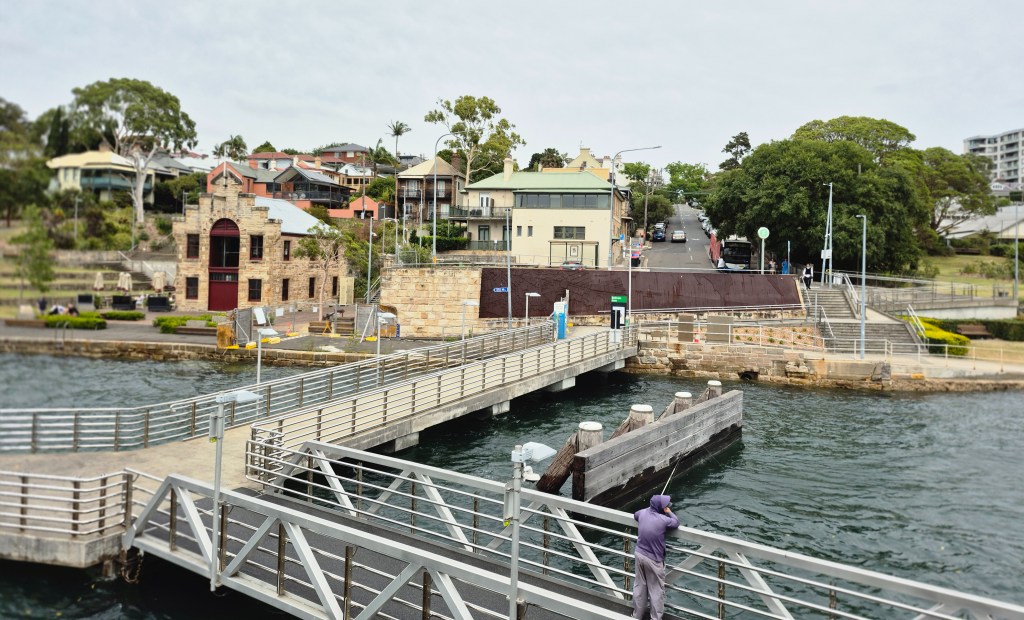
Balmain, seen from Balmain East Wharf.
“Traditionally blue collar, Balmain was where the industrial roots of the trade unionist movement began. It has become established in Australian working-class culture and history, due to being the place where the Australian Labor Party formed in 1891 and its social history and status is of high cultural significance to both Sydney and New South Wales. … In the 21st century however, Balmain is often considered to be an affluent area. … a 2021 article on the Domain website described Balmain as a Harbourside version and cheaper version of Eastern Suburb Paddington” (Wikipedia)

Crown Sydney, the tallest building in Sydney, contains a hotel.
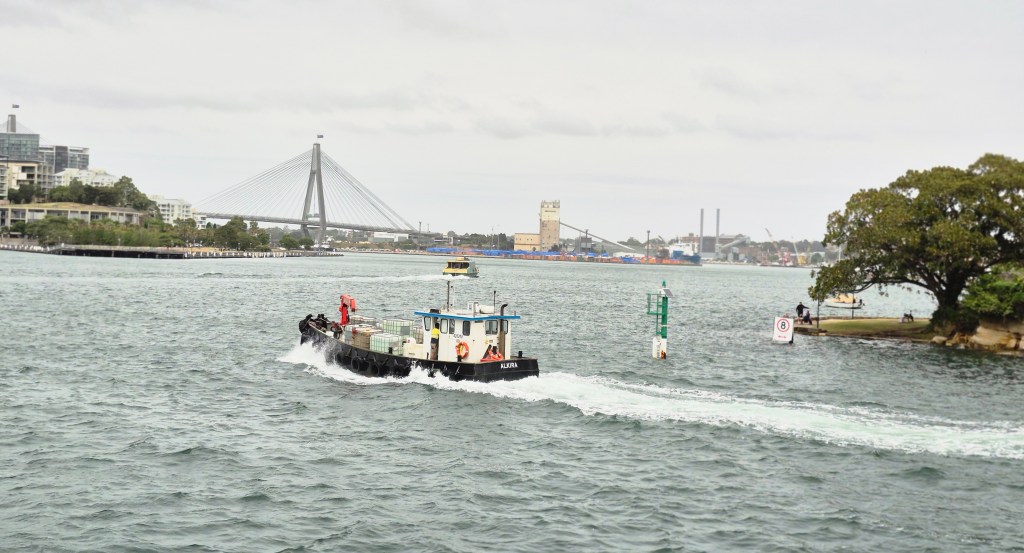
The same boat as in the last photo. In the distance you can see the Anzac Bridge.

Barangaroo Wharf, under the curved roof next to the ferry, dwarfed by the International Towers. Next to it is the Crown Sydney Hotel.

Passengers getting off the ferry at Barangaroo Wharf.
The Barangaroo website says “Barangaroo, the Cammeraygal woman from whom Barangaroo the place takes its name, was a considerable influence in the days of the early European colony. From the Eora language group, she was one of the Cammeraygal clan who lived in and around the north harbour and Manly. Independent and strong, she had her own way of dealing with the early settlers.”

Approaching the National Maritime Museum. The antiquated ship on the left of the above photo is actually a modern replica of the HMV Endeavour.
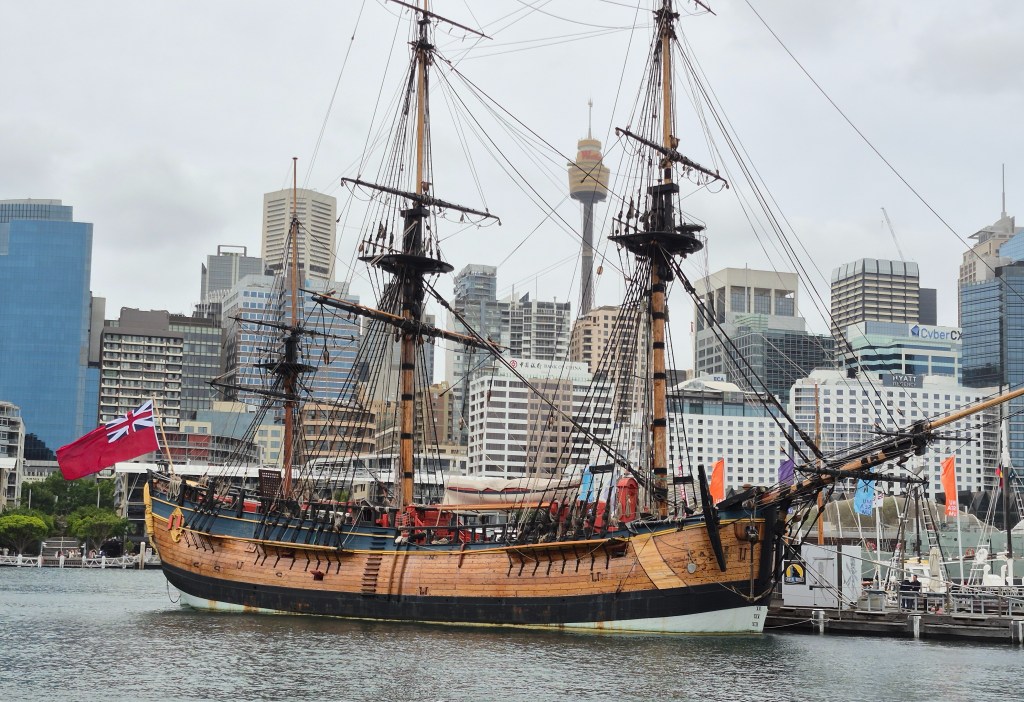
“The Endeavour’s voyage was the first British scientific expedition to the Pacific. … When the ship left England in 1768 under James Cook’s command, the Endeavour carried 94 people, including 71 officers and crew and 12 marines. Also on board were Joseph Banks and his party of scientists and artists, including fellow botanist Daniel Solander … They lived alongside each other for nearly three years. When the ship returned to England in 1771, the products of the voyagers’ work — maps, art, specimens, artefacts — captivated Europe’s imagination and changed scientific knowledge.” (National Museum Australia)

The National Maritime Museum says “HMAS Vampire [centre of photo], Australia’s largest museum vessel, is the last of the country’s big gun ships. After this, Australia’s fighting ships were equipped with missile weaponry. The Daring class were the largest destroyers built in Australia. Their strong, light construction combined high speed with maximum armament. Vampire served in the Royal Australian Navy from 1959 to 1986.”
I put this photo here even though chronologically I took it while walking back up on the Pyrmont Bridge.
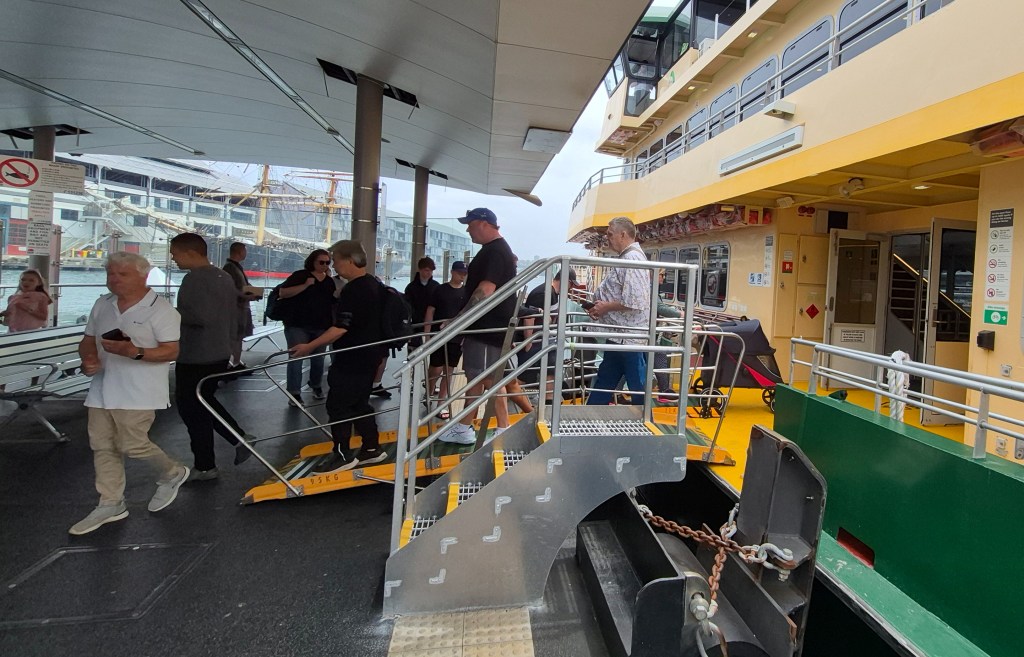
I disembarked at Pyrmont Bay Wharf, along with most of the passengers (above).
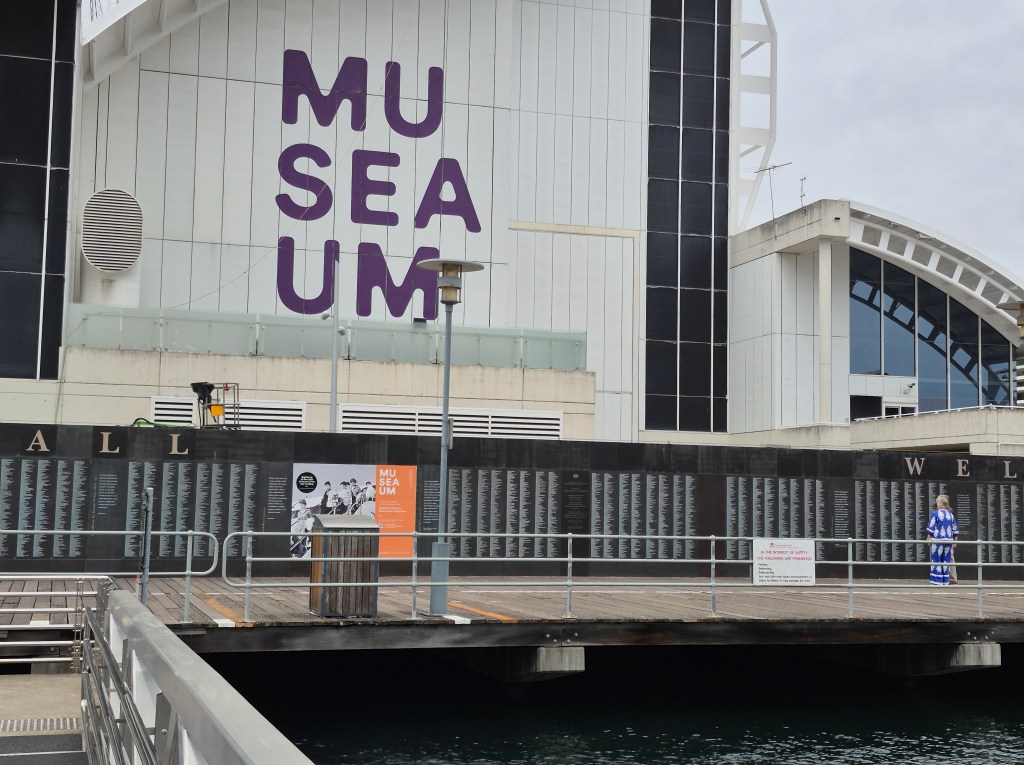
Out the front of the museum is the Welcome Wall, officially known as the National Monument to Migration: “Today’s Australia has been shaped by migration. We’ve come from all the lands on earth to build this great country. The museum collects the stories of migrants to Australia, and the National Monument is one of our most important and visible ways of recognising the people behind these stories. ” (National Maritime Museum)

Examples of migrants on the Welcome Wall.
I walked around the corner to the light rail stop.
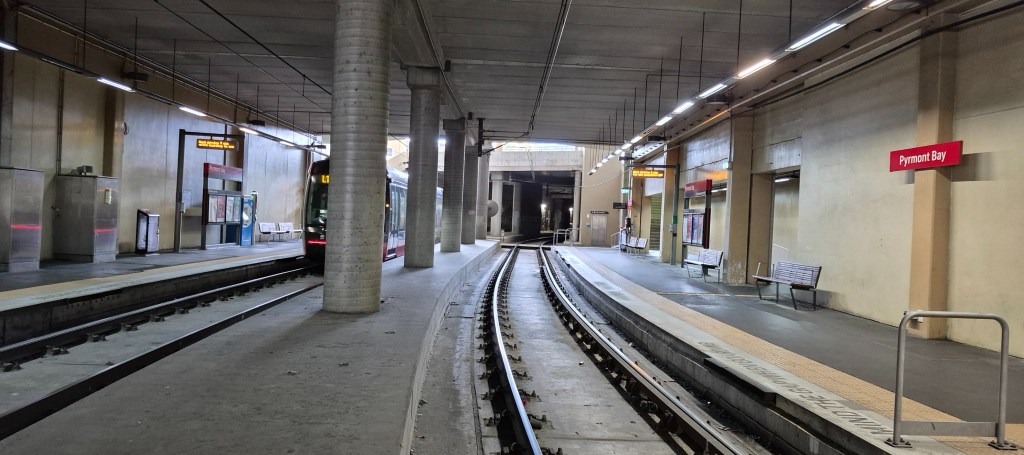
The Pyrmont Bay light rail stop, on the Dulwich Hill Line. The stop is under a building. A tram is at the left of the photo, partially hidden behind some columns.
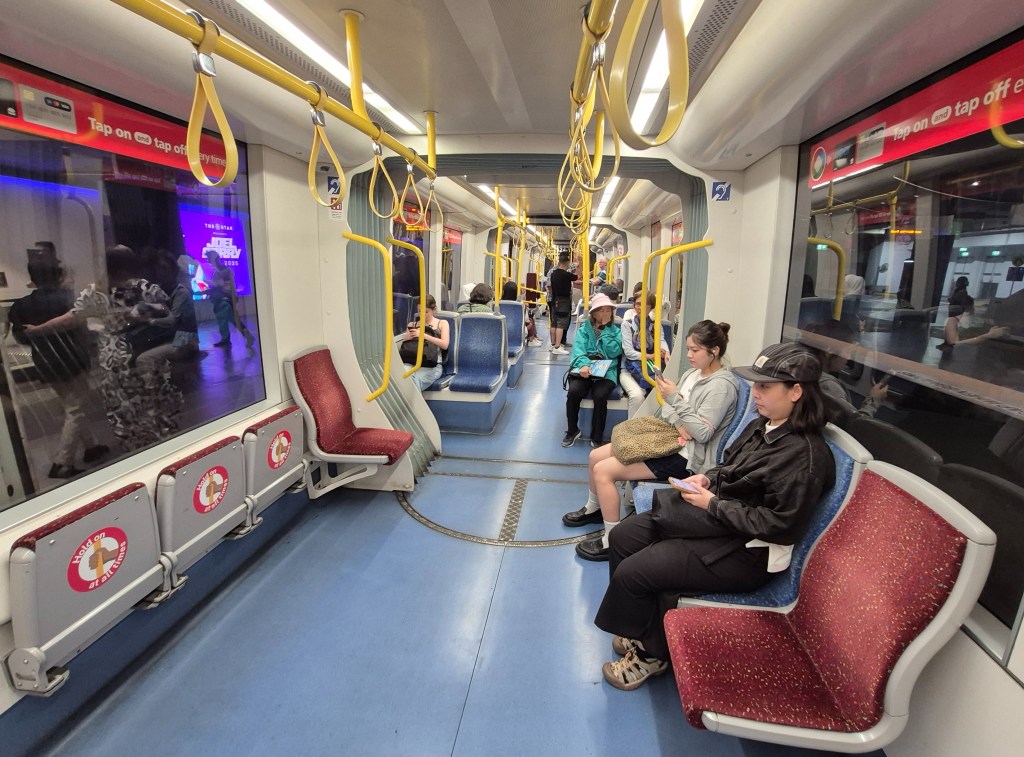
A photo of the inside of the light rail carriage.

The light rail tracks were in cuttings and tunnels the whole way to the Fish Markets. Wikipedia says “Most of the alignment of the Dulwich Hill Line had its origins as the Rozelle–Darling Harbour Goods Line. … This line was extended to Dulwich Hill via the John Street tunnel, the Glebe tunnel, and Lilyfield in 1922. …With widespread use as a freight line throughout the early 20th century, the use of containers and the decentralisation of freight terminals in Sydney to places such as Port Botany and Chullora, Darling Harbour traffic was reduced considerably. The port closed and the area was redeveloped in the 1980s.”

I got off at Fish Market light rail stop (above).

There was only a short walk to the Sydney Fish Markets, through a car park (above).

The entrance to the Sydney Fish Markets. In 1966, “Sydney Fish Market was built as a wholesale fish market, operated by the Fish Marketing Authority. Sydney Fish Market moved from the Haymarket area of Sydney to its current location at Blackwattle Bay, Pyrmont.” The auctions were held in the early morning. By the time I visited, the auctions were over, and multitudes of tourists had arrived.
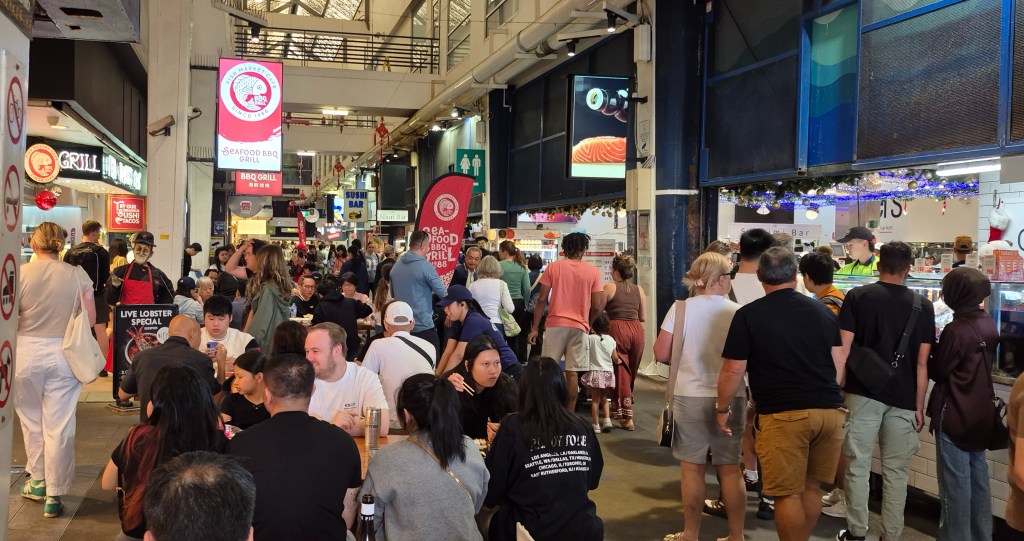
It was Sunday, so the place was very busy.

Pyrmont History Group says “Sydney Fish Market attracts more tourists than any other Sydney site except the Opera House. It is the largest market of its kind in the southern hemisphere and trades over 13,500 tonnes of seafood annually. The Authority organises the weekday wholesale auctions when 1,000 crates or 20,000 kg of seafood are sold every hour. It has also operated the Sydney Seafood School since 1989. The market accommodates six seafood retailers, and several other shops and restaurants.”
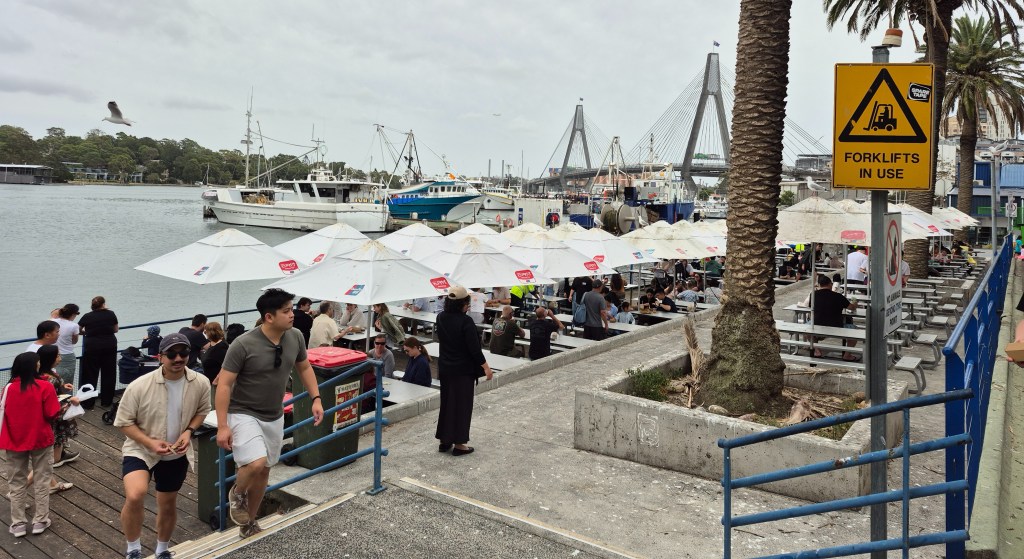
It was too crowded in the Fish Market building, so I came outside. The Fish Market was right near the water (above).

Of course, there were ibis. I’ve written about ibis before.

An ibis making a move.

There was another species of bird…

A pelican!
The Australian Museum says they are the “Australian Pelican. Scientific name: Pelecanus conspicillatus. The most characteristic feature of pelicans is the elongated bill with its massive throat pouch. The Australian Pelican’s bill is 40 cm – 50 cm long and is larger in males than females. … Pelicans mainly eat fish, but they are opportunistic feeders and eat a variety of aquatic animals including crustaceans, tadpoles and turtles. They readily accept ‘handouts’ from humans, and a number of unusual items have been recorded in their diet. During periods of starvation, pelicans have been reported capturing and eating seagulls and ducklings. The gulls are held under water and drowned before being eaten head first.”

Google AI says pelicans are ubiquitous at the Sydney Fish Market, begging for scraps and sneaking into buildings, but you don’t want to feed them as they are wild animals.
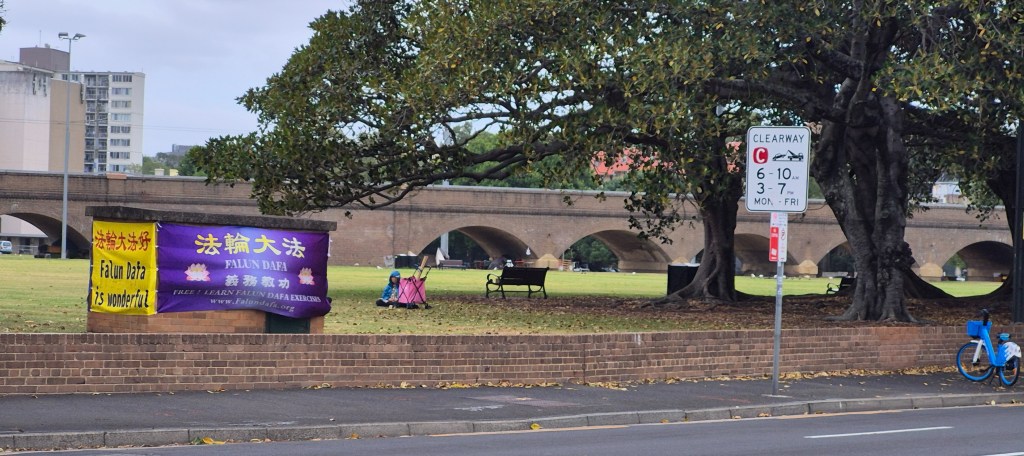
Outside the Sydney Fish Markets there is Wentworth Park (above), with an elevated light rail running across it. There are also some banners put there by Fǎlún dàfǎ (法輪大法). One of their operations is the famous dance troup Shen Yun. Wikipedia says “They are known for their opposition to the ruling Chinese Communist Party (CCP), espousing anti-evolutionary views, opposition to homosexuality and feminism, and rejection of modern medicine, among other views described as ‘ultra-conservative'”.
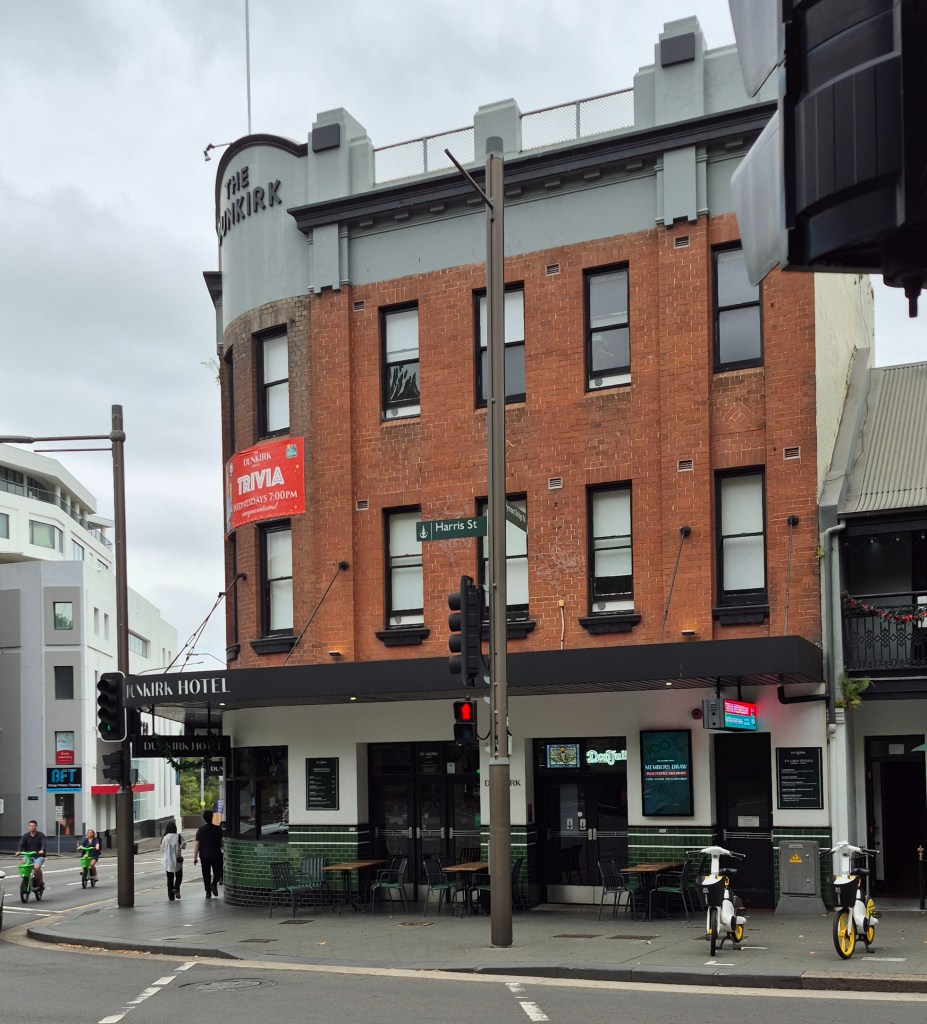
I felt hungry, but the Sydney Fish Markets were so crowded. So I walked along Pyrmont Bridge Road to Harris Street and went into a grand pub, The Dunkirk (above).
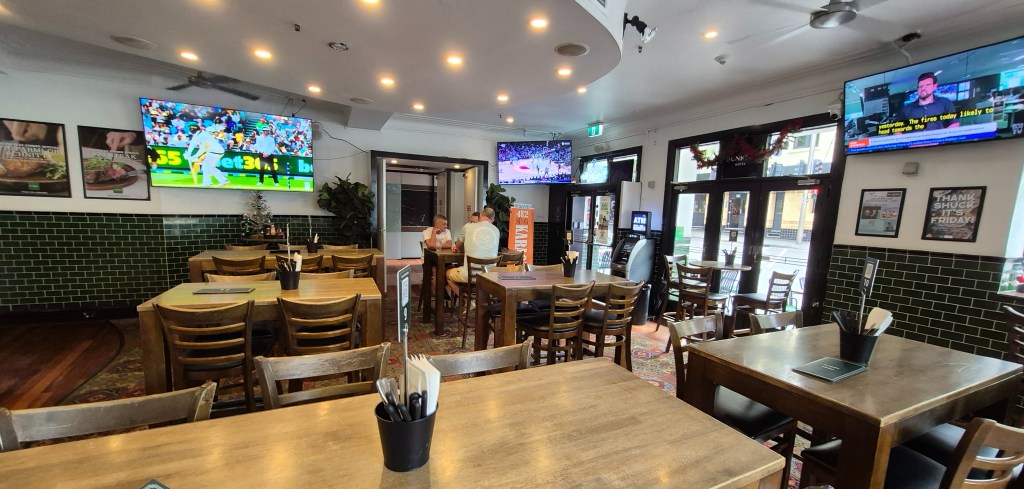
The interior of the pub: dark, a bar along one side, and overhead televisions tuned to different sports channels.

I ordered Chicken Parmigiana. Despite its Italian name it’s an Australian dish. I paid just under $AUD 30, a bit expensive.
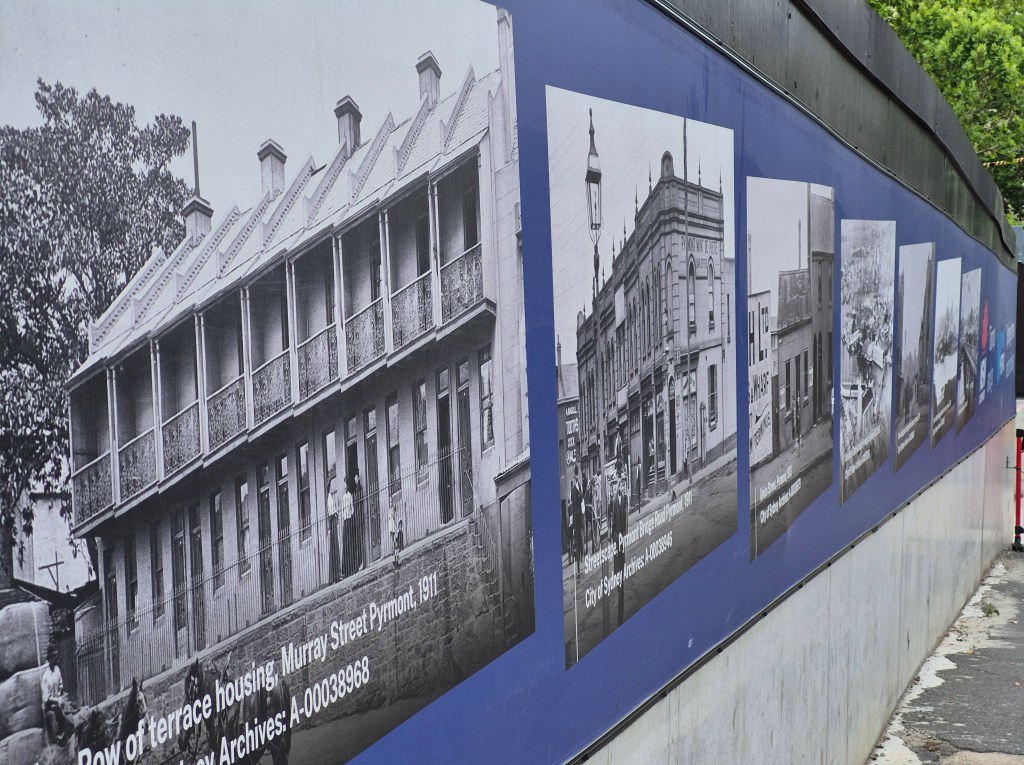
Resuming my journey, I came across these placards memorializing old Sydney (above). My father used to work at the Government Printers office just down the road, and remembers Pyrmont as lively with the nearby port and railways.

I was going to take the light rail again, but I discovered Pyrmont Bridge (above), which is a short-cut to the city, so I took that.
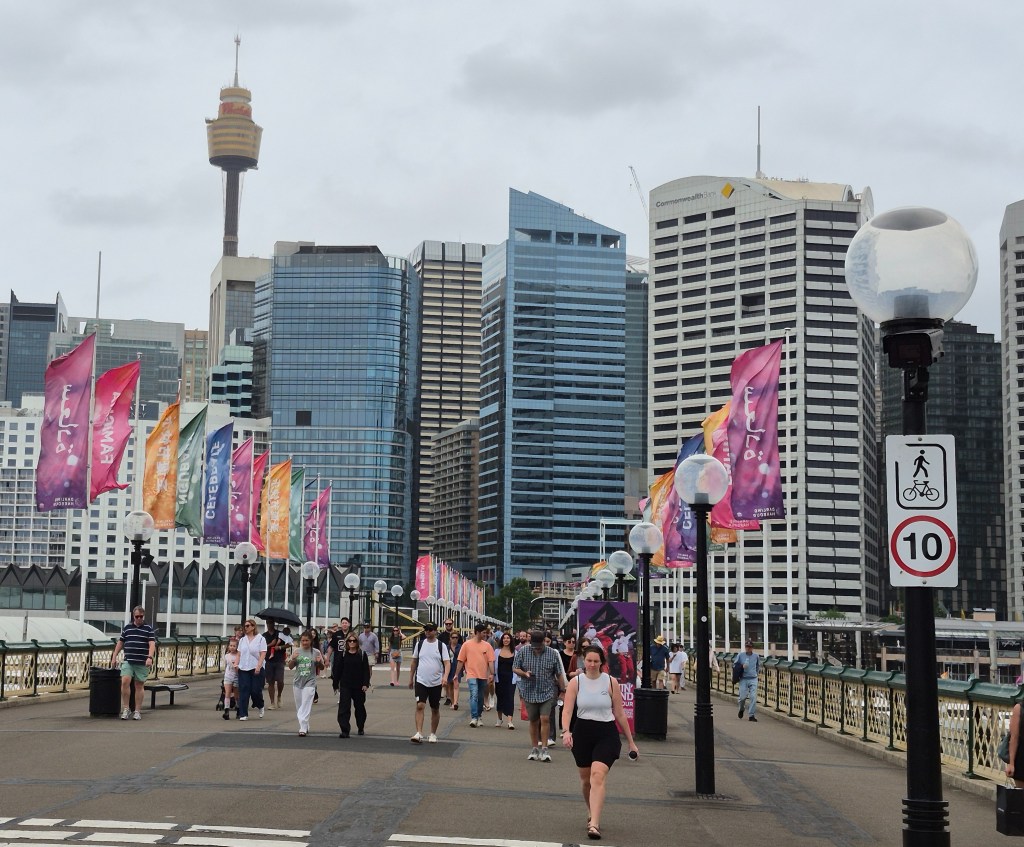
On Pyrmont Bridge.
The Pyrmont History Group says “Pyrmont Bridge is one of the world’s oldest surviving electrically operated swingspan bridges. It cost £112,500 to build, and opened in 1902, replacing the first bridge (that had been carrying traffic since 1857), allowing tall vessels to access southern Darling Harbour. … Almost all previous swingspan bridges were operated by winches, steam or hydraulic power. In this case Ultimo Power House was nearby, and modified tram motors drove the swingspan. This innovation won acclaim as a marvel of modern engineering at the international conference of the Institution of Civil Engineers (London) in 1907. As container ships came to dominate trade, freight moved to Botany Bay, the railway goods yards closed and in 1981 Pyrmont Bridge closed to traffic. When Darling Harbour was redeveloped, the swingspan was restored and a monorail built. The monorail was dismantled in 2013 but the bridge still opens for demonstrations on weekends and public holidays, and whenever a tall vessel needs to pass through.”
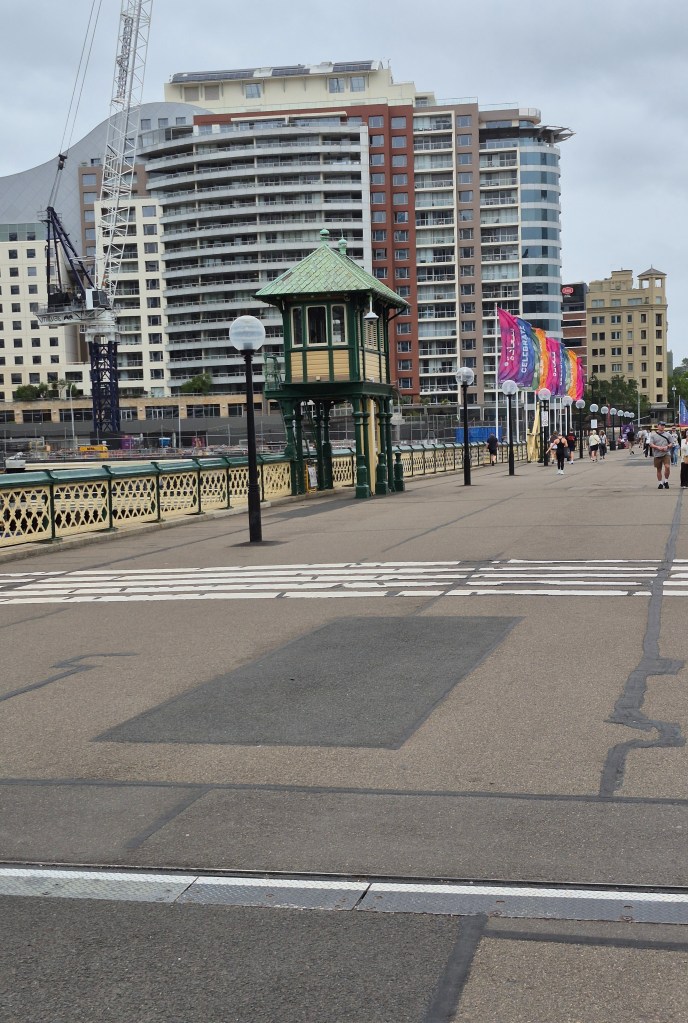
The control cabin (above) over Pyrmont Bridge. The swingspan extended to the metal line in the foreground.
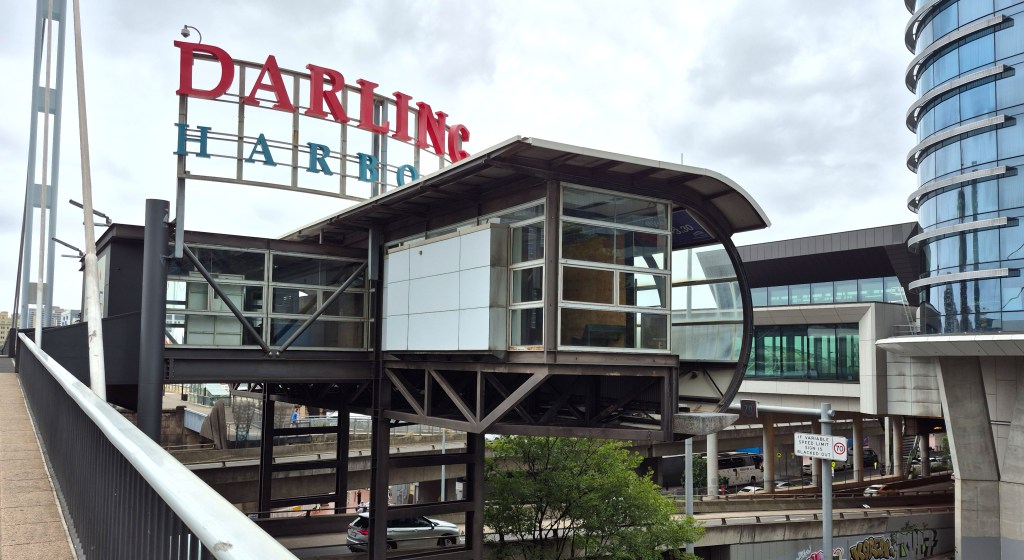
The Pyrmont History Group article mentioned a monorail; this was a station on said monorail.
The Sydney monorail was very controversial. The Dictionary of Sydney says “Apart from being considered a general eyesore and an intrusion on heritage and architectural values of the CBD streetscape, the Monorail was impractical because it didn’t actually connect with any of the major transport hubs in the city. Nor did the investment make economic sense, critics pointed out the construction of Light rail would have been $20 million cheaper to build, service more passengers per hour and cost 40% less for a ticket.”
The bus was only a short distance from Pyrmont Bridge; I didn’t have long to wait.
 Wandering Richard