August 28, 2024
I’m in Sydney again, for one week while the Mandarin Training Center at NTNU in Taiwan is closed.
Sydney is a really beautiful place, but in my Wandering Richard webpage you’d never appreciate that. The Sydney Opera House, the Sydney Harbour Bridge, Bondi Beach – growing up in Sydney I became used to these places. But living in Taiwan, I now realise Sydney is a gorgeous city. I’ll try to show it off to you, by going to Taronga Zoo.

The Google Map above shows the route. From my parents’ house in Northbridge I took a bus to Wynyard in the Central Business District, changing to a ferry a Circular Quay (pronounced ‘Key’), sailed across Sydney Harbour to Taronga Zoo Wharf.
That day the weather was balmy and very windy; the temperature was around 25 degrees Centigrade. On the wind you could smell the enormous dry hinterland of Australia.
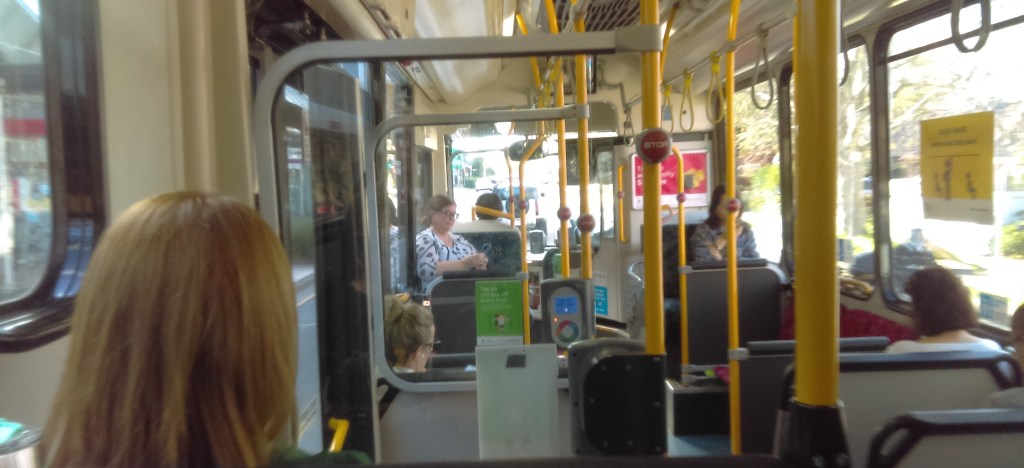
The above photo is of the 206 bus taking me from Northbridge. The time was about 9am. Note the lack of masks – Australians view COVID19 as ancient history.

On the bus as we roared down the Cahill Expressway, a spectacular view outside from Sydney Cove – Sydney Harbour, the Opera House to the right, the Harbour Bridge to the left, a ferry just pulling out from Circular Quay below us.
The National Museum of Australia says “The arrival of the First Fleet at Sydney Cove in January of 1788 marked the beginning of the European colonisation of Australia. The fleet was made up of 11 ships carrying convicts from Britain to Australia. Their arrival changed forever the lives of the Eora people, the traditional Aboriginal owners of the land in the Sydney area, and began waves of convict transportation that lasted until 1868.” My great-great-great-great-great-great grandmother was on the First Fleet, as a convict.

I got off the bus nearby and walked a short distance, under Circular Quay Station, and took this photo facing the same direction (look at the Opera House). When I last visited Taronga Zoo pre-COVID19, the Zoo had a stand at Circular Quay where you could buy a combination entry fee and ferry ticket. Now I discovered it was all online, and since I omitted to bring my Chromebook I would have to pay inflated prices.
YouTube has many, many clips about taking the Taronga Zoo ferry. Here’s one that doesn’t feature an influencer.
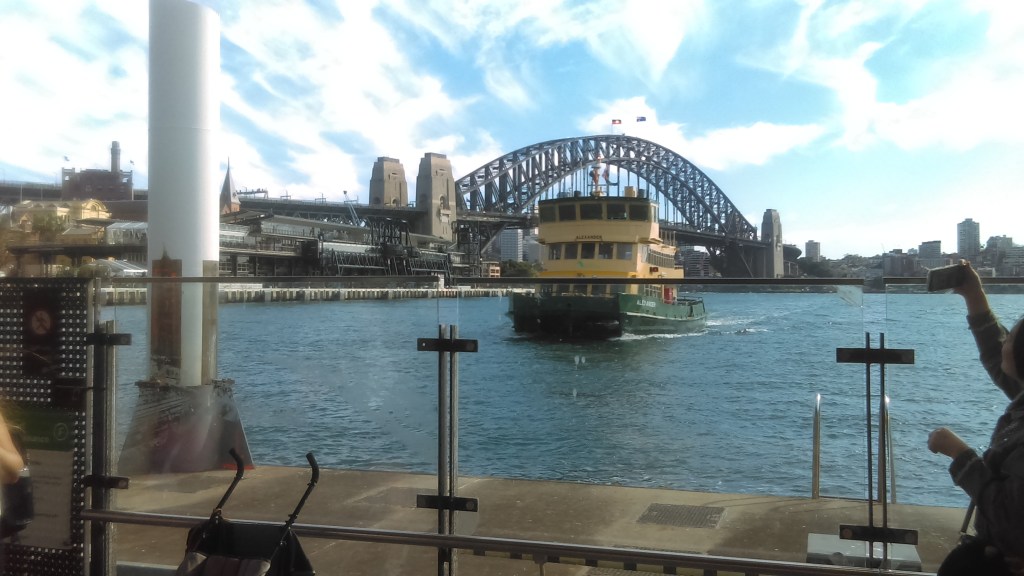
Here comes the Taronga Zoo ferry.

I strode up the gangway and to the bows, and took this rather blurry photo. Most of the passengers were from overseas.

The ferry passed the Sydney Opera House.
“The Sydney Opera House is one of the 20th century’s most iconic buildings. It broke new ground for design and engineering around the world. Since its opening in 1973 it has become a symbol the world immediately associates with Sydney and Australia. The story of the Opera House is a drama that for more than 15 years grabbed national headlines and pitted the artistic vision of the architect Jørn Utzon against the politics and budgets of the New South Wales Government and the limits of architecture and construction. … Finally, the Sydney Opera House was opened by Queen Elizabeth II on 20 October 1973. It was 10 years overdue and, at $102 million, 14 times the original budget. However, Australia was now home to one of the greatest buildings of the 20th century – an instantly recognisable piece of exhilarating architecture that remains a credit to this country and one with which Sydney and Australia are instantly associated.” (National Museum of Australia)

The Sydney Harbour Bridge:
“in January 1923 [Bradfield] issued calls for tender for the ‘Construction of a Cantilever or an Arch Bridge across Sydney Harbour’. … The government had to clear hundreds of houses from the northern and southern approaches to the bridge. … A total of 802 buildings were demolished. … In total more than 52,800 tonnes of steel were used; 39,000 tonnes in the arch alone. … Slowly the main span of the bridge was erected by cantilevering the two half arches towards each other from each shore. … On 19 August 1930 the two halves of the arch were joined, making the bridge self-supporting and allowing the cables to be removed. … Load testing began in January 1932 with 96 locomotives lined up end to end across all four of the bridge’s rail tracks. … More than 1,600 people worked on the bridge during the nine years of its construction, providing much-needed jobs for Sydney during the Great Depression. … By today’s standards industrial safety on the work site was poor. During the construction of the bridge, 16 men died. … The official opening of the bridge took place on 19 March 1932. … More than 750,000 people gathered around the harbour for the official opening event. The bridge was to be opened by the New South Wales Premier, Jack Lang. Before Lang could cut the ribbon and declare the bridge open, Francis De Groot, a member of the ultra-right-wing New Guard group, rode a borrowed horse out of the crowd and slashed the ribbon with his cavalry sword. De Groot was arrested. Lang cut a new ribbon, the bridge was declared open, and a public bridge walk took place. De Groot was fined £5. … The cost of building the bridge was £4,238,839, although with the costs of constructing the approaches, the land resumptions, and interest paid during construction, the total cost of the build was closer to £10 million. The debt was finally paid off in 1988. The Sydney Harbour Bridge has become one of the most recognisable icons, along with the Sydney Opera House, of Sydney and Australia.” (National Museum of Australia)
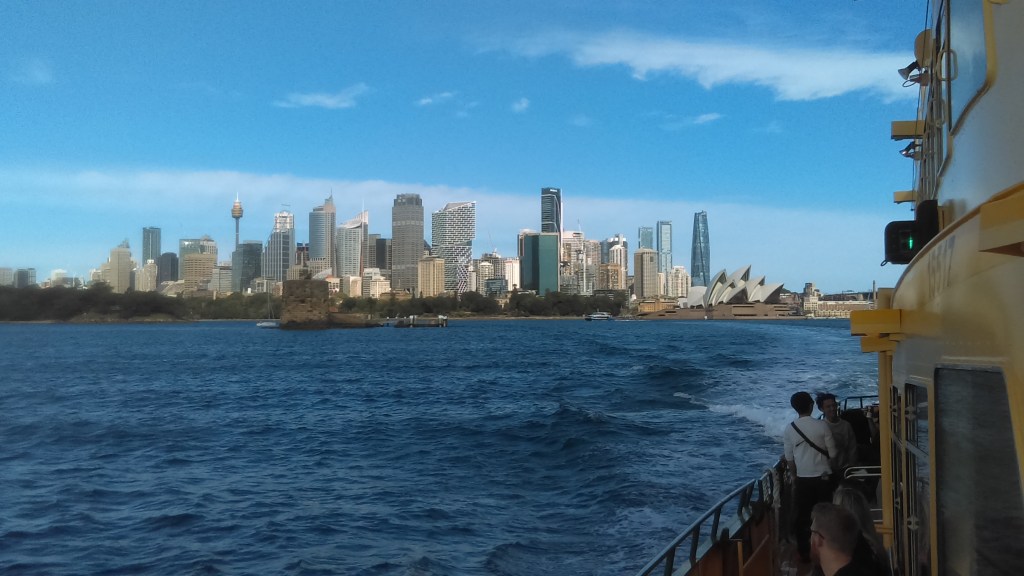
A good view of the Sydney skyline. The island to the centre right is Fort Denison.
“Fort Denison was originally a rocky outcrop to the north of Woolloomooloo Bay, known by its Aboriginal name of Mat-te-wan-ye, also spelt Muttewai or Muttenwaya. Governor Arthur Phillip renamed it Rock Island soon after European settlement to Sydney Cove, but it was informally known as Pinchgut Island. This colourful name is commonly believed to refer to the island’s use as place of punishment for convicts until the early 1800s, and the starvation diet they received there of bread and water. … In 1855 work began again on transforming the island into a fortification … The distinctive Martello tower – to the design of the forts that ringed the British coastline in the Napoleonic wars – was the only one built in Australia. … The Martello tower received some damage during World War II, when it was hit by a shell from the USS Chicago during an engagement with Japanese midget submarines entering the harbour.” (Dictionary of Sydney)
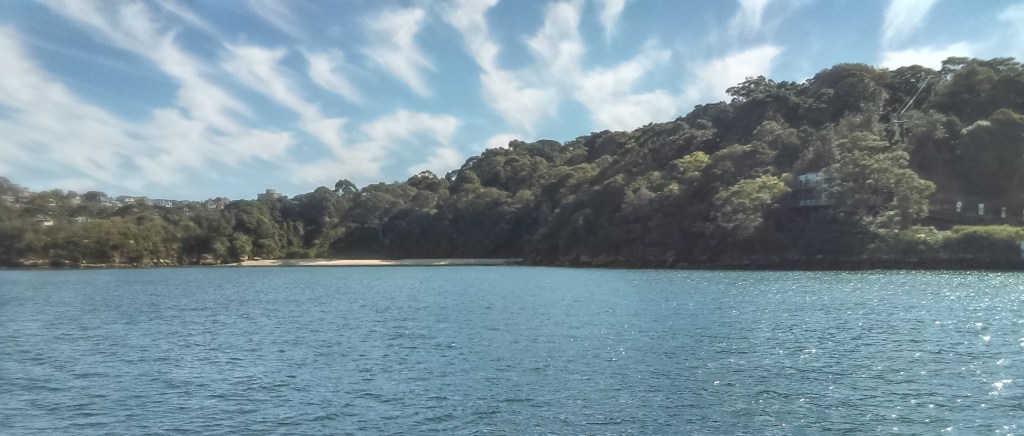
Nearing Taronga Zoo Wharf, just of the above photo on the right. On the left is Whiting Beach. The foreshore is all public land; I’ve stood on that beach.

Taronga Zoo Wharf. The forested area behind it is actually Taronga Zoo.

Disembarking the ferry. Actually, I took this photo going home, waiting to board the ferry.

The ferry in front of the Sydney skyline. I took this photo too while waiting to board the Scarborough ferry; the ferry coming from Circular Quay was the Alexander. The First Fleet class are named after ships of the First Fleet.
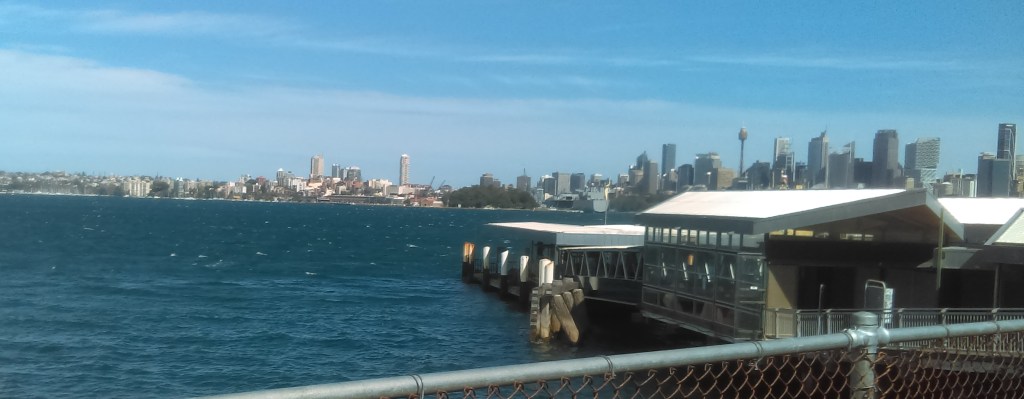
Nice view of Taronga Zoo Wharf.

I expected to be transported via gondola, but the Sky Safari has retired. Instead I took the bus (above).
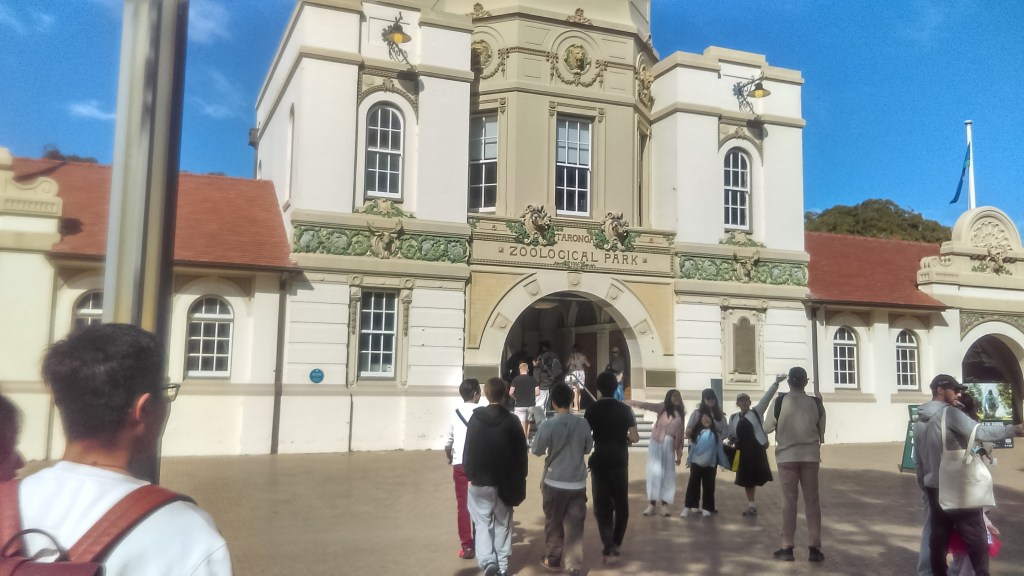
The bus drove a short route to the main entrance on the opposite, uphill, side (above).
Brittanica says “One of the outstanding zoos in Australia, Taronga Zoo opened to the public in 1884 in an area outside Sydney known as Billy Goat Swamp. … By 1912 the original site was no longer adequate, and the state government made a grant of land in Taronga Park, north of Sydney Harbour. The new zoo, comprising some 52 acres (21 hectares), opened in 1916; most of the animals from the old zoo had to travel to their new home via barge”.
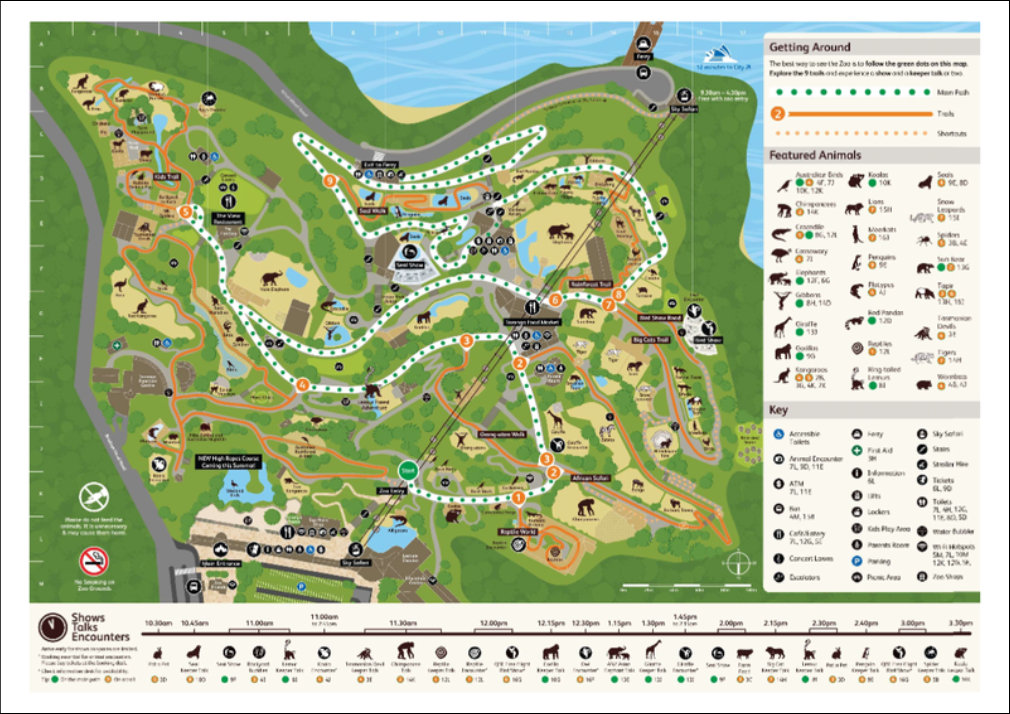
I was given a map of Taronga Zoo, similar to the above map. The Australia section is in the north-east corner (bottom left in the above map).
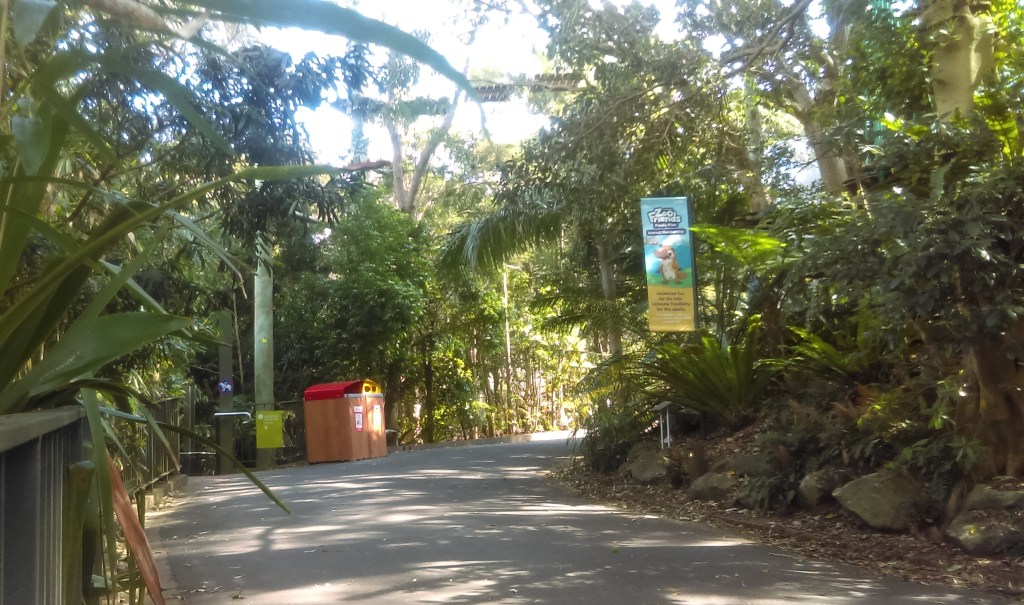
Taronga Zoo was all shady winding alleys between forested blocks, quite attractive.

There were occasional glimpses of Sydney Harbour.

The first precinct I came to had a circular fence enclosing a wide irregularly-shaped area containing emus (above).
The Australian Museum says “The name ’emu’ is not an Aboriginal word. It may have been derived from an Arabic word for large bird and later adopted by early Portuguese explorers and applied to cassowaries in eastern Indonesia. The term was then transferred to the Emu by early European explorers to Australia. … The Emu is found only in Australia. It lives throughout most of the continent, ranging from coastal regions to high in the Snowy Mountains. Emus were once found in Tasmania, but were exterminated soon after Europeans arrived. Two dwarf species of emus that lived on Kangaroo Island and King Island also became extinct.”
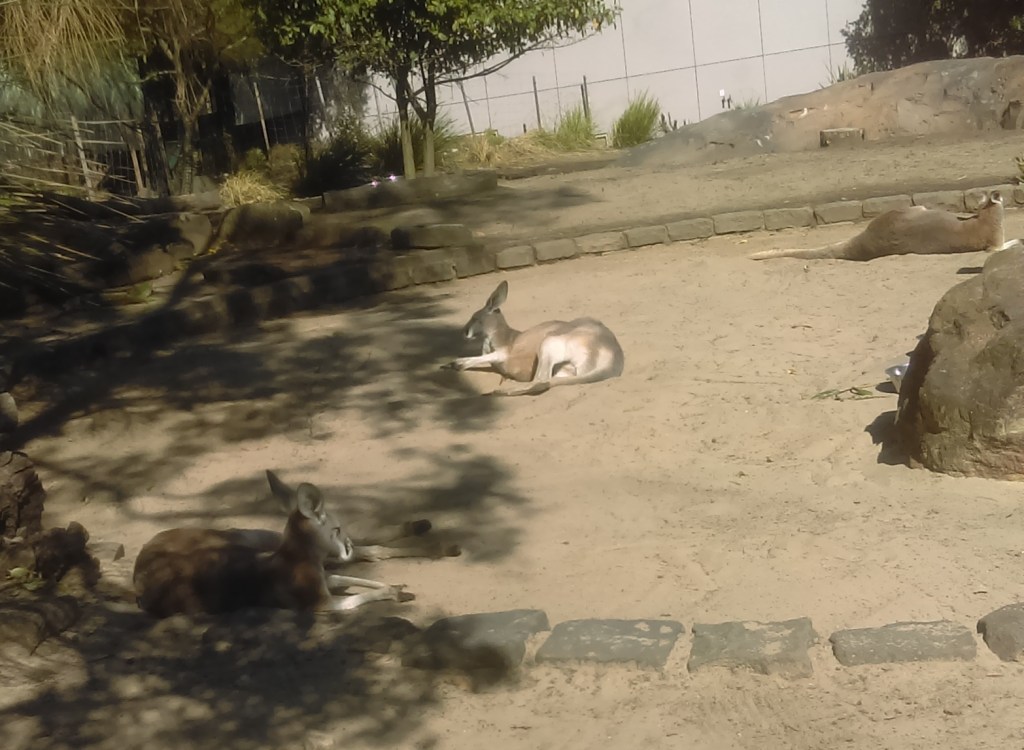
Also in this enclosure were kangaroos (or wallabies), resting in the balmy weather.
“No image of outback Australia is complete without a mob of kangaroos hopping across the horizon. Kangaroos belong to the Macropodidae family, meaning ‘big foot’ in Latin (a reference to their large back feet). What’s the difference between a kangaroo and a wallaby? Kangaroos are simply the larger animals in the Macropus genus. … The word kangaroo derives from ‘Gangurru’, the name given to Eastern Grey Kangaroos by the Guuga Yimithirr people of Far North Queensland. Kangaroos are of cultural and spiritual significance to Aboriginal people across Australia. Plus, their meat was, and continues to be, a staple protein source; pelts were used for clothing and rugs; and their skin crafted into water bags. Kangaroos are the world’s largest marsupials. A Red Kangaroo can weigh 90kg and can grow two metres tall. Black Wallaroos, at around 20kg, are the smallest species. ” (Bush Heritage Australia)

I moved to a different enclosure, this one containing koalas.
“Koalas are not bears. They are not placental or ‘eutherian’ mammals, but MARSUPIALS, which means that their young are born immature & they develop further in the safety of a pouch. It’s incorrect to call them ‘Koala bears’ – their correct name is simply ‘Koalas’ … The AKF estimates that there are likely to be less than 60,000 Koalas remaining in Australia today and it could be as low as 33,000. Much of their habitat has already been lost. This makes it vitally important to save what is left”. (Australian Koala Foundation)
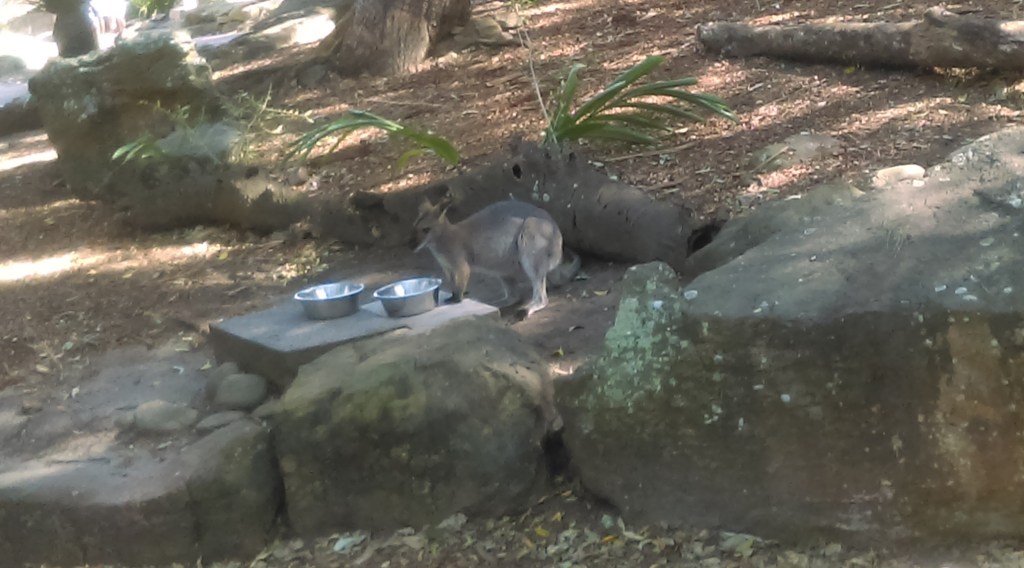
Wallabies! The website for Taronga Zoo says “Wallaby is the general term for medium-sized, hopping macropods found throughout Australia and New Guinea… The taxonomic classification of wallabies is informal, and not universal. Wallabies are macropods smaller than a kangaroo, though this distinction is drawn entirely off their size. By this simple definition, a range of macropods can be classed as wallabies including Quokkas, Pademelons, and Wallaroos, however whether these should be considered wallabies is disputed. There are generally considered to be around 30 species of wallaby…. Some wallaby species are mostly solitary whilst others live in groups called mobs. They feed on a range of low-lying vegetation, though grass is the main food source for most wallabies. Some species can survive on very little water, getting most of it from their diets. Thick undergrowth can provide cover from predators, and their agile hops allow a quick escape even in uneven or rocky terrain. …Wallabies are endemic to Australia and New Guinea, yet due to humans can now be found in several other countries around the world…. New Zealand’s invasive population has boomed to over a million wallabies, causing significant harm to local ecosystems and wildlife.”

An animal I didn’t expect – Tasmanian Devils!
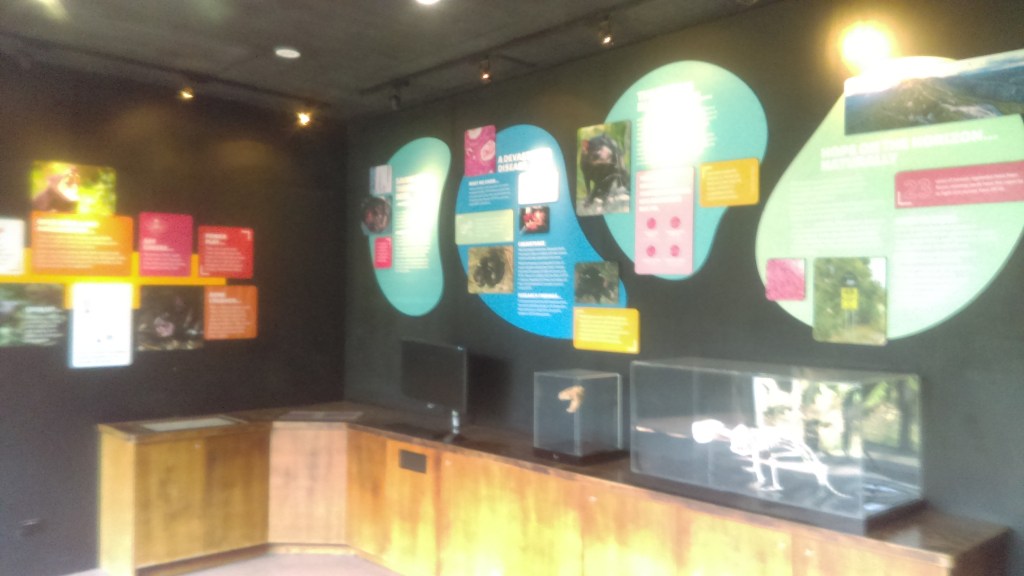
There is a separate small building just to house Tasmanian Devils. The above photo is of the interior of the building; there is a skeleton of a Devil on the bottom right. Sorry about the quality of the photo. There were a number of photos that I couldn’t use because they were too blurry.
The Australian Museum says “The Tasmanian devil is the world’s largest surviving carnivorous marsupial. … Tasmanian Devils were once abundant on mainland Australia as evidenced by fossil remains. Reliable fossil evidence suggests they became extinct from the mainland between 3,200 and 3,500 years ago. They are widespread and common in Tasmania … Tasmanian Devils are mainly scavengers feeding upon the carcasses of dead animals but can also be effective predators. … Their powerful jaws and teeth enable them to entirely devour their food including bones and fur. They are particularly renowned for their noisy communal eating during which use noise and threatening physical displays to assert dominance amongst the pack. … the greatest current threat for devils is the Devil Facial Tumour Disease (DFTD). This fatal condition is characterised by facial tumours and is one of only three contagious cancers ever recorded. It is believed to be transmitted from devil to devil through biting.”

There was a viewing area, but it seemed to be empty of Devils. However I spotted a Devil drowsily lying high up (above).
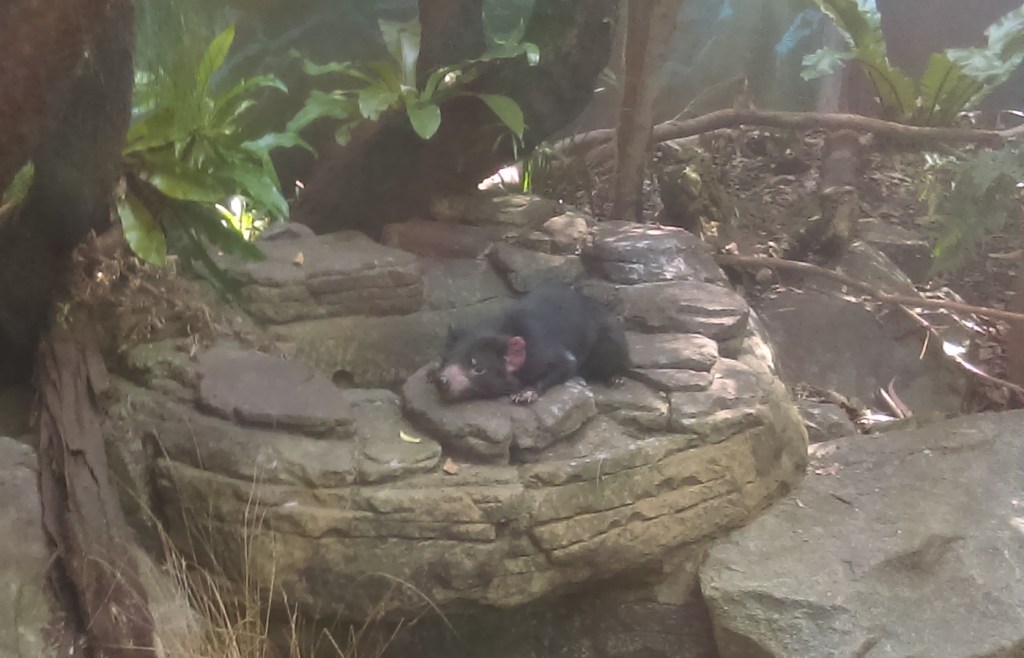
There was a second separate viewing area in which a second Devil was quite active, clambering about the enclosure, while I agitatedly clicked my phone.
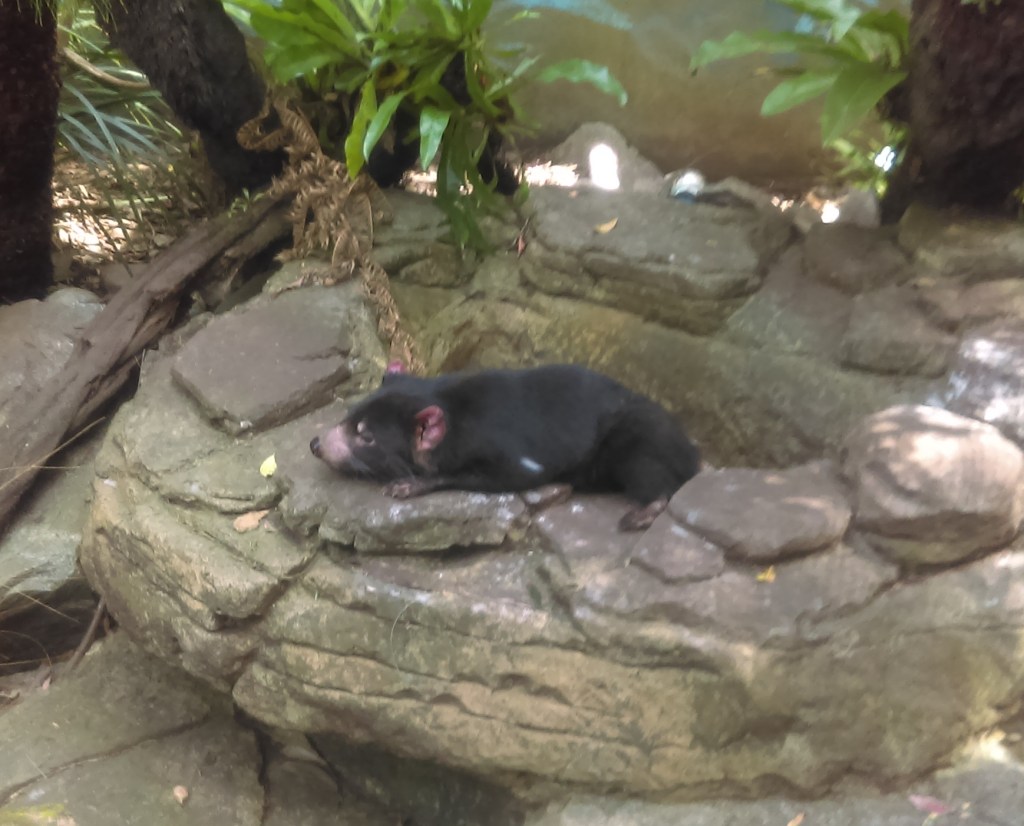
A better shot of the Devil.
“Taronga Western Plains Zoo [linked to Taronga Zoo] became involved in the Save the Tasmanian Devil Program in 2008 when Australian zoos and wildlife parks committed to establishing an insurance population on the mainland. This decision was crucial at that time as an untreatable and fatal threat, the Devil Facial Tumour Disease (DFTD), had spread amongst wild devils through bites, usually obtained during mating, feeding and fighting. Since commencement of the breeding program, Taronga Western Plains Zoo has successfully bred 50 joeys in a dedicated behind-the-scenes breeding facility. The Zoo has now transitioned to an ambassador role within the region for this species as insurance population goals have been met and wild populations are exhibiting a resistance to the disease.” (Taronga Conservation Society).
A YouTube clip of a Tasmanian Devil.
Then I retraced my journey, catching a bus from the entrance to the Zoo down to Taronga Zoo Wharf, a ferry to Circular Quay, and up on the light rail to the Queen Victoria Building, where I transferred to the 194 bus and home.
 Wandering Richard