August 19/20, 2023
I’m having some trouble with my visa, so instead of sorting it out, I’m flying back to Sydney and restarting the process. I’m flying via Singapore; 國慶 is interested in holidaying in Singapore, so I offered to send him some photos of my stopover.
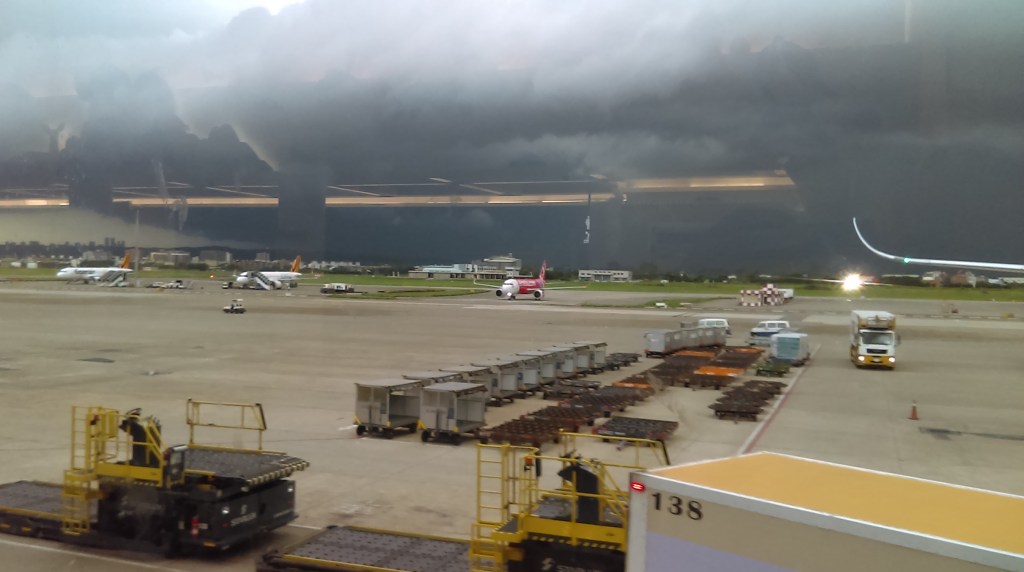
In Taoyuan Airport, Taiwan, waiting for my flight. An enormous dark cloud was sweeping up towards me; soon after a tropical downpour began, with torrential rain. The yellow strip lights are the reflection in the glass of the overhead lights in the room behind me; the bright circle at centre right is the reflection of my camera.

On the plane, watching people queuing for their narrow seats. Note the absence of screens on the back of the seats; nothing to do until we reach Singapore, four hours away.
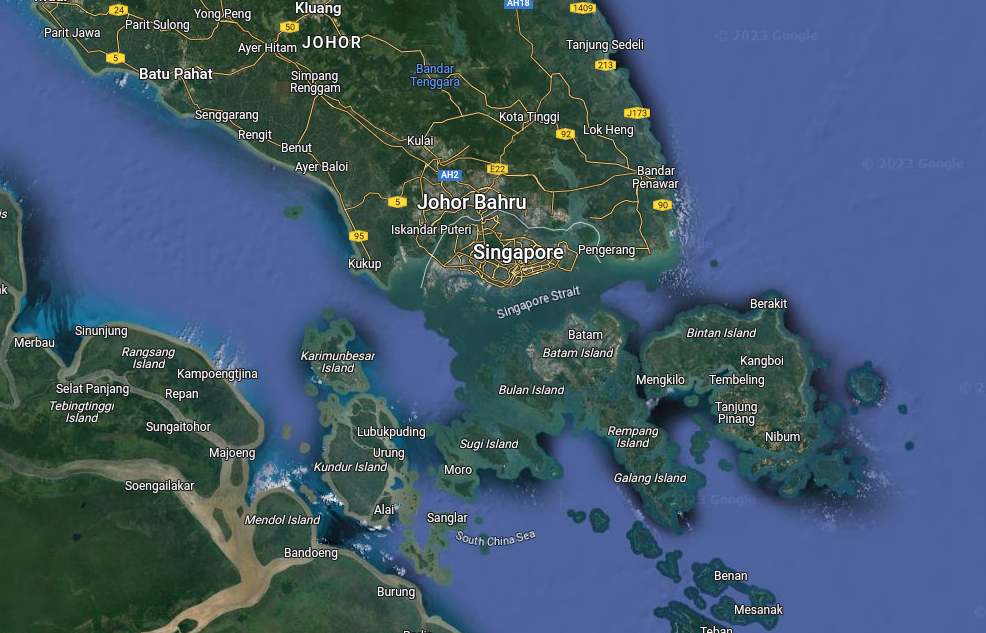
A Google view of Singapore, sandwiched in between Malaysia (north of Singapore) and Indonesia (south).
A YouTube clip of the history of Singapore. The above clip is private in some countries, so I’m putting a link so you can view it in a separate window: https://www.youtube.com/watch?v=gAGDBz0Uo0U
From the introduction to the clip: “The history of the modern state of Singapore dates back to its founding in the early nineteenth century; however, evidence suggests that a significant trading settlement existed on the Island of Singapore in the 14th century. At the time, the Kingdom of Singapura was under the rule of Parameswara, who killed the previous ruler before he was expelled by the Majapahit or the Siamese. It then came under the Malacca Sultanate and then the Johor Sultanate. In 1819, British statesman Stamford Raffles negotiated a treaty whereby Johor allowed the British to locate a trading port on the island, ultimately leading to the establishment of the crown colony of Singapore in 1867. During World War II, Singapore was conquered and occupied by the Japanese Empire from 1942 to 1945. When the Japanese surrendered, Singapore reverted to British control, with increasing levels of self-government being granted, resulting in Singapore’s merger with the Federation of Malaya to form Malaysia in 1963. However, social unrest and disputes between Singapore’s ruling People’s Action Party and Malaysia’s Alliance Party resulted in Singapore’s expulsion from Malaysia. Singapore became an independent republic on 9 August 1965. Facing severe unemployment and a housing crisis partially caused by the Bukit Ho Swee fire, Singapore embarked on a modernisation programme beginning in the late 1960s through the 1970s that focused on establishing a manufacturing industry, developing large public housing estates, and investing heavily in public education and infrastructure. By the 1990s, the country had become one of the world’s most prosperous nations, with a highly developed free market economy and strong international trading links. It now has the highest per capita gross domestic product in Asia, which is 7th in the world, and it is ranked 9th on the UN Human Development Index.” Singapore has 5.5 million people.
Landing at Singapore was impressive, coming in low over the harbour with the ships lit up. Unfortunately my photos of that were squiggly lines, unusable.
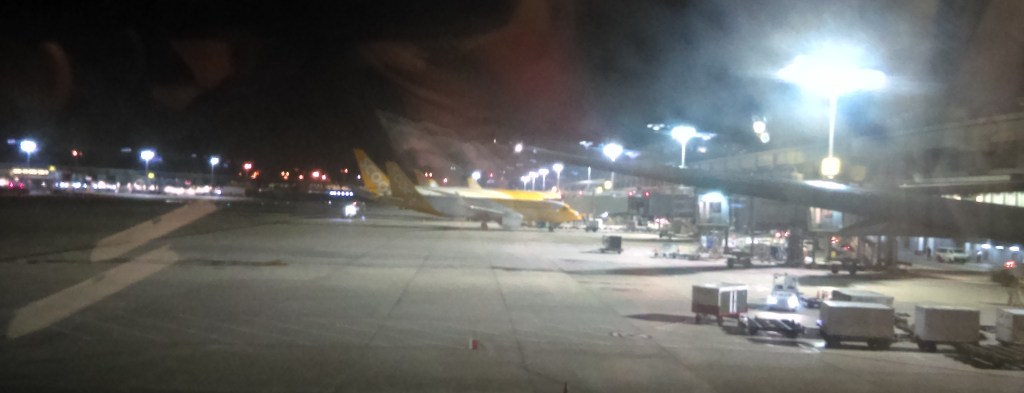
In Singapore Airport (above), formally Changi Airport. The time was 1am.
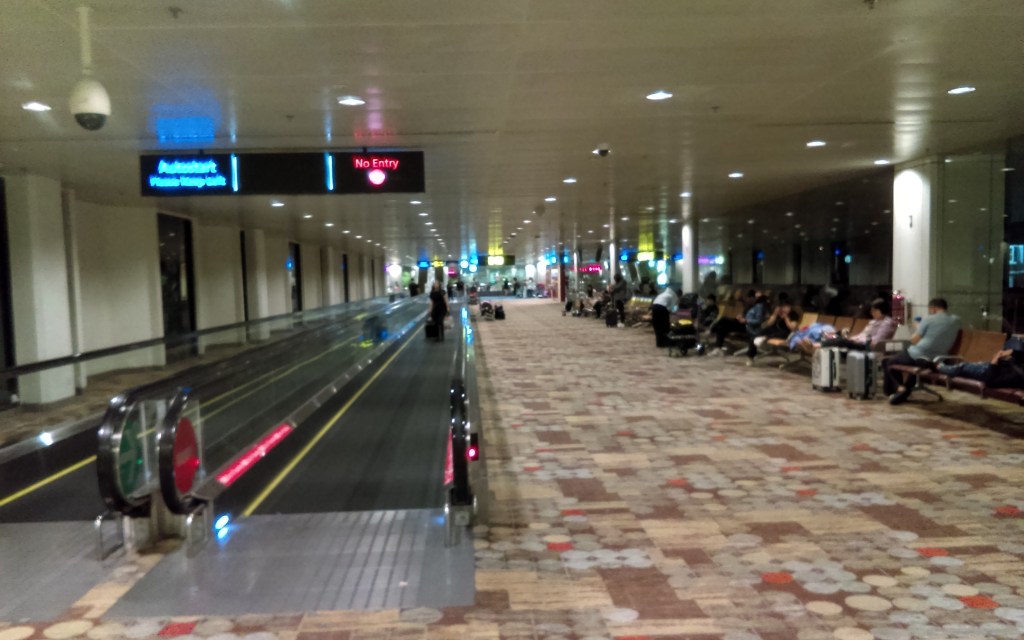
The walkway leading from where I disembarked. Airports all round the world are similar, no matter if you’re in Sydney or Seoul.

Changi Airport (above) is quite large, occupying the eastern edge of the city-state. Skytrains and shuttle buses run between terminals. The MRT (Mass Rapid Transit) has a station at Changi Airport, called logically enough Changi Airport MRT Station, between Terminal 2 and Terminal 3, underground. Fortunately I didn’t have to go far, as Scoot planes are near each other.
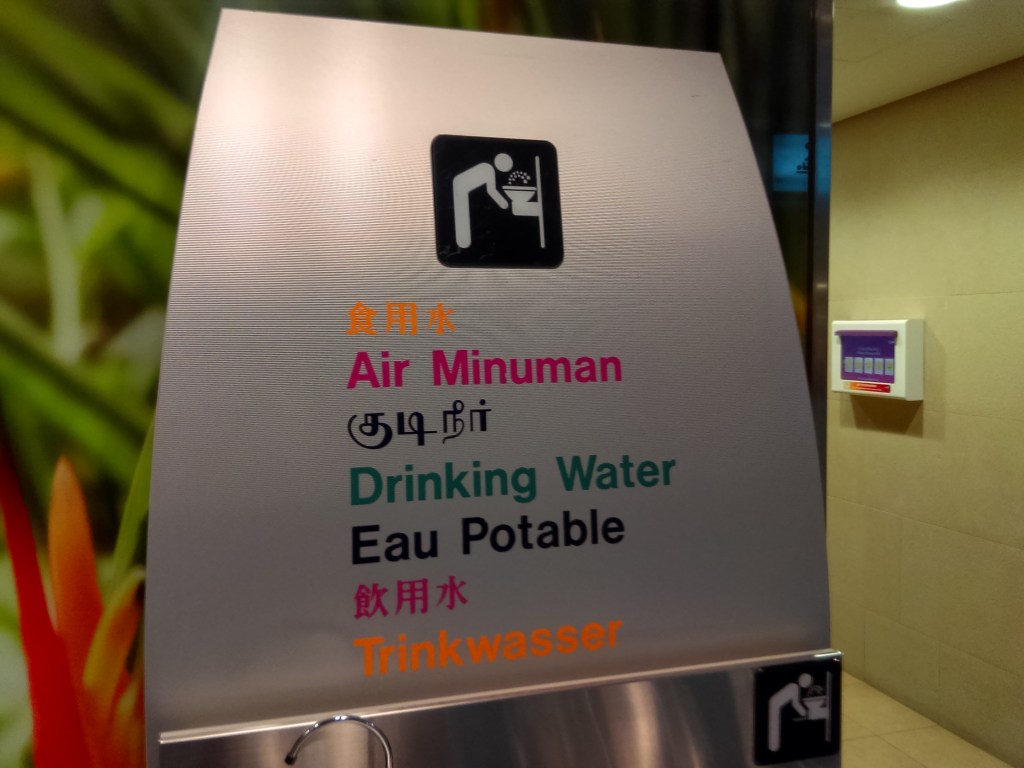
I stopped to fill up my water-bottle. Look at signs in various languages! There are two signs corresponding to Mandarin, in the traditional and simplified script. Singapore uses simplified Chinese characters, rather than traditional ones as in Taiwan.

Queuing again at 2am, to get into the departure lounge. I had to take off my money-belt and my belt, sent my boots through the X-ray machine separately, had to pour out my newly acquired drinking water, and had a pat-down by a male security guard. Everybody was tired and irritable, but the security staff were patient. Soon I was in the airplane, taking photos of the view from above Singapore, none of which turned out.
I found a YouTube clip titled “SINGAPORE TRAVEL GUIDE: Everything You Need to Know”, given by this rather eccentric guy. He gives good advice, except for the accommodation which is way too much money. You don’t need $US300 (about NTD9,000) to stay in Singapore.
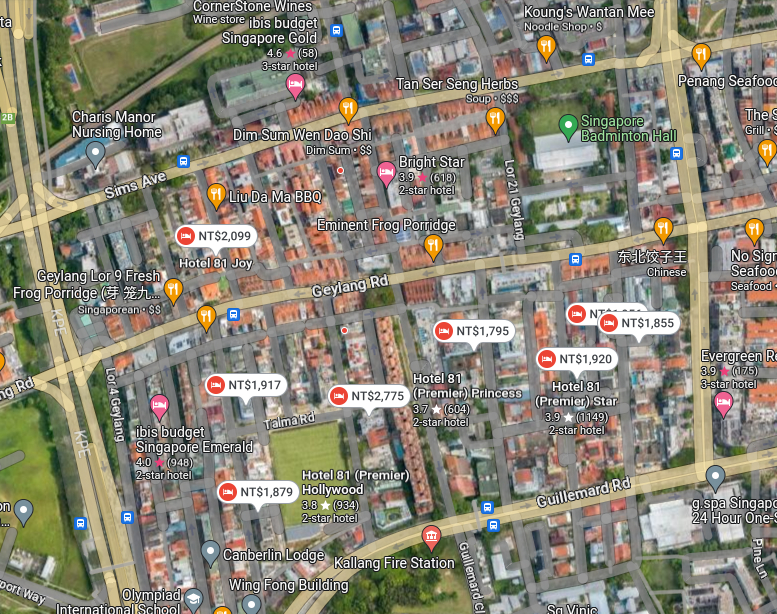
The above picture shows only the Hotel 81 chain, which is where I stayed last time I was in Singapore, in a part of Geylang. The price of one night’s stay is shown in bubbles, about NTD2,000. There are many other hotels in the area. Aljunied Station, on the East West subway line, is just out of view in the top right. Hotel 81 is a very basic chain, but I found it tolerable. The Geylang area is lively, with good food.
I grew fond of Singapore breakfast: coffee, kaya toast, and soft-boiled eggs with soy sauce. I recommend eating this in hawker markets: “For the uninitiated, Singapore hawker centres are basically large food courts with stalls around the perimeter serving everything from full meals to snacks and drinks. You’ll usually find a selection of local dishes as well as flavours from across the world, including Chinese, Malay, Indian, and western.”
 Wandering Richard