February 28, 2025
I’m back in Sydney for a week, between MTC Chinese courses. I’m staying with my parents. My mother has just finished the initial period of chemotherapy; I went with her to her last session.
I thought I’d see Sydney as a visitor would see it. Being born in Sydney, I didn’t get to do any of Sydney’s attractions. In particular, I’ve never gone on a tour of the Sydney Opera House. My mother bought me a fancy mobile ‘phone, so this was an opportunity to learn its functionality.
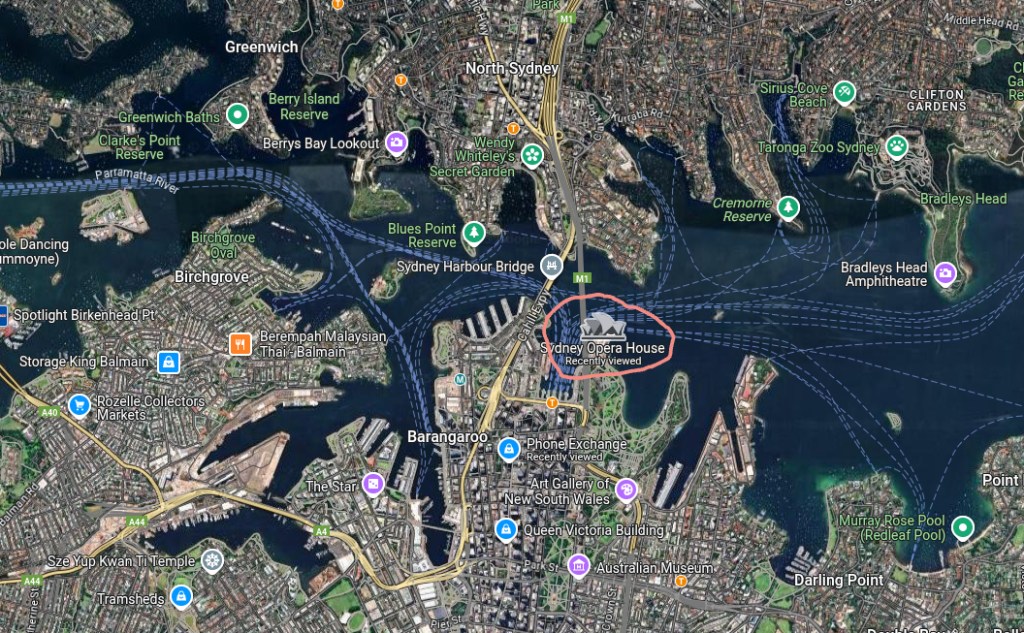
The above is a detail from Google Maps, showing the Opera House (in a pink circle) on the northern tip of the Sydney Central Business District, across from the Sydney Harbour Bridge.
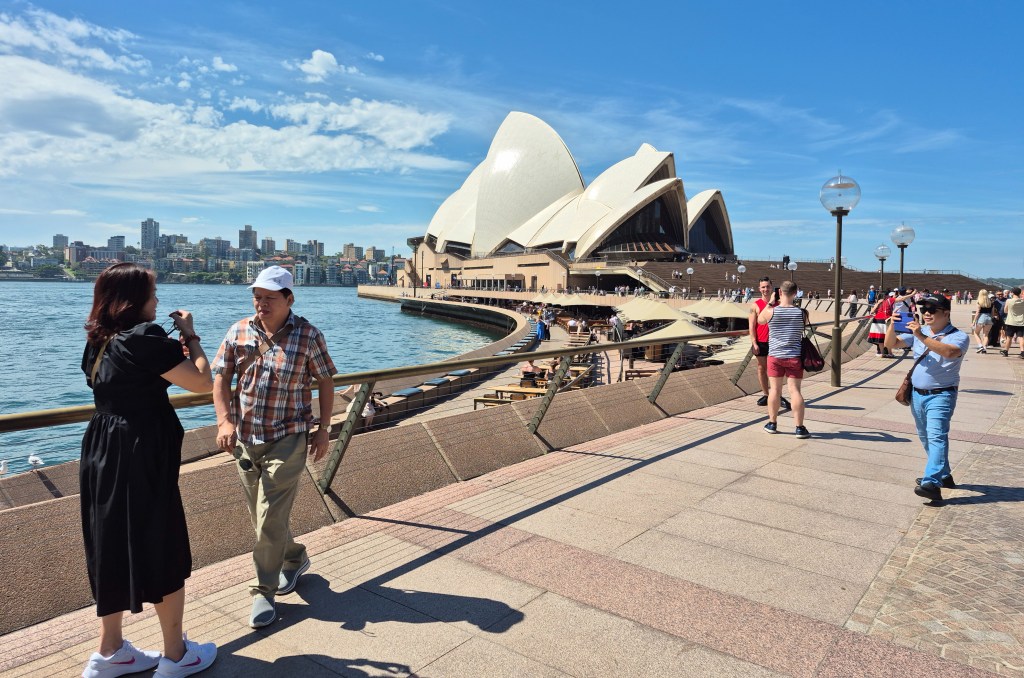
Above is the Sydney Opera House, as I walked north. It’s in a ridiculously pretty location, with Sydney Harbour on three sides.

The Opera House is on Bennelong Point.
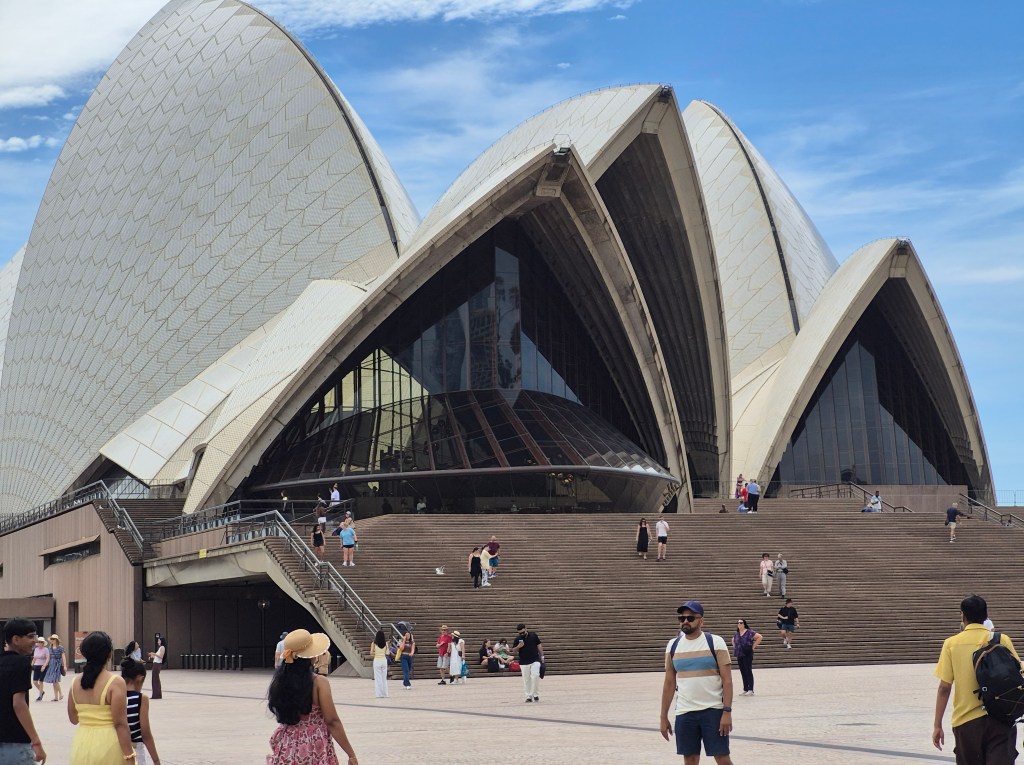
The white “sails” of the Sydney Opera House. It’s a striking modern building, even though it was begun in the 1950’s.

A nod to the traditional owners of the land on which the Opera House sits.

At the foot of the monumental stairs.

Standing at the top of the stairs, looking south to the Sydney skyline. Circular Quay (pronounced “key”) is in the middle of the photo, along with a yellow and green Sydney ferry tied up alongside the wharf. A new cruise ship, the Queen Anne, is to the right.

A view of the Sydney Harbour Bridge.

I experimented with my camera on my mobile ‘phone, capturing a wide-angle view (3x larger) of the Opera House and the Bridge together.

Likewise, I took a wide-angle view towards the east. That land across the bay is Garden Island, a military base; tied up is a warship.
“Garden Island … has been associated with the defence of Sydney and eventually Australia, since the first fleet of convicts arrived in 1788. … possibly its best kept secret is its spectacular 360 degree view of Sydney from the top of the old signal station… Access to Garden Island is restricted, due to it being a military base.”
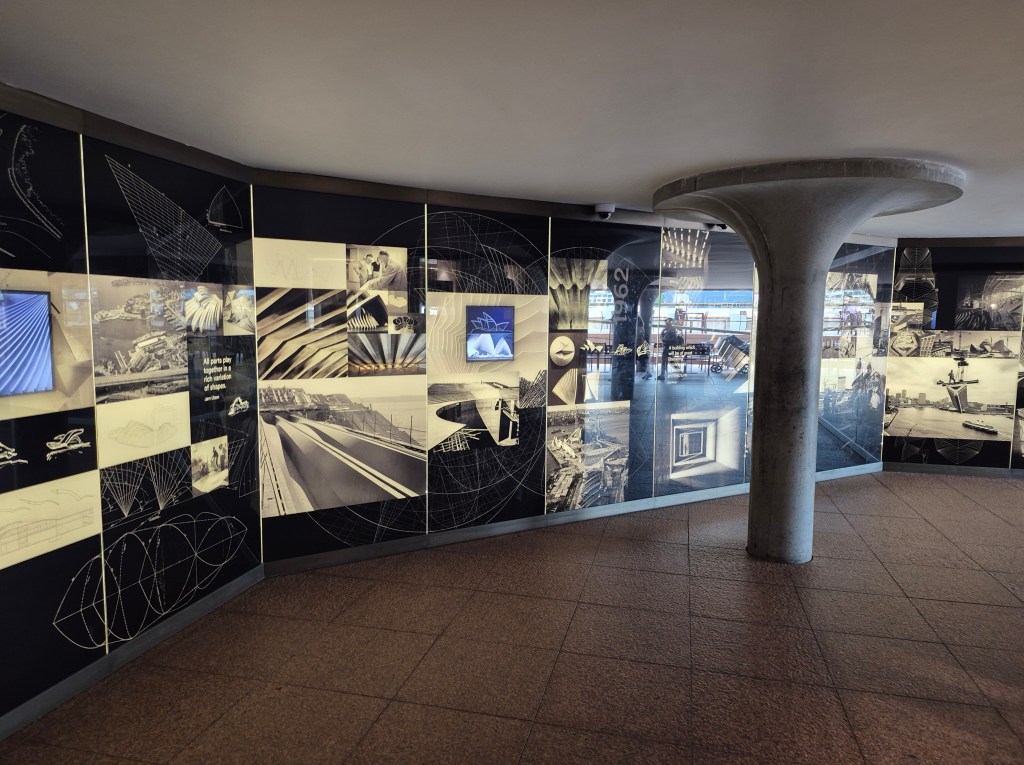
You can go in the Sydney Opera House quite easily. I became a little lost going along the various levels. I came across Jørn Utzon‘s sketches for the Opera House (above).
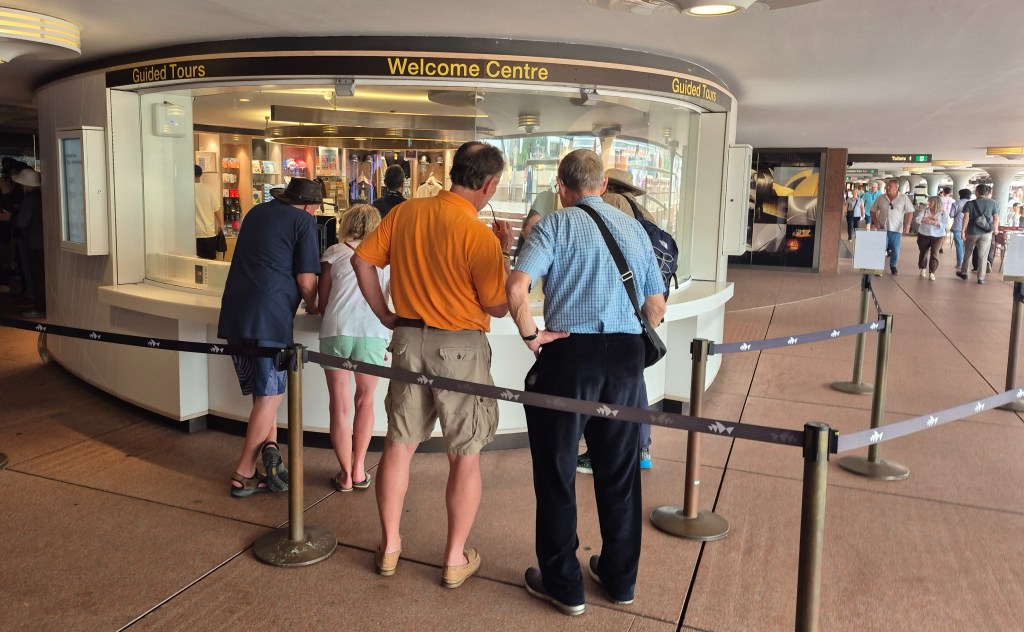
At last I found the departure point for the guided tours. The English guided tour were all booked out that day, but fortunateIy I booked a few days’ previously.

The attendant printed out a physical ticket. I selected a “concession” ticket but they didn’t seem to check – but maybe it was obvious to them, since I needed a cane to get around.

I was more than an hour early, so I ate something while looking at the view.
Above is a YouTube clip giving the true story of the building of the Sydney Opera House.
As recounted in this BBC article, “The idea to build an opera house for the city had been proposed in the late 1940s by an acclaimed English conductor, Sir Eugene Goossens. At the time, Goossens was something of a celebrity in the classical music world, having carved out a successful career in the UK and the US… Throughout the 1950s, Goossens lobbied hard, trying to turn his dream into a reality. … Goossens convinced the Premier of New South Wales, Joseph Cahill, that an opera house would reshape the world’s view of Australia, that he had found the perfect site for it, and that they should launch [an architectural competition] … [But] Goossens himself would not get to see his ambition realised. In 1956, having just picked up his knighthood in the UK, he was detained upon his entry back into Australia, where his bags were searched and found to contain, among other things, smuggled pornography, compromising photographs and rubber masks. The resulting scandal … completely scuppered the conductor’s career in Sydney. He fled the country for Rome … never to return.”
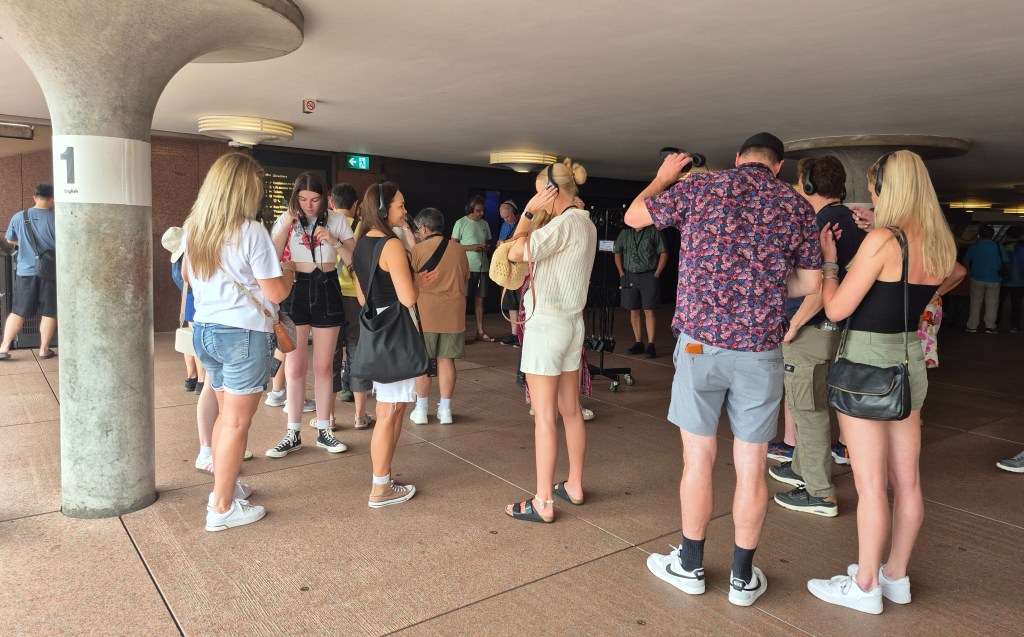
The tour group waiting area. The tour groups were classified according to language: the above pillar marked “1” is where the English language tour groups started from. Just beyond is the pillar, obscured by patrons, marking the French, German and other European languages’ tour groups. Further away is the pillar marking the (simplified) Chinese-language groups, and a different pillar marks the Japanese and Korean tour groups. We were warned that photographs would be prohibited inside certain rooms.

We collected round our pillar, were given a headset, and followed the tour leader (above). I estimated there were approximately 30 people on the tour.
As this BBC article continues, “a panel of judges evaluat[ed] some 233 submitted entries. At the start 1957, the government announced that a largely unknown Danish architect, Utzon, was the unexpected winner. Part of the surprise at Utzon’s success was that his entry had largely consisted of preliminary sketches and concept drawings.” Sydneysiders called it the Danish pastry. “Premier Cahill, worried that the project might be derailed by adverse public opinion or political opposition, pushed for construction work to start early. This was despite the fact that Utzon was still finalising the building’s actual design, and had yet to resolve critical structural issues. … The initial estimate of the final cost of the Sydney Opera House was put at A£3.5m or A$7m”.

The inside of the shells were oddly cramped, justified in that the passages and steps were shoehorned into any available space between the halls and the shells (above).
As this BBC article goes on, “the first of the project’s delays and eye-watering extra costs” was lack of a strong foundation. “Nobody had also fully understood the scale of the engineering challenge that the Opera House’s daring curved roof surfaces presented.” Delays and costs mounted; “the project was dogged by labour disputes, design changes and rising material costs, making its budget balloon and its potential completion date disappear into the distance.”

There were opportunities to photograph the view (above).
As the BBC article said, “Robert Askin, who had vocally opposed the project, was elected the New South Wales Premier. He appointed Davis Hughes as the new Minister for Public Works, who clashed repeatedly with Utzon. Hughes, determined to rein in spending, began to challenge the architect’s costs and schedules, demanding a full set of working drawings for the interiors – the next stage of the project. … Hughes refused the payments demanded by the construction team, which left Utzon unable to pay his staff. In 1966, the Danish architect resigned from the project and left Australia, never returning to see his Opera House completed.”
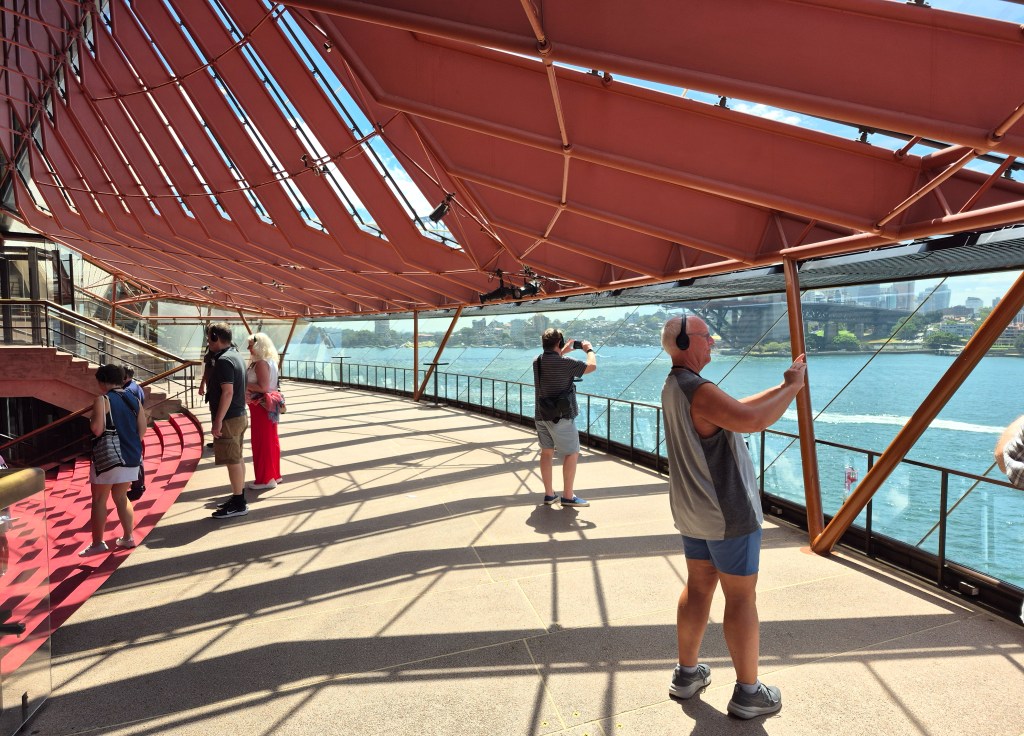
A different view of outside.
As this BBC reports, “Hughes appointed a new panel of Australian architects to complete the interior as well as the glass walls. But if Hughes thought this would reduce costs and speed up the project, he was very much mistaken. The new team scrapped most of Utzon’s plans for the interior and radically redesigned it. … The Sydney Opera House’s spiralling bill was pushed even higher when a labour dispute by union workers, over the dismissal of a worker and demands for better wages, culminated in a sit-in strike at the site in 1972. … But the following year, the monumental undertaking that was the construction of the Sydney Opera House was finally completed. Ten years late and 14 times over its initial budget, it came in at a cost of A$102m (£51m). It was formally opened by Queen Elizabeth II on 20 October 1973. … Utzon declined to attend its opening”.
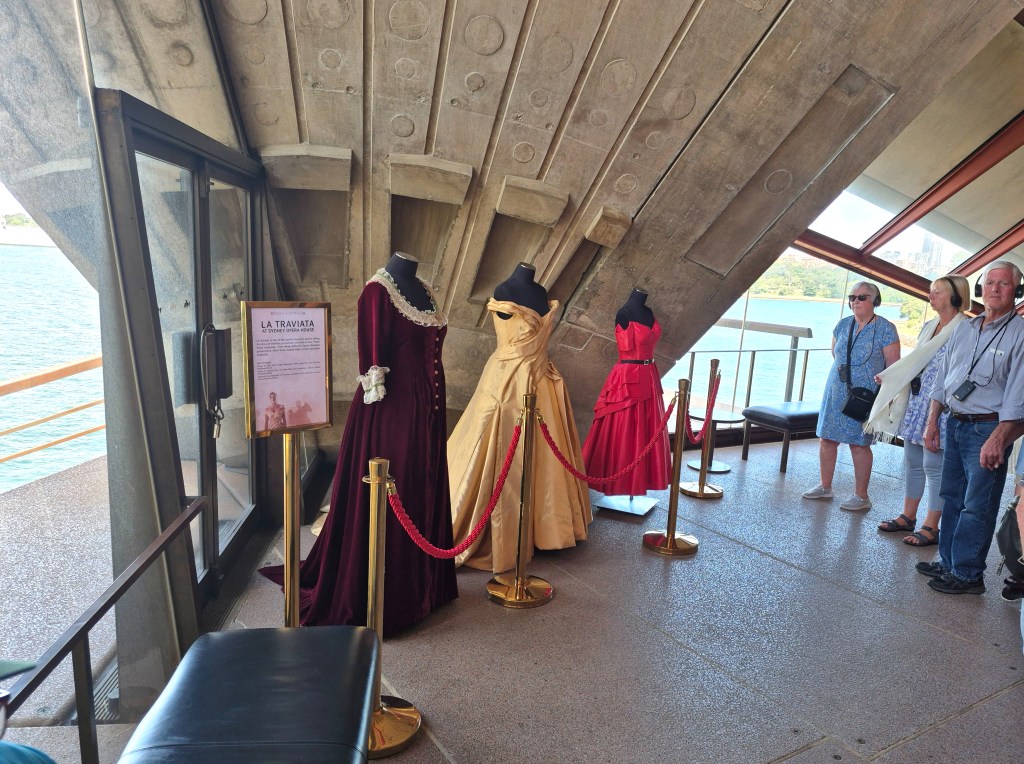
Dresses from a production, located in an awkward location near one of the shells.
As this BBC article said, “In the years since its completion, acclaim for Sydney Opera House’s visionary architecture has only grown. Its distinctive sculptural form has made it one of the most immediately recognisable buildings in the world. More than 10.9m people visit it annually, and it has come to epitomise the Australian national identity, its soaring roof a celebration of creativity, culture and ambition in the face of seemingly insurmountable odds. … In 2007, the building that had been brought about by a combination of art, engineering and sheer bloody-minded perseverance was formally recognised as a World Heritage Site by Unesco.”

Unfortunately photography was forbidden in the main opera hall, though not the recital hall (above). Very impressive for a 50-year-old chamber!
The group tour lasted about an hour. I was impressed by the mobile ‘phone’s new cameras; no blurring or out-of-focus images at the sides. Selecting one of the three cameras made it more easy to take photos. I went home impressed with my mobile ‘phone’s capabilities, but even more affected by the Sydney Opera House.
 Wandering Richard