January 7-18, 2026
Gordon and I went to Cambodia.
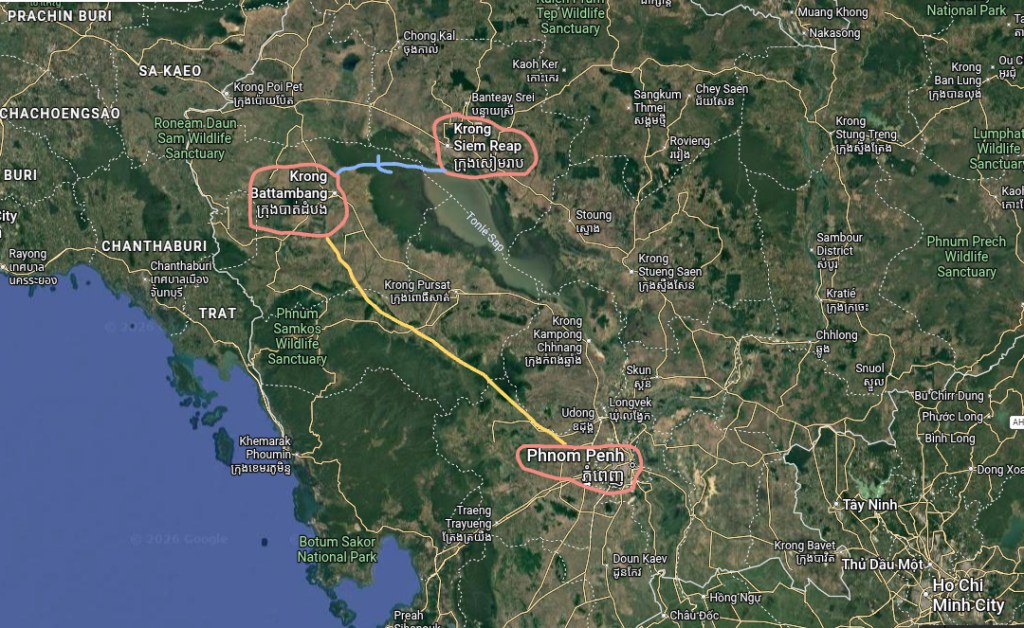
The Google Maps above show the route. We flew into Siem Reap, toured the Angkor Archeological Site, then travelled by boat to Battambang, then by train to Phnom Penh.
Gordon has very kindly offered to write up our trip! Over to him:
Richard has invited me to post about our journey in Cambodia.
When I landed in Siem Reap mid-morning—from Hobart to Sydney to Singapore—I’d only managed a couple of hours sleep. Richard had arrived the previous day, which was very handy for me.
Travel tips!
Always be met at the airport by someone who is conscious and well rested and who knows their way around. Preferably they should have cake.
Good to see Richard anyway, regardless of his utilitarian value.
He’d arranged a car from the airport—mad extravagance! I reached for my seatbelt and felt a nanosecond of stress, but the gendarmes at the airport are not concerned with seatbelts and six people on a scooter is legal as long as one of them has a firm hold on the piglet.
I checked into the hotel and caught a couple of hours sleep. By 3pm, I was feeling somewhat functional and coherent, so we decided to visit Angkor Wat—7 or 8 kilometres from the centre of Siem Reap.
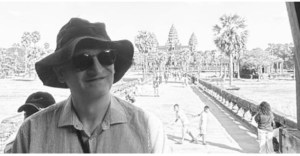
We took a tuk-tuk. I like the music of that sentence, but actually it was a moto-remorque—a two-wheeled trailer pulled by a motorbike. Tuk-tuks are three-wheelers with an integrated cabin enclosing the driver and passengers. Further nuances of differentiation can be found in the Big Bumper Book of Vehicle Identification so there’s no point in me going on about them here.
First to Angkor Enterprise, to the northeast of the city centre, to get our tickets. One day is US$35; three, $62; and seven, $72. We took the middle way, because we are deeply spiritual like that.
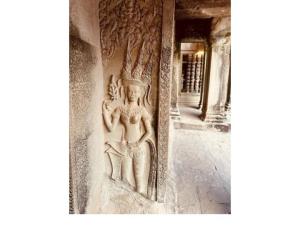
Angkor means city, and wat is temple. To build it, you get enough stone to make a pyramid and arrange it into a quincunx ⁙ and bung on spires and sun-filled colonnades and similar architectural terminology and carve almost every exposed surface into episodes from the Hindu epics and 37 versions of heaven (but just 32 of hell) and bas reliefs of gods, demon kings and apsaras, etc.
The Hindu-ness of it all is because Cambodia was created from the union of an Indian prince and a princess of the Naga—snake—people.
Khmer script is a descendant of the Brahmi script used for Sanskrit with extra curliness added for writing on banana leaves—I kid you not. Sadly, banana leaves don’t last down the centuries, but they also used it to inscribe stuff all over the surfaces of Angkor, so that’s good.
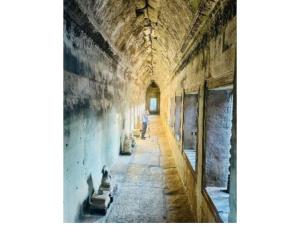
It’s all about the water and engineering really. The wat is the fruiting body of a mycelium of canals and man-made lakes that take advantage of the unique natural hydrology of this place, including the amazing expandable Tonle Sap Lake and the wonderful reversing Tonle Sap River.
More travel tips!
Learn all the stuff about all the things before you get there by listening to podcasts as you fall asleep. As this tends to blur the line between reality and the wonderful world of dreams / brain farts, always travel with a polymath who actually knows the geomorphology and myth and religion and history to get the story straight.
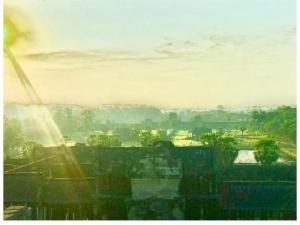
This is the view from the top if you get all the photo editing knobs and turn them up to eleven. Note divine presence emanating from upper left
Angkor Wat
★★★★★
Five stars!
Wat a Wat!
Cambodia uses US dollars and Cambodian riels interchangeably. There are 4000 riels to the US dollar—that is, 144 Australian cents. A thousand riel is like an American quarter—or about 36c Australian. No one uses Australian money, though—I just added that in for needless confusion. It’s quite simple once you get used to it, like most things.
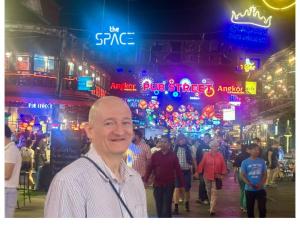
That night we went to pub street. It’s a street with pubs! You can drink, you can eat, you can have your feet nibbled on by itty bitty fishes in a tank for one dollar an hour. We didn’t, but we could have, which is pretty good! Five stars for everyone.
Pub street
★★★★★
Nibbles!
Pubs!
That first night we ate at the riverside night market and nearby street vendors.
You can get a fruit juice or smoothie for 3 to 4 thousand riel. A plate of veggies, protein and noodles or rice for 5 or 6. Stuff cooked on a stick—pork, beef, itty bitty sausages, mystery chicken—are 1 to 4 thousand. Sometimes there are frogs’ legs if you want them—also there even if you don’t. You can get pancakes with banana, chocolate, and condensed milk for 3 thousand—5 thousand if you add all the things: cheese, egg, Nutella.
Market and street Food
★★★★★
Stuffed for 20 thousand riel!
The Sovann bakery and coffee shop on the night market street is a great place for breakfast. Local-friendly prices. Croissants or a mighty slab of banana bread or a muffin for two to four thousand. Coffee somewhere around whatever goes with that. Simple, elegant, friendly vibe.
General Vibe
★★★★★
Angkor Wat, including its moat, is about 1.5 x 1.3 km and was built between 1113 and 1150 – fast work. In 1177 the Cham sacked the city – faster work – but by 1181 a Khmer king was back on the throne, launching construction at a cracking pace on a new walled capital a kilometre and a half to the north: Angkor ‘Big City’ Thom.

The walls of Angkor Thom rise about 8 metres and enclose a 3-by-3-kilometre square, surrounded by a 100-metre-wide moat.
We arrived early at the South Gate – the ancient ceremonial entrance.
The causeway across the moat shows devas and asuras hauling on a naga to churn the Ocean of Milk – the same wacky cast, the same cosmic tug-of-war you meet at Angkor Wat. But here there are new faces: the Bodhisattva of Compassion gazing in quadruplicate – one toward each compass point – from the 23-metre gate tower.
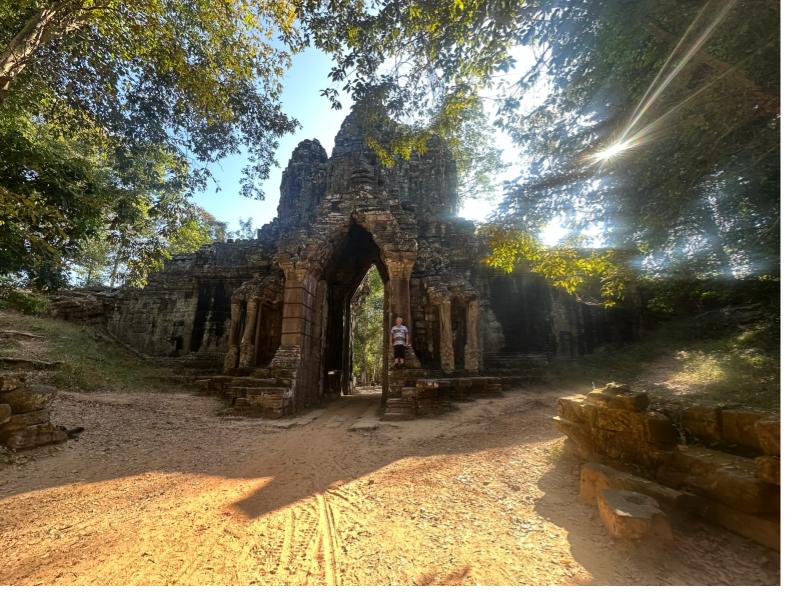
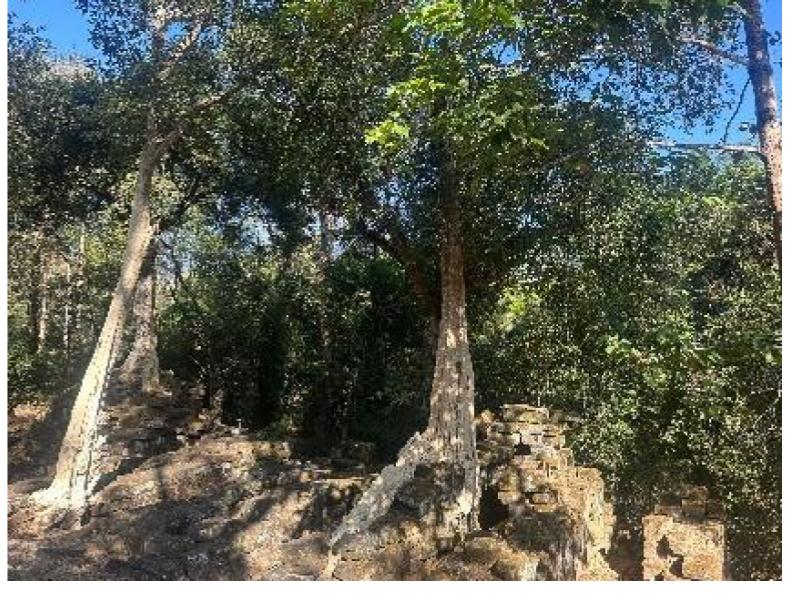
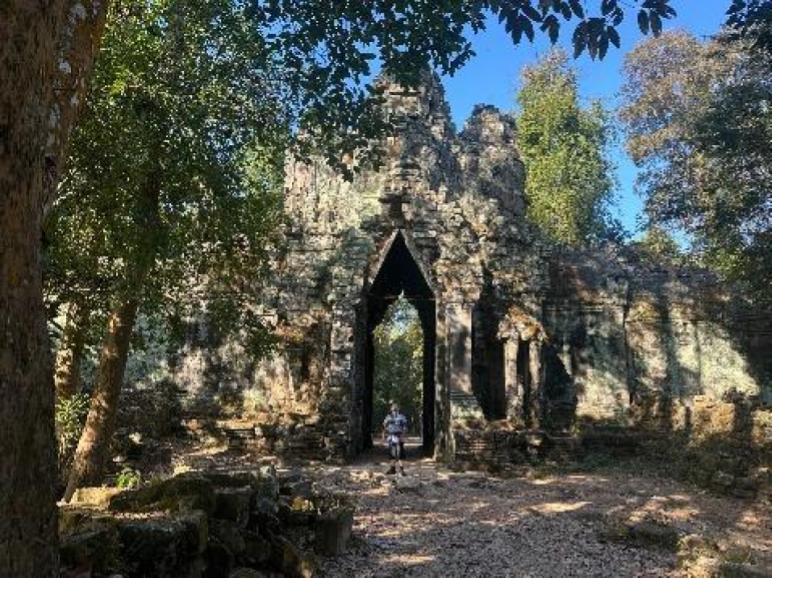
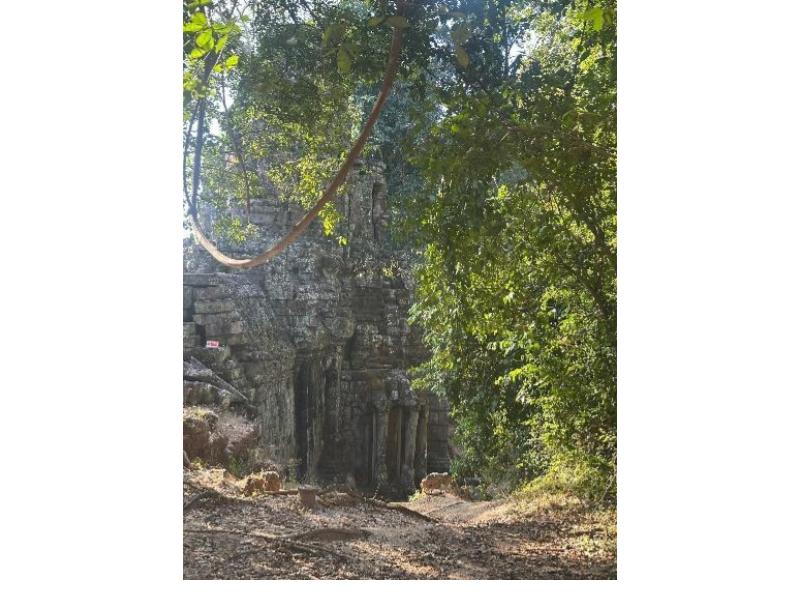
After a quick squiz, we drove around to the eastern wall and the Gate of the Dead. It was cool and green, and we got there along an unpaved forest trail, which is exactly what you want in a Gate of the Dead. Unlike the South Gate, which was already getting busy, we had it to ourselves. Some say this is where bodies left the city on their way to the cremation grounds.
It’s just as grand as the South Gate, but a little quieter about it.
All the gates feature the same four faces. Some say they represent the king’s face, rather than the Bodhisattca of C. The smart money is on it being a subtle mash-up of both. In any case, the sculptor got a promotion. Probably.
Even more additional top travel tips!
- It’s good to set out at sunup, rest for the hottest three hours, then set out again for the late afternoon. This rhythm worked for us.
- You can use your days non-consecutively. This is very handy because who the heck wants to spend all day every day looking at a bunch of old ruins?
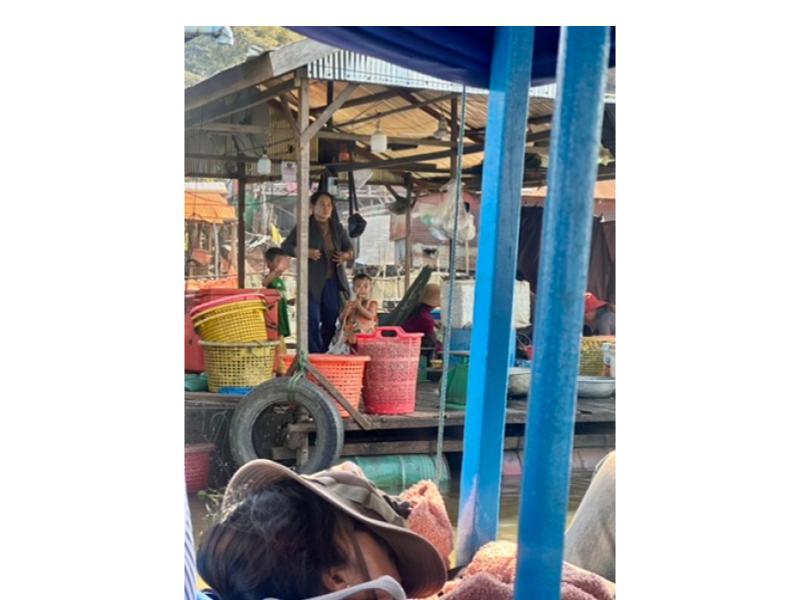
It’s a short drive from Siem Reap to the shores of Tonlé Sap Lake where we caught the Battambang Ferry. It took us across the northern end of the lake and then up the Sangker River for a few hours. Every couple of kilometres we’d go through a village, sometimes stopping for a few seconds to pick up or drop off a parcel or local passenger.
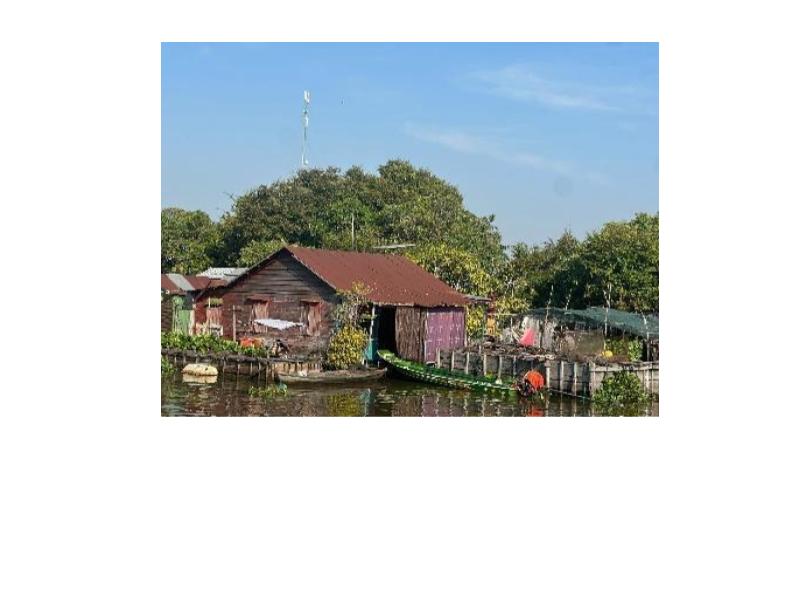
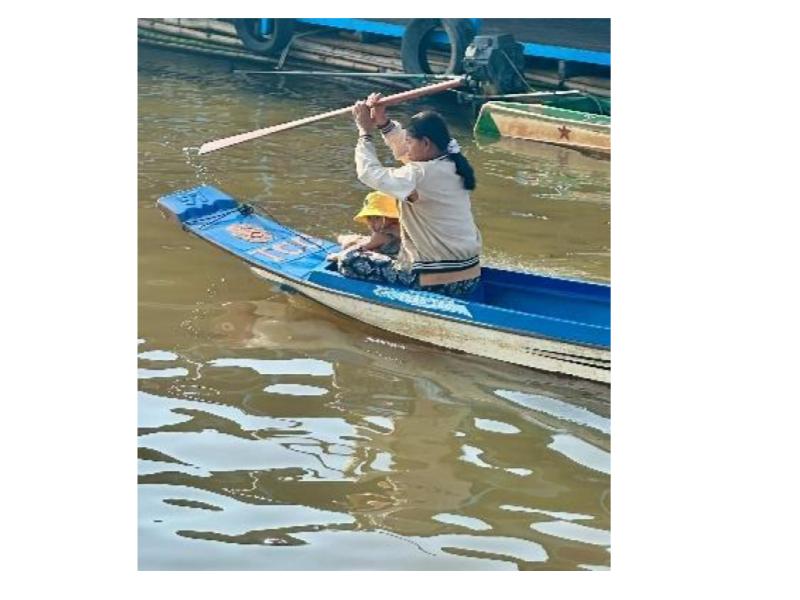
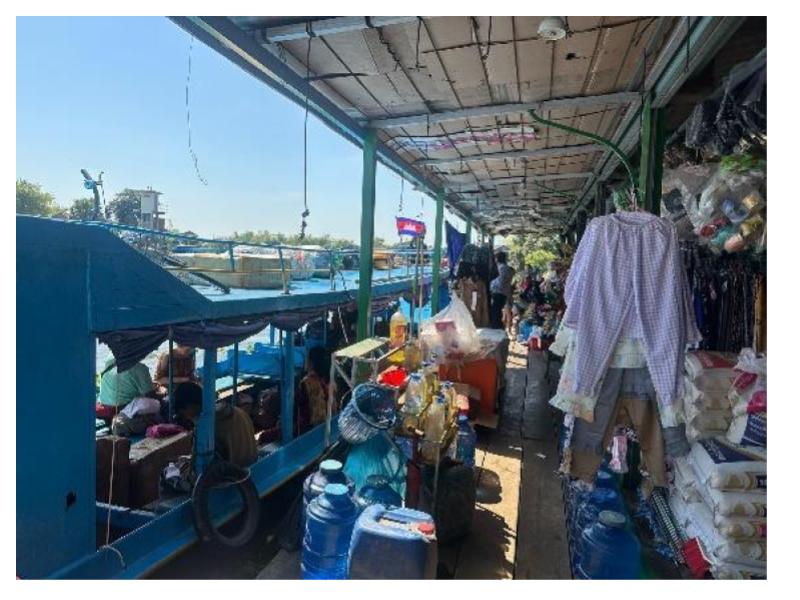
We stopped at a food/aluminium cup/mosquito net/plumbing supply shop for lunch. The river became narrower and shallower toward the end, and we passed people in the water, tending to fish traps and nets.
Headphones are good to block out the engine noise, but I recommend purging your playlist of anything from 1968 or 69. Journeys upriver, snaking deep into the heart of etcetera can make you go a bit Conrad & Coppola if you’re not careful. Deep into the heart of orangeness according to DFAT’s travel advice at the time. Trouble at the Thai border.
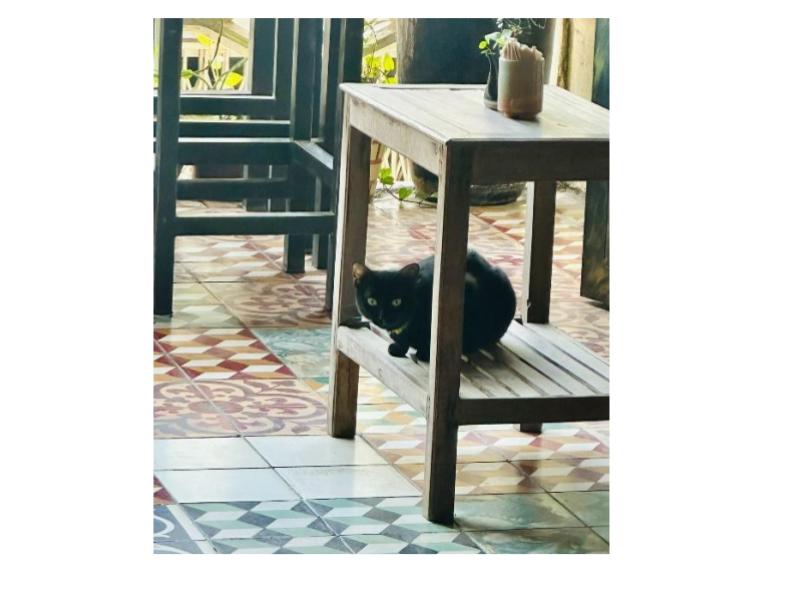
Battambang’s Lonesome Tree Café has a wonderful atmosphere, excellent food, great prices, and this cat.
We checked out the bat cave on the western outskirts of the city. Around sundown, they fly out of their cave in their gazillions (or whatever number is in Wikipedia). On the other side is a cave where Pol Pot’s idiots did Pol Pot stuff.
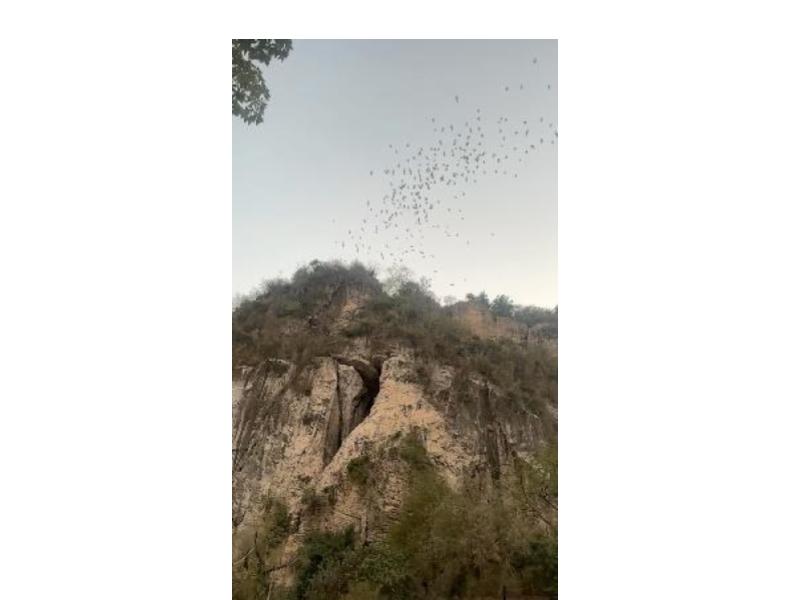
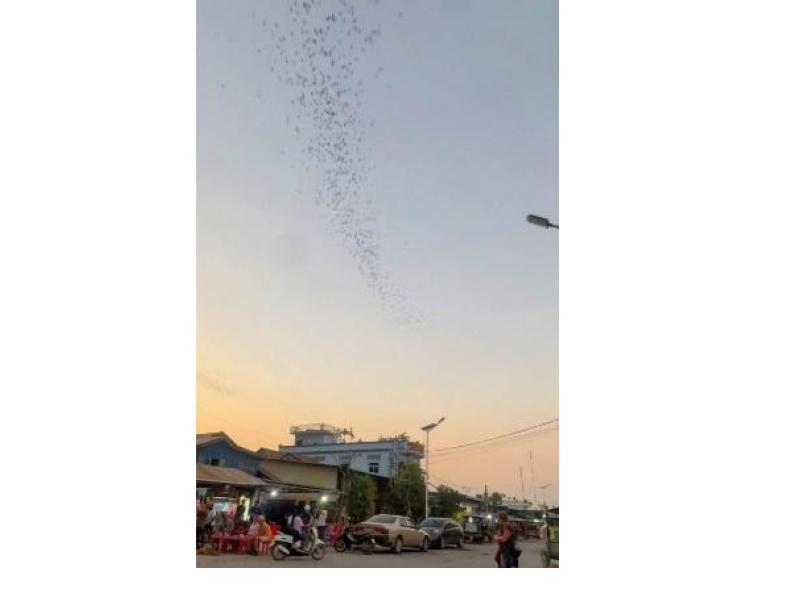
Richard and I sat and drank coconut juice and watched the bats head out for the evening. Coconut juice straight from the coconut is a glorious thing and should get all the stars, but I went crazy dispensing stars earlier and the currency is sadly debased.
On our last day in Battambang, I went a short way into the countryside southeast of town to ride the bamboo railway. Decades of war destroyed the locomotives, but the rail lines were still functioning – and so people created bamboo trains.
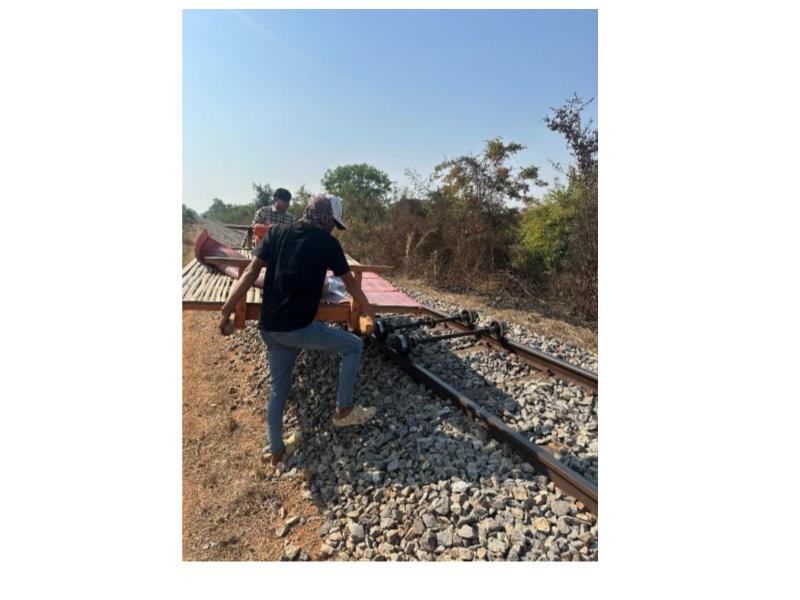
Two axels topped by a lightweight removable platform and powered by a motorbike engine.
Bamboo trains are on the way out, apparently. They run real trains along these lines now, and a tamed tribute version has been developed somewhere called bamboo-train-experience-land or something.
We were early to the station to take the non-bamboo train to Phnom Penh later that day, and I chatted to a remorque driver. He had sound opinions on Henry Kissinger and other topics and was born in 1951, two years before independence. They learnt French in primary school back then, so he could parlez vous like a champion. I can’t, so I had to take his word for that.
Tuk-tuk – in its more general sense – is a perfectly cromulent word for all kinds of vehicles inhabiting the zone between two-wheelers and cars, despite what those sticklers at the Big Bumper Book of Vehicle Identification say. The word remorque, however, lets you explore the rich comedic potential of rue de remorques, but I didn’t think of that till I got home, so poor Richard missed out on me making that joke every time we looked for transport.
The Battambang to Phnom Penh train is great for watching rusticated vistas of everyday life if you’re in the mood, and who isn’t? Women spreading rice on tarps to dry, barefoot children waving at the train, men leading water buffaloes to wherever water buffaloes are led to.
Pondering pilchards
A woman carrying plastic jerry cans joined our carriage. A couple of hour later, the people in the surrounding seats started hooting and yelling at something moving around on the floor. A fish had escaped from one of the containers, and I only tell this tale so I could say pondering pilchards.
Phnom Penh
Phnom Penh means Penh’s Hill, and the wat on that hill, sensibly enough, is called Phnom Wat.
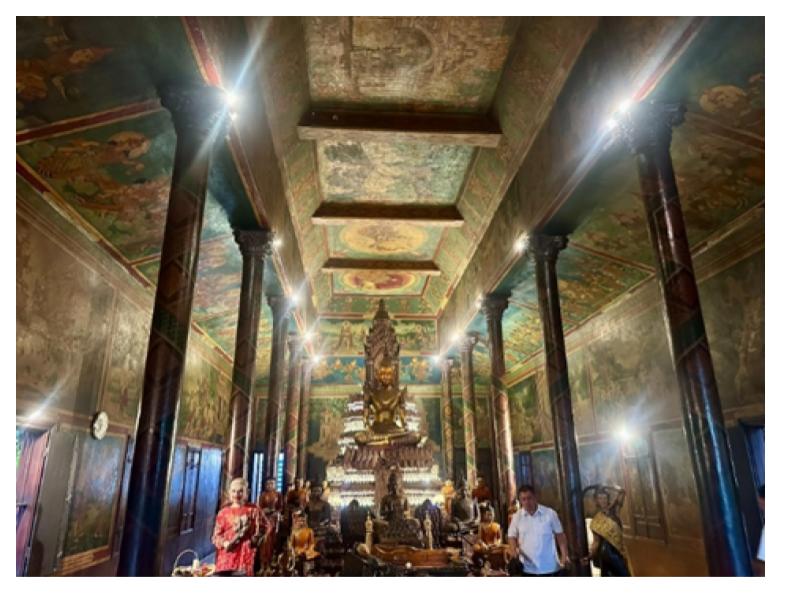
Security Prison 21, where thousands were killed, is now Tuol Sleng Genocide Museum. I met Chum Mey, who survived by fixing a typewriter, followed by other equipment his captors brought him. His book – Survivor – is for sale at the museum. I would have gone with Scheherazade with a Screwdriver, but nobody asked me. He was one of 12 prisoners left when the place was liberated in 1979. I talked to two others, brothers Ly and Phal, who were six and nine at the time. Their story is told in Norng Chan Phal: The Mystery of the Boy at S-21. They hid from their evacuating captors by hiding under a pile of filthy blood-soaked clothes.
There are walls displaying the photos of those who didn’t make it. I noticed a couple of white faces in the sea of brown – New Zealander Kerry Hamill and Englishman John Dewhirst, who were on a yacht that drifted into Cambodian waters. Kerry’s confession included details of his CIA handler Colonel Sanders. I like to think he was having a laugh.
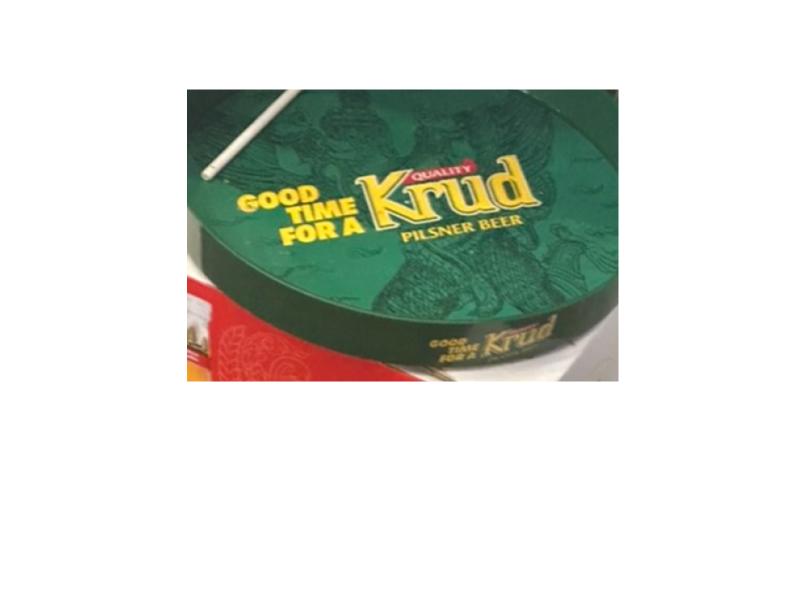
Evening harbour cruises start at $10 or so. More if you want to consume lots of Krud, but we didn’t.
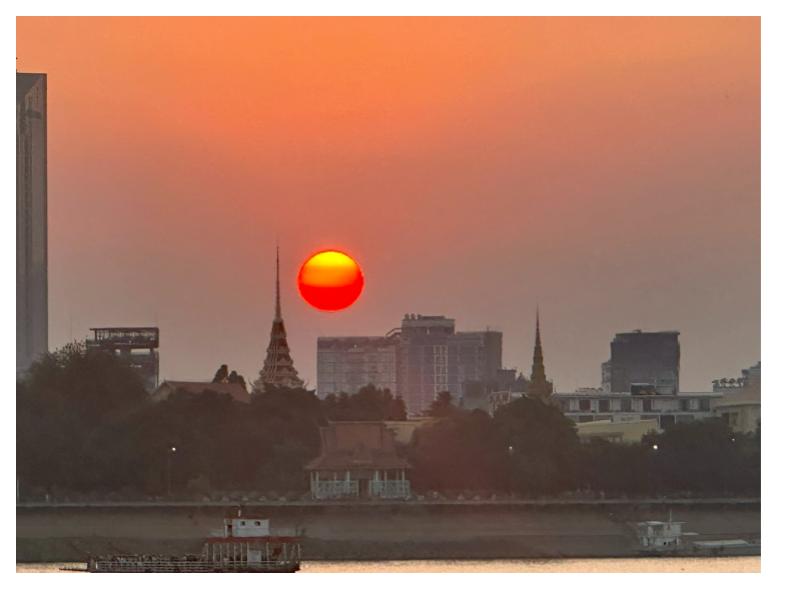
The next day we tried a cheaper harbour cruise – the vehicle ferry. Passenger fares are about 10c each way. Much the same route, same glorious views, but to get there we had to navigate rush hour traffic. Round here major highways intersect without anyone stopping, traffic lights are mainly decorative, and everyone drives with calm good humour and lots of honking.
This is the end
Sorry. I drifted into heart of etcetera territory again on account of my next adventure being a boat trip into the Mekong delta. I said goodbye to Richard, who was spending a few more days in Cambodia, in a place modelled on the dining salons of the Titanic—which might have been disturbing but for the lack icebergs at this latitude.
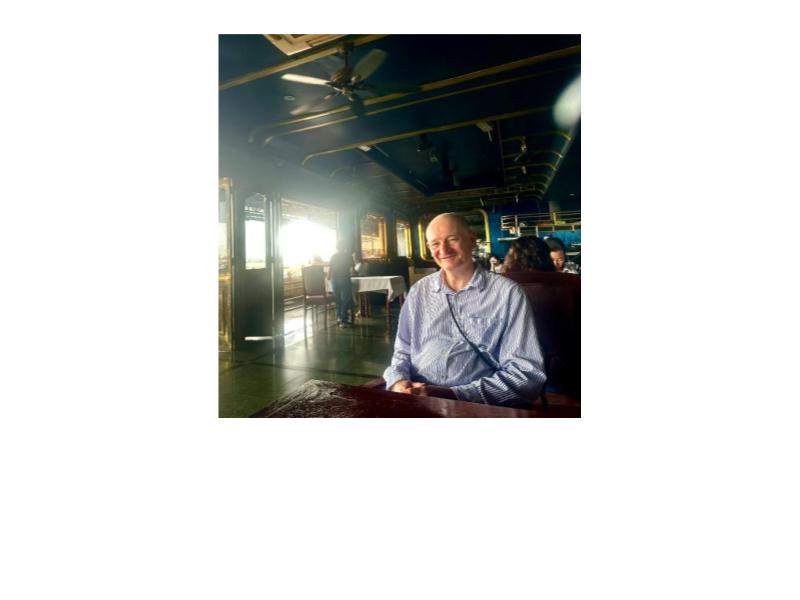
 Wandering Richard