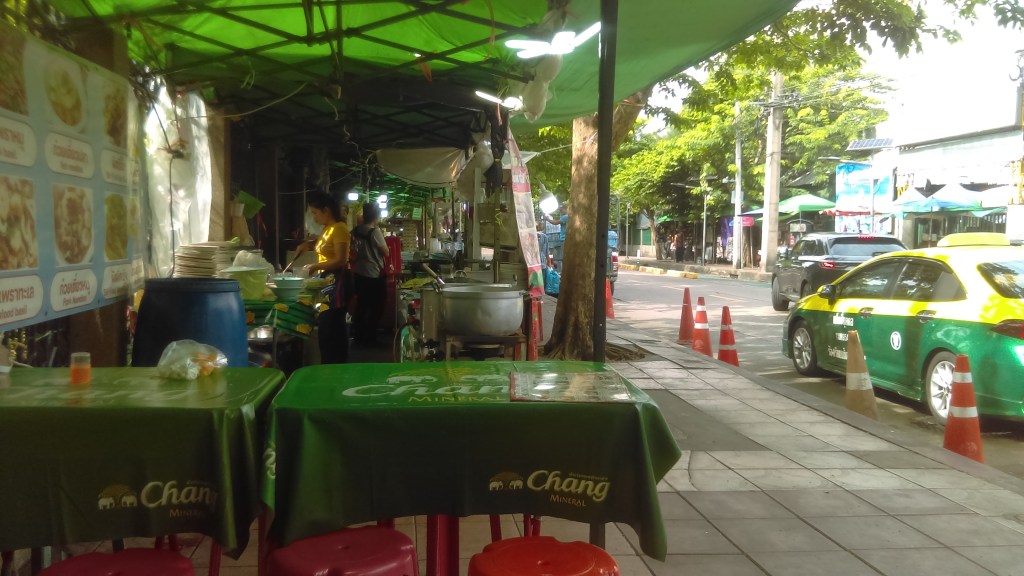
Raohe Street Night Market – from Wandering Richard (http://wanderingrichard.com)

January 27, 2025

新年快樂! (xīn nián kuài lè) – Happy Lunar New Year!  Last night at midnight I heard fireworks ushering in the New Year on the 29th. I got up from my bed and stood on the balcony over the Xindian valley, watching a few sites lit by fireworks, out of time to the distant bangs.

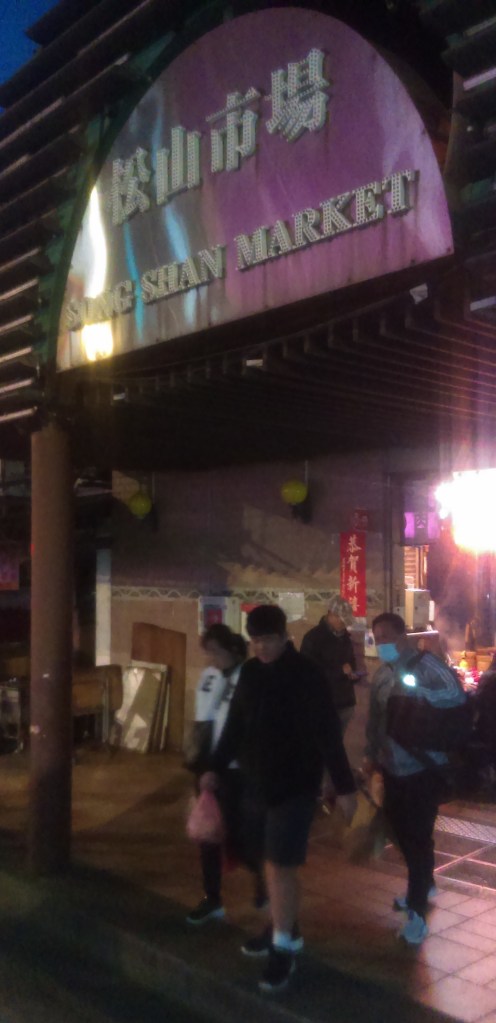
The Mandarin Training Center was closed this whole week. I met with my mother in a Zoom call to check on her. I planned on making a Wandering Richard webpage, and realized I hadn’t put it in going to a night market. Raohe Street Night Market was a convenient choice, on the end of the Green line at Sōngshān (松山, “Pine Mountain”) Station.

Unfortunately, I picked up a virus on Sunday, the day I meant to go. So I went to bed, and the next night, Monday, January 27, I thought I was recovered enough to go. I underestimated the virus, how it made me feel tired and grumpy for many days afterwards.

Another factor was the weather. When I visited the markets it was in the middle of a cold snap. After I got back from the night market I checked the temperature on my computer and it was 8 degrees Centigrade. I know some of you are scoffing at that, particularly if you live in England. But Taipei is only a few hundred kilometers from the Tropic of Cancer where the tropics begin; in Australia it would be on the central Queensland coast north of Brisbane. Eight degrees are as cold as I’ve known it in Taipei since I moved here in 2019. I wore my puffer jacket when I left for the night market.

Above is the Google Maps version of my route. I will be taking the MRT Green line from Qizhang Station (七張站) to the end of the line at Sōngshān Station. The night market is just a few minutes’ walk.

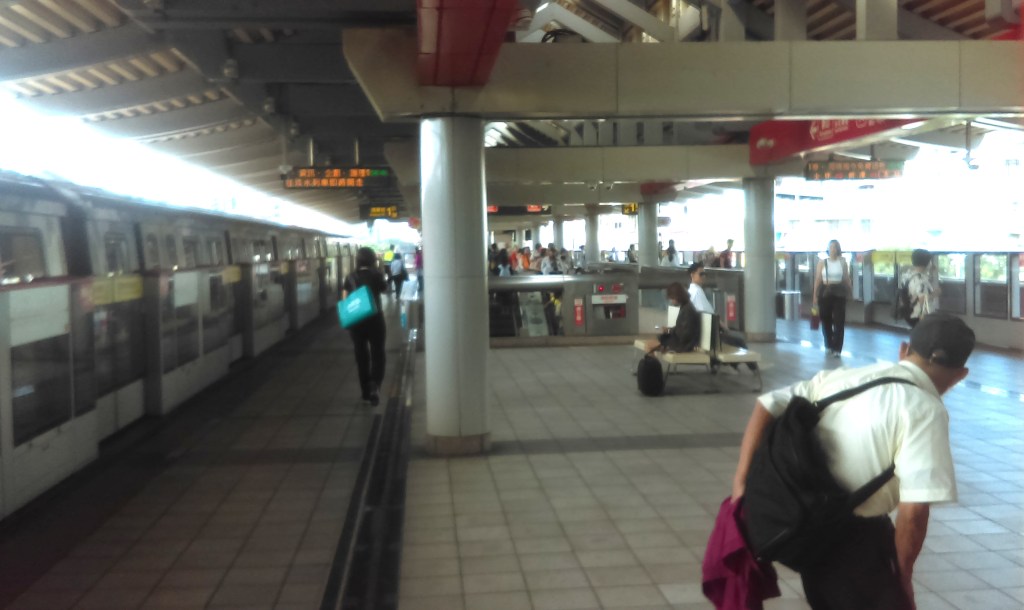
The obligatory MRT train to the night market. I like riding on trains, something I share with Ben Groundwater’s children.

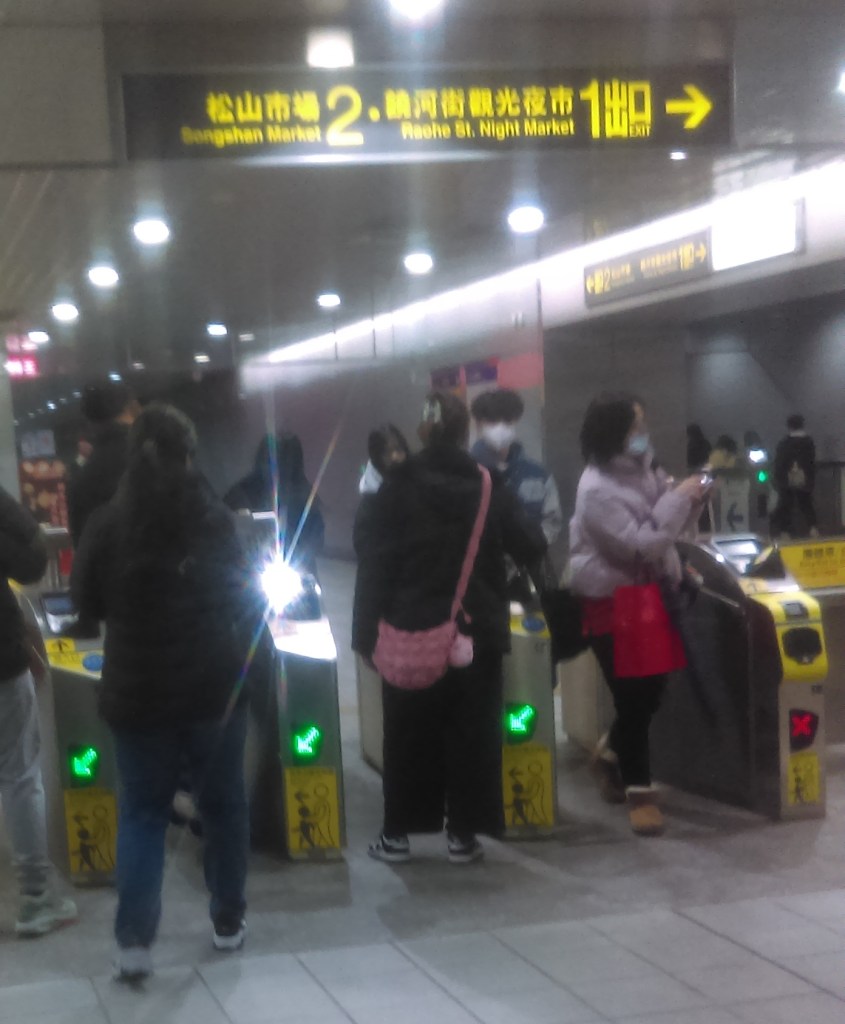
The turn style at Sōngshān Station, with the direction board indicating Raohe Night Market.

I followed the directions, and found – wait, that’s not it! For a while I wandered aimlessly, retracing my steps.

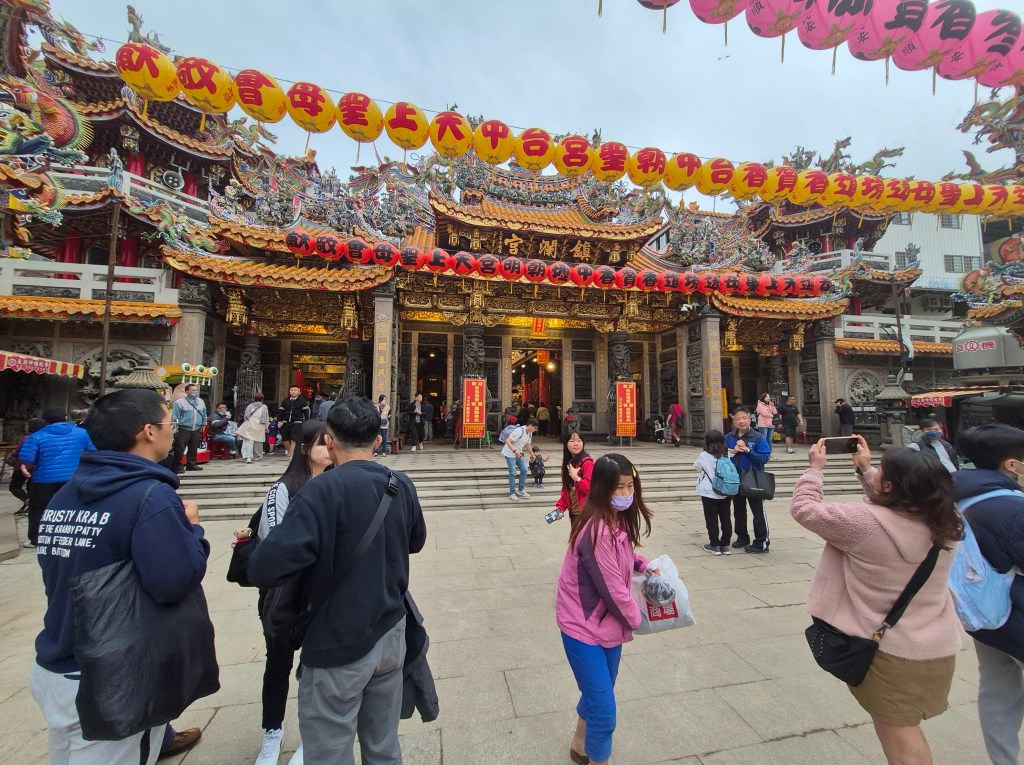
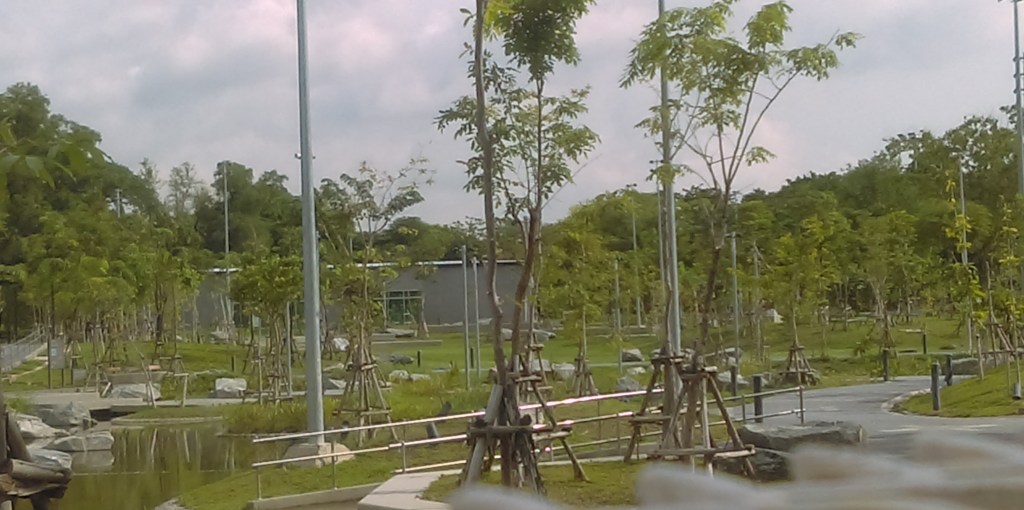
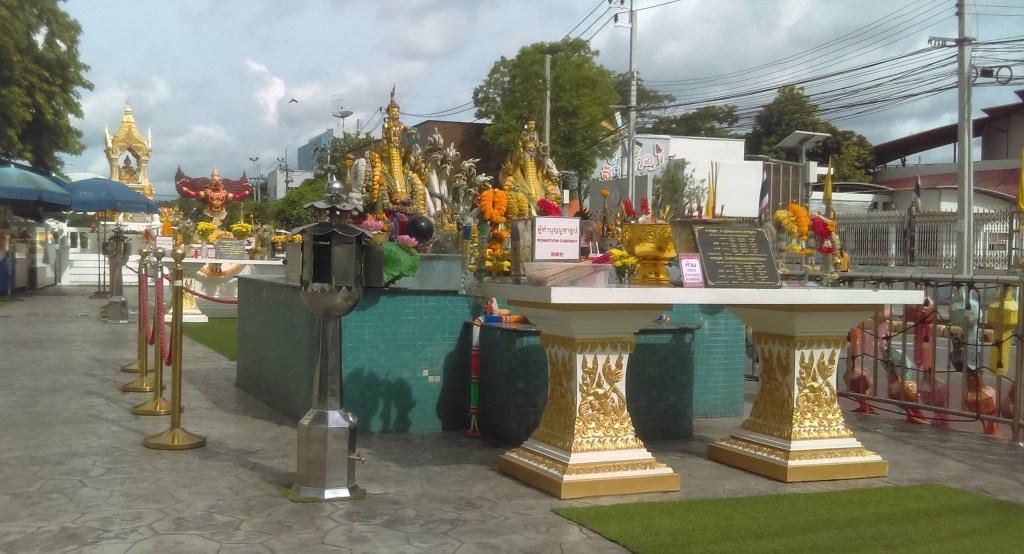
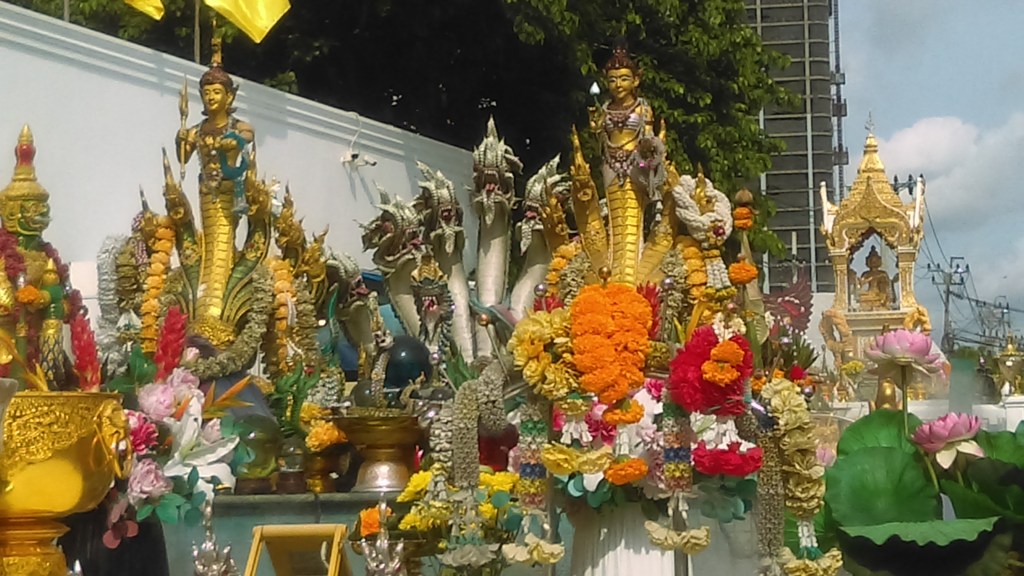
Then I stumbled on a temple (above).

That’s the Sōngshān Cíyòu Gōng (松山慈祐宮), or Cíyòu Temple. I was worried that I wouldn’t find a YouTube clip dedicated to only the Cíyòu Temple, but I found a couple, one of which is above.

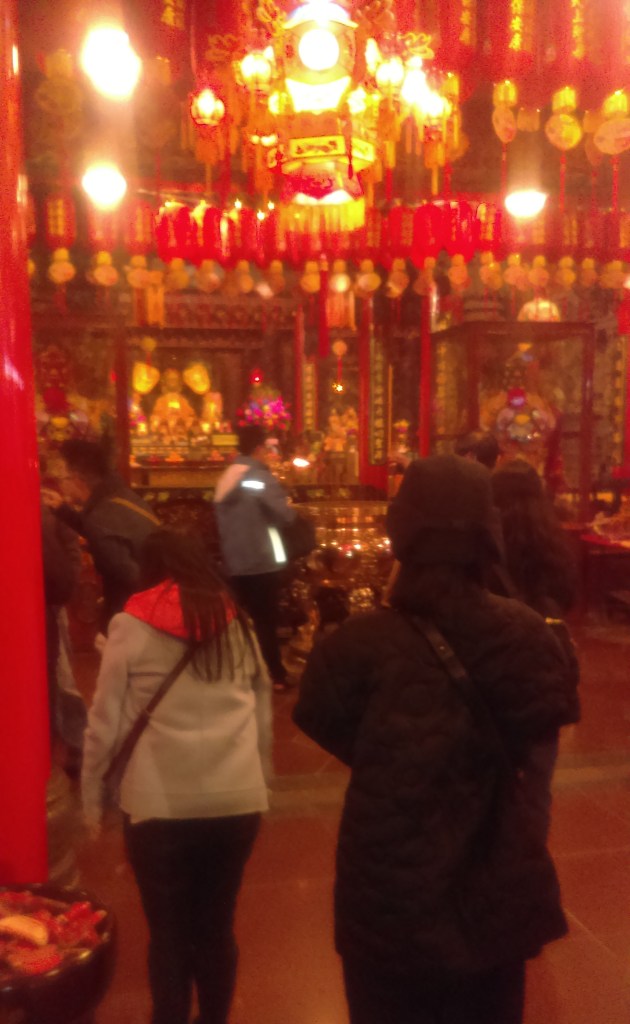
There were more people in the Cíyòu Temple when I was there (above). According to Taiwan: Waves of Wonder, “This temple, built in the mid-18th century, is the cradle of development of the Songshan district. The story goes that a monk once roamed this area, carrying a gilded image of Mazu, Goddess of the Sea, as he begged for alms. One day at Xikou—the old name for this district—the monk came upon a number of people, all Mazu believers, from his old home. Together they planned construction of a temple to honor the goddess, and after raising funds for more than 10 years they were able to realize their dream. Construction started in 1753 and was completed in 1757.”

New Taipei City Travel said “The deity statues in the temple, including Mazu, Qianliyen and Shunfenger, have been here for several hundred years. They have witnessed the rise and fall of this place and can stir up visitors’ nostalgia about the old days.”

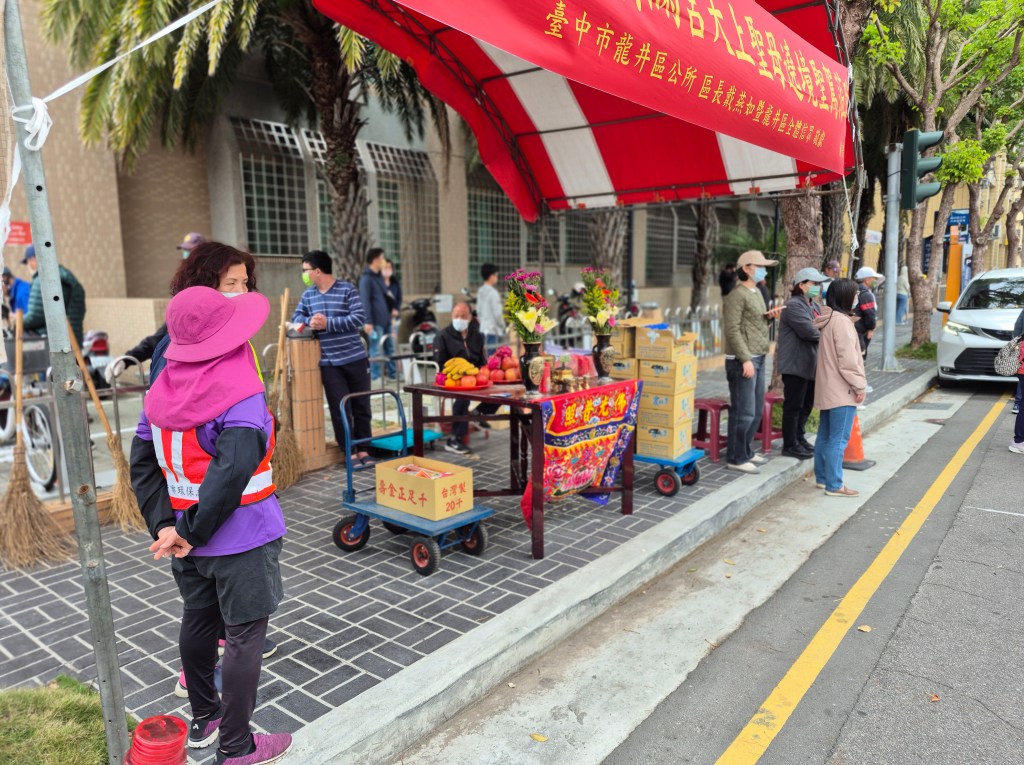
There was food laid out (above) on long tables, but I didn’t understand the meaning of the offering. Perhaps someone could explain it?

A nice photo of the doors (above).

Moon blocks. According to Gods of Taiwan, “Prayer in Taiwanese Popular Religion is a quite specific and practical affair. It is often used to help the faithful make decisions, be they major or minor, as well as to ask for help from the gods. A prime motivation for a visit to the local temple is to find the answer to a particular question, and to find that answer, adherents will turn to the divination tools of their faith, jiao bei [Moon blocks] … The question also must be phrased very clearly, and due to the binary nature of the jiao bei, must only be answerable with yes or no. The two blocks are then tossed onto the floor, and how they fall will reflect the answer.” There are four different results, either yes, no, undecided, or ‘laughter’ – “interpreted as the gods laughing at the proposition, either because it is a particularly bad idea, because the enquirer has already decided, or the question lacks relevancy in some other way”. Read the article, it gives a great insight into people’s perception of the gods.

The inside of a temple roof. According to Taiwan: Waves of Wonder, “The top of the temple roof is richly ornamented; in addition to human figures, there is also a flying dragon placed there because dragons were believed to have the power to prevent fires. Inside the temple are layer after layer of oil lamps lighted by devotees in the hope that Mazu will grant their wishes. The side altar to the right of the Mazu image enshrines the Earth God, who is protected on either side by flag-gearing Tiger Lords. The side altar to the left is devoted to Zhusheng Niang-niang, the Goddess of Birth. This goddess is normally accompanied by 12 female aides, but here she has 13. The extra aide is Duyu Niang; in life she was a midwife who never accepted money for helping women with childbirth, so after death she was deified because of her kindness and skill.”

The above is a photo I took of an interpretative sign, which is mostly legible. My camerawork is rubbish.

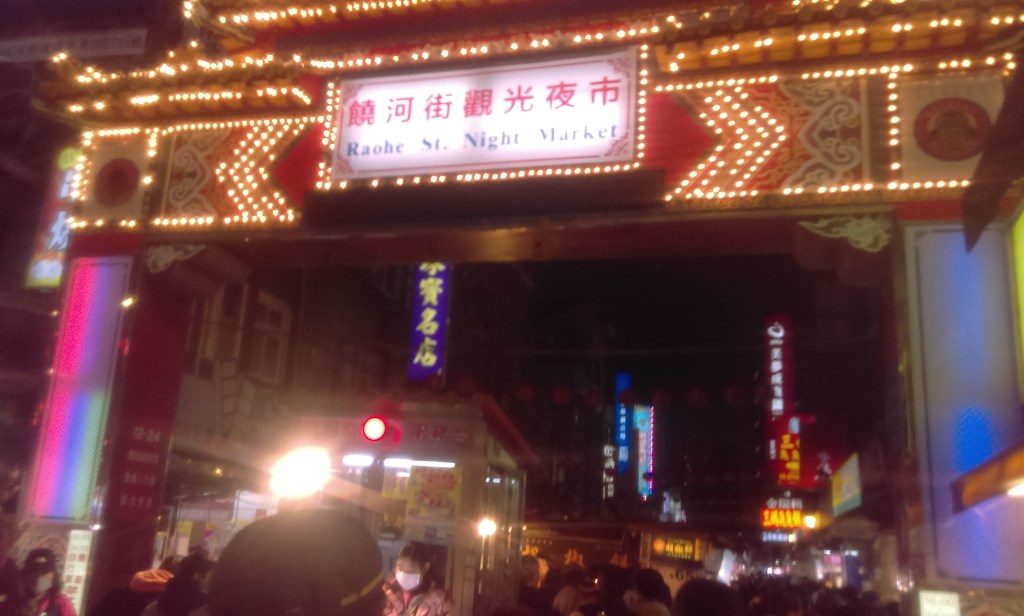
Right next door is the Raohe Street Night Market – in traditional Chinese characters 饒河街觀光夜市, “Raohe Street Tourist Night Market”.

Yellow Productions has a clip on the Raohe Night Market. I like the presenter, he has quirky and interesting things to say.

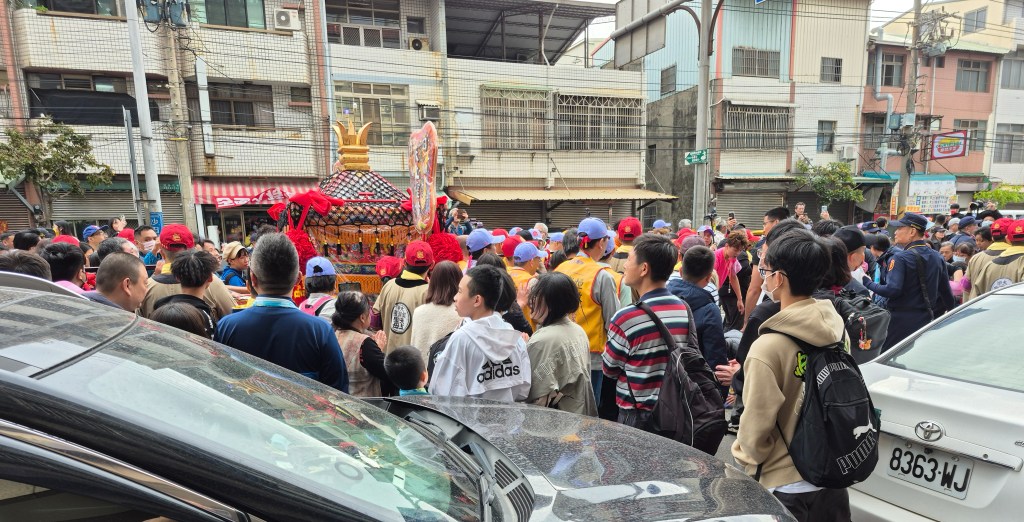
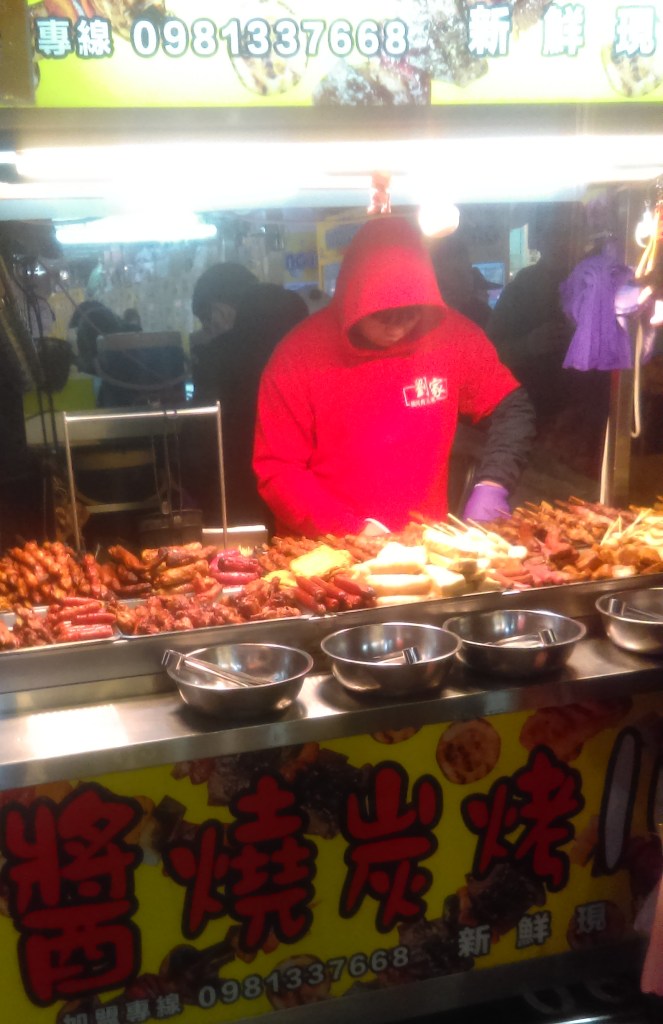
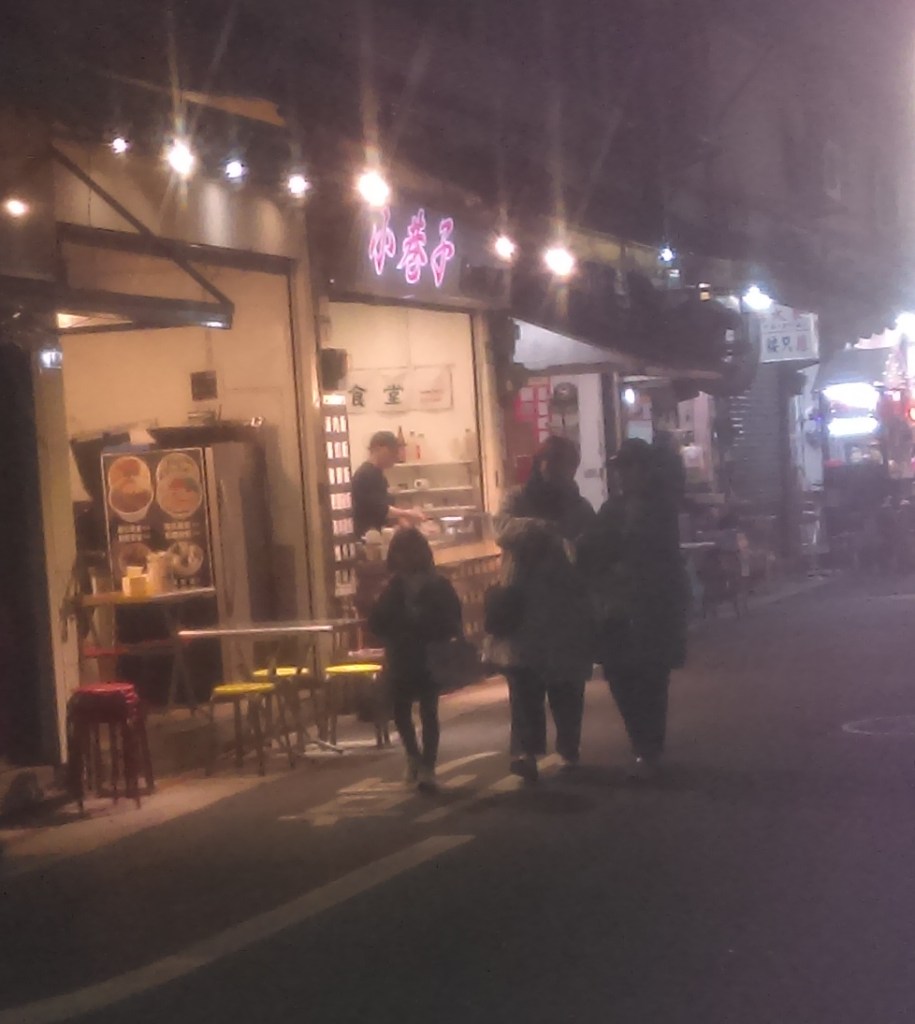
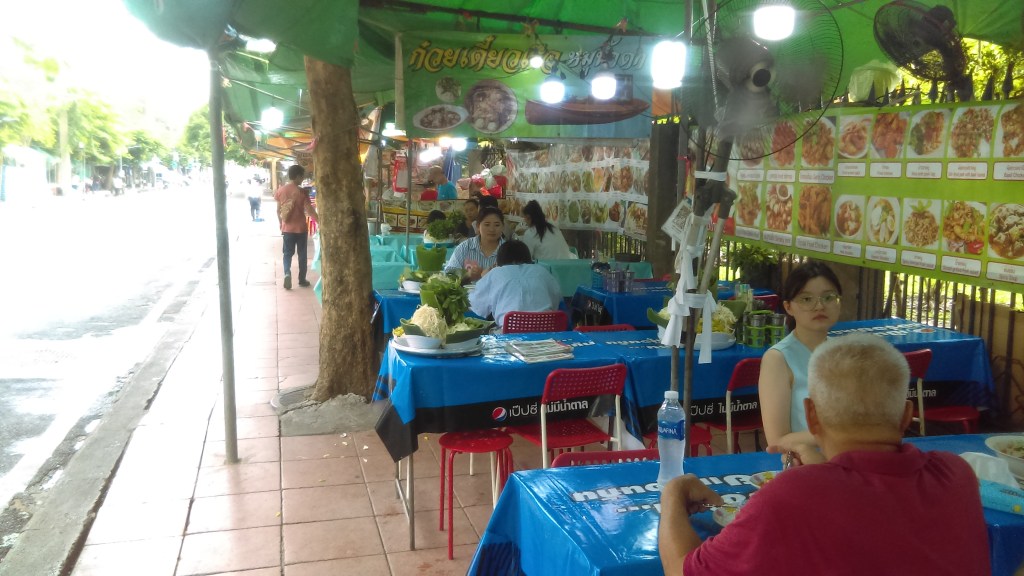
I joined the crowd of people and was moved along by them. Above is a stall in a long double line of stalls in the middle of the street.

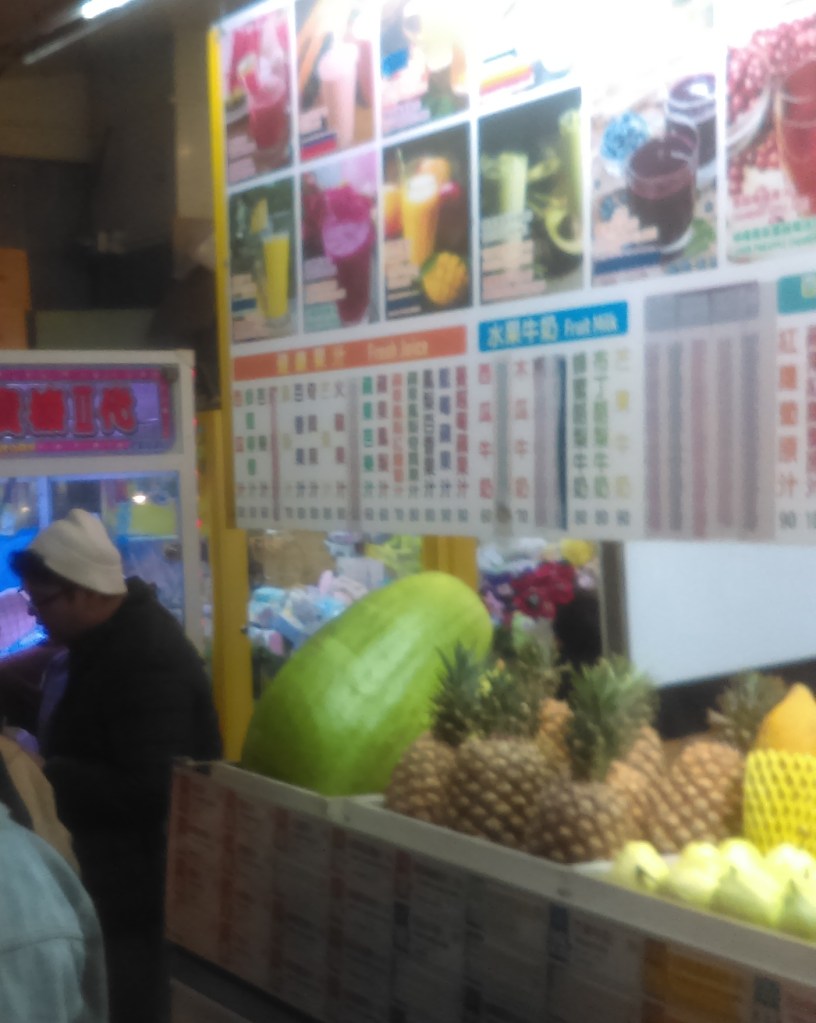
There were many drink stalls (one of which is above). A great idea in summer after a hot and humid day; not so much in winter, with the temperature in single digits.

There were quieter streets off the central road (above).

My impression of the night market was crowded, jostling people, and overwhelming noise. I realized I didn’t like it one bit. Of course I had the virus, which shaped my perception quite a bit.

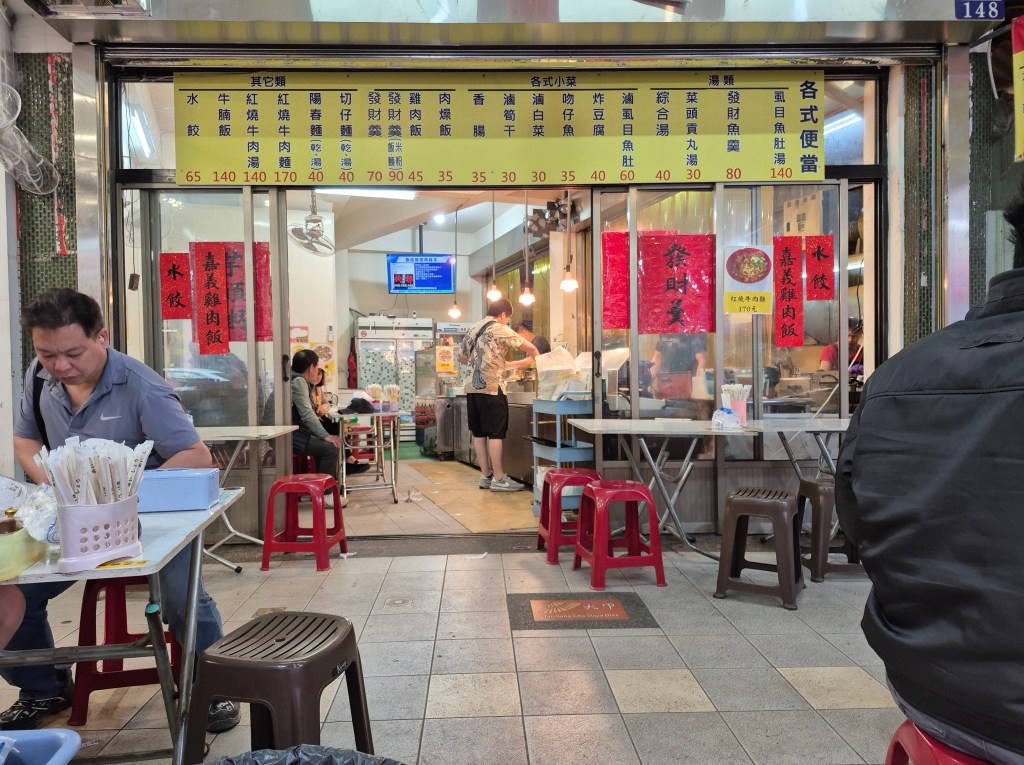
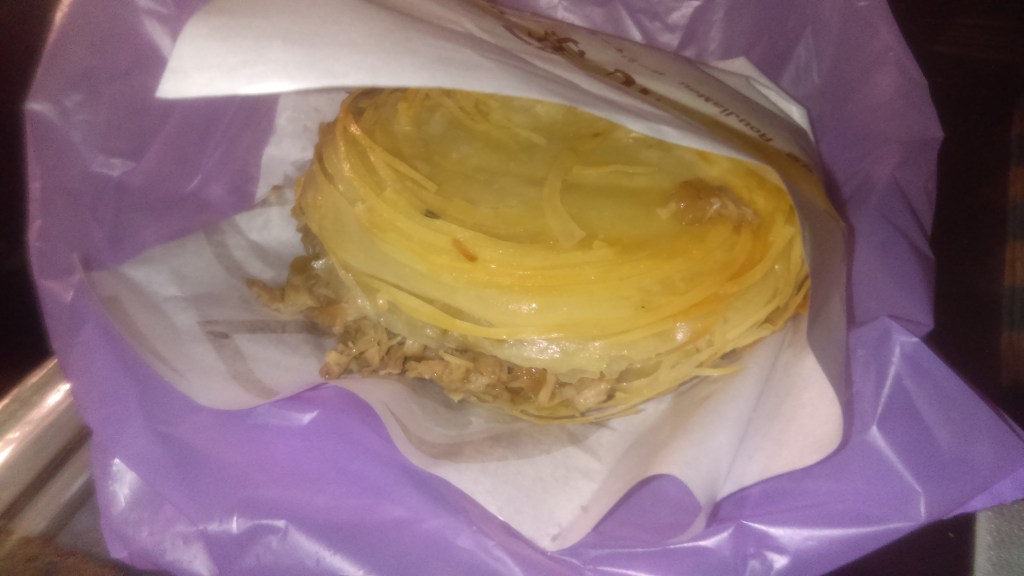
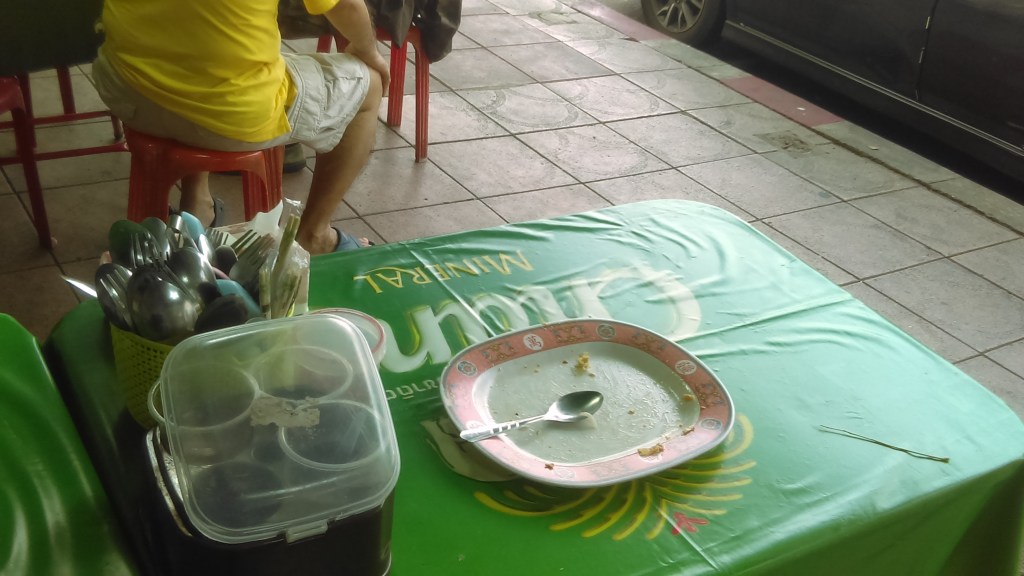
I bought a 刈包, “guàbāo” (above) from a stall. I ate the guàbāo standing, as there wasn’t anywhere to sit down.

From Wikipedia, “Koah-pau or gua bao… or cuapao… also known as a pork belly bun…, bao,… or bao bun, … consists of a slice of stewed meat and condiments sandwiched between flat steamed bread … typically 6–8 centimetres (2.4–3.1 in) in size, semi-circular and flat in form, with a horizontal fold that, when opened, gives the appearance that it has been sliced. The traditional filling for gua bao is a slice of red-cooked pork belly, typically dressed with stir-fried suan cai (pickled mustard greens), coriander, and ground peanuts.” According to the MOFA Taiwan, “In those days of material poverty, pork was a rare treat, so people had the chance to eat gua bao only on special occasions like year-end banquets or when venerating the local earth god. … It was not until the 1970s that gua bao became widespread in the daily lives of ordinary people.”

Finally the cold and the virus overcame me, so I headed for home on the MRT, and went to bed. As I write, three days later, I still feel the virus.

Wat Pho, Bangkok – – from Wandering Richard (http://wanderingrichard.com)

January 13, 2025

I’m in Bangkok, with Wren who was my tutor in Chinese, and Ben her partner.

I made the airline bookings half a year ago, booked the hotel room well in advance, and paid for my travel insurance. I was really looking forward to the holiday in Bangkok. Then, only a few weeks ago, my mother was diagnosed with advanced ovarian cancer. I immediately started to book my airfare home, but my parents were strongly against me coming back. My father said this is a sustained effort over years, a marathon not a sprint. Over Zoom, my mother said that she was inundated with offers of assistance, and me coming back to live with her wouldn’t help. So, very reluctantly, I stayed in Taipei, and went on this trip. I still will be going back home in a little over a month.

I noticed that the internet censorship in Thailand are increased. YouTube is blocked, so I have to update this blog with a YouTube clip back in Taiwan. My Australian bank is also blocked, for reasons known to the Thai authorities but not to me; I do my banking over the Internet so this is an annoyance for me. The Sydney Morning Herald, an Australian newspaper to which I have an internet subscription, is blocked as well. Oddly, VPNs are not blocked, so I could use a VPN to get around all this.

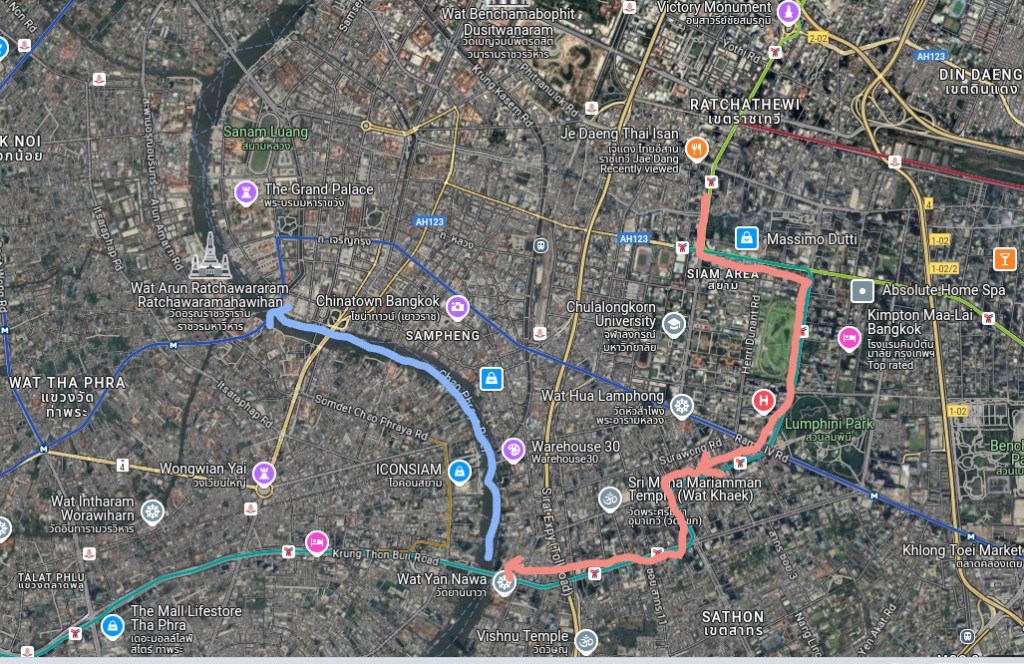
My route, courtesy of Google Maps. I went on the BTS from Ratchatewi BTS station to Saphan Taksin BTS station on the Chao Phraya riverbank, then caught a riverboat to Tha Tien pier, next to Wat Pho, in the heart of the old city next to the Grand Palace. There was an easier way to arrive, on the MRT to Sanam Chai MRT station convenient to the old city, but I wanted a ride on the riverboat.

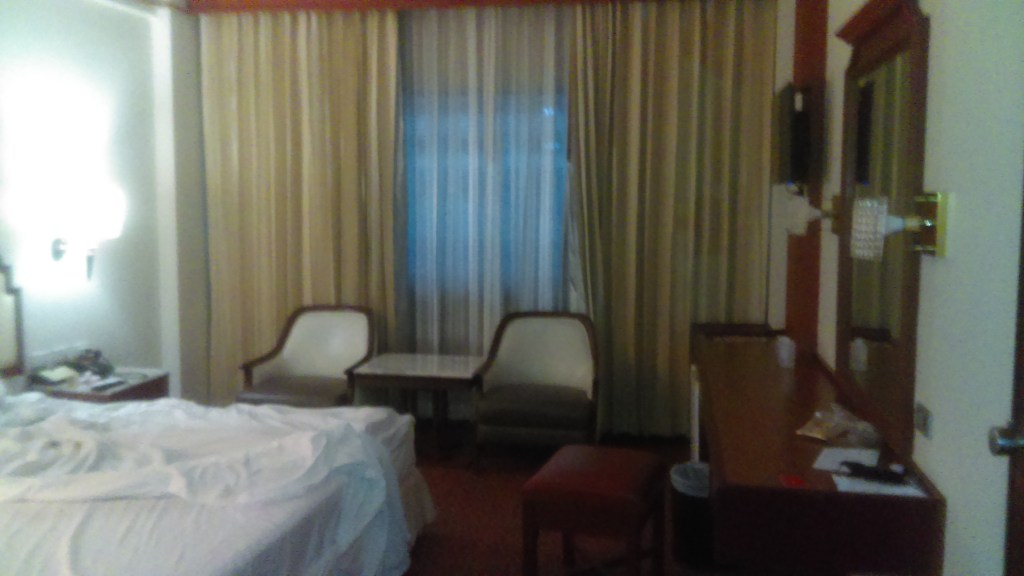
My room at the Asia Hotel. I booked a long way in advance and secured the room for $AUD55 a night. The Asia Hotel is rumoured to be haunted; TraveMyth says: “Asia Hotel in Bangkok is believed to be one of the most haunted hotels in Thailand. Apart from its general spooky and misty atmosphere, some guests have reported hearing crying sounds coming out of the bathrooms, feeling someone touching them when they sleep or seeing strange apparitions wandering around”.

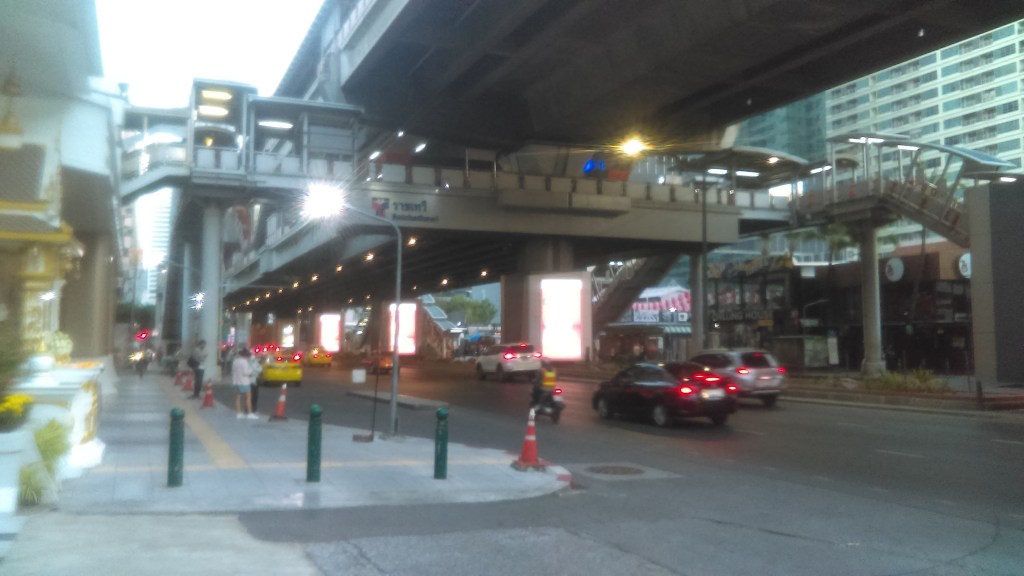
The Ratchatewi BTS station above Phaya Thai Road. Note there is a spirit house at the far left. There is an entrance-way directly into the Asia Hotel. I left the Asia Hotel early, about 7am. On this day the weather in Bangkok was remarkably cold, around 20 degrees Celcius – chilly for Bangkok!

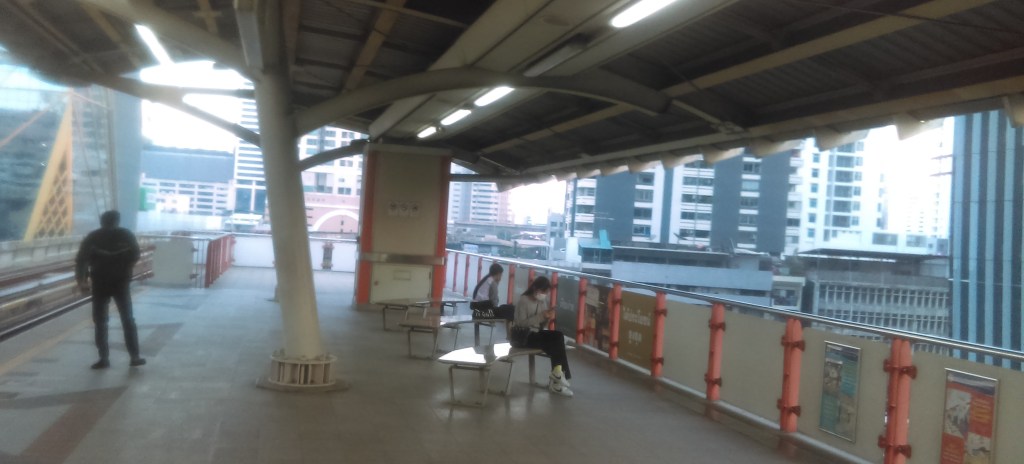
On the platform high above the road, waiting for the BTS train. I was supposed to change trains at Siam BTS station, but I was too busy photographing the scenery and forgot. A quick round of trains put me right.

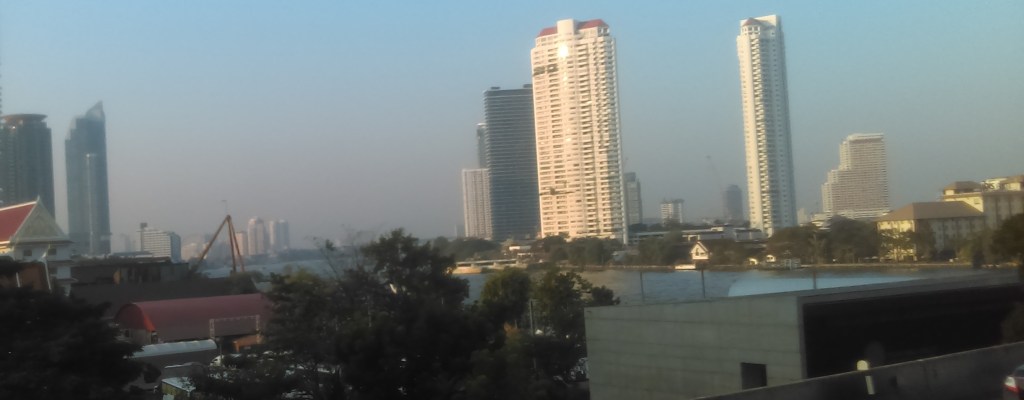
At the Saphan Taksin BTS station, and my first glimpse of the river.

I bought my breakfast at the 7-11 but didn’t eat it. As a result by this stage I was ravenously hungry, so had my breakfast at the Saphan Taksin pier, watching life beside the river.

A long-tailed boat: “The longtail gets its name from the trailing drive shaft and propeller at the back of the boat. … The engines at the back of the boats are sometimes custom-made, but more often than not they are simply a converted car or truck diesel engine which makes them relatively cheap and easy to maintain. The boatman sits or stands at the back of the boat whilst the passengers sit in front of him on small wooden planks. An overhead canopy provides shade and shelter and some boats also have pull-down plastic canopies that cover the sides to protect passengers from spray or rain.”

Life on the water.

A river ferry letting off passengers.

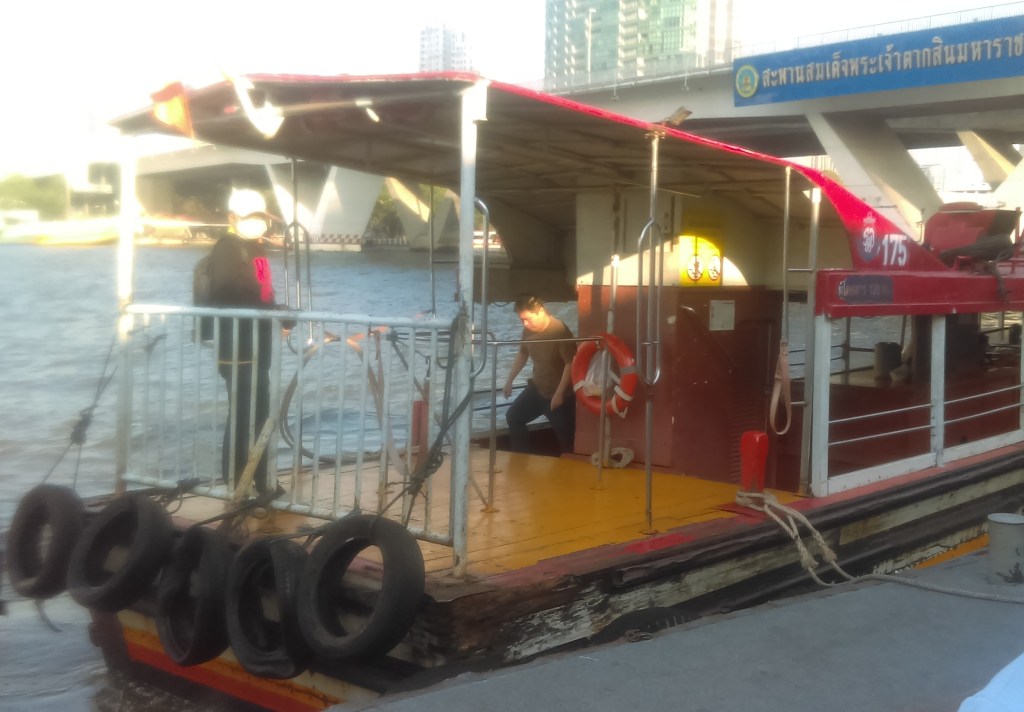
And here’s my river-ferry! A big step over the side of the boat and down into the front where I took my seat.

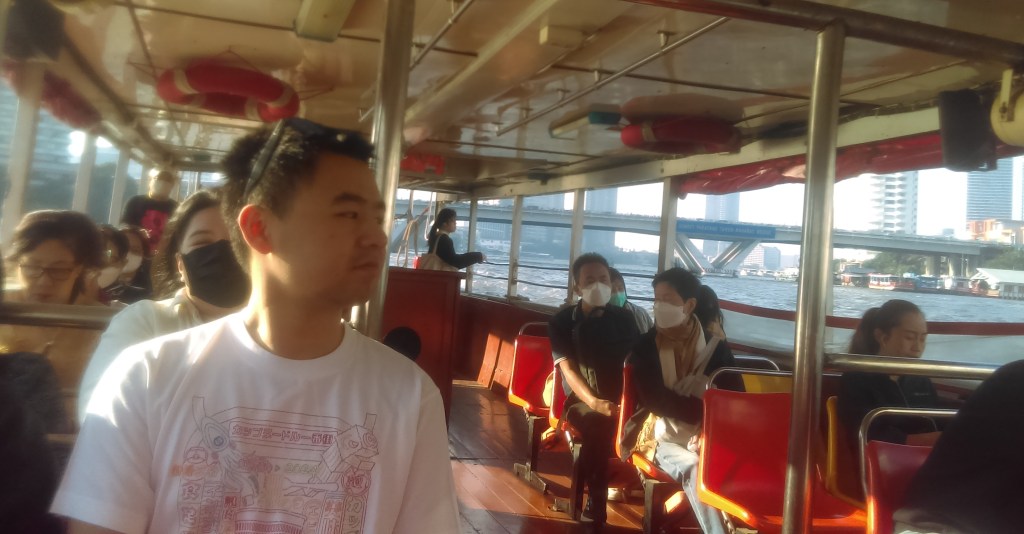
A view back aft.

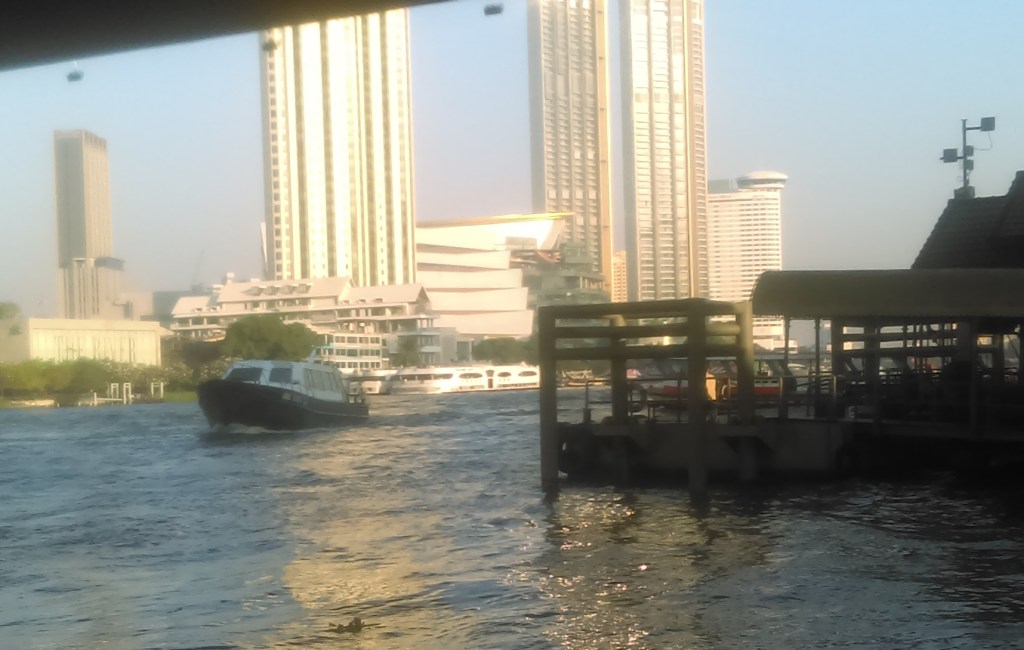
There was some rough water as we roared along.

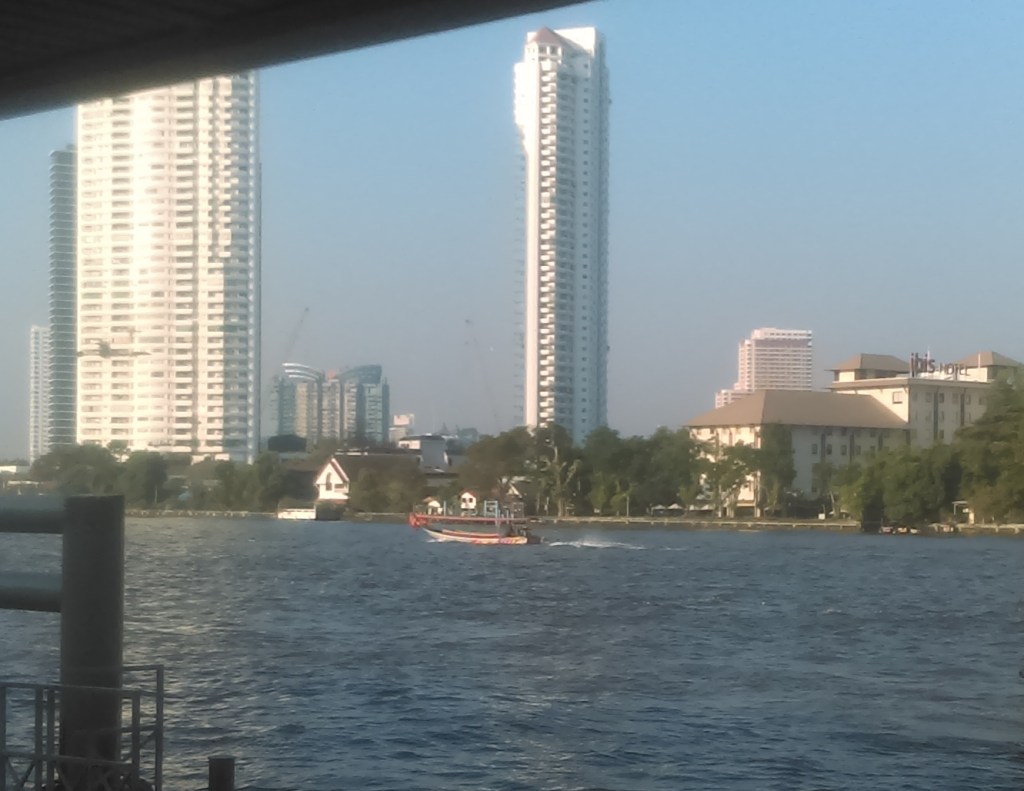
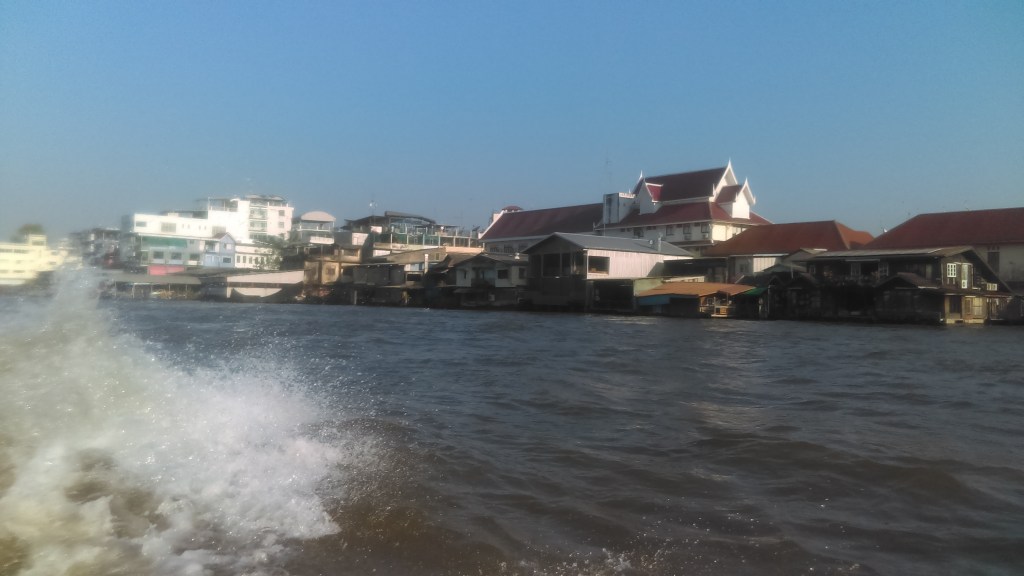
Nice view of the riverbank.

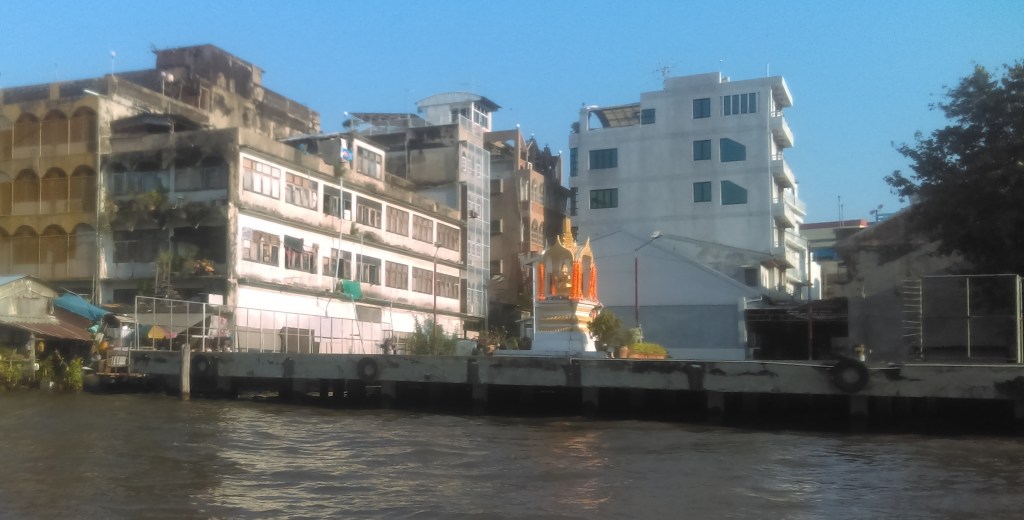
A prominent spirit house: “you may wonder what are those little buildings in front of your apartment or nearby restaurants? They look almost like miniature temples on pedestals. However, these are Spirit houses, also called San Phra Phum in Thai. San means shrine and Phra Phum means Spirit, God or Angel. Thais believe that protector spirits live in these little houses so they will build one in front of their home or business.”

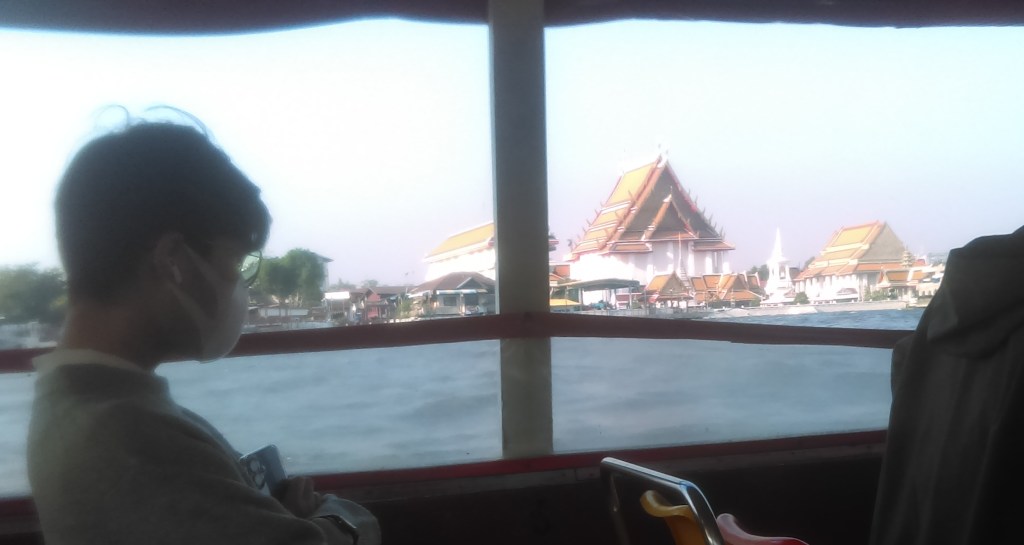
A framed view of a large wat complex, probably Wat Kanlayanamit Woramahawihan.

The Royal Seminary: “This beautiful ochre coloured building stands on the east bank of Chao Phraya river. It is a Neo-Classical building which was constructed 136 years ago. … after Queen Sunantha Kumariratana drowned in the Chao Phraya River King Rama V built this Sunanthalai Building in her memory.” Wikipedia said “There is an often repeated myth that the many witnesses to the accident did not dare to touch the queen, a capital offense—not even to save her life. However, this was not the case; the King’s diary records that boatmen dived into the water, pulled the queen and her daughter from the entangling curtains, and carried them to another boat, where attendants worked in vain to resuscitate them.”

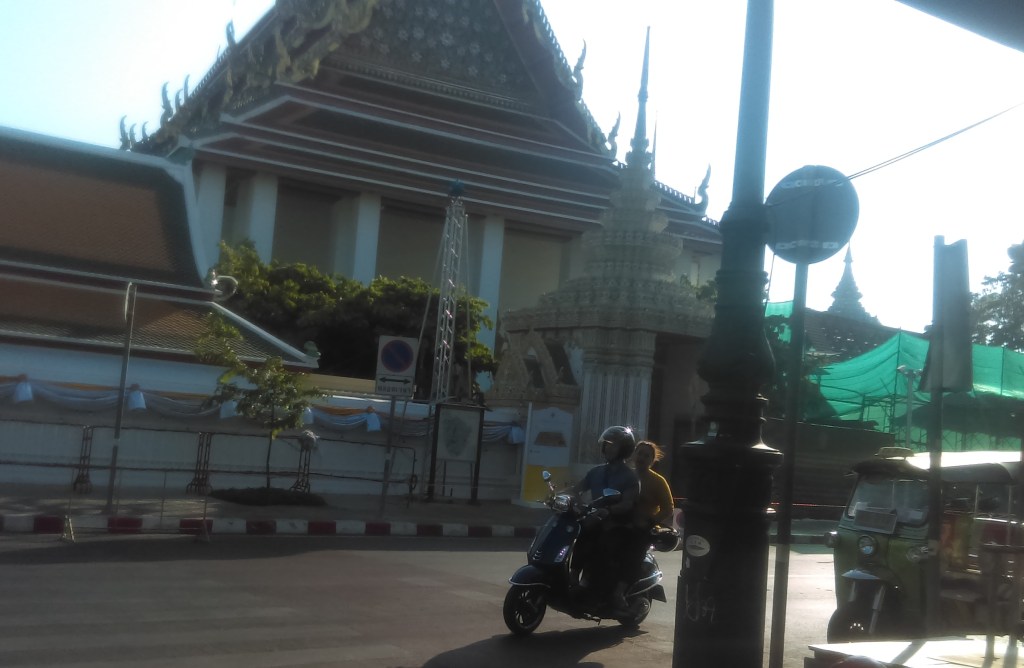
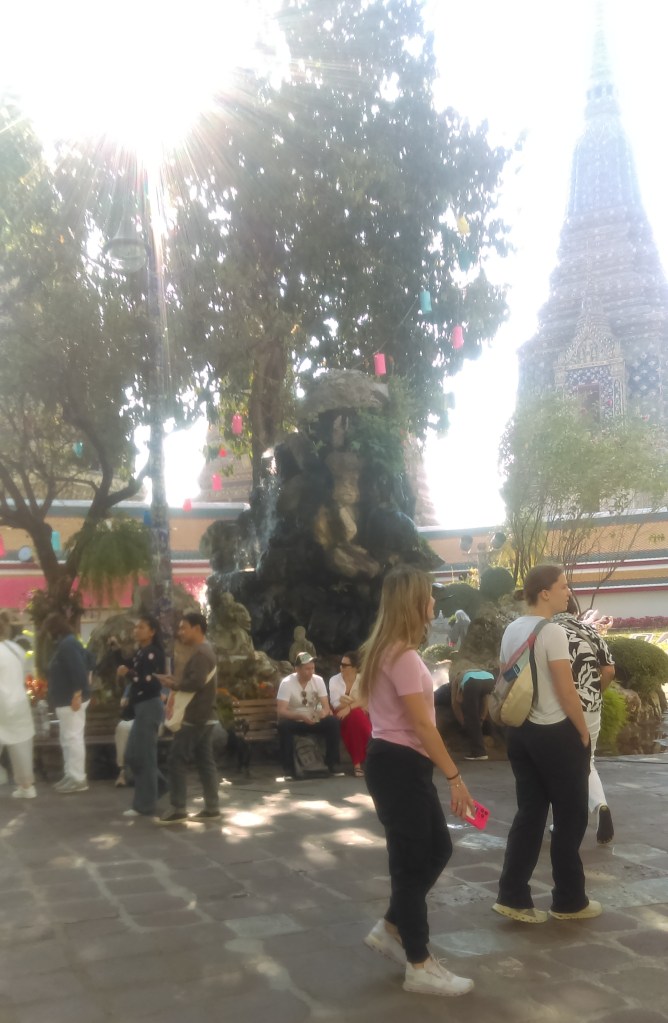
I disembarked the river-boat at Tha Tien pier and walked a block to Wat Pho (above). The building behind the gate houses the Reclining Buddha.

Wikipedia said “The temple is first on the list of six temples in Thailand classed as the highest grade of the first-class royal temples…. It is associated with King Rama I who rebuilt the temple complex on an earlier temple site. It became his main temple and is where some of his ashes are enshrined…. The temple was later expanded and extensively renovated by Rama III.”

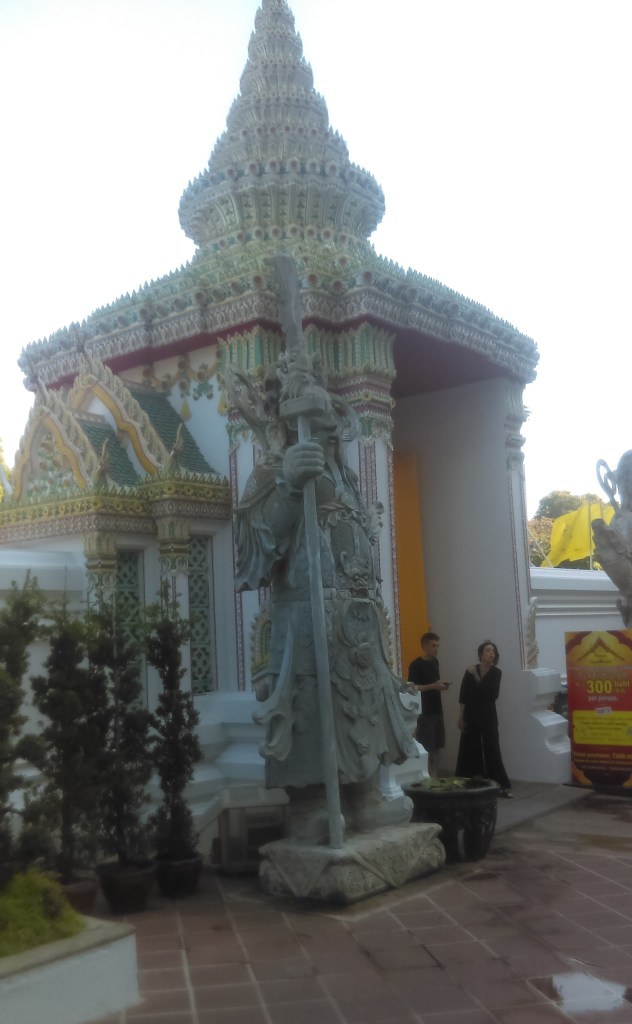
Another gate. According to Wikipedia, the statue is one of the Chinese statues that were imported from China as ballast.

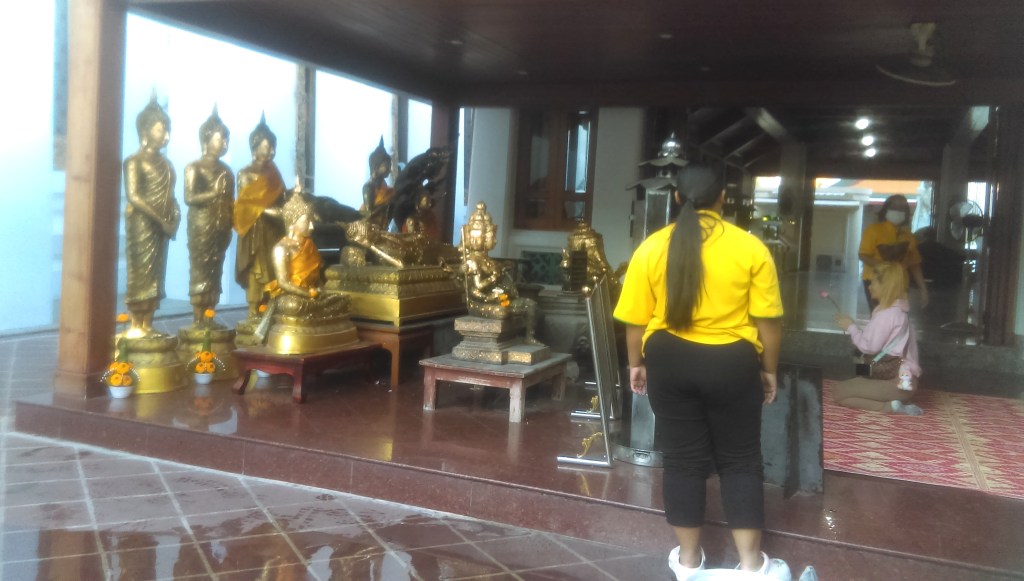
A woman worshiping in front of images of the Buddha. Wikipedia said “During its construction [in 1788], Rama I also initiated a project to remove Buddha images from abandoned temples in Ayutthaya, Sukhothai, and various other sites in Thailand, and many of these retrieved Buddha images were then kept at Wat Pho”.

I paid the entrance fee of BTH300; Thais get in free. When I go back to Taiwan I plan to put a YouTube clip here, as YouTube is banned in Thailand – watch this space!

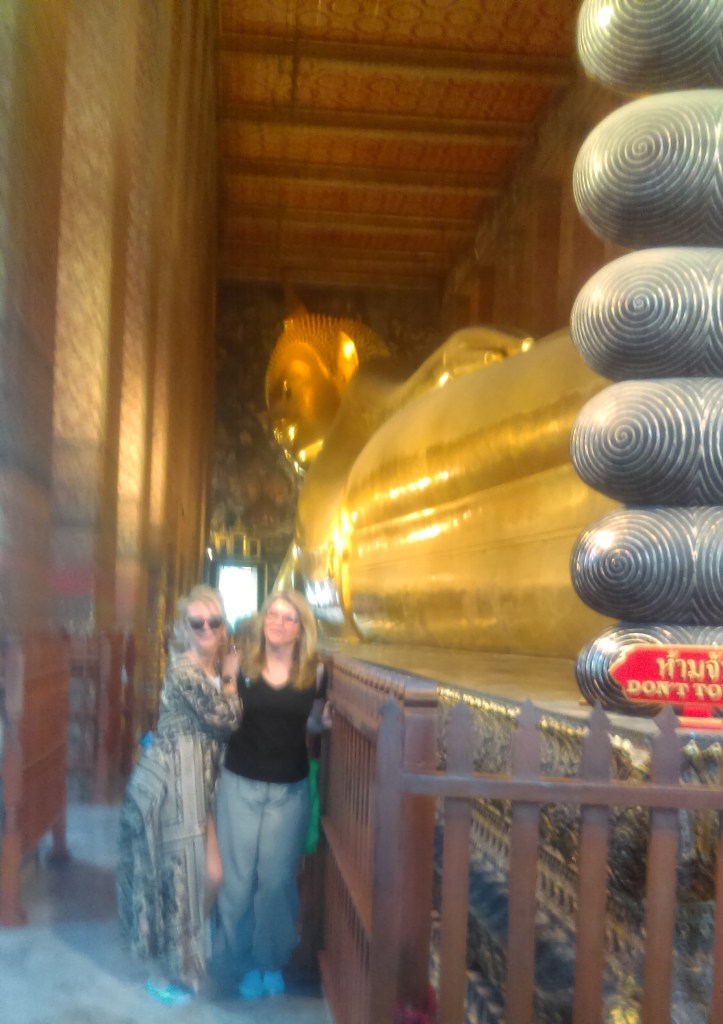
The Reclining Buddha is actually about to die. Lonely Planet said “Located in the compound’s main wí·hăhn (sanctuary), the genuinely impressive Reclining Buddha, 46m long and 15m high, illustrates the passing of the Buddha into nirvana (i.e. the Buddha’s death).” This was viewed as a good thing: the cycle of reincarnation after reincarnation was about to end.

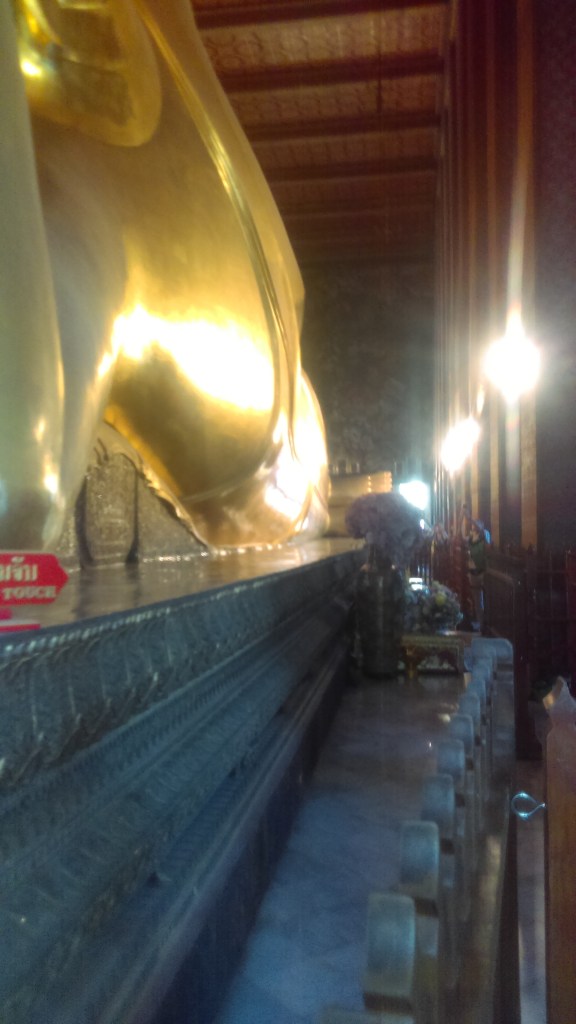
Looking from the head to the feet. When you are in the hall you feel the sheer enormity of the Reclining Buddha. The Civilatis Bangkok said that this is “the largest Reclining Buddha statue in the country. At 150 feet (46 m) long, this gold-plated figure barely fits in the temple that shelters him!”

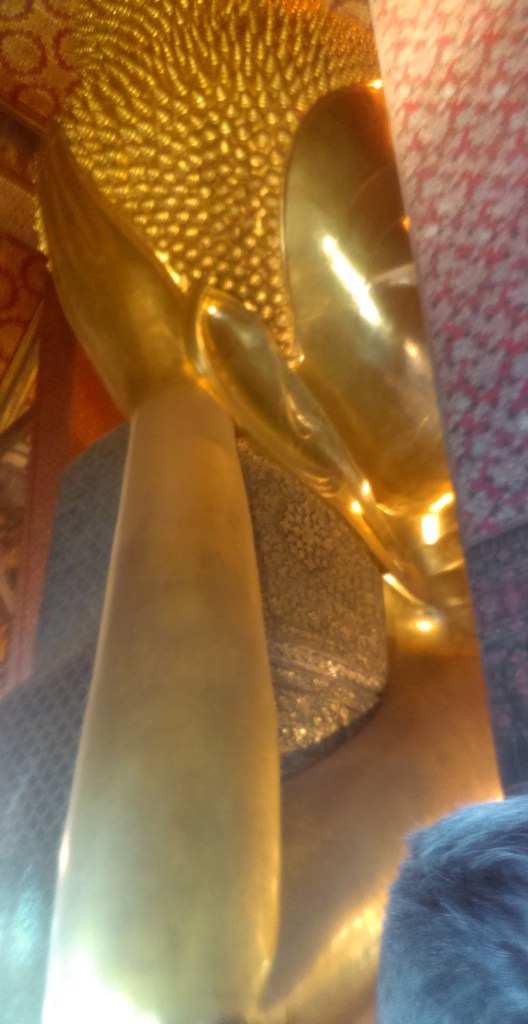
The view reversed, looking from the feet to the head. At the extreme right you just catch a glimpse of the underside of the feet. Emerald Buddha said “The soles of the feet of the reclining Buddha are exquisitely crafted with inlaid mother-of-pearl shell. At the centre of each foot is a symbol of a wheel (dharma- cause and effect) and representing one of many chakra energy points where universal energy flows into the body. Portioned into 108 sections and displaying auspicious symbols identifying The Buddha, including flowers, dancers, white elephants, tigers and altar accessories.”

Standing next to the hall. Apart from the Reclining Buddha, as Wikipedia said, “The temple is considered the earliest centre for public education in Thailand, and the illustrations and inscriptions placed in the temple for public instructions has been recognised by UNESCO in its Memory of the World Programme. It houses a school of Thai medicine, and is also known as the birthplace of traditional Thai massage which is still taught and practiced at the temple.” I saw none of those things.

Instead, I was going to see Wat Arun, the Temple of Dawn (above). Wat Arun said “It’s one of the most spectacular and recognizable Thai landmarks…. Visitors journey here in pilgrim like status, due to it’s one of few temples you are permitted to climb its main staircase, rewarding the intrepid with panoramic views of the bustling Chao Phraya river, the Grand Palace and Wat Pho on the opposite bank. … King Taksin (1734–82) when establishing the new capital of Thonburi, following the fall of Ayutthaya (previous Thai capital), brought with him from Vientiane, Loas, The Emerald Buddha which was previously housed in one of the two small buildings located in front of the Grand Pagoda.” It ended up in the Temple of the Emerald Buddha.

I took a short ride on a cross-river ferry (above). When I reached Wat Arun, the entrance fee was BTH200. Around this time, my mobile phone camera indicated it had reached the limit of photos; to take new photos I would have to delete some old ones. I was only going to briefly visit Wat Arun, so I decided to skip it, and go back on the cross-river ferry again. I walked past all the attractions the old city had, and went to Sanam Chai MRT station and home.

Phnom Penh, Cambodia from Wandering Richard (http://wanderingrichard.com)

November 23 – November 27, 2024

I’m in Phnom Penh, Cambodia.

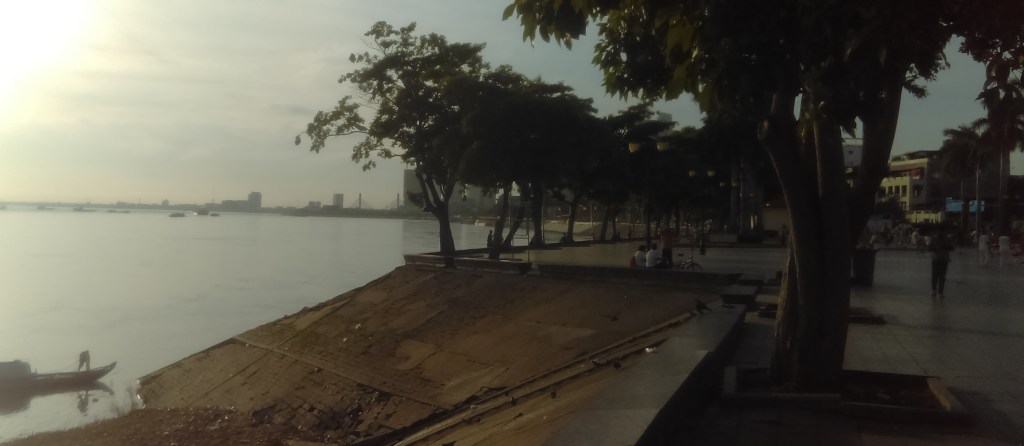
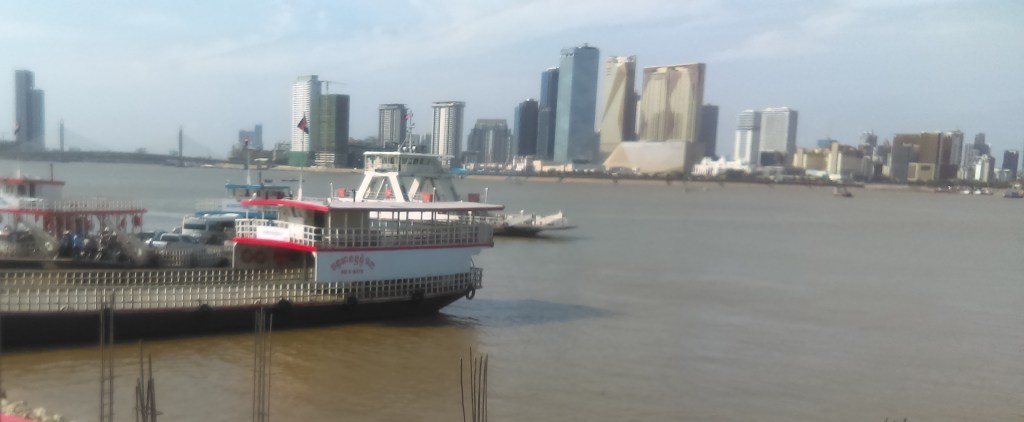
Above is a view of the Tonle Sap river, just 100 meters from my hotel, near sunset.

I’m here in the week between the old MTC course finishing and another one beginning. I booked the airfare and the hotels several months in advance, securing early bird discounts. Unfortunately, a few weeks ago, someone committed identify theft on my credit card. Over perhaps two weeks, they added bogus charges, slowly increasing them to avoid alerting the automatic detection mechanism. I eventually realized and cancelled the card, sending the new card to my address in Taiwan. 

Unfortunately, it didn’t come when I was due to fly to Cambodia.  So I was unable to pay for things over the Internet, including my Cambodian visa. I was also unable to use the ATM in Cambodia.  So I didn’t use the financial system in Cambodia at all.

Before leaving, I had withdrawn slightly less than $AUD 1,000. I flew into Phnom Penh International Airport and paid the “visa on arrival” option in cash. Next I went outside, caught a bus to the riverside, and walked to my hotel. I was apprehensive I would have to pay the accommodation bill, but fortunately it was already paid. A big relief!

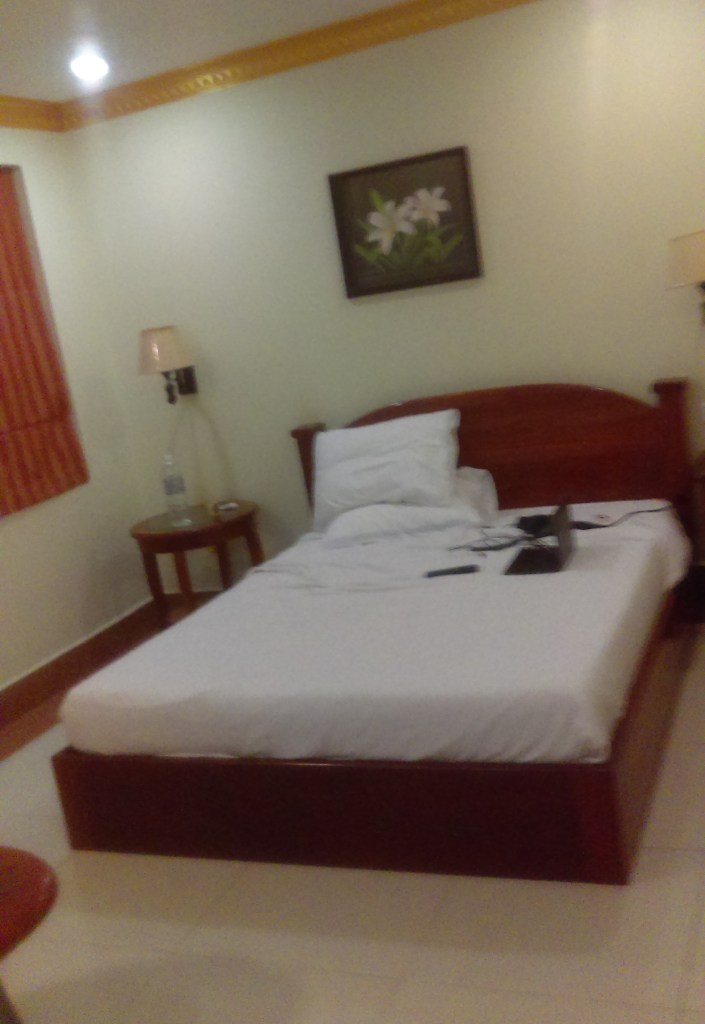
My room. Not shown is the en-suite bathroom and cable TV. The cost is around $AUD 50 a night. The hotel is downtown, a block from the river. I can walk to the National Museum and Wat Phnom.

Phnom Penh according to Google Maps. My hotel is circled in red. All along the riverside, from Wat Phnom to the ferry crossing (shown in light red) is a combination of hotels, bars, restaurants (both Western and Khmer), and markets. It’s a bustling, lively atmosphere.

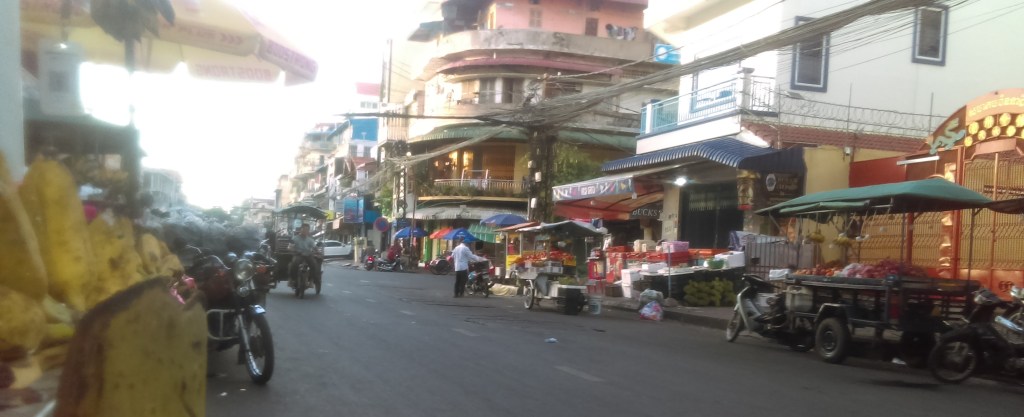
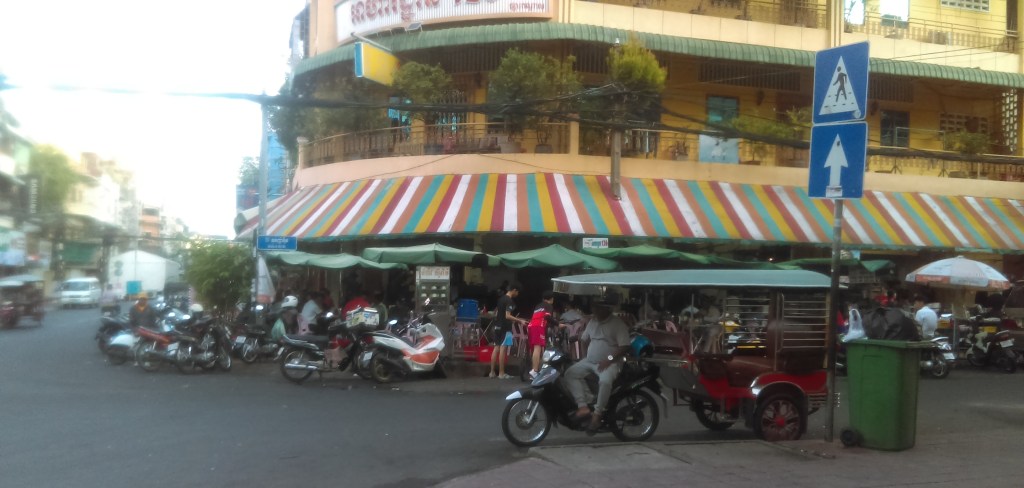
General street life. Note in the above photo a “tuk-tuk”, a vehicle mating the front half of a motorcycle with the back half of a cart. The more modern version is in this article.

Above is a view of the Tonle Sap river, this time about 6am.

A different view from about the same location, looking at the meeting with the Mekong River.

There is a market a block from my hotel. According to Google maps, it does’t have an English name, only “នំបញ្ចុកខ្មែរ ឆ្ងាញ់ ឆ្ងាញ់” in Khmer. In the above photo it’s the whole block to the right of the lane, a warren of tiny huts selling groceries or food.

It was busy in the mornings near the market.

While I was taking photos, a guy arrived on his motor-scooter, with a tub of food on the pillion seat. He then proceeded to sell the food (above) off the bike. Note the butcher’s shop in the background, raw meat displayed for sale.

A block from my hotel was this Khmer cafe/restaurant. This quickly became my new favorite place; I ate there almost every morning.

The blurry photo above is what I ate every morning: an iced coffee, a pork bao already eaten, and a beef stew with a baguette:

“Intensely rich, savoury, and a little sweet … something incredibly more-ish that you’ll be eating until the last spoonful and then licking the bowl. Our favourite way to eat it is with a crunchy French baguette”.

One morning I decided to cross the river. I left my hotel, marked with a dark red circle in Google Maps, to take a tuk-tuk down to the Kampong Chamlong Phnom Penh Areiy Ksatr wharf. You can check the Google Maps above, shown in light red.

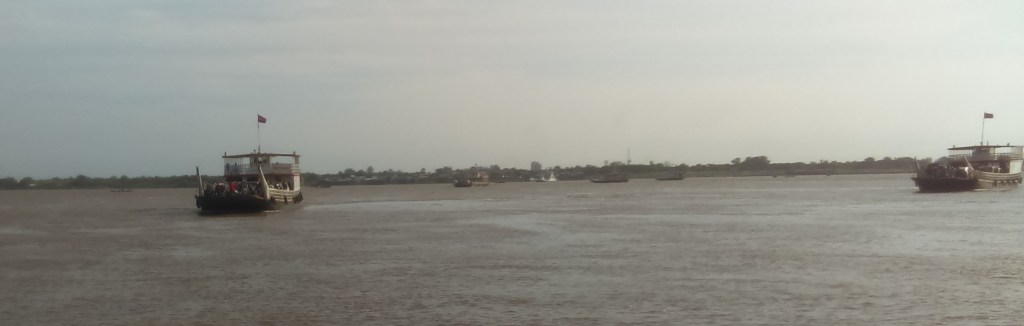
The photo above is that wharf, with some ferries discharging passengers and motor vehicles.

Preparing to board the ferry. The ferry was pushed up only by the action of the propellers, seen causing turbulence in the left side of the photo. Cars and trucks drove on over the ramp in the bottom right of this photo, as did I. When the ferry was full, the captain reversed the propellers, and we were off.

Nice view, although hot – I estimated over 30 degrees.

There were many other vessels doing the same.

This photo is of the Mekong River, from the Sokha Phnom Penh Hotel on the peninsular to the right, to Kandal Province on the left.

“The Mekong or Mekong River …is the world’s twelfth-longest river and the third-longest in Asia with an estimated length of 4,909 km (3,050 mi)… From its headwaters in the Tibetan Plateau, the river runs through Southwest China (where it is officially called the Lancang River), Myanmar, Laos, Thailand, Cambodia, and southern Vietnam.”

Just even hearing its name exerts a powerful effect on me. In 2008 I traveled up the Mekong River, from its several mouths in southern Vietnam near Ho Chi Minh City, through Phnom Penh, Vientiane in Laos, Luang Prabang, and Jǐnghóng (景洪) in China – 5 months total, over 3,000 kilometers. An interesting (and now, nostalgic) time.

In Areiksart Ferry Port, looking over at the skyscrapers of Phnom Penh.

The view along the road from the Areiksart Ferry Port.

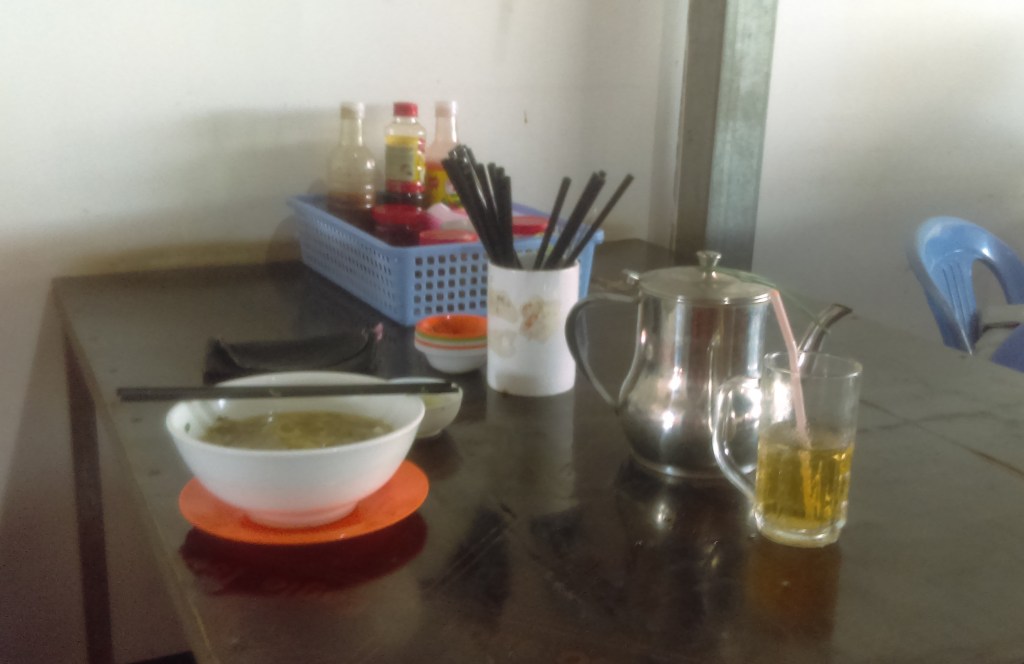
The day was hot, so I stopped at a restaurant. The waitress spoke no English, but I pointed to another customer’s order, resulting in the noodle soup above. The tea was complimentary.

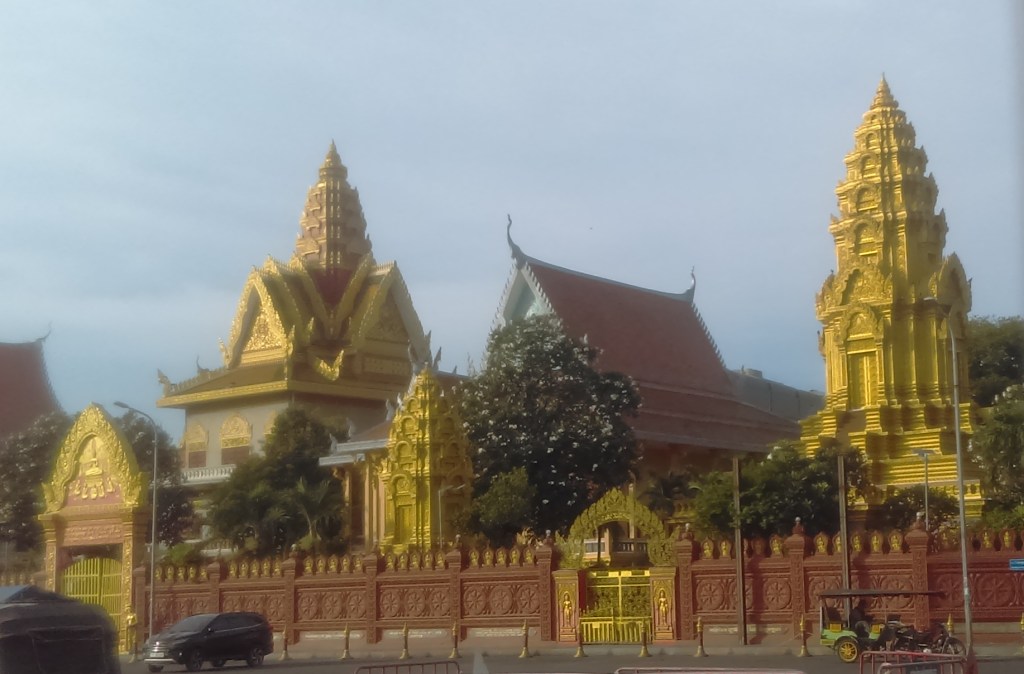
On another day, I went past Wat Ounalom:

“It was built in 1422 by King Ponyea Yat, the last king of the Khmer empire. …Wat Ounalom is recognized as the ‘headquarters’ of Cambodian Buddhism. The patriarch, the chief abbot of Cambodia, resides here. … This monastery was home to over 500 monks and housed a huge library consisting of over 30,000 titles. During the regime of the Khmer Rouge, many of the buildings along with many religious statues and symbols were damaged, but most of which have since been restored. The buildings are used for a variety of purposes. There is the temple itself, schools, libraries, living quarters and the stupa that gives the temple its name; the stupa holds an Ounalum, a hair from the eyebrow of the Buddha.”

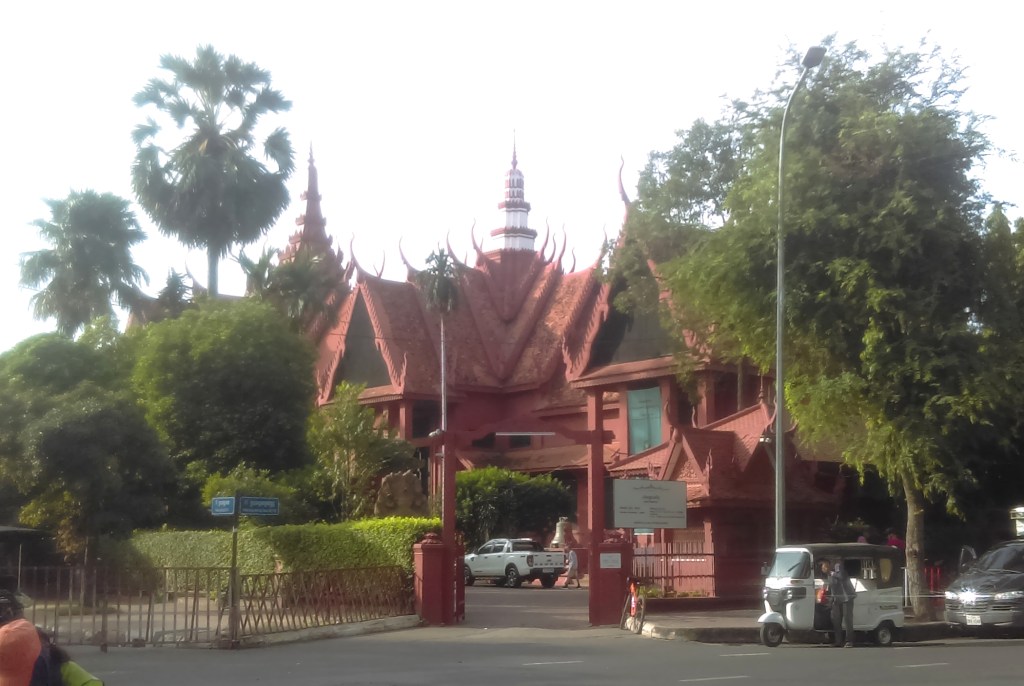
I was heading for the National Museum of Cambodia (above). I’ve been a few times so this was a quick visit.

Lonely Planet says: “The National Museum of Cambodia is home to the world’s finest collection of Khmer sculpture: a millennium’s worth and more of masterful Khmer design. It’s housed in a graceful terracotta structure of traditional design (built from 1917 to 1920) with an inviting courtyard garden, just north of the Royal Palace.”

Inside the building. While writing this up I found that “visitors are not allowed to photograph the collection, only the central courtyard” – so the above photo is illegal.

The central courtyard (where photography is permitted) is a very elegant place.

Next I planned to go down to Kampot for the day.

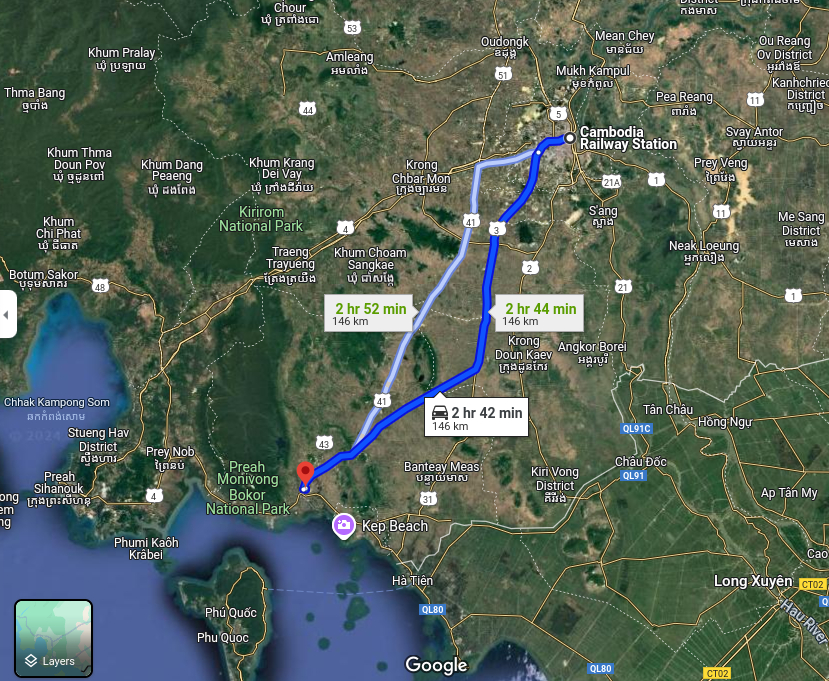
From Google Maps, Phnom Penh to Kampot is 146 kilometers. An equivalent is Sydney to the Hunter Valley. I was taking the train, which meant nearly 4 hours’ travel. I planned to go down to Kampot by the 7am train, spend 5 hours there, and take the afternoon train back up to Phnom Penh. I booked the tickets in person a few days before.

The day of the trip to Kampot, I got up very early, before 4am. Exiting the hotel, a film crew was at work, filming a scene in the middle of the street. Fake pedestrians, fake tuk-tuk drivers, even a fake backpacker took their positions, and on the call of “Action!”, pretended to walk. It was a little over 5am and still dark. I tried to take a photo, but one of the film crew stopped me, so I took this photo from a distance. It was very strange.

The Phnom Penh Train station in the early morning. The website says:

“Phnom Penh Railway Station was constructed during the French colonial era, opening to passengers in 1932. Despite being effectively out of use as railway station for an 11 year period from 2005 to 2016 Phnom Penh Railway Station is a beautifully preserved building from a much different era.”

Behind the station, several trains were waiting. Our train was the one at the left, a single car.

The above YouTube clip gives you a flavour of the ride. I think it’s a Thai train in the clip.

I was on a different train to that clip; the windows didn’t open and it was split about half between tourists and Khmer.

The railcar moved out of Phnom Penh’s suburbs at an estimated 40 kilometers an hour. We trundled on a dead flat plain (above) with relatively scrubby vegetation.

After 2 hours or so, we passed through a line of hills, and the vegetation improved. This was classic Cambodian countryside.

I go off at Kampot and hired a tuk-tuk to get me to the centre of town, beside the river. I paid the driver $US 1.

The Wikivoyage page says: “Kampot’s main draw is its relaxing riverside setting. While there is a sizable town (population approximately 40,000) set back from the river, most tourists will spend most of their time enjoying the river. Most tourist businesses are scattered along the riverside promenade or are within one or two blocks of it. The riverside’s main reference points are the ‘old bridge’, a mongrel of various styles and temporary parts thrown together after its breaching in the Khmer Rouge days, and the French-built market building, which is being restored. Back from the river, the town is centered on the bizarre ‘durian roundabout’ featuring a huge statue of a durian. From where the buses drop passengers, walking down the wide boulevard leads towards the river and the French-built market.”

There were many tourist businesses by the river, including a few Western restaurants and a tourist night market a block from the river. I ate in one of the tourist restaurants (above).

Then I went back to the train station and waited for an hour and a half for the train – I think it was delayed. The train came and I boarded it. A few minutes later, some Khmer passengers boarded and demanded my seat. There was an unoccupied seat only a few seats over; a cautionary lesson on might makes right. I did move, and watched the countryside, and slept, waking up a few minutes before arriving at Phnom Penh Train Station.

I have enjoyed visiting Phnom Penh, and it appeals to me, although I think it’s a little too poor and rough to make living there enjoyable.

Taronga Zoo, Sydney – from Wandering Richard (http://wanderingrichard.com)

August 28, 2024

I’m in Sydney again, for one week while the Mandarin Training Center at NTNU in Taiwan is closed.

Sydney is a really beautiful place, but in my Wandering Richard webpage you’d never appreciate that. The Sydney Opera House, the Sydney Harbour Bridge, Bondi Beach – growing up in Sydney I became used to these places. But living in Taiwan, I now realise Sydney is a gorgeous city. I’ll try to show it off to you, by going to Taronga Zoo.

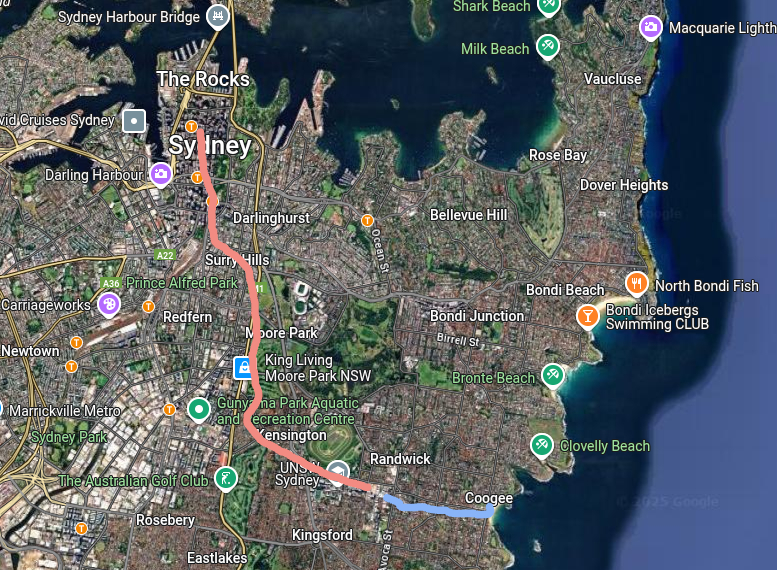
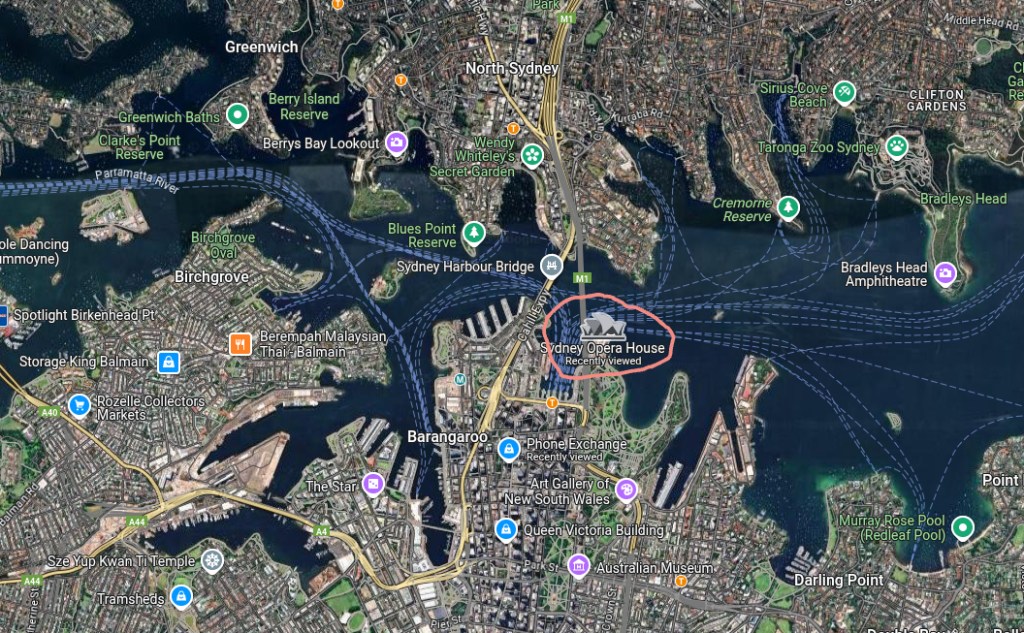
The Google Map above shows the route. From my parents’ house in Northbridge I took a bus to Wynyard in the Central Business District, changing to a ferry a Circular Quay (pronounced ‘Key’), sailed across Sydney Harbour to Taronga Zoo Wharf.

That day the weather was balmy and very windy; the temperature was around 25 degrees Centigrade. On the wind you could smell the enormous dry hinterland of Australia.

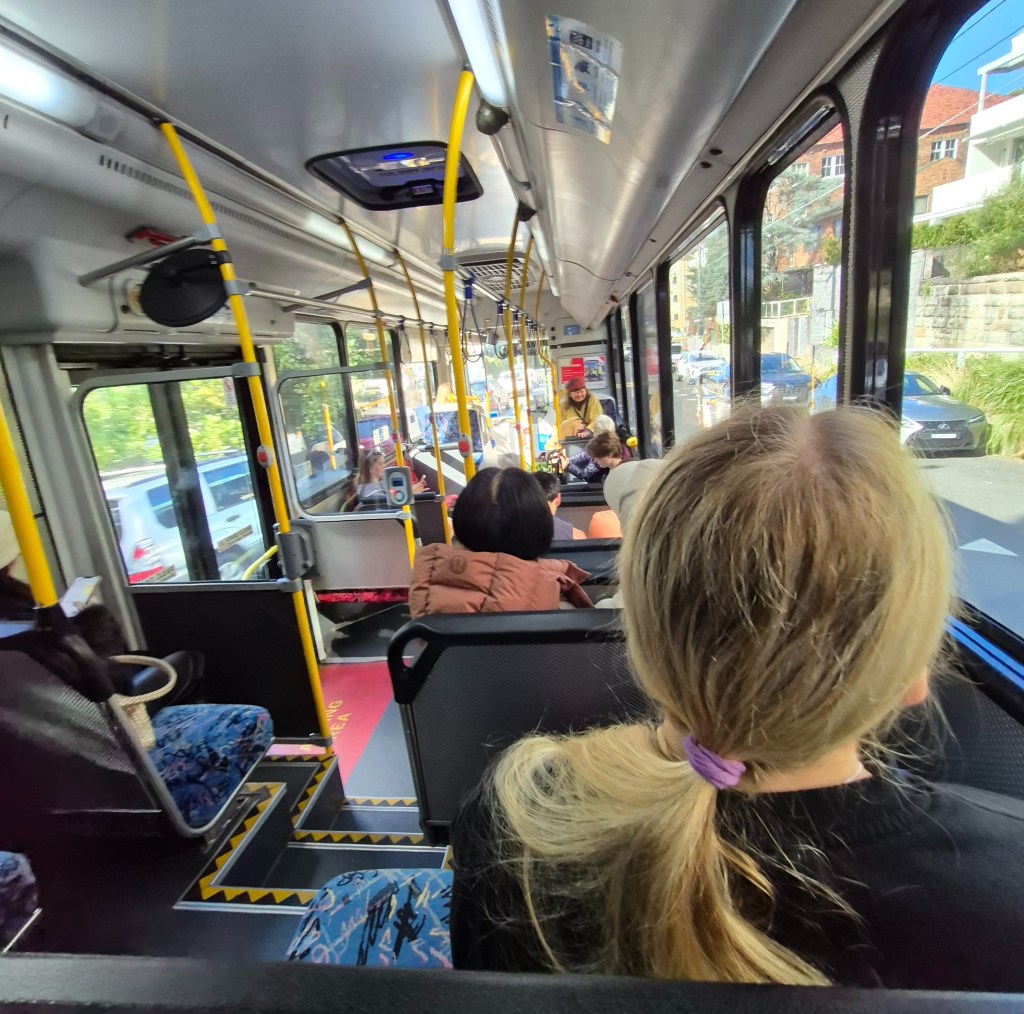
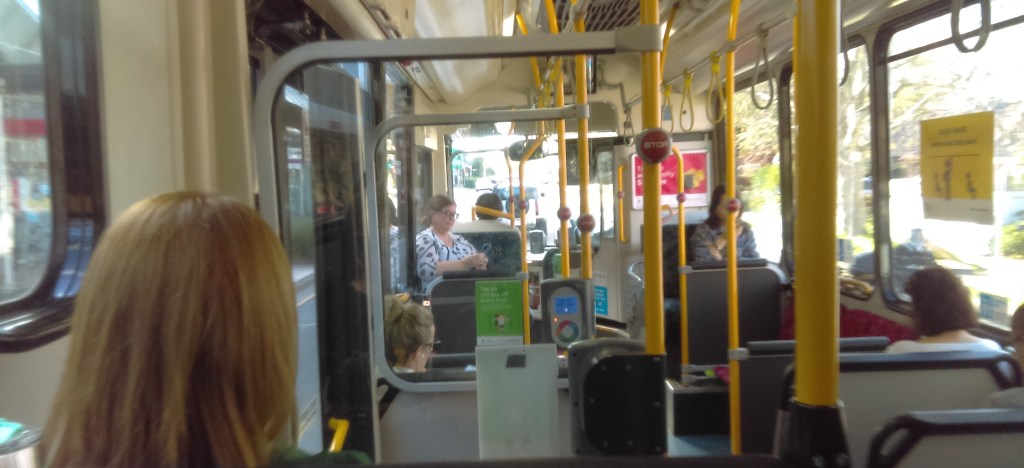
The above photo is of the 206 bus taking me from Northbridge. The time was about 9am. Note the lack of masks – Australians view COVID19 as ancient history.

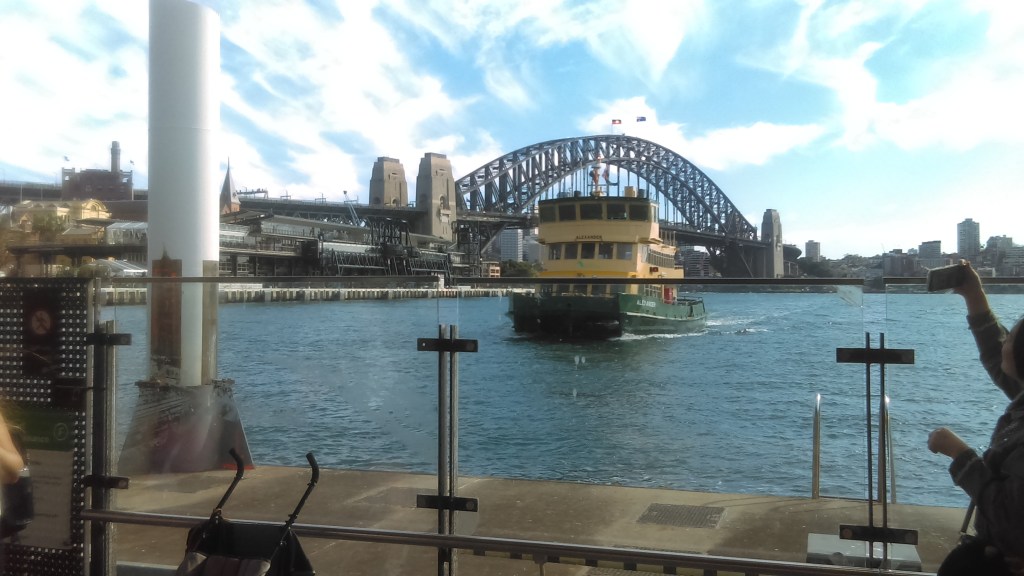
On the bus as we roared down the Cahill Expressway, a spectacular view outside from Sydney Cove – Sydney Harbour, the Opera House to the right, the Harbour Bridge to the left, a ferry just pulling out from Circular Quay below us.

The National Museum of Australia says “The arrival of the First Fleet at Sydney Cove in January of 1788 marked the beginning of the European colonisation of Australia. The fleet was made up of 11 ships carrying convicts from Britain to Australia. Their arrival changed forever the lives of the Eora people, the traditional Aboriginal owners of the land in the Sydney area, and began waves of convict transportation that lasted until 1868.” My great-great-great-great-great-great grandmother was on the First Fleet, as a convict.

I got off the bus nearby and walked a short distance, under Circular Quay Station, and took this photo facing the same direction (look at the Opera House). When I last visited Taronga Zoo pre-COVID19, the Zoo had a stand at Circular Quay where you could buy a combination entry fee and ferry ticket. Now I discovered it was all online, and since I omitted to bring my Chromebook I would have to pay inflated prices.

YouTube has many, many clips about taking the Taronga Zoo ferry. Here’s one that doesn’t feature an influencer.

Here comes the Taronga Zoo ferry.

I strode up the gangway and to the bows, and took this rather blurry photo. Most of the passengers were from overseas.

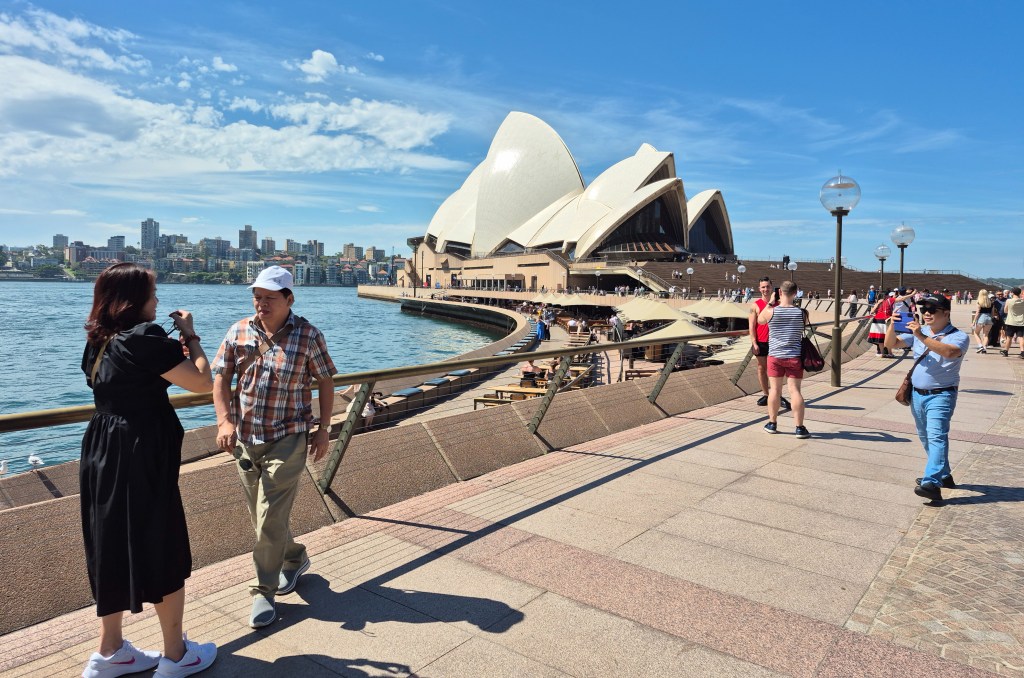
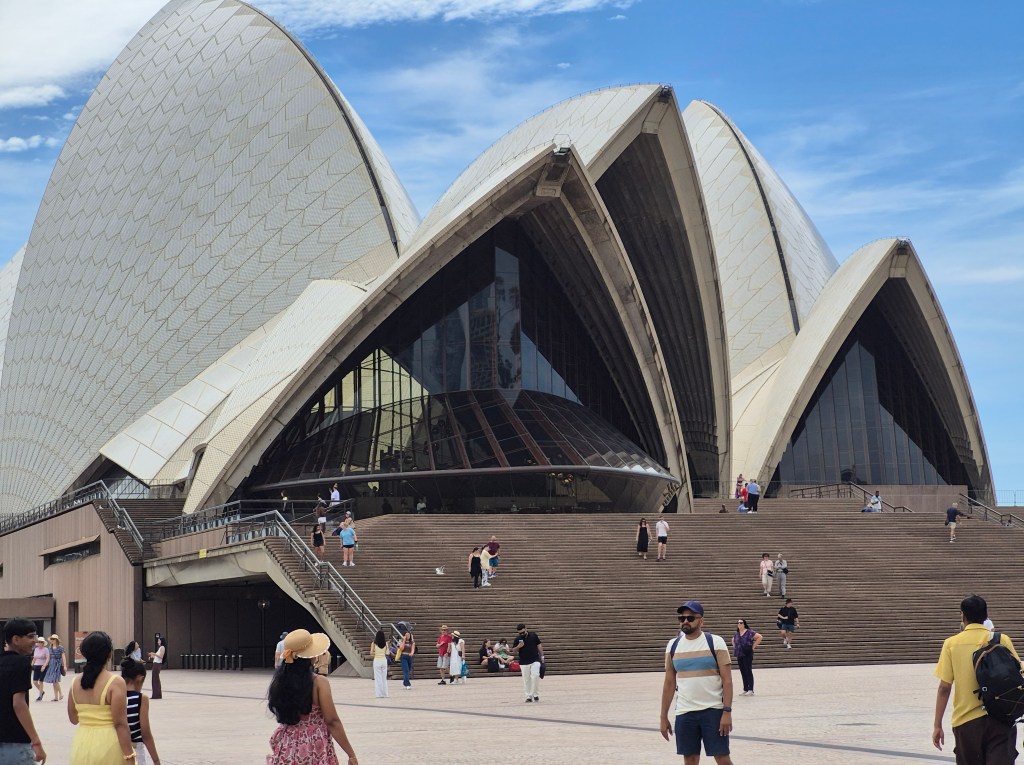
The ferry passed the Sydney Opera House.

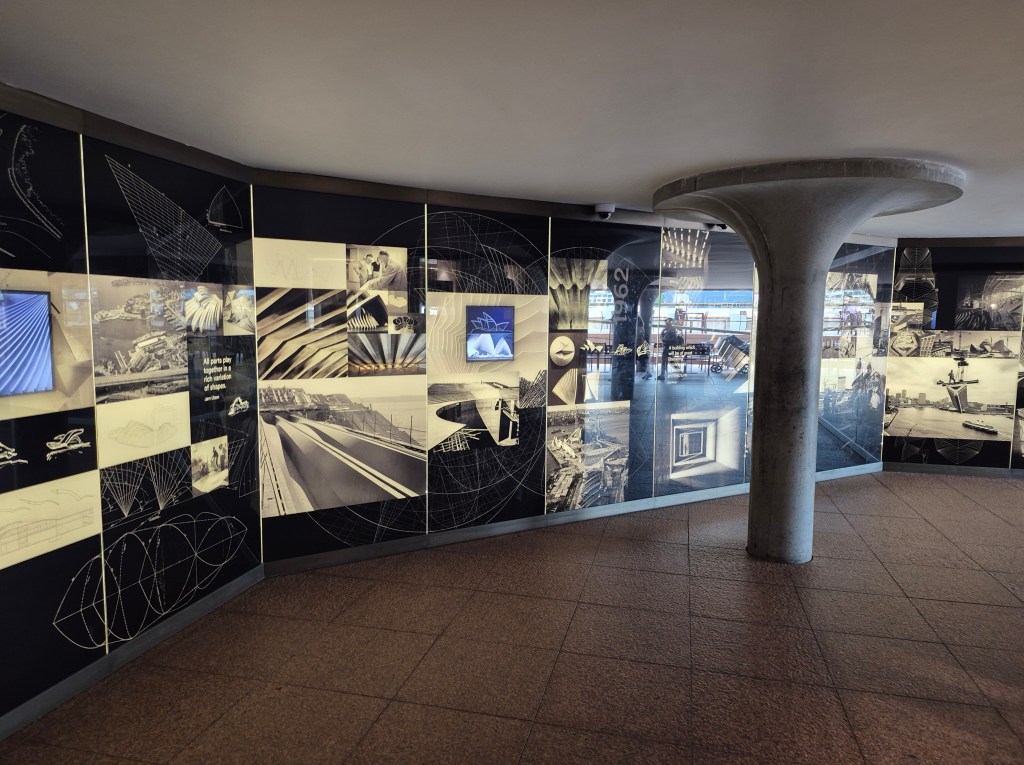
“The Sydney Opera House is one of the 20th century’s most iconic buildings. It broke new ground for design and engineering around the world. Since its opening in 1973 it has become a symbol the world immediately associates with Sydney and Australia. The story of the Opera House is a drama that for more than 15 years grabbed national headlines and pitted the artistic vision of the architect Jørn Utzon against the politics and budgets of the New South Wales Government and the limits of architecture and construction. … Finally, the Sydney Opera House was opened by Queen Elizabeth II on 20 October 1973. It was 10 years overdue and, at $102 million, 14 times the original budget. However, Australia was now home to one of the greatest buildings of the 20th century – an instantly recognisable piece of exhilarating architecture that remains a credit to this country and one with which Sydney and Australia are instantly associated.” (National Museum of Australia)

The Sydney Harbour Bridge:

“in January 1923 [Bradfield] issued calls for tender for the ‘Construction of a Cantilever or an Arch Bridge across Sydney Harbour’. … The government had to clear hundreds of houses from the northern and southern approaches to the bridge. … A total of 802 buildings were demolished. … In total more than 52,800 tonnes of steel were used; 39,000 tonnes in the arch alone. … Slowly the main span of the bridge was erected by cantilevering the two half arches towards each other from each shore. … On 19 August 1930 the two halves of the arch were joined, making the bridge self-supporting and allowing the cables to be removed. … Load testing began in January 1932 with 96 locomotives lined up end to end across all four of the bridge’s rail tracks. … More than 1,600 people worked on the bridge during the nine years of its construction, providing much-needed jobs for Sydney during the Great Depression. … By today’s standards industrial safety on the work site was poor. During the construction of the bridge, 16 men died. … The official opening of the bridge took place on 19 March 1932. … More than 750,000 people gathered around the harbour for the official opening event. The bridge was to be opened by the New South Wales Premier, Jack Lang. Before Lang could cut the ribbon and declare the bridge open, Francis De Groot, a member of the ultra-right-wing New Guard group, rode a borrowed horse out of the crowd and slashed the ribbon with his cavalry sword. De Groot was arrested. Lang cut a new ribbon, the bridge was declared open, and a public bridge walk took place. De Groot was fined £5. … The cost of building the bridge was £4,238,839, although with the costs of constructing the approaches, the land resumptions, and interest paid during construction, the total cost of the build was closer to £10 million. The debt was finally paid off in 1988. The Sydney Harbour Bridge has become one of the most recognisable icons, along with the Sydney Opera House, of Sydney and Australia.” (National Museum of Australia)

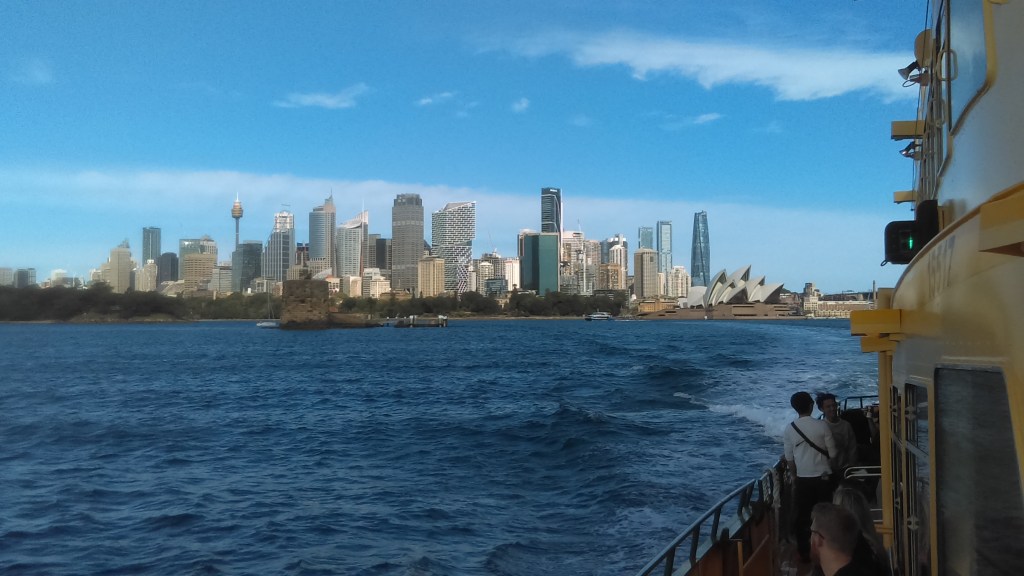
A good view of the Sydney skyline. The island to the centre right is Fort Denison.

“Fort Denison was originally a rocky outcrop to the north of Woolloomooloo Bay, known by its Aboriginal name of Mat-te-wan-ye, also spelt Muttewai or Muttenwaya. Governor Arthur Phillip renamed it Rock Island soon after European settlement to Sydney Cove, but it was informally known as Pinchgut Island. This colourful name is commonly believed to refer to the island’s use as place of punishment for convicts until the early 1800s, and the starvation diet they received there of bread and water. … In 1855 work began again on transforming the island into a fortification … The distinctive Martello tower – to the design of the forts that ringed the British coastline in the Napoleonic wars – was the only one built in Australia. … The Martello tower received some damage during World War II, when it was hit by a shell from the USS Chicago during an engagement with Japanese midget submarines entering the harbour.” (Dictionary of Sydney)

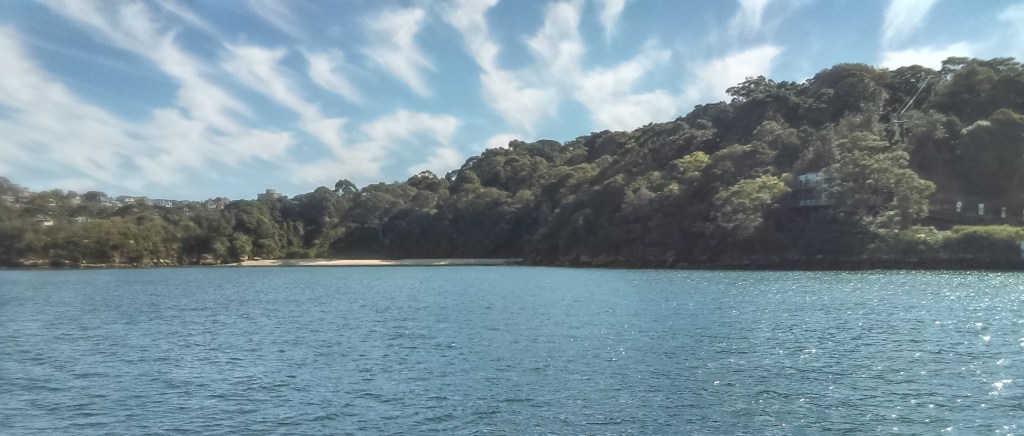
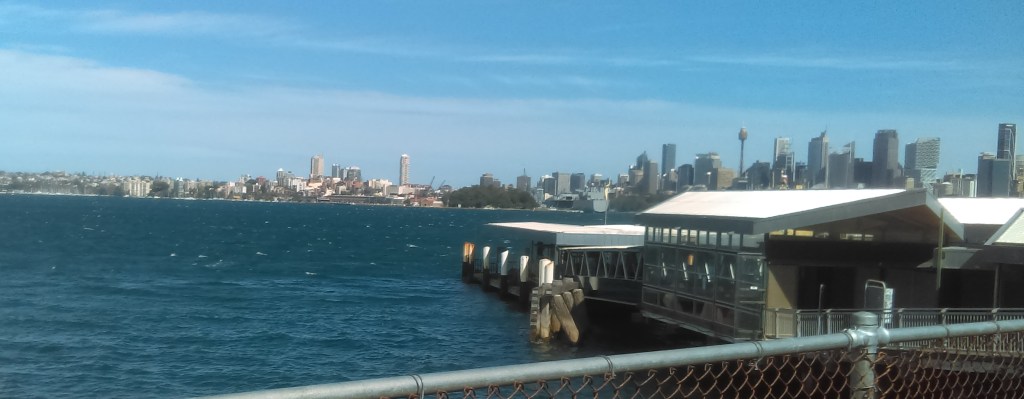
Nearing Taronga Zoo Wharf, just of the above photo on the right. On the left is Whiting Beach. The foreshore is all public land; I’ve stood on that beach.

Taronga Zoo Wharf. The forested area behind it is actually Taronga Zoo.

Disembarking the ferry. Actually, I took this photo going home, waiting to board the ferry.

The ferry in front of the Sydney skyline. I took this photo too while waiting to board the Scarborough ferry; the ferry coming from Circular Quay was the Alexander. The First Fleet class are named after ships of the First Fleet.

Nice view of Taronga Zoo Wharf.

I expected to be transported via gondola, but the Sky Safari has retired. Instead I took the bus (above).

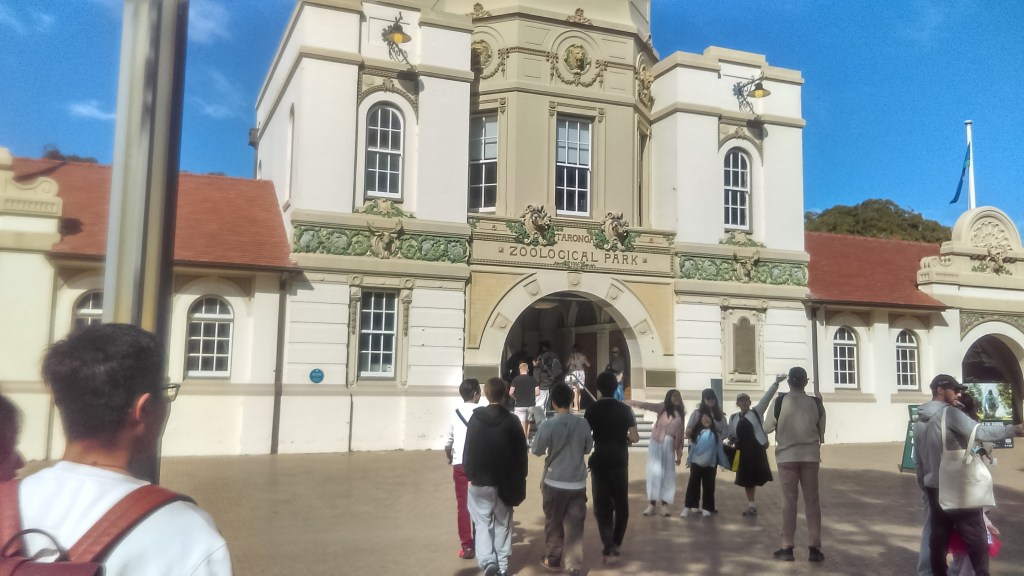
The bus drove a short route to the main entrance on the opposite, uphill, side (above).

Brittanica says “One of the outstanding zoos in Australia, Taronga Zoo opened to the public in 1884 in an area outside Sydney known as Billy Goat Swamp. … By 1912 the original site was no longer adequate, and the state government made a grant of land in Taronga Park, north of Sydney Harbour. The new zoo, comprising some 52 acres (21 hectares), opened in 1916; most of the animals from the old zoo had to travel to their new home via barge”.

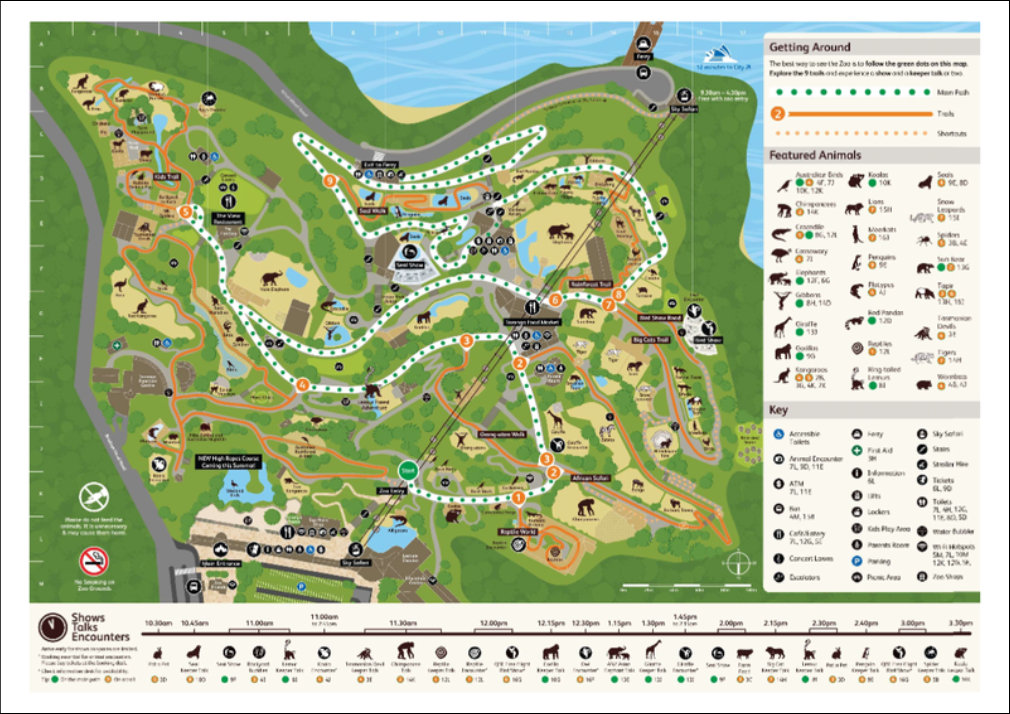
I was given a map of Taronga Zoo, similar to the above map. The Australia section is in the north-east corner (bottom left in the above map).

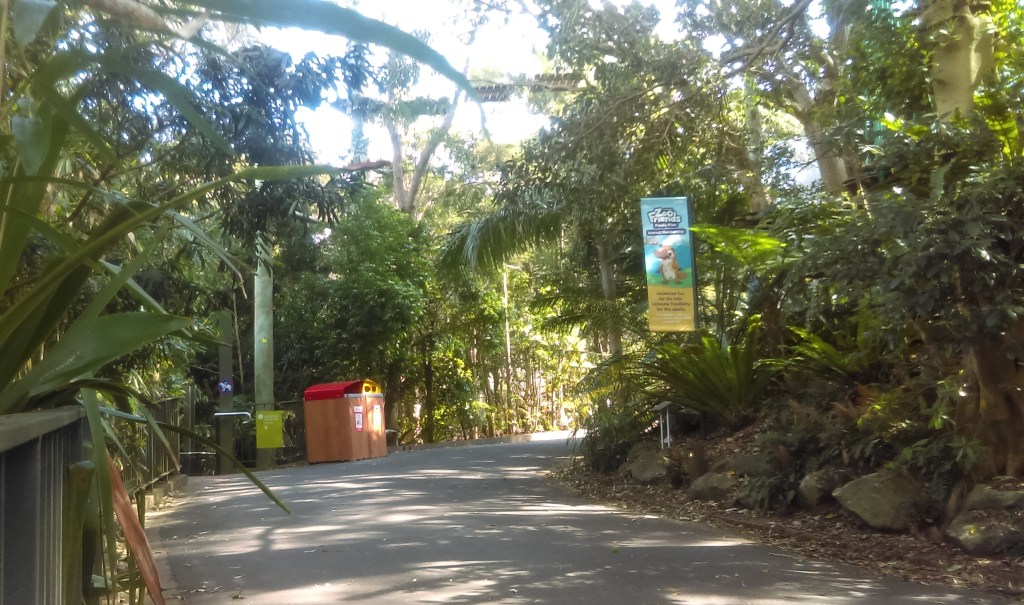
Taronga Zoo was all shady winding alleys between forested blocks, quite attractive.

There were occasional glimpses of Sydney Harbour.

The first precinct I came to had a circular fence enclosing a wide irregularly-shaped area containing emus (above).

The Australian Museum says “The name ’emu’ is not an Aboriginal word. It may have been derived from an Arabic word for large bird and later adopted by early Portuguese explorers and applied to cassowaries in eastern Indonesia. The term was then transferred to the Emu by early European explorers to Australia. … The Emu is found only in Australia. It lives throughout most of the continent, ranging from coastal regions to high in the Snowy Mountains. Emus were once found in Tasmania, but were exterminated soon after Europeans arrived. Two dwarf species of emus that lived on Kangaroo Island and King Island also became extinct.”

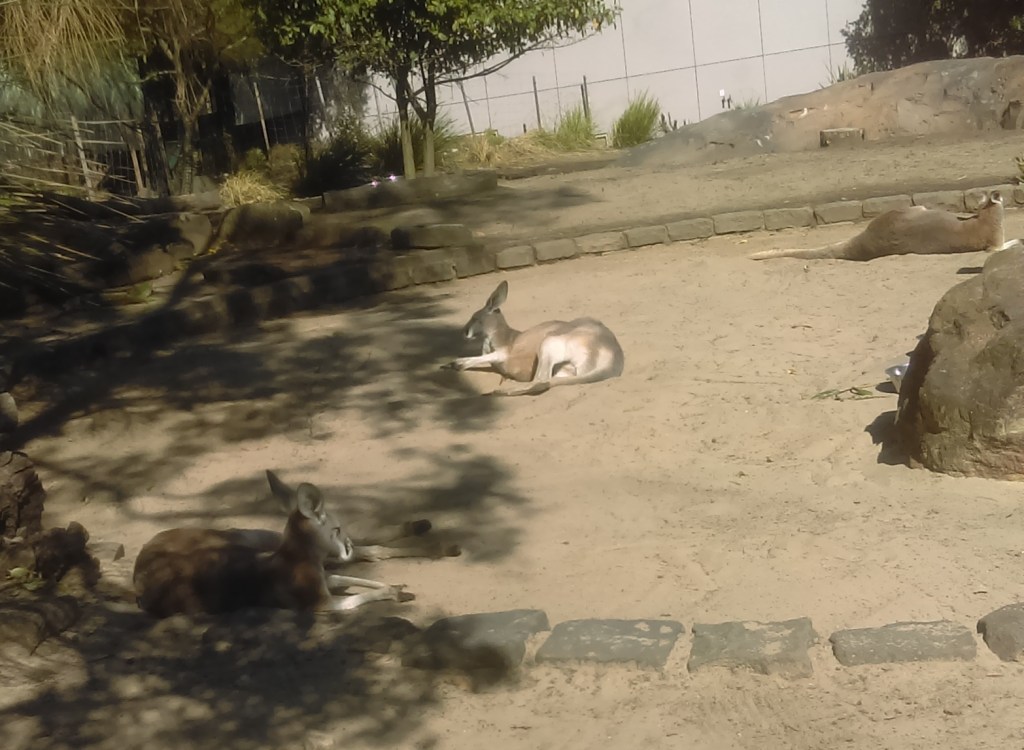
Also in this enclosure were kangaroos (or wallabies), resting in the balmy weather.

“No image of outback Australia is complete without a mob of kangaroos hopping across the horizon. Kangaroos belong to the Macropodidae family, meaning ‘big foot’ in Latin (a reference to their large back feet). What’s the difference between a kangaroo and a wallaby? Kangaroos are simply the larger animals in the Macropus genus. … The word kangaroo derives from ‘Gangurru’, the name given to Eastern Grey Kangaroos by the Guuga Yimithirr people of Far North Queensland. Kangaroos are of cultural and spiritual significance to Aboriginal people across Australia. Plus, their meat was, and continues to be, a  staple protein source; pelts were used for clothing and rugs; and their skin crafted into water bags. Kangaroos are the world’s largest marsupials. A Red Kangaroo can weigh  90kg and can grow two metres tall. Black Wallaroos, at around 20kg, are the smallest species. ” (Bush Heritage Australia)

I moved to a different enclosure, this one containing koalas.

“Koalas are not bears. They are not placental or ‘eutherian’ mammals, but MARSUPIALS, which means that their young are born immature & they develop further in the safety of a pouch. It’s incorrect to call them ‘Koala bears’ – their correct name is simply ‘Koalas’ … The AKF estimates that there are likely to be less than 60,000 Koalas remaining in Australia today and it could be as low as 33,000. Much of their habitat has already been lost. This makes it vitally important to save what is left”. (Australian Koala Foundation)

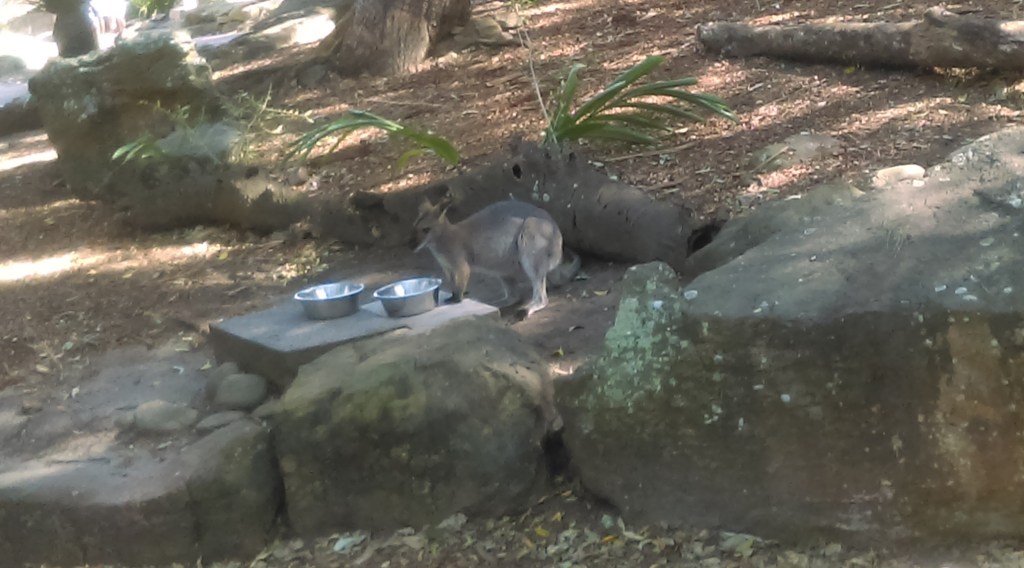
Wallabies! The website for Taronga Zoo says “Wallaby is the general term for medium-sized, hopping macropods found throughout Australia and New Guinea… The taxonomic classification of wallabies is informal, and not universal. Wallabies are macropods smaller than a kangaroo, though this distinction is drawn entirely off their size. By this simple definition, a range of macropods can be classed as wallabies including Quokkas, Pademelons, and Wallaroos, however whether these should be considered wallabies is disputed. There are generally considered to be around 30 species of wallaby…. Some wallaby species are mostly solitary whilst others live in groups called mobs. They feed on a range of low-lying vegetation, though grass is the main food source for most wallabies. Some species can survive on very little water, getting most of it from their diets. Thick undergrowth can provide cover from predators, and their agile hops allow a quick escape even in uneven or rocky terrain. …Wallabies are endemic to Australia and New Guinea, yet due to humans can now be found in several other countries around the world…. New Zealand’s invasive population has boomed to over a million wallabies, causing significant harm to local ecosystems and wildlife.”

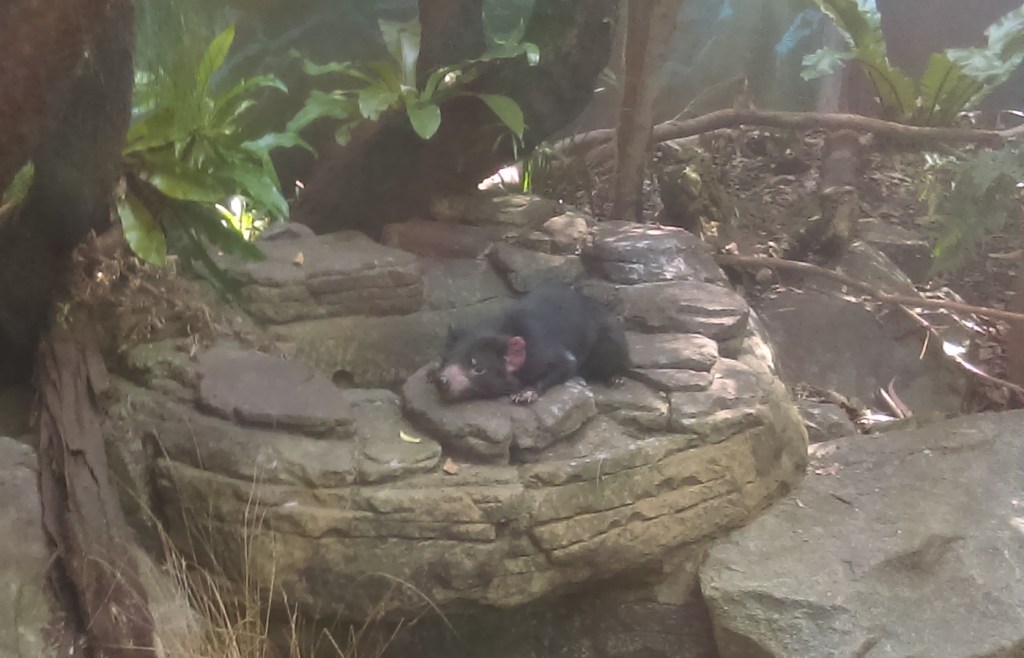
An animal I didn’t expect – Tasmanian Devils!

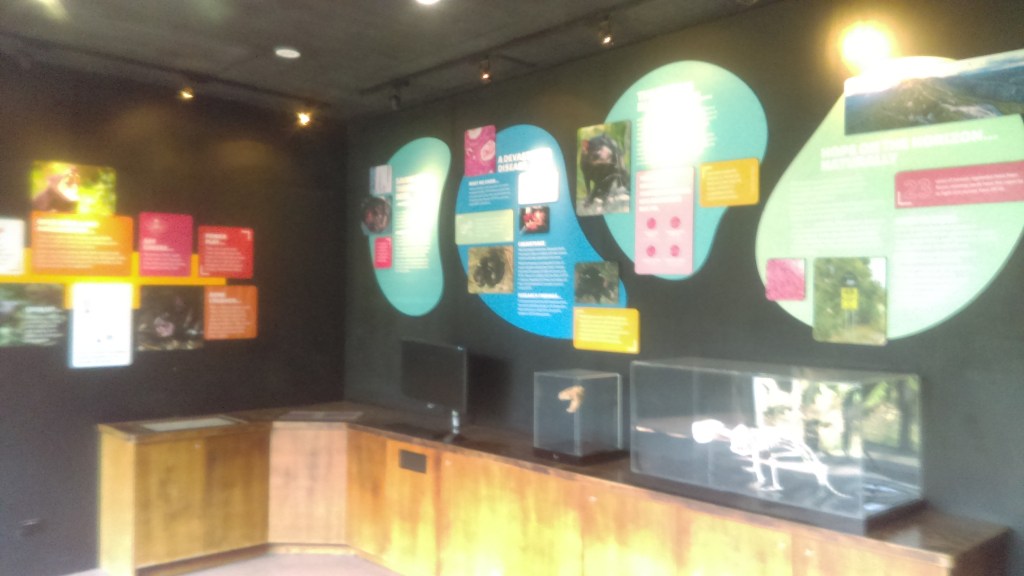
There is a separate small building just to house Tasmanian Devils. The above photo is of the interior of the building; there is a skeleton of a Devil on the bottom right. Sorry about the quality of the photo. There were a number of photos that I couldn’t use because they were too blurry.

The Australian Museum says “The Tasmanian devil is the world’s largest surviving carnivorous marsupial. … Tasmanian Devils were once abundant on mainland Australia as evidenced by fossil remains. Reliable fossil evidence suggests they became extinct from the mainland between 3,200 and 3,500 years ago. They are widespread and common in Tasmania … Tasmanian Devils are mainly scavengers feeding upon the carcasses of dead animals but can also be effective predators. … Their powerful jaws and teeth enable them to entirely devour their food including bones and fur. They are particularly renowned for their noisy communal eating during which use noise and threatening physical displays to assert dominance amongst the pack. … the greatest current threat for devils is the Devil Facial Tumour Disease (DFTD). This fatal condition is characterised by facial tumours and is one of only three contagious cancers ever recorded. It is believed to be transmitted from devil to devil through biting.”

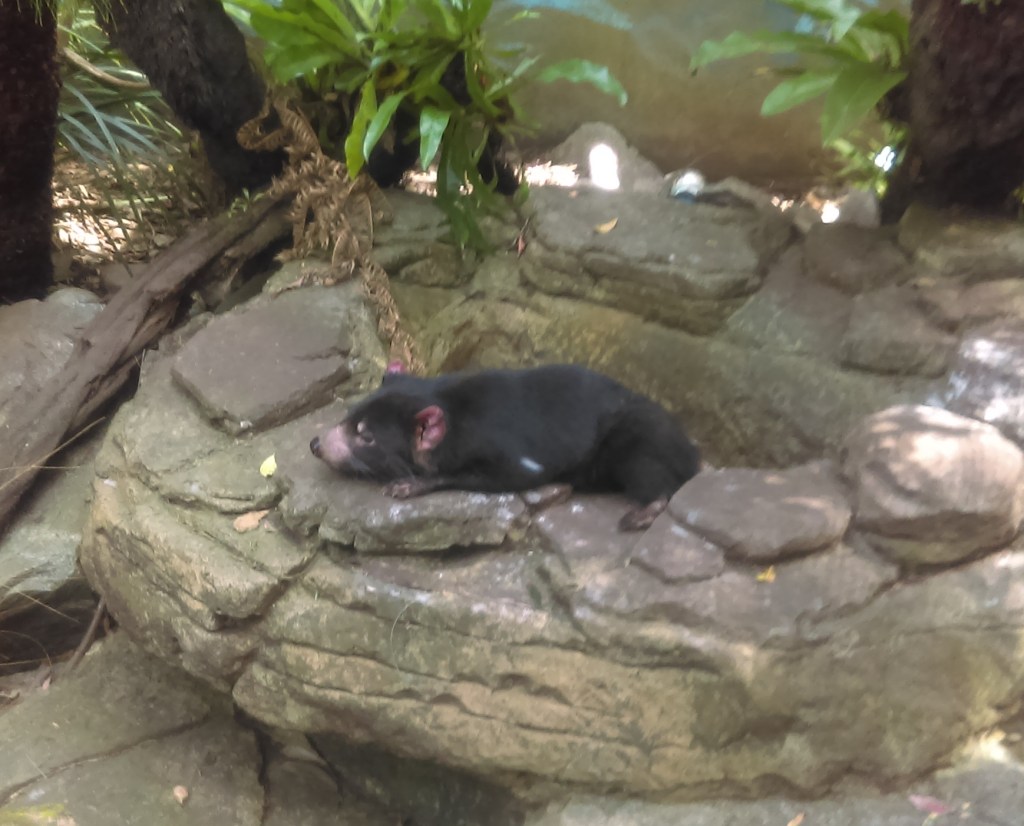
There was a viewing area, but it seemed to be empty of Devils. However I spotted a Devil drowsily lying high up (above).

There was a second separate viewing area in which a second Devil was quite active, clambering about the enclosure, while I agitatedly clicked my phone.

A better shot of the Devil.

“Taronga Western Plains Zoo [linked to Taronga Zoo] became involved in the Save the Tasmanian Devil Program in 2008 when Australian zoos and wildlife parks committed to establishing an insurance population on the mainland. This decision was crucial at that time as an untreatable and fatal threat, the Devil Facial Tumour Disease (DFTD), had spread amongst wild devils through bites, usually obtained during mating, feeding and fighting. Since commencement of the breeding program, Taronga Western Plains Zoo has successfully bred 50 joeys in a dedicated behind-the-scenes breeding facility. The Zoo has now transitioned to an ambassador role within the region for this species as insurance population goals have been met and wild populations are exhibiting a resistance to the disease.” (Taronga Conservation Society).

A YouTube clip of a Tasmanian Devil.

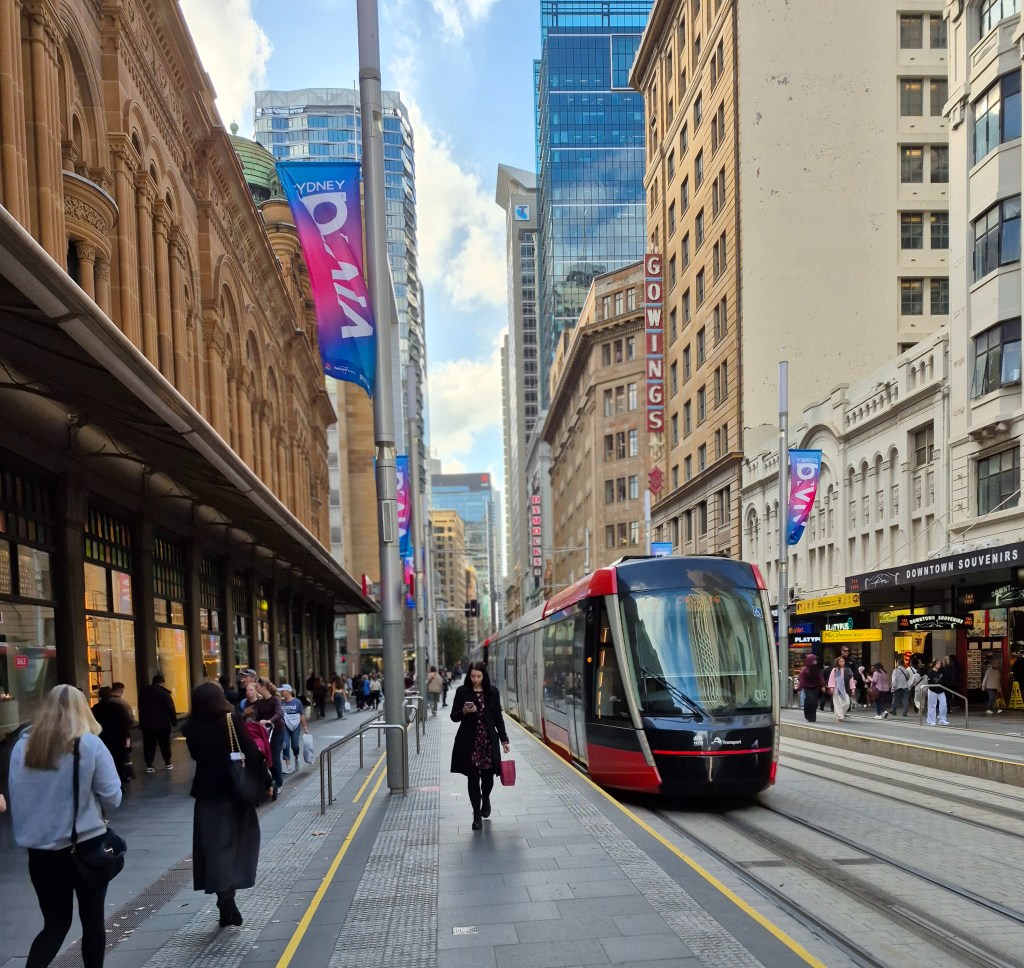
Then I retraced my journey, catching a bus from the entrance to the Zoo down to Taronga Zoo Wharf, a ferry to Circular Quay, and up on the light rail to the Queen Victoria Building, where I transferred to the 194 bus and home.

Dragon Boat Race 2024 – from Wandering Richard (http://wanderingrichard.com)

Note: in late 2024 / early 2025 I am going to Cambodia for one or two weeks – the plans are not yet finalised. If you are interested in going with me, email me and we can discuss it.

June 10th, 2024

We are into summer now, real tropical weather. June 10th, 2024 was very humid; according to weather.com, the weather was 31 degrees, but felt like 41 degrees.

Four years ago, pre-COVID19 quarantine, I wrote a post on the Dragon Boat Festival. Now this was the first unrestricted Dragon Boat Festival after COVID19 quarantine – where does the time go?

I also briefly referred to zongzi, “a traditional Chinese rice dish made of glutinous rice stuffed with different fillings and wrapped in bamboo leaves. Fillings can be either sweet, such as red bean paste, or savory, such as pork belly or Chinese sausage.”

Taste Asia Food says: “The history of zongzi 粽子is closely related to a famous poet and patriotic minister Qu Yuan 屈原 of the Kingdom of Chu during the Warring States 戰國 period of China (ranging from 481 BC to 403 BC). Qu Yuan served as a minister for the Chu but was ousted for opposing the alliance of a much larger kingdom called Qin. When the Qin eventually conquered the capital of Chu, Yingdu, the grief was so intense that he finally committed suicide by drowning himself in the Miluo River 汨羅江 on the 5th of May. Moved by the patriotism of Qu Yuan, the local people rolling their boats to save him. The act to save Qu Yuan was the origin of the dragon boat races during this festival. After they had failed to retrieve his body, they threw packets of sticky rice into the river, hoping the fishes would eat the rice instead of his body. Chinese people serve zongzi every year on the day when Qu Yuan committed suicide, which happens on the fifth day of the fifth month of the Chinese calendar. This day had slowly evolved to become the Duanwu Festival or Double Fifth Festival; both means the date and month as mentioned. … Duanwu Festival (also called Dragon Boat Festival) has slowly shifted its focus from commemorating Qu Yuan to become a carnival, with dragon boat competition and eating zongzi as the key features.”

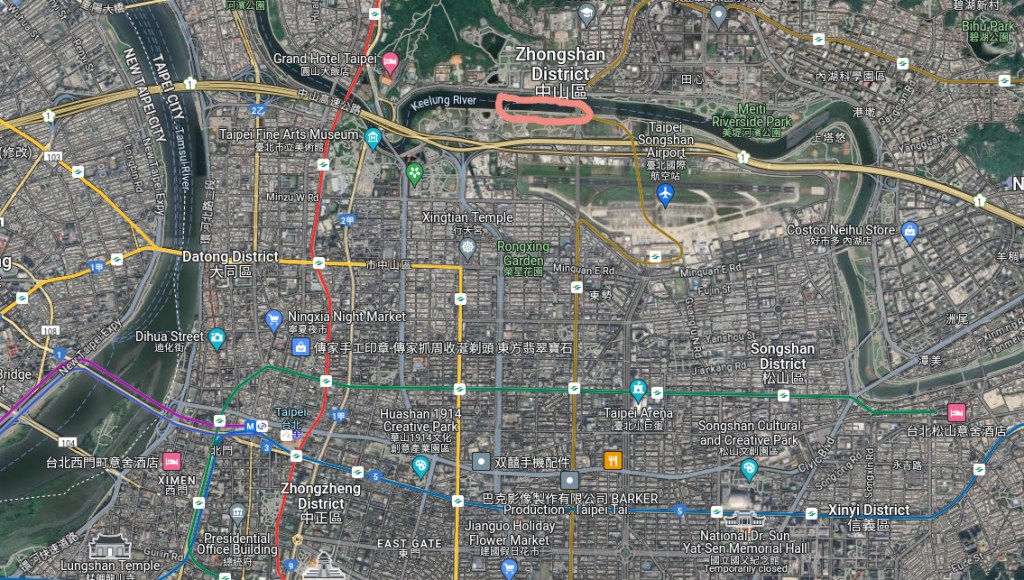
In the above image (courtesy of Google Maps) the competition was held in the red squashed band, near Zhongshan Airport. I thought I’d catch the MRT to Yuanshan (圓山) MRT station, on the Red line at the top of the picture, immediately below the Keelung River. Then I’d take the 132 bus, or failing that, a taxi, to the Dajia Riverside Park (大佳河濱公園), where the event was held, at the Dragon Boat Pier (龍舟碼頭). I prepared written instructions for the taxi driver just in case.

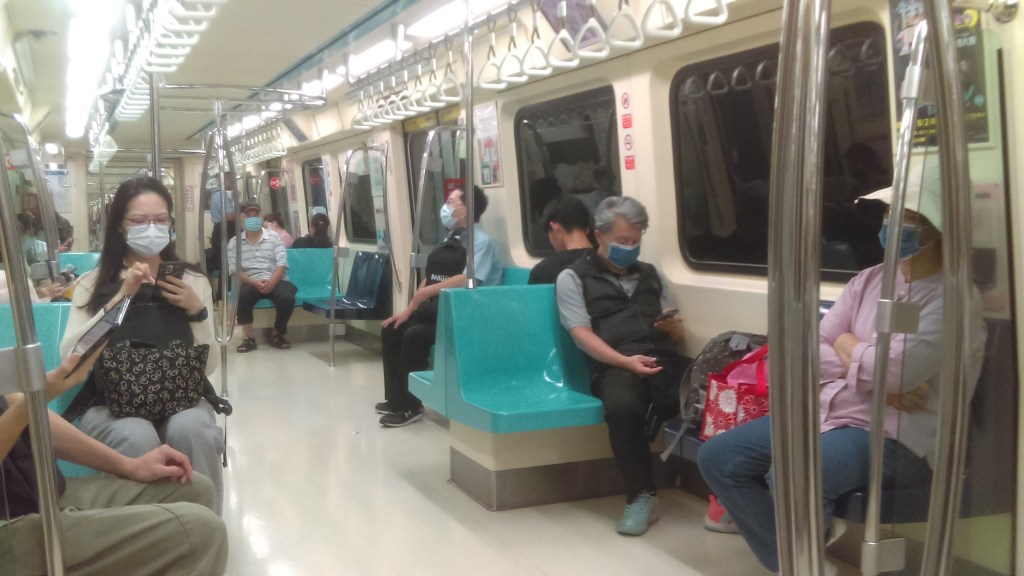
On the MRT, heading towards Yuanshan MRT station. Notice the masks of the passengers; I was wearing a mask myself.

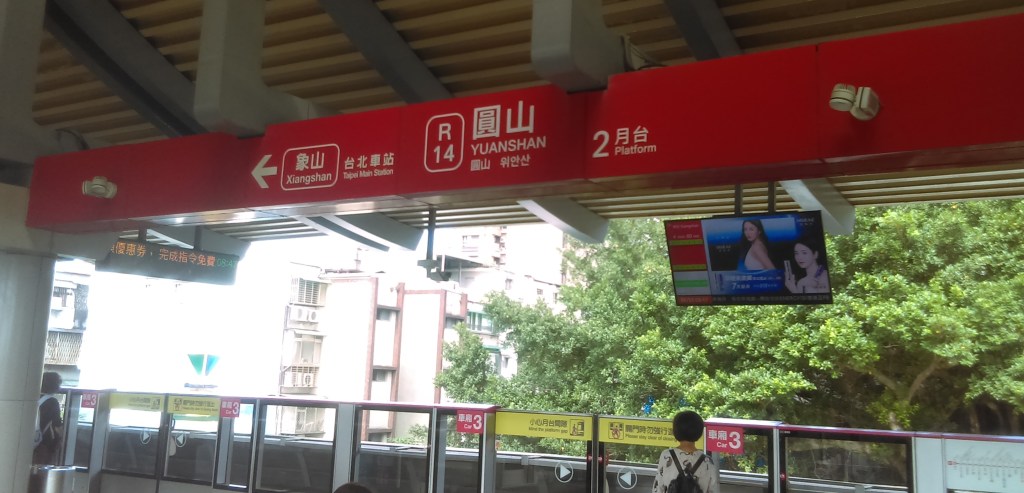
Yuanshan MRT station. Google Translate interpreted 圓山 as “Round Mountain”.

Another picture of Yuanshan MRT station.

Looking out towards the dragon boat racing. Yuanshan MRT station is close to Taipei Expo Park.

On the map Yuanshan Bus Station is directly below Yuanshan MRT station, so I thought the 132 bus would be only steps away. My error: there was no 132 bus either directly below, or cross the street. I was worried that I would have to flag down a taxi and explain in execrable Chinese. Fortunately a station guard helpfully pointed out the way. The above photo shows people walking to the bus (center right).

I got onto the crowded 132 bus (above), a tight squeeze. Immediately a gentleman insisted I sit down – I was very grateful.

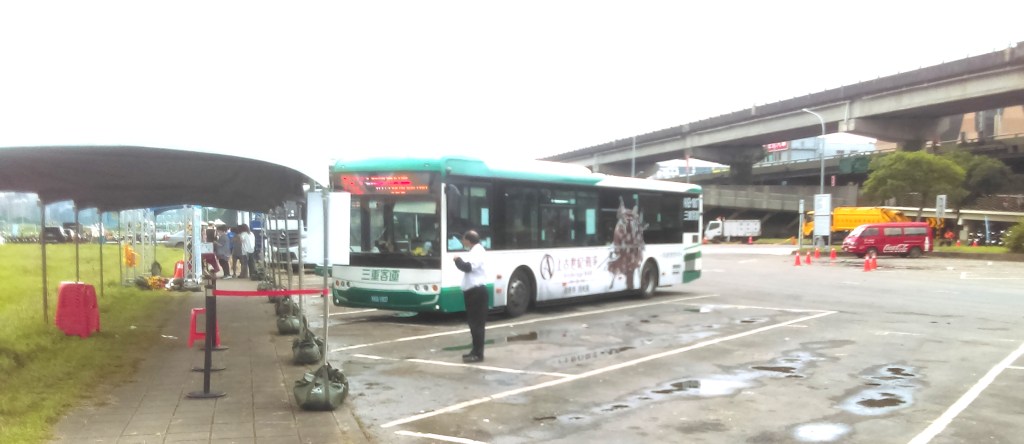
After a 10-minute trip we reached Dajia Riverside Park (大佳河濱公園). Everybody got off, and I took a photo of the empty bus.

The above YouTube clip shows you the Dragon Boat Festival better than I could.

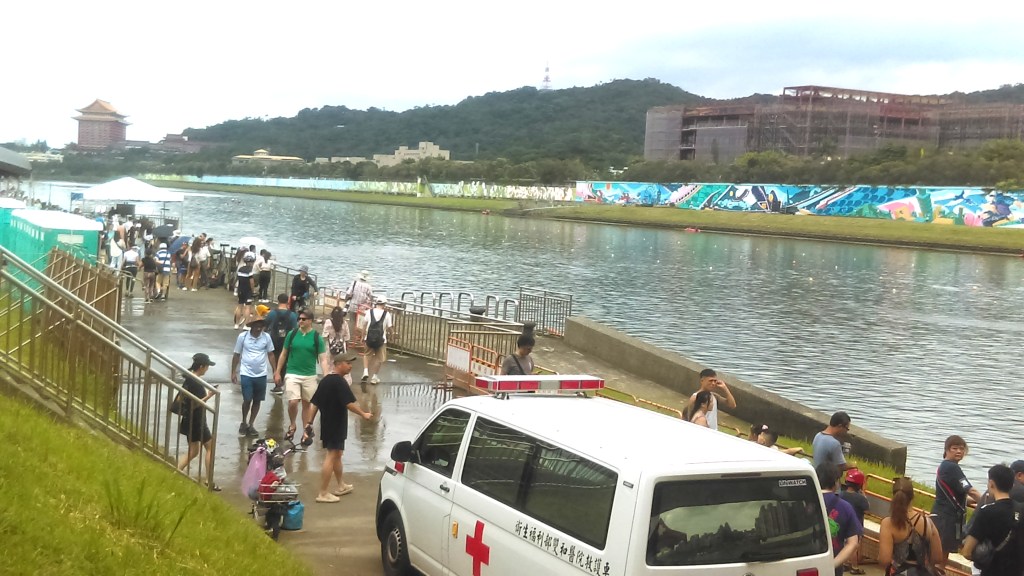
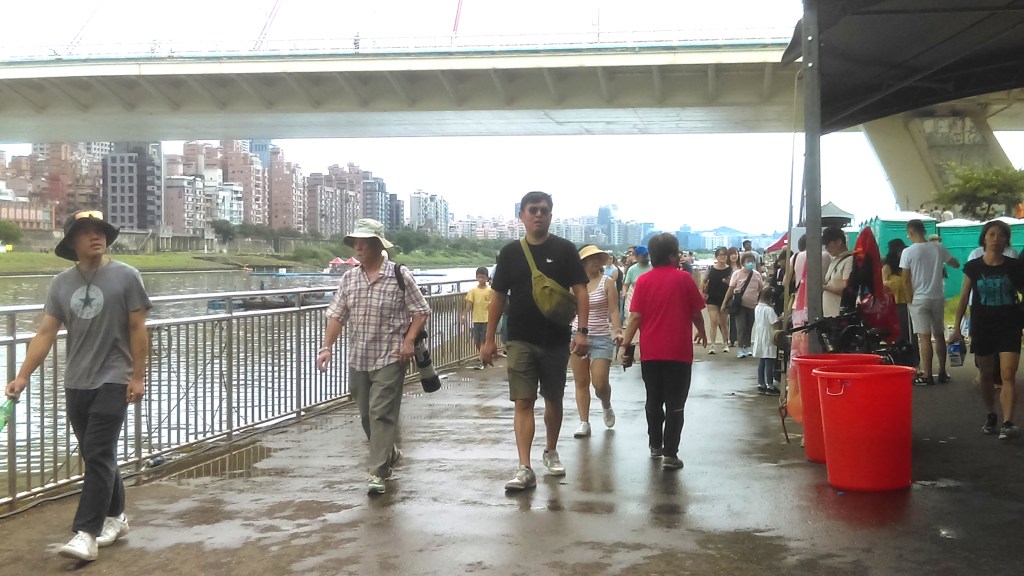
Dazhi Bridge (大直橋), with the temporary booths underneath it. The weather was stifling – probably due to the humidity.

Under the Dazhi Bridge, amid rowing crews (above). In the background there were a few fast food stalls, though it’s hard to see them. Unfortunately I didn’t try any on the zongzi.

The Dragon Boat races, on the Keelung River at Dajia Riverside Park. I discovered that the boat races hadn’t started yet.

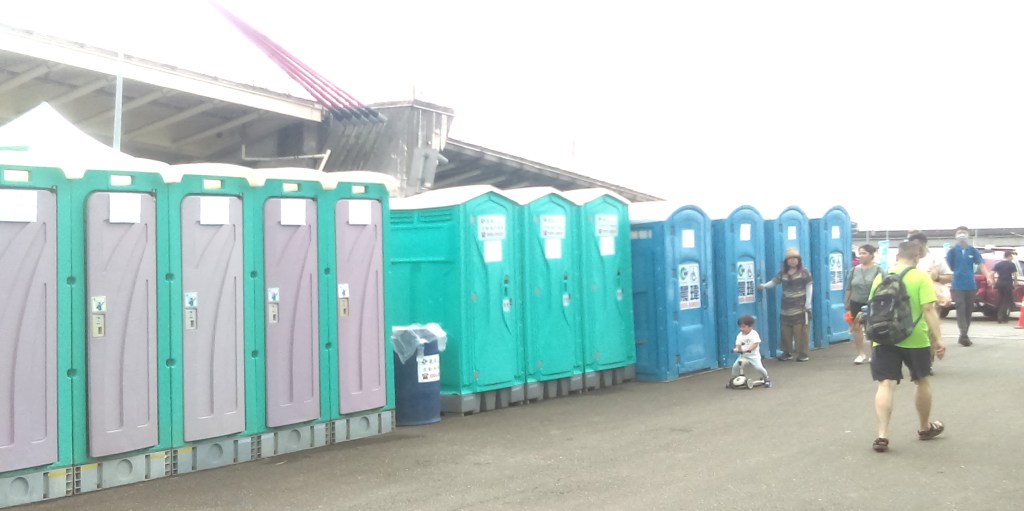
The Dajia Riverside Park Public Toilet (大佳河濱公園公共廁所) – it’s on the map.

The television crews were already in position.

A view back along the riverside to the bridge. In the photo it seems there was water on the ground, but that’s not how I remember it. I’d say there was water in the air – the humidity was suffocating.

A view in the opposite direction.

Rescuers patiently waited.

I strolled for half an hour, but the heat and humidity proved too much; my shirt was becoming drenched. I headed for the bus to take me to Yuanshan MRT station and home.

Queen Sirikit Park, Bangkok – from Wandering Richard (http://wanderingrichard.com)

(Note: When I’m studying at NTNU in Taiwan, I have an option to take a week off per semester – two weeks if I time it right. Besides visiting my parents in Sydney, I will spend it in South-East Asia. If you are interested in vacationing in SE Asia, send me an email or a LINE chat; there’s a possibility that I’ll be able to travel with you at least part of the way.)

May 26, 2024

The NTNU MTC semester had just finished, so I had a week off. I planned a quick trip (9 days / 8 nights) to Thailand.

I asked my father if there was anything that he wanted me to do in Bangkok. He suggested I visit the botanic garden, as he has an interest in them. So I went to Google and I found an ideal match, Queen Sirikit Botanic Garden, a major centre for research.  The problem was, it’s near Chiang Mai, and I would be based in Bangkok, nearly 700km away, too far to travel.  My father then suggested Queen Sirikit Park in Bangkok as an alternative. He advised me to go on a self-guided tour, alerting me to unique and interesting flora.

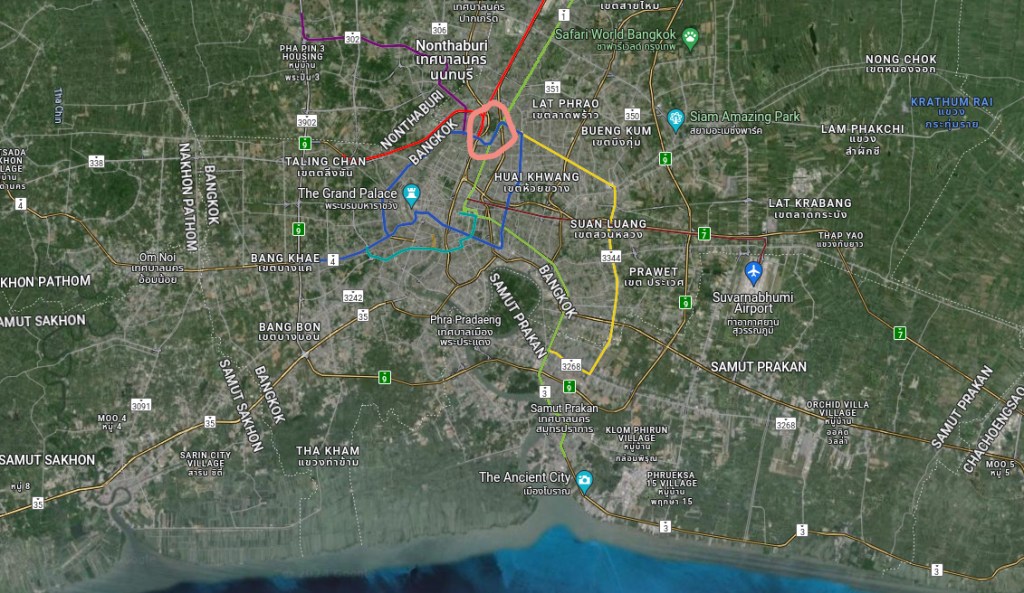
Queen Sirikit Park is located in the north of Bangkok. I’ve added a red circle roughly corresponding to the Google map below.

Queen Sirikit Park is part of a complex of parks, directly to the north of Chatuchak Markets. The local BTS (an elevated light rail system) station is Mo Chit (sounds like “Mor Chidt”).

Before I went to Queen Sirikit Park I went online to see if there was a brochure or any kind of material. The Expats in Bangkok website give it a favourable review:

“Stretching across an impressive expanse of 200 acres, Queen Sirikit Park boasts a diverse array of meticulously manicured gardens. Explore the exotic wonders of the orchid gardens, where vibrant blooms dance in the gentle breeze, or lose yourself amidst the tranquil groves of rare tropical plants. The park also invites you to wander through its magnificent botanical gardens, where you can marvel at an astounding collection of indigenous flora, showcasing the incredible biodiversity of Thailand. … it also serves as an educational hub, offering courses and workshops on gardening, horticulture, and environmental conservation. Immerse yourself in the fascinating world of botany and learn from the experts who passionately share their knowledge and love for nature with visitors of all ages.”

However I couldn’t find publicly-accessible information on specific botanic materials.

After breakfast at my hotel, I took the BTS – here’s a photo of a station. Despite starting at 7:30am, the weather was hot and very humid; I estimate the temperature was 35 degrees, but it’s the humidity that does the most damage.

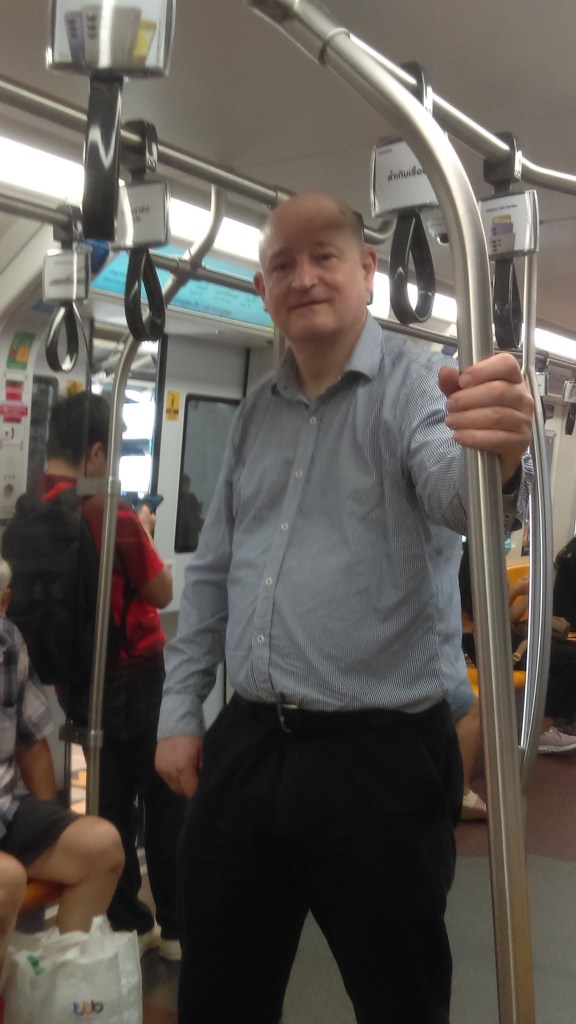
Here’s me, on the BTS, taken by an obliging passenger.

On the Mo Chit BTS station, looking westward over the park. It’s not actually Queen Sirikit Park, but Chatuchak Park; my destination lies further west.

A photo of some motosai riders. As this AFAR article explains, motosai are motorcycle taxis. On a moto-scooter, you sit pillion, behind the motosai rider; helmets for the pillion are optional.

“Motosais are a ubiquity in Bangkok’s cityscape. Usually congregated in makeshift shelters at the top of a soi (Thai for “side street”) or around the entrance of metro stations, they connect all corners of town for a prenegotiated handful of bahttwo handfuls if you’re a farang (foreigner) like me. The drivers’ tattered nylon vests are instantly recognizable; flashes of neon orange hurtling through traffic, bearing the name of their win (a loosely defined pack of motosai drivers) in swirly Thai characters. To kill time between rides, they watch Thai soap operas on dashboard-mounted smartphones, play checkerboard games with bottle caps, and chug stubby bottles of Red Bull. Some manage a curbside snooze on their backseat.”

I walked around the southern edge of the park complex and along the border with Chatuchak Markets. In this photo Chatuchak Market is across the road, behind the motosai guy.

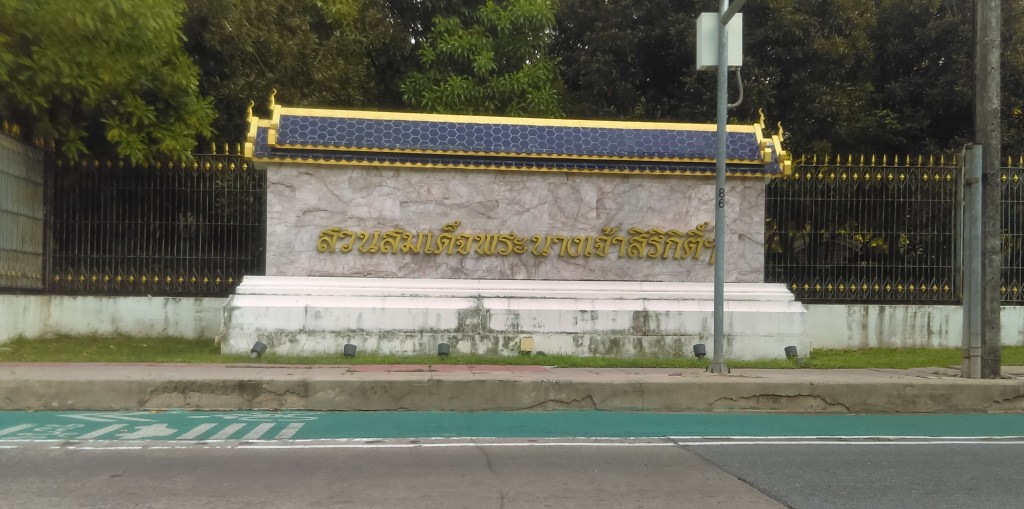
I walked on until I came to this elaborate sign (above). Is it Queen Sirikit Park? I have no idea what it means, as there is no English translation. This is a problem for a non-Thai speaker like me.

Beside the sign there is an open gate. I went though this gate and found myself in a well-tended garden (above).

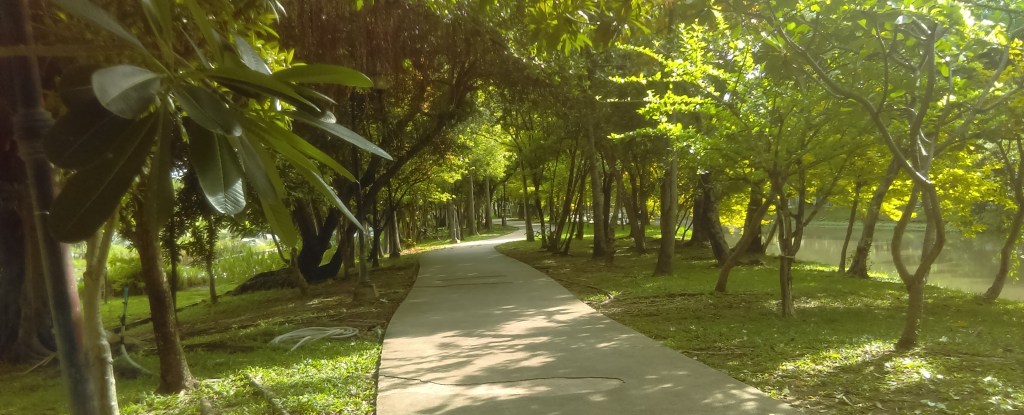
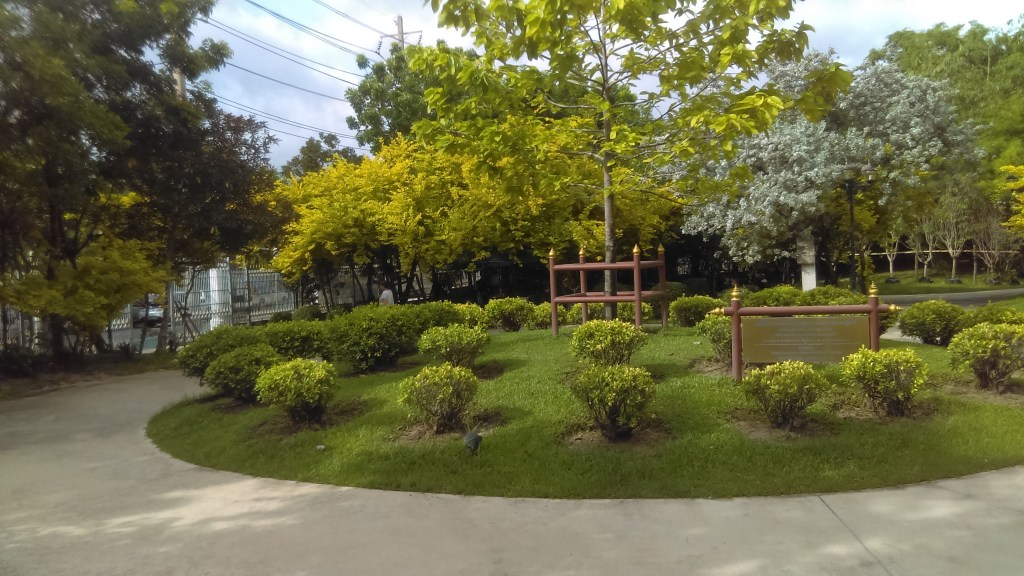
The garden was quite beautiful (above), with a path, a lake visible to the right, and trees with accompanying descriptions.

There were workers under an old fig.

I selected a YouTube clip of Queen Sirikit Park, filming at head height while walking around.

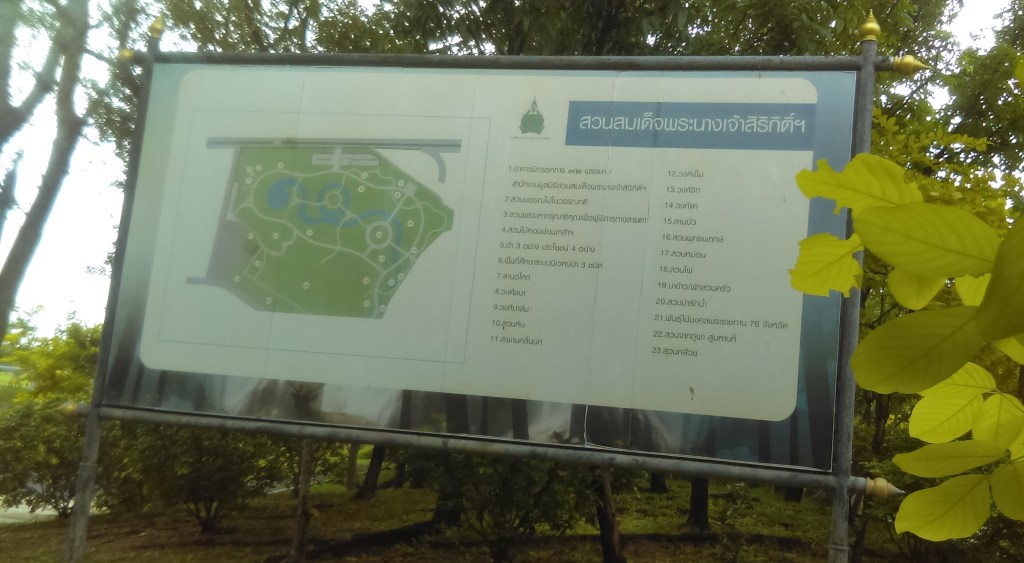
In the above photo, there is a major sign giving a layout of the Park. Or, I think it is doing that, as the sign is only in Thai.

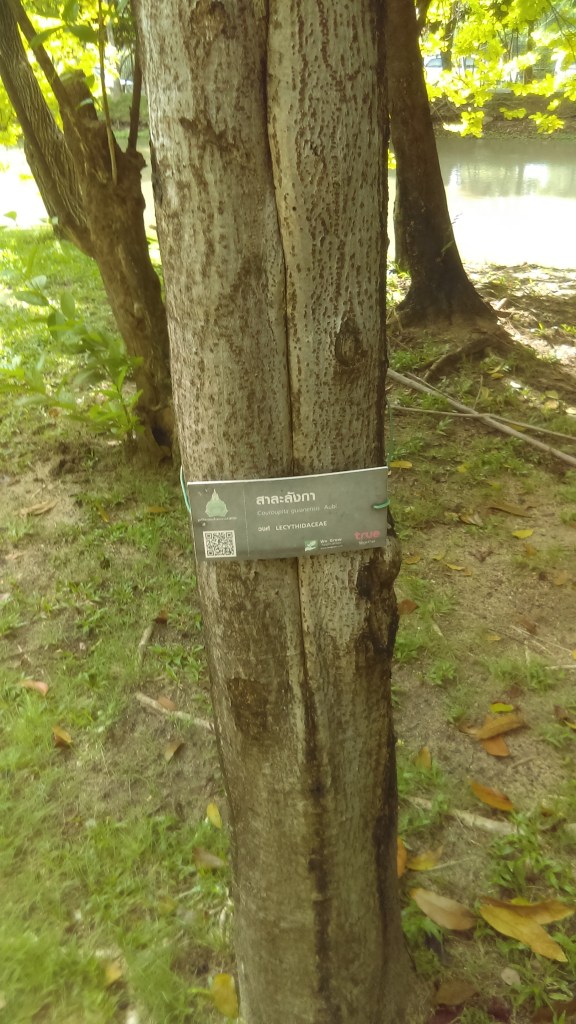
Similarly, all the interpretive signs are only in Thai, although I can read the scientific name.

The signs affixed to trees are in Thai.

Although it’s difficult to make out, the above sign is all in Thai too. It seems like most information on Queen Sirikit Park is in Thai, including interpretive signs and unique and interesting flora. I don’t speak Thai, so all this written information is out of reach.

It’s a real pity that my father wasn’t with me at Queen Sirikit Park. He would find it very interesting.

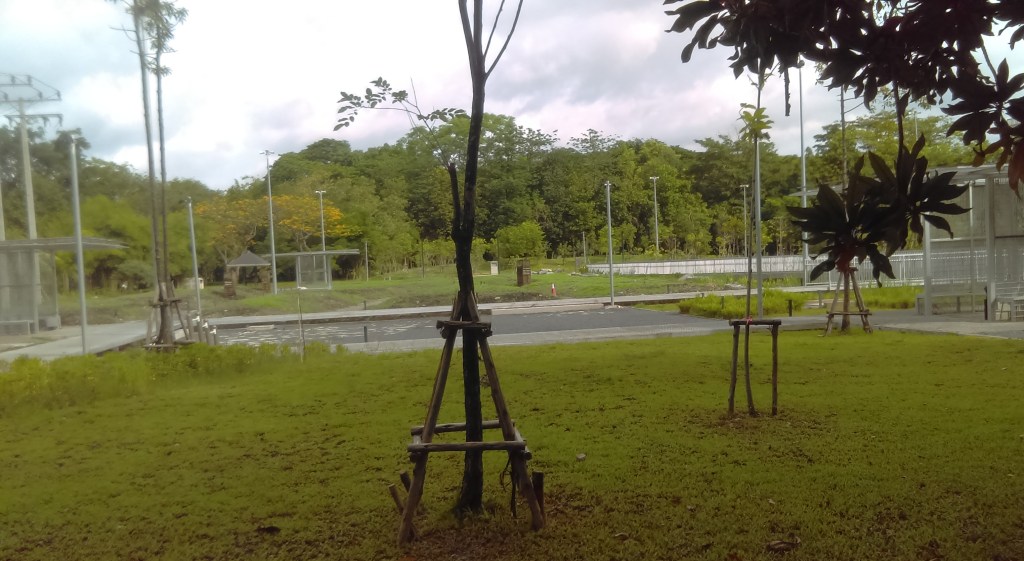
I read that part of Queen Sirikit Park is still under construction; it’s true (above).

Another photo shows young trees and bare patches where eventually a forest will arise.

The Expats in Bangkok article cited the “educational hub” of Queen Sirikit Park, but of course this requires flexibility as to dates. I visited the Park at a time driven by my schedule, and so there is nothing on the day I visited.

It was only 8:30am, but the heat and humidity drove me towards the exit. I very much liked Queen Sirikit Park, even though it was not English-language friendly.

A little down the road there was the entrance to Chatuchak Markets, with accompanying elaborate mythology (above).

A close-up of naga (above). “The Naga is a mythical creature with long-standing beliefs and connections to the Thai people, and its designation as a national symbol is a significant step towards preserving and promoting Thai culture”.

There were many simple restaurants (above) between the street and the park.

There were take-away beverage shops as well (above).

I decided to have bruch at one – it was 9am. The above photo shows me sitting, waiting to dine. The weather was stifling hot.

The dish I ordered was chicken Pad See Ew (above). Carlsbad Cravings said:

“Pad see ew ผัดซีอิ๊ว,  (sometimes spelled pad siew, pad siu or phat si-Io) is a Thai stir fried rice noodle dish commonly mixed with protein (chicken, pork, beef or shrimp,) vegetables and a rich, savory, sweet and salty soy-based sauce.  True to its name in Chinese, pad sew ew translates to “fried (with) soy sauce” (pad meaning fried and see ew meaning soy sauce). Pad see ew is a Chinese-influenced dish that combines the technique of stir-frying noodles borrowed from Chinese immigrants with the taste of Thailand. Today, pad see ew is the most popular Thai noodle dish in Thailand sold by street vendors and in restaurants throughout the country … Both pad see ew and pad Thai became popular in World War II when Thailand was facing a rice shortage.  Rice noodles, on the other hand, were in abundance so the Thai government encouraged the substitution of rice with rice noodles.  The citizens mixed rice noodles with various vegetables and proteins resulting in a new inexpensive, instant classic known as pad see ew that the world has been enjoying ever since. … Pad see ew is characterized by chewy rice noodles, stir fried in a very hot wok until charred, mixed with protein (chicken, pork, beef or shrimp) dark, sweet soy sauce, oyster sauce, Chinese broccoli, and eggs.  Pad see ew is sweet from the sweet soy sauce, salty from the oyster sauce, and sour from the vinegar and infused with chargrilled flavor from the caramelized noodles to create a beautifully balanced dish.”

This Chicken Pad See Ew was delicious. The photo is of my empty plate. Cost: 70 baht, around $AUD3.50.

After that I went back to the station – not the BTS station, but a MRT (Metropolitan Rapid Transit) station, the complement to the BTS but underground. MRT stations are blissfully air-conditioned, and I rode in comfort on the long ride home.

Sānxiá Old Street, New Taipei City – from Wandering Richard (http://wanderingrichard.com)

April 26, 2024

Teacher Du (杜老師)arranged for us to go on an excursion to Sānxiá Old Street (三峽老街).

I’ve marked the location on Google Maps. It’s in the south-west, beyond the MRT. International House, my home in Taipei, is on the very right-hand corner of the Map, about half-way down.

On my way to the meeting point, on the MRT Blue Line train. Note how many of the people use masks. I think it’s not from any lingering COVID19 fear, but concern for being in a confined space with many other people who might cough on you.

On leaving the terminal MRT station it was raining furiously, a real tropical downpour. The temperature was 23 degrees, cold for Taipei at this time of year. Outside I ran into three young men who I’d taken classes with before. I was going to get a taxi from the taxi rank nearby, so I offered to give them a lift free of change. They accepted, and one of them helped me climb into the taxi.

On the road to Sanxia, a view out the passenger’s windscreen. My impression of the journey was of jungle-covered hills mixed in with skyscraper residential buildings. No trace of suburbia here!

We passed through increasingly built-up areas (above) and into Sanxia. It was a bustling area, full of restaurants. Trucks stopped in the street, regardless of parking signs. We were close to Sanxia Old Street.

Sanxia Old Street, right where our taxi stopped. I paid the driver 245元, about $AUD12.50. Sanxia Old Street is within walking distance from Sanxia. Sanxia Old Street starts immediately to the right just out of shot, while Zǔ Shī Temple, our meeting place, was just out of shot to the left. The street ends in the Sanxia River (三峽河), not a river but an estuary, obscured by the big truck.

We walked down only a few dozens of meters, turned a corner, and was in front of Sānxiá Qingshui Zǔshī Temple (三峽祖師廟, above). It was still raining, so one of the young men obliged me by taking some photos – the above photo could well be by him. Then the young men excused themselves and vanished, and I saw no more of them that day.

I took this on the front steps, looking to where the previous photo had been taken. In the middle distance, in front of the high-rise buildings, is the Sanxia River.

While I was waiting for the group I explored the temple (above). Travel to Taiwan (the Taiwan Tourist Administration website) says “Qingshui Zushi (Qingshui Master) Temple was built in 1769. The temple was destroyed by an earthquake in 1833 and was rebuilt in 1867. However, during 1895, it was burned down by the Japanese army. After World War II, the restoration was led by the renowned artist Li Mei Shu. The restored temple presents refined carvings and sculptures and it is the work of Taiwanese artists.”

There is an entry in Wikipedia, but the temple is called the Changfu Temple. Wikipedia notes that in this temple Master Qingshui is the main deity and is known regionally as Zushi Gong (袓師公). Both of the entries record this as being a Daoist temple; the Chinese character 廟, “miào”, “temple”, denotes both a Buddhist or a Daoist temple.

The Changfu Temple article in Wikipedia says “Every sixth day of the first month of the Chinese lunar calendar on Zushi-Gong’s birthday, Changfu Temple holds a sacred pig (神豬 …) contest. Farmers would compete by raising the largest pig, which during the competition day, the pig is decorated with ornaments. The largest pig will then be sacrificed to the mountain deities, then the meat will be distributed among the devotees. In the past few years, this tradition has been met with objection by animal rights activists. While the majority of temples that practice this rite have started using symbolic pigs, Changfu Temple in Sanxia still continues the tradition of using an actual pig.” Indeed, one of the postings for Google’s Qingshui Zǔshī Temple was headed “Please, please ‘Stop’ the Magic Pig Weight Contest”.

Eventually we gathered together. It was a multicultural group. There was Teacher Du, a Taiwanese man, and our students – a Japanese man; an Italian woman; a Vietnamese woman; a man from the Caribbean; and an Australian man (me).

We were joined by a tour guide, and shown around the temple.

The tour guide’s explanation was in English, though I think Teacher Du’s English was better – although he spoke only in Chinese.

The inner sanctum.

It was about this point in time that my mobile phone, who I was using to take photos, signalled that it had no storage space left, so it wouldn’t be able to take new photos.

We went next to a tea shop, and were served several different varieties of tea. The shopkeeper didn’t speak English, so other students tried talking with her in Chinese. I couldn’t tell if it was a cultural engagement or a commercial transaction. One of our party bought some tea, so it was probably a little of both.

From the tea shop we walked a short way to Sanxia Old Street (三峽老街, above – taken when my phone still worked).

Undiscovered Taipei says “The old street has been a pivot of commercial activities since the Qing dynasty as the distribution center of many commodities and raw materials. This area was transformed into a neat, dazzling place after an overhaul [i.e. burned down] during the Japanese rule. In previous years, Sanxia Old Street was packed with stores selling tea, dyed cloth and camphor. The glory of this town was manifested by many examples of architecture built in a western style during this period. The 260 meter-long old street area on Mingquan Street has over 100 antique houses, which make Sanxia a great destination for people who want to see archways in Baroque style, innovative traditional craftsmanship, and a busy business area from over 100 years ago. Sanxia Old Street these days is as busy as in its golden age. When you walk in the red-brick arcade, you can see old stores named after family names, which was a common practice in the past.”

The YouTube clip above gives a good impression of the area surrounding Sanxia Old Street. The clip is one take, without voice-over, wandering (presumably on foot) through the area.

The tour guide took us to a narrow alley parallel to Sanxia Old Street, which she said was the real Sanxia Old Street. The alley’s width was two or three times smaller than the official Sanxia Old Street, much too narrow. The tour guide showed us holes in the brickwork of a house, which she said were emplacements for rifles. Evidently this was a more dangerous time.

We emerged on Sanxia Old Street. My impression was a street wholly devoted to tourism, with none of the day-to-day business real roads require. Undiscovered Taipei says “Stores selling cold drinks, calligraphy brushes, sweets, antiques, old-fashioned toys, furniture and snacks, all have a historic look, unlike their counterparts in other tourist destinations. Sanxia has a lot of gourmet food, including Jinnujia which is a kind of bread that gives out a strong fragrant smell and A-Laibo soy pudding which has an unforgettably smooth texture made by mountain spring water. Hengxi Q Chinese meatball next door is also a good choice because its special texture of stuffing with bird eggs. All the snacks sold in Sanxia Old Streets are worth trying because they are delicious but at reasonable prices.” Unfortunately I didn’t try any of them.

By now I was feeling very tired, so I told Teacher Du I had to go, and paid 102元 (about $AUD5) to cover the fee of the tour guide. Then I walked back through Sanxia looking for a taxi. I forgot the name of the MRT station, which was a problem. Fortunately, I came across a main road – with buses! A bus swiftly carried me to the MRT network and so home.

Yang Ming Shan – from Wandering Richard (http://wanderingrichard.com)

Note: we had a big earthquake a few days ago that received international attention; some people emailed me, including my mother. Most of the damage, and all of the 12 fatalities, were in Hualien, nearly 200 kilometers from Taipei.  The damage in Taipei was limited to broken glass and shaken-up people.


April 4th, 2024

Recently I have been meeting with 櫻婷 (Yīng Tíng), English name Wren, to practice Chinese. Last week, 櫻婷 said to me, what will you do for the holidays? What holidays? I looked on the Internet, and sure enough, there was a holiday, Qing Ming Festival (also known as Tomb-Sweeping Day) coming in only a few days. On reflection, I thought I’d always wanted to see the Yang Ming Shan (陽明山) area, on the northern outskirts of Taipei, so I went there.

Here’s the Google Maps plan of Yang Ming Shan, centered upon Yangmingshan National Park. By the way, in writing this webpage I found the website The Ultimate Yangmingshan National Park Guide from Nick Kembel valuable, particularly for finding out the names of natural attractions.

Yangmingshan National Park only dates from 1985. The Yangmingshan National Park website says that during the Japanese Occupation Period, the government chose a part of Datun Volcano group as the site of the “Datun National Park,” but after the start of the Second World War the plan was suspended. In 1963, the newly independent government tried again, creating the “Yangmingshan National Park”; that too was suspended. In 1985 the Yangmingshan National Park plan was finally promulgated. The place is named for Wang Yangming, a Ming dynasty general and famous Neo-Confucian philosopher.

I went online and booked a ticket for Yangmingshan and Beitou – I couldn’t get only Yangmingshan. In return I was given an itinerary with times and places, with the attractions at Beitou coming first.

The ticket directed me to Zongxiao Park (忠孝公園) directly in front of the Zhongxiao Xinsheng (忠孝新生) MRT where I would be picked up. It turns out, several different companies use this as their meeting point at the same time. There were tourists (above) and tour guides moving from group to group, holding pages of printed names, trying to get their groups together.

We boarded a bus exactly like the above photo (but it’s not). The tour guide disregarded the itinerary and took us out of order.

As you would expect, there are many YouTube clips of Yangmingshan. I selected the one above as it conveys a good feeling of Yangmingshan as a place.

The bus drove up and up into the mountains. At the end of a dead-end road stood the Qingtiangang Visitors Center (above). This was our first stop.

The Qingtiangang Visitors Center was surrounded by picturesque mountains (above). Qingtiangang means “Hill Holding up Heaven” referring to the KMT Qingtian garrison here. According to a plaque here, Qingtiangang is a lava plateau. During the Japanese occupation this was an important place for cattle pastures, and gazing turned the area into grassland – hence the name, Qingtiangang Grassland. The height is about 770 meters. It was an important route for the pioneer settlers.

There are apparently water-buffalo in Qingtiangang, although I didn’t see any of them. The Foreigners in Taiwan website says “The water buffalo at Qingtiangang are actually closely watched and cared for. Although they roam free around Yangmingshan, they are watched over by the Agricultural Associations of Jinshan, Shilin, Yangmingshan, and Beitou, and well as the national park management. In the winter of 2020 which was unusually wet, tens of cows began to die of malnutrition, therefore the park took steps to supplement the diet of the remaining cattle. Many cows were brought to lower eve lavations for rehabilitation before being released back to Yangmingshan. “

Me, taken by the tour guide.

According to the accompanying plaque, the small temple in the photo above honors the Earth God. It’s actually two centuries old and quite famous. The two people are paying respects.

We boarded the bus and drove a short distance to Lengshuikeng Hot Springs (冷水坑溫泉浴室). The Chinese name means “cold water pit”.

The foot dipping pool. According to The Ultimate Yangmingshan National Park Guide there are separate bathhouses where you can enter the spring water, but I didn’t go there.

The attraction here is that you can put your feet in the hot springs. I didn’t join the group soaking in the springs, but I tested it by putting my finger in the pool – only lukewarm water (40 degrees according to this site).

There is a fine view across the valley.

We walked a short distance to Lengshuikeng (冷水坑). I photographed the Milk Pond (above).

The pond does not contain milk. The plaque above lets you in on the secret.

Stupendous views at Lengshuikeng.

I crossed the suspension bridge. Later I found a website by a person using a wheelchair that gives detailed impressions of Lengshuikeng and this bridge.

That’s me, taken by an acquaintance.

There was a track that led through the woods to a pond (above). Quite a pretty journey.

Next stop: Yangmingshan Shuwu. We didn’t see much, but we heard the tour guide speak about the sons of Chiang Kai-shek and some of the shenanigans instigated by them.

I took this photo as I was hurried out.

Next stop: lunch. We drew up at a “village”. It was all restaurants, set up for this purpose, with enormous rows of tables after tables. The food was overpriced, but quite plentiful and delicious.

Afterwards I walked around the “village” and took photos (one of which is above) while waiting for the bus.

After lunch we went to Xiaoyoukeng (小油坑). The road went up into mist and light rain, with fog so thick that it bottled out the view. That isn’t trick photography in the above picture, it really was foggy!

The rain was light but constant, but I elected not to put up my umbrella, taking refuge beneath my hat.

Xiaoyoukeng smelled strongly of rotten eggs, because of the sulphur. The Yangmingshan National Park website says “Before the Han Chinese people settled in the area, the Datun Volcano Group was the traditional hunting ground and traditional sites of the ancestors of the northern Plains indigenous tribes and the mid-to-late-age Shihsanhang culture people. Aside from hunting and gathering, these people also mined sulfur to trade with Chinese merchants, the Spanish and Dutch. … [F]earing that local people may engage in the manufacturing of illegal gun powder for use in uprisings, the Qing Court ordered the banning of sulfur mining after the Lin Shuang-wen Rebellion of 1786. The sulfur mines were guarded by garrisons, and the surrounding areas were periodically burned during each year. By 1877, Qing officials Ding Ri-chang and Shen Bao-zhen petitioned the Qing Court to relax the ban on sulfur mining, and the government hired workers to mine and refine sulfur. In 1886, Liu Ming-chuan, the Governor of Taiwan, formally requested the establishment of a Sulfur Commission in Taiwan to oversee the mining and trading of sulfur. Since that time, sulfur has become one of the Four Commodities of Taiwan, along with camphor, tea, and sugar.”

The end of the walkway. Thick fog surrounded us, preventing any view, although I could hear a constant roaring sound. The view on a clear day would be the first picture of something like this.

There was a small fumerole just near the path. In the above photo, the mud to the right of the yellow sign is boiling.

Unfortunately, I began to get tired. At the next stop I rested inside the bus. We headed for Beitou, but I had already seen Xinbeitou in a post on this website, so I was dropped off at Xinbeitou, near the Beitou Hot Spring Museum, and headed home.EditYang Ming Shan

University of Sydney, Australia – from Wandering Richard (http://wanderingrichard.com)

February 28, 2024

My Chinese course was over, and a new course would begin in 10 days; so I used this opportunity to travel back to Sydney for a week. I took the opportunity to visit the University of Sydney. (Note that this page is really only for non-Sydney origin readers; readers such as Danny and Jenny went to the University of Sydney with me.)
The Google map shows Sydney University (the two terms are equivalent) just to the south-west of the Central Business District. When the uni (short for ‘university’) opened in 1854, this was outside Sydney in the bush.
A plan of Sydney University itself. It shows Victoria Park, a green triangle on the upper left; the historic buildings to the right of Victoria Park; the colleges on the right filling up half the map; and the engineering quarter on the other side of City Road, marked “Darlington” on the plan.

I took this photo at the Gardener’s Cottage, at the very east of Victoria Park. There is a display in the very right, which said it was designed and built in 1888 in the Victorian Gothic architectural style.

Victoria Park has changed since I was there 35 years ago. I recall it was a bare area with a sprinkling of trees and a swimming pool; the entrance to the University was from Parramatta Road. But in the 1990s the University restored the avenue to the Gardener’s Cottage, and now it’s a beautiful place (above).

The University of Sydney’s motto “sidere mens eadem mutato” and coat of arms, at the entrance to the uni proper. According to the uni’s website, the motto means something like “The same learning under new stars”, the implication being Sydney University is just like Oxford or Cambridge but in the southern hemisphere.

This photo was taken beside the coat of arms facing west, Victoria Park behind me, about to cross into the historic building section. In the centre is the Main Quadrangle.

Time to take a YouTube journey around the historic buildings!

The main entrance to University of Sydney Main Quadrangle. According to the NSW government,

“This group of Gothic Revival buildings, forming the Main Quadrangle is probably the most significant group of Gothic Revival buildings in Australia. Indicating the growth and development of the University of Sydney since its inception. The symbolic and functional heart of the University. The first building of Australia’s first university, designed on an impressive scale and in an architectural style traditionally associated with the highest standards of learning, the original building was a potent symbol of the vision and ambition of its founders, of their belief in the future of the colony and of the overriding importance of education in the age of responsible government. The East Range and Great Hall have remained symbolically at the heart of the University throughout its history, despite substantial changes to the dynamics of the University campus and its building stock. One of Australia’s grandest secular buildings in the Gothic Revival style and, at the time of its construction, the largest public building in the Colony.”

Notice above the great doorway level with the roof, there is a national coat of arms, which wasn’t Australia – it’s Britain. New South Wales was a colony of Britain until 1901. Notice also the flag flying above the roof – it’s the Rainbow Flag.

Another view of the Main Quadrangle. On the right is the Great Hall. On the far left is the historic Anderson Stuart Building:

“Teaching in medicine began in 1883 in a small cottage on Science Road. A brilliant student in Edinburgh, Anderson Stuart was a pioneer of University-based medical education in Australia, at a time when most English practitioners were still the product of apprenticeships and hospital-based medical schools. The first medical class had only six candidates; but this number had increased to nearly two hundred by the turn of the century. Constructed between 1884 and 1892 the building was designed by the Colonial Architect James Barnet to the specific brief of Professor Anderson Stuart who supervised every aspect of the development of the Medical School and its building as well as subsequent additions until his death. On a prominent site to the south of the main building, the school was designed to be in harmony with it, in both architectural style and materials and is made of brick, encased in sandstone. The building’s eastern façade is aligned with the Great Hall and is part of the grand complex of Gothic revival buildings presenting a balanced vista from the city.”

Standing at the entrance to the Great Hall – sorry about the bad photo. The pictures of past NSW governors, the statue of dignitaries (the statue of Wentworth at far left), the hammerbeam roof – I felt the weight of history upon me.

“In 1854, Edmund Thomas Blacket began designing the University’s Great Hall. The original colonial architect, Blacket’s design was intended to mirror the Tudor Gothic style seen in the London Guildhall, the Banqueting House at Hampton Court Palace and Westminster Hall in England. The foundations were laid in 1855 and by July 1859, the Great Hall was ready for unveiling. A grand music festival was held over a week to commemorate the momentous opening of University buildings to the public. … An iconic feature of the Great Hall is the sloped roof, built in hammerbeam style to resemble that of Westminster Hall in London. Look up and you’ll see 12 carved wooden figures of angels sitting among the beams holding items that reference the arts and sciences”.

Incongruously, there was Careers Day at the uni – the bottom of the photo is taken up by booths promoting different jobs. It was a strange scene.

A closeup of the very imposing door leading into the quadrangle. I was reminded of some of the old Oxford colleges.

In the Main Quadrangle. As SudentVIP says, “A big old slab of gothic architecture, right in the middle of Sydney Uni. Come here for offices of philosophy lecturers, vast and stuffy lecture theatres, the famous jacaranda tree [since died], and to take photos with your motorboard [sic] on graduation day.”

A tourist looking out over the Main Quadrangle. The Department of Philosophy is behind the grass. An article in Honi Soit (pronounced “Ony Swa”, a shibboleth marking the Sydney University student) details in depth the Department of Philosophy battles: “Philosophy itself is notorious for having eccentric characters, so it’s no surprise that the Department at Sydney University has its own colourful history. In the 1960s and early 1970s, the Department was caught in a quagmire of big personalities and political tensions culminating in an infamous split in 1973.”

I went upstairs to MacLauren Hall, filled with booths advertising careers (above). It was very imposing, with the Gothic Revival architecture, hammerbeam roofs, and heavily decorated windows. SudentVIP says “Massive hall space used by the university for particularly prestigious lectures and seminars. Creepy, like a lot of the rooms in the Quad.”

In 1987 this was used as a registration point for new initiates like me.

A photo of the southern entrance to the Main Quadrangle, ornately decorated. Note the lion and the unicorn motif – the kangaroo and emu, part of the national coat of arms, were yet to come. The coat of arms of the various departments decorated the arch below the animals.

A photo of the Physics Building. The University of Sydney says “The School of Physics at the University of Sydney is the leading physics department in the country … we were the only physical sciences school in Australia to receive a perfect score in all eight categories, and achieved a top score of five in every category.” I was going to do Honours in Physics, until I found out what it involves.

Inside the building, shot furtively from the doorway. In this room, I recall, the lecturer derived the speed of light from Maxwell’s Equations. Fun times.

I returned to Redfern train station via St Paul’s College. I was told that when Sydney University was new a big proportion of eligible young men (no young women, they were banned) were in the bush, so the colleges were established for them. These colleges were independent of the University, despite providing accommodation. This led to interesting university-college complications.

On my way out of Sydney University I crossed City Road and into Darlington. Once Darlington was a suburb, but the Dictionary of Sydney writes,

“The social trajectory of inner city ‘slums’ was mostly upwards in the later part of the twentieth century, as once despised terraces acquired a new trendy status. But any such chance for Darlington was stymied by the predations of the University of Sydney, which viewed the area as essential to its expansion after World War II, and obliteration was the only course it was charting for the suburb. It acquired ‘special zoning rights’ under the County of Cumberland Planning Scheme, adopted in 1951, and from 1958 it began acquiring Darlington properties. In 1960 the state formally permitted it to buy up all land in a specified area of 36 acres (14.5 hectares), without regard to the usual planning regulations. At the time, this area included 416 houses, 28 house/shops or shop-only buildings, 47 factories, five pubs, a dance hall (the Surryville) the Royal Institute for the Deaf, Dumb and Blind, the Darlington Town Hall, post office and public school. This decision blocked further development in the area … [but] plans were altered to allow retention of the original stone school house, which was upgraded for use by the university’s Music Department – the first reluctant admission by the university of any obligations to the heritage of the area.”

The above photo is of that schoolhouse, standing alone. In the background are various engineering departments.

Redfern Train Station was just a short walk away; I caught a train home.

Huì Guó Market, Taipei – from Wandering Richard (http://wanderingrichard.com)

January 20th, 2024

Today we visited Huì Guó Market (惠國市場), near International House.

In the above Google Map, Huì Guó Market is indicated by the red oval; it’s too insignificant to be given a marker at this level. Huì Guó (惠國) translates as “benevolent country” on my computer – I’m sure there is a reason to have this as the name of the market, but my search came up negative.

A view in the market itself.  Reading the Google reviews of Huì Guó Market were interesting. Apparently the market was here from early on, 40 or more years ago. Originally the market was in a different place. Then a construction corporation bought the market and planned to redevelop it, so the market moved to a temporary home in a side-street nearby. However, construction stalled, and the temporary home became permanent. The site of the old market is now a parking lot, which I walk past to get to the market. 

The reason I said “we” is that I was accompanied by Tim (above). He is in International House for a month, so I offered to show him the market. The photo was taken on my phone.

…and there’s me, same location, taken on Tim’s phone. Tim’s phone has a clearly superior camera. Most of the pictures are taken with his phone.

A picture of a butcher’s shop.

A fruit stall – note the dragon fruit. ”Dragon fruit grows on the Hylocereus cactus, also known as the Honolulu queen, whose flowers only open at night. The plant is native to southern Mexico and Central America. Today, it is grown all over the world. … The two most common types have bright red skin with green scales that resemble a dragon — hence the name. … Its taste has been described as a slightly sweet cross between a kiwi and a pear.”

I took this opportunity to buy some fruit for next week. The photo above is me buying apples, the proprietor obligingly selecting some for me. 

We stopped at a stall selling baozi, steamed pork buns, to eat later. According to Wikipedia, “In many Chinese cultures, these buns are a popular food, and widely available. While they can be eaten at any meal, baozi are often eaten for breakfast. They are also popular as a portable snack or meal.”

We ate at a place which I’ve covered before. The above photo is me standing waiting to enter – there’s usually a line.

Food! We’re sitting in the back room of the shop. I’m holding a youtiao (油條). “Step into any dim sum restaurant, and you’ll likely run into some version of youtiao. Roughly translated as ‘oil strips’ in Mandarin, these airy, golden fried sticks of dough are the equivalent of savory donuts or churros. While they’re commonly eaten in China for breakfast with congee, youtiao are also found in other East and Southeast Asian cuisines, from Cambodia to Laos, and even in the Philippines and Thailand, although the pastry is known by different names.” 

There are also Cáibào (菜包), a steamed bun stuffed with vegetables, and those baozi we bought earlier.

A close-up of the one of the baozi, showing the pork stuffing. The outside dough was really rich and oily, and the pork was very flavoursome.

I also bought xiǎolóngbāo (小籠包), according to Wikipedia, “a type of small Chinese steamed bun (baozi) traditionally prepared in a xiaolong, a small bamboo steaming basket. … Xiaolongbao are traditionally eaten for breakfast. The buns are served hot in the bamboo baskets in which they were steamed”.

I was interested to hear Tim was at the University of Oxford (Worcester College – I was at Merton). We chatted and ate quite comfortably. Then Tim went back to International House while I did the rest of my shopping.