November 23 – November 27, 2024
I’m in Phnom Penh, Cambodia.

Above is a view of the Tonle Sap river, just 100 meters from my hotel, near sunset.
I’m here in the week between the old MTC course finishing and another one beginning. I booked the airfare and the hotels several months in advance, securing early bird discounts. Unfortunately, a few weeks ago, someone committed identify theft on my credit card. Over perhaps two weeks, they added bogus charges, slowly increasing them to avoid alerting the automatic detection mechanism. I eventually realized and cancelled the card, sending the new card to my address in Taiwan.
Unfortunately, it didn’t come when I was due to fly to Cambodia. So I was unable to pay for things over the Internet, including my Cambodian visa. I was also unable to use the ATM in Cambodia. So I didn’t use the financial system in Cambodia at all.
Before leaving, I had withdrawn slightly less than $AUD 1,000. I flew into Phnom Penh International Airport and paid the “visa on arrival” option in cash. Next I went outside, caught a bus to the riverside, and walked to my hotel. I was apprehensive I would have to pay the accommodation bill, but fortunately it was already paid. A big relief!
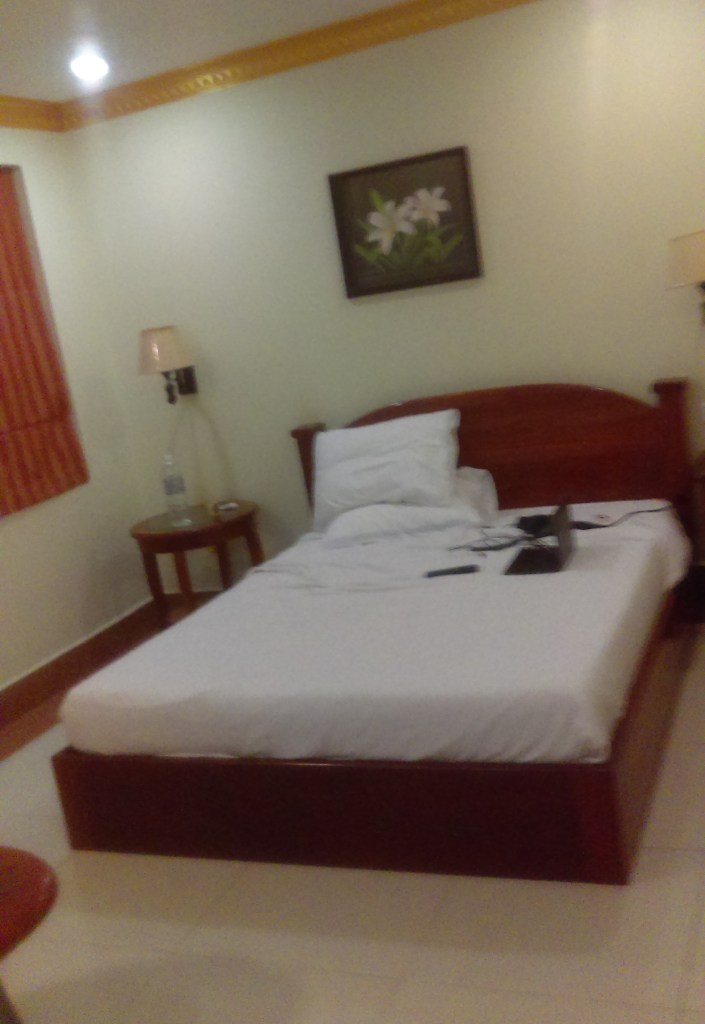
My room. Not shown is the en-suite bathroom and cable TV. The cost is around $AUD 50 a night. The hotel is downtown, a block from the river. I can walk to the National Museum and Wat Phnom.

Phnom Penh according to Google Maps. My hotel is circled in red. All along the riverside, from Wat Phnom to the ferry crossing (shown in light red) is a combination of hotels, bars, restaurants (both Western and Khmer), and markets. It’s a bustling, lively atmosphere.
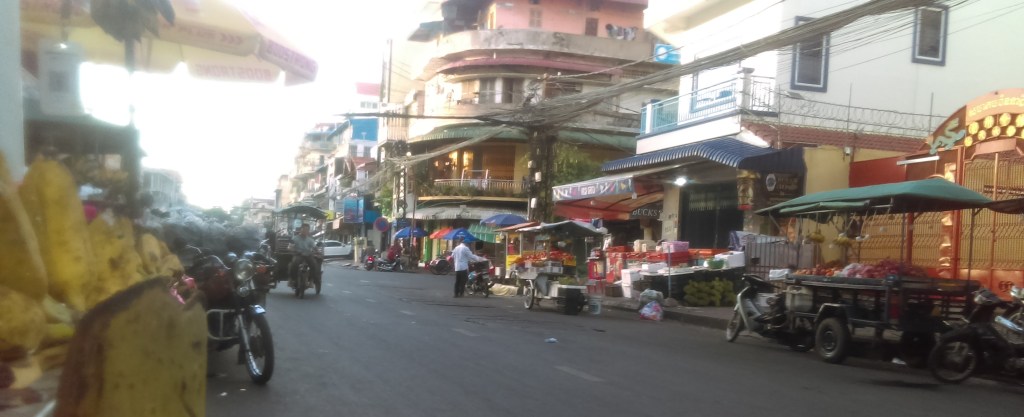
General street life. Note in the above photo a “tuk-tuk”, a vehicle mating the front half of a motorcycle with the back half of a cart. The more modern version is in this article.

Above is a view of the Tonle Sap river, this time about 6am.
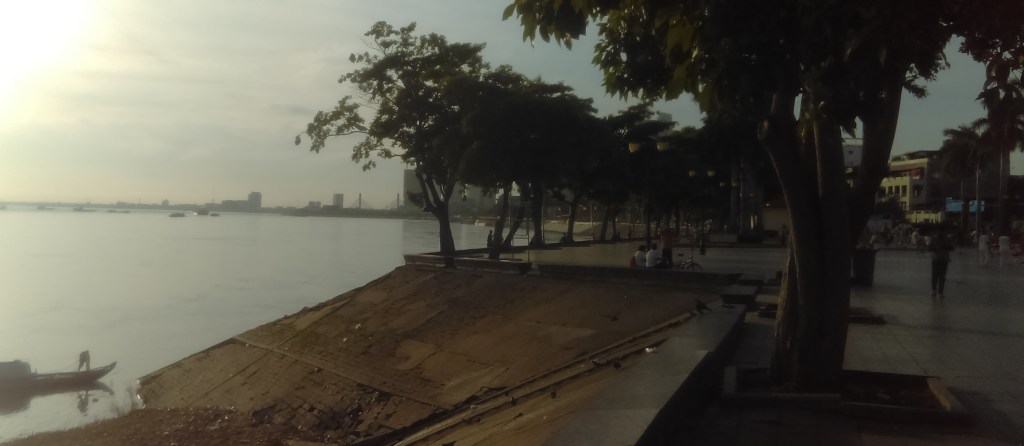
A different view from about the same location, looking at the meeting with the Mekong River.

There is a market a block from my hotel. According to Google maps, it does’t have an English name, only “នំបញ្ចុកខ្មែរ ឆ្ងាញ់ ឆ្ងាញ់” in Khmer. In the above photo it’s the whole block to the right of the lane, a warren of tiny huts selling groceries or food.

It was busy in the mornings near the market.

While I was taking photos, a guy arrived on his motor-scooter, with a tub of food on the pillion seat. He then proceeded to sell the food (above) off the bike. Note the butcher’s shop in the background, raw meat displayed for sale.
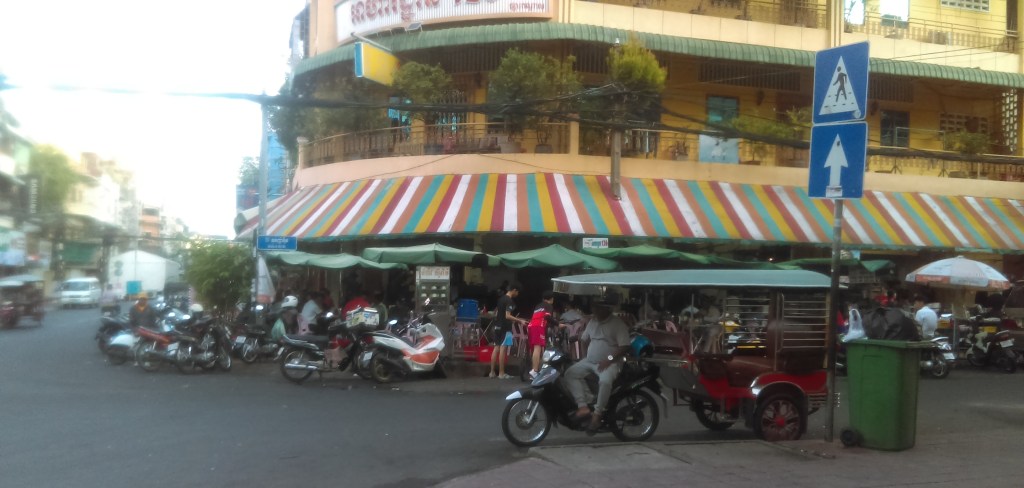
A block from my hotel was this Khmer cafe/restaurant. This quickly became my new favorite place; I ate there almost every morning.
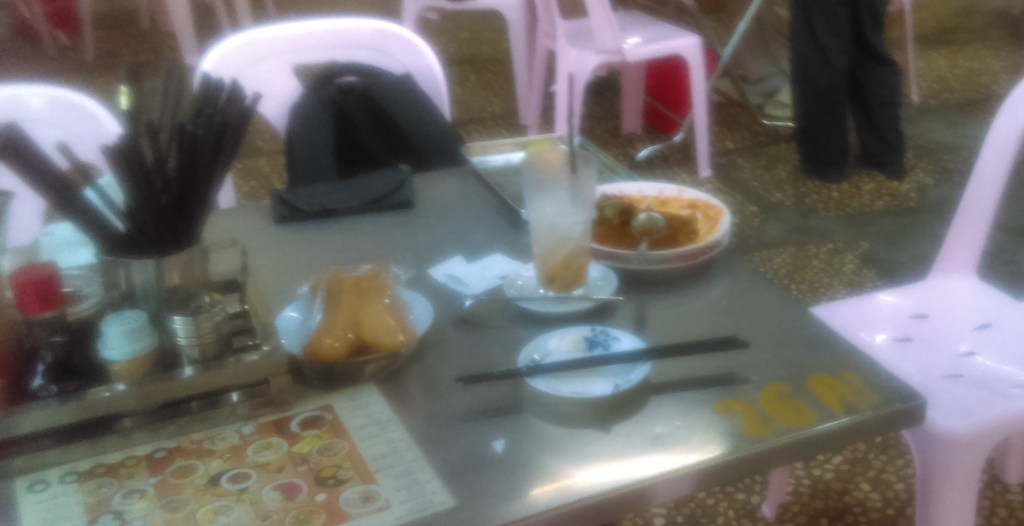
The blurry photo above is what I ate every morning: an iced coffee, a pork bao already eaten, and a beef stew with a baguette:
“Intensely rich, savoury, and a little sweet … something incredibly more-ish that you’ll be eating until the last spoonful and then licking the bowl. Our favourite way to eat it is with a crunchy French baguette”.
One morning I decided to cross the river. I left my hotel, marked with a dark red circle in Google Maps, to take a tuk-tuk down to the Kampong Chamlong Phnom Penh Areiy Ksatr wharf. You can check the Google Maps above, shown in light red.

The photo above is that wharf, with some ferries discharging passengers and motor vehicles.

Preparing to board the ferry. The ferry was pushed up only by the action of the propellers, seen causing turbulence in the left side of the photo. Cars and trucks drove on over the ramp in the bottom right of this photo, as did I. When the ferry was full, the captain reversed the propellers, and we were off.

Nice view, although hot – I estimated over 30 degrees.
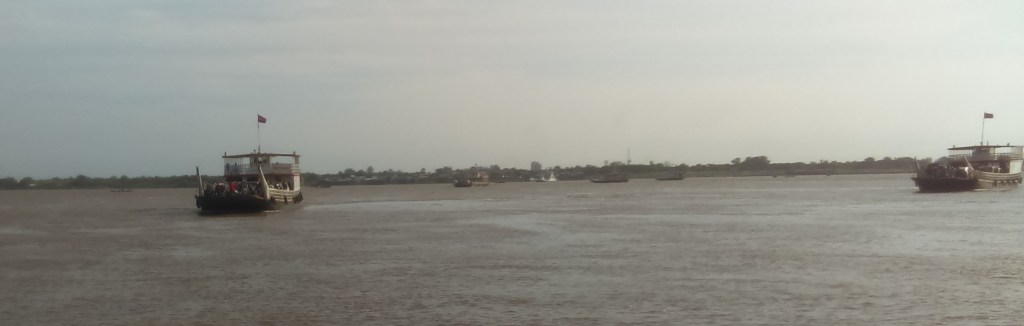
There were many other vessels doing the same.

This photo is of the Mekong River, from the Sokha Phnom Penh Hotel on the peninsular to the right, to Kandal Province on the left.
“The Mekong or Mekong River …is the world’s twelfth-longest river and the third-longest in Asia… with an estimated length of 4,909 km (3,050 mi)… From its headwaters in the Tibetan Plateau, the river runs through Southwest China (where it is officially called the Lancang River), Myanmar, Laos, Thailand, Cambodia, and southern Vietnam.”
Just even hearing its name exerts a powerful effect on me. In 2008 I traveled up the Mekong River, from its several mouths in southern Vietnam near Ho Chi Minh City, through Phnom Penh, Vientiane in Laos, Luang Prabang, and Jǐnghóng (景洪) in China – 5 months total, over 3,000 kilometers. An interesting (and now, nostalgic) time.
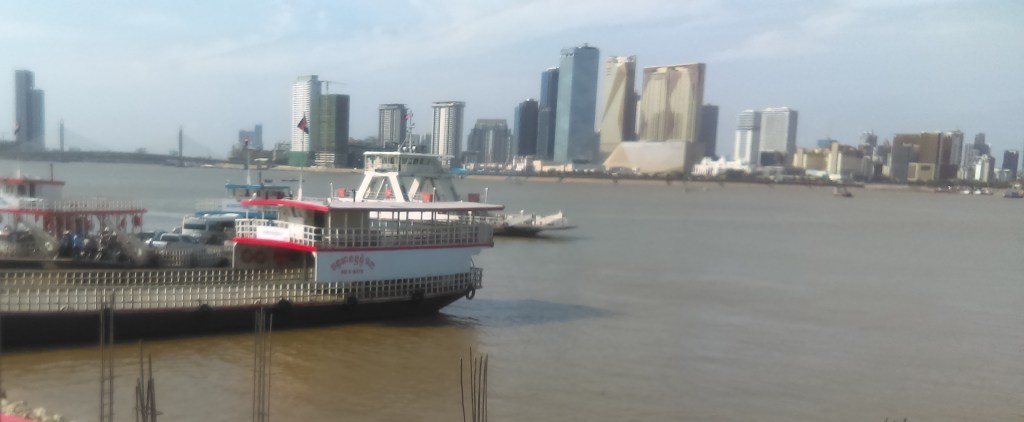
In Areiksart Ferry Port, looking over at the skyscrapers of Phnom Penh.

The view along the road from the Areiksart Ferry Port.
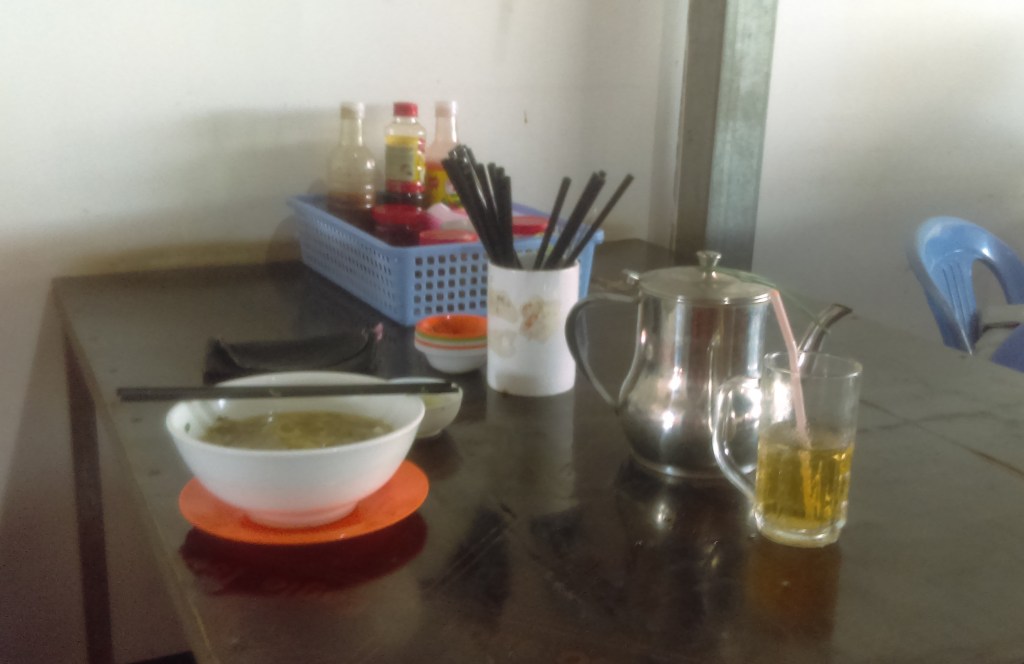
The day was hot, so I stopped at a restaurant. The waitress spoke no English, but I pointed to another customer’s order, resulting in the noodle soup above. The tea was complimentary.
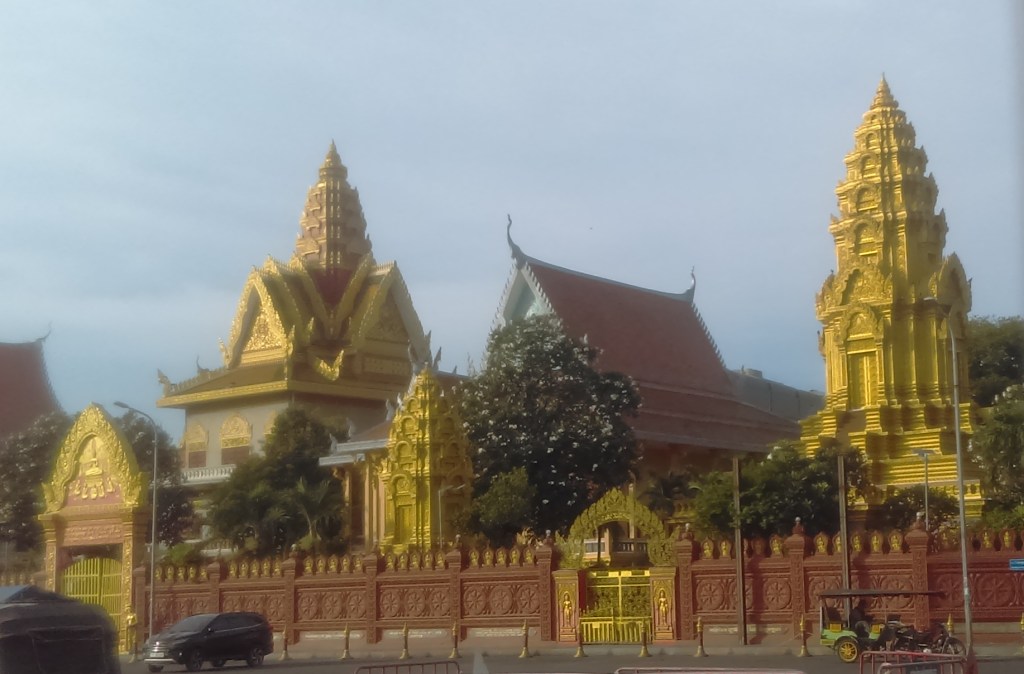
On another day, I went past Wat Ounalom:
“It was built in 1422 by King Ponyea Yat, the last king of the Khmer empire. …Wat Ounalom is recognized as the ‘headquarters’ of Cambodian Buddhism. The patriarch, the chief abbot of Cambodia, resides here. … This monastery was home to over 500 monks and housed a huge library consisting of over 30,000 titles. During the regime of the Khmer Rouge, many of the buildings along with many religious statues and symbols were damaged, but most of which have since been restored. The buildings are used for a variety of purposes. There is the temple itself, schools, libraries, living quarters and the stupa that gives the temple its name; the stupa holds an Ounalum, a hair from the eyebrow of the Buddha.”
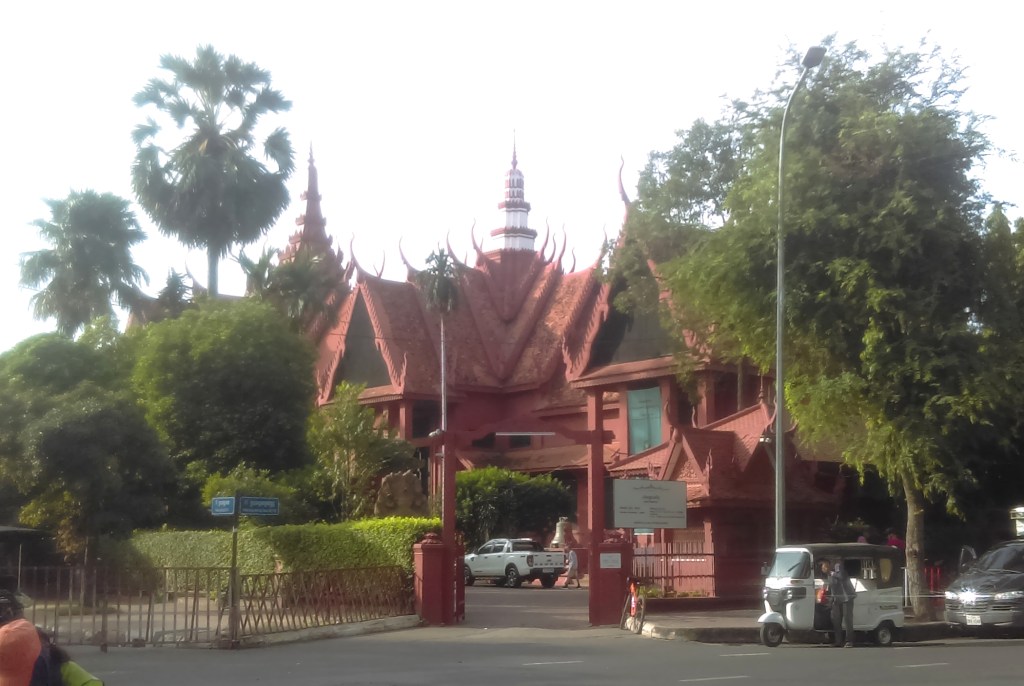
I was heading for the National Museum of Cambodia (above). I’ve been a few times so this was a quick visit.

Lonely Planet says: “The National Museum of Cambodia is home to the world’s finest collection of Khmer sculpture: a millennium’s worth and more of masterful Khmer design. It’s housed in a graceful terracotta structure of traditional design (built from 1917 to 1920) with an inviting courtyard garden, just north of the Royal Palace.”

Inside the building. While writing this up I found that “visitors are not allowed to photograph the collection, only the central courtyard” – so the above photo is illegal.

The central courtyard (where photography is permitted) is a very elegant place.
Next I planned to go down to Kampot for the day.
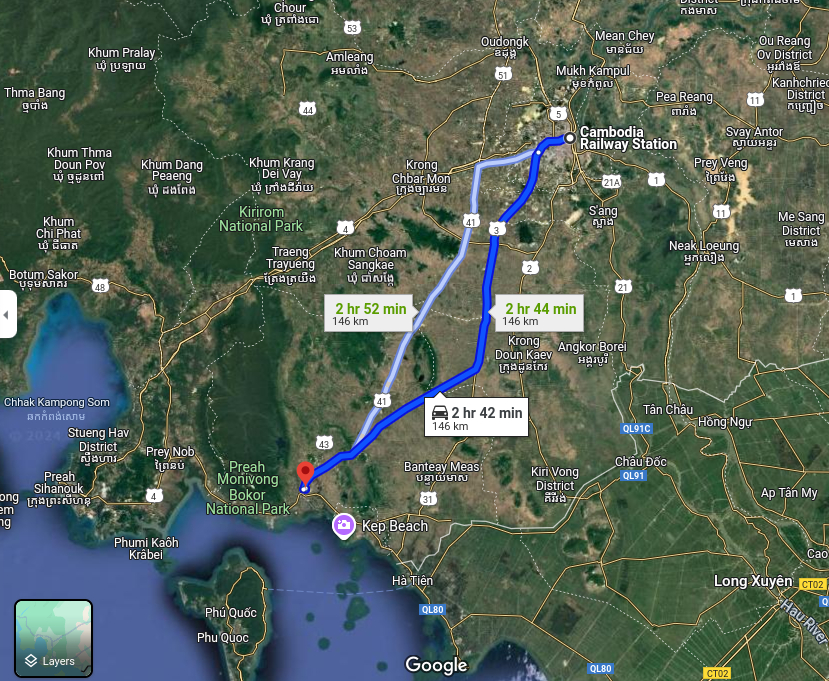
From Google Maps, Phnom Penh to Kampot is 146 kilometers. An equivalent is Sydney to the Hunter Valley. I was taking the train, which meant nearly 4 hours’ travel. I planned to go down to Kampot by the 7am train, spend 5 hours there, and take the afternoon train back up to Phnom Penh. I booked the tickets in person a few days before.

The day of the trip to Kampot, I got up very early, before 4am. Exiting the hotel, a film crew was at work, filming a scene in the middle of the street. Fake pedestrians, fake tuk-tuk drivers, even a fake backpacker took their positions, and on the call of “Action!”, pretended to walk. It was a little over 5am and still dark. I tried to take a photo, but one of the film crew stopped me, so I took this photo from a distance. It was very strange.

The Phnom Penh Train station in the early morning. The website says:
“Phnom Penh Railway Station was constructed during the French colonial era, opening to passengers in 1932. Despite being effectively out of use as railway station for an 11 year period from 2005 to 2016 Phnom Penh Railway Station is a beautifully preserved building from a much different era.”
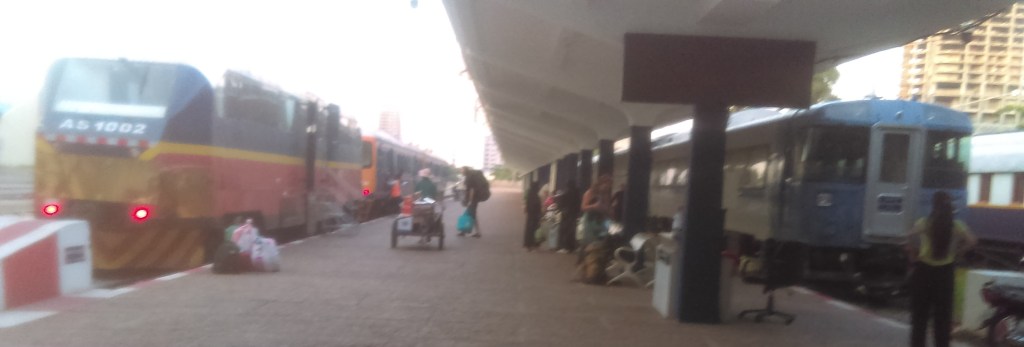
Behind the station, several trains were waiting. Our train was the one at the left, a single car.
The above YouTube clip gives you a flavour of the ride. I think it’s a Thai train in the clip.
I was on a different train to that clip; the windows didn’t open and it was split about half between tourists and Khmer.
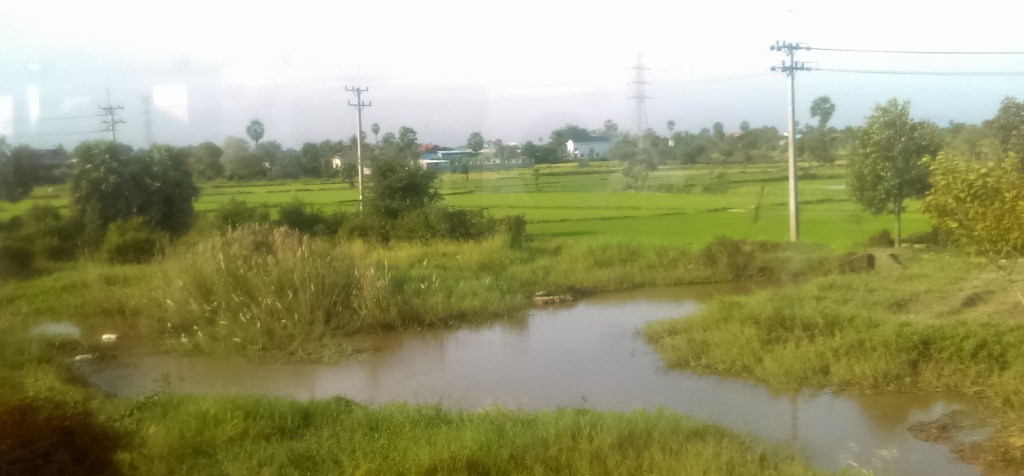
The railcar moved out of Phnom Penh’s suburbs at an estimated 40 kilometers an hour. We trundled on a dead flat plain (above) with relatively scrubby vegetation.

After 2 hours or so, we passed through a line of hills, and the vegetation improved. This was classic Cambodian countryside.

I go off at Kampot and hired a tuk-tuk to get me to the centre of town, beside the river. I paid the driver $US 1.
The Wikivoyage page says: “Kampot’s main draw is its relaxing riverside setting. While there is a sizable town (population approximately 40,000) set back from the river, most tourists will spend most of their time enjoying the river. Most tourist businesses are scattered along the riverside promenade or are within one or two blocks of it. The riverside’s main reference points are the ‘old bridge’, a mongrel of various styles and temporary parts thrown together after its breaching in the Khmer Rouge days, and the French-built market building, which is being restored. Back from the river, the town is centered on the bizarre ‘durian roundabout’ featuring a huge statue of a durian. From where the buses drop passengers, walking down the wide boulevard leads towards the river and the French-built market.”
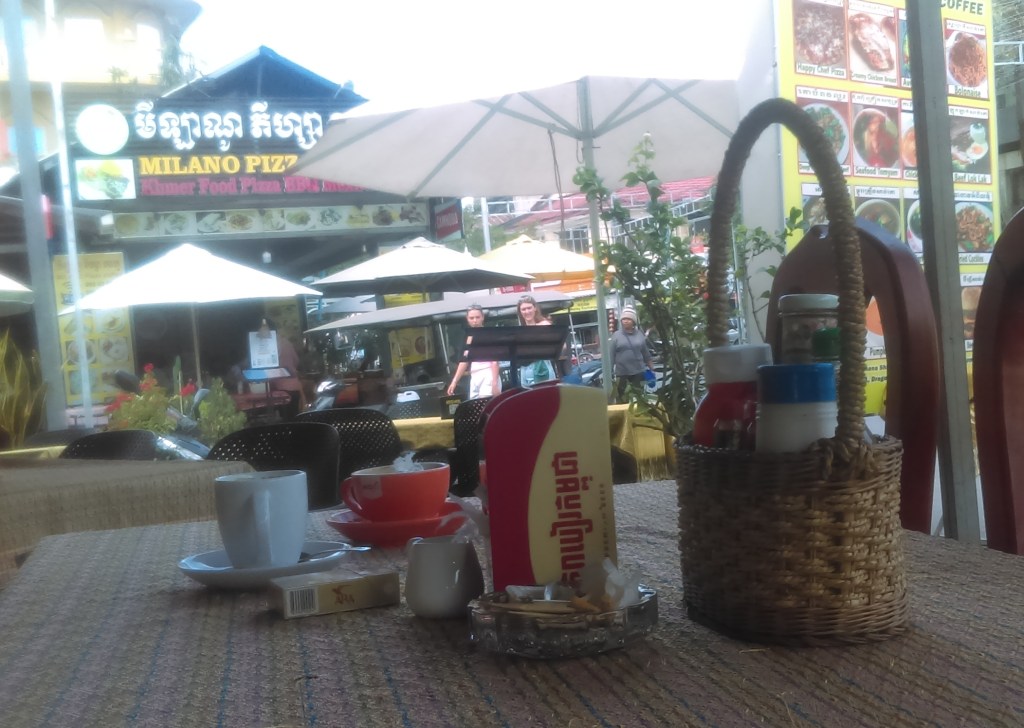
There were many tourist businesses by the river, including a few Western restaurants and a tourist night market a block from the river. I ate in one of the tourist restaurants (above).
Then I went back to the train station and waited for an hour and a half for the train – I think it was delayed. The train came and I boarded it. A few minutes later, some Khmer passengers boarded and demanded my seat. There was an unoccupied seat only a few seats over; a cautionary lesson on might makes right. I did move, and watched the countryside, and slept, waking up a few minutes before arriving at Phnom Penh Train Station.
I have enjoyed visiting Phnom Penh, and it appeals to me, although I think it’s a little too poor and rough to make living there enjoyable.
 Wandering Richard
It looks like you had an interesting week in Cambodia. But you do need a
better camera to do justice to the places and scenery you observe. dad.
LikeLike
Very interesting and beautifully written. Sorry to hear about your ID theft woes. I’ve been there too, very stressful. Contacte when you are not too busy. Clodi
LikeLike
great journey, was occupied, happy new year to you
LikeLike