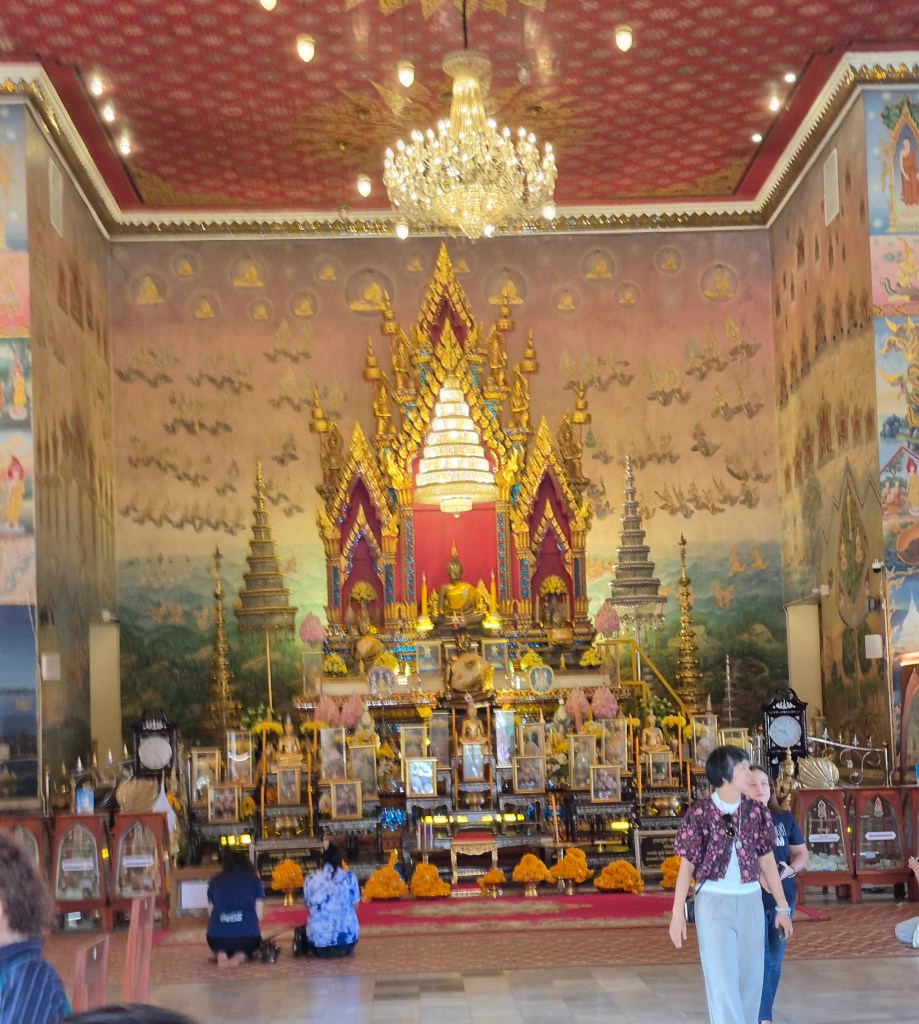
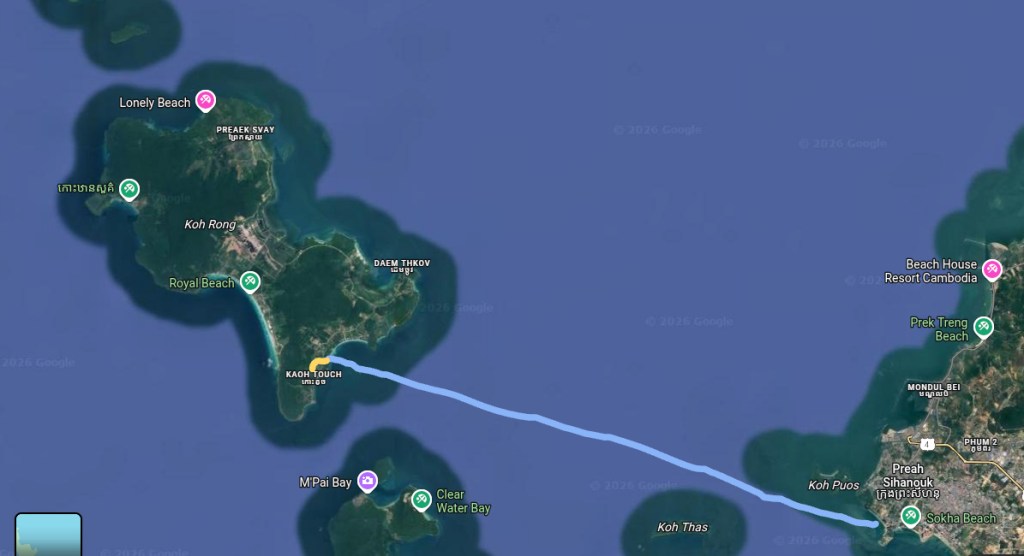
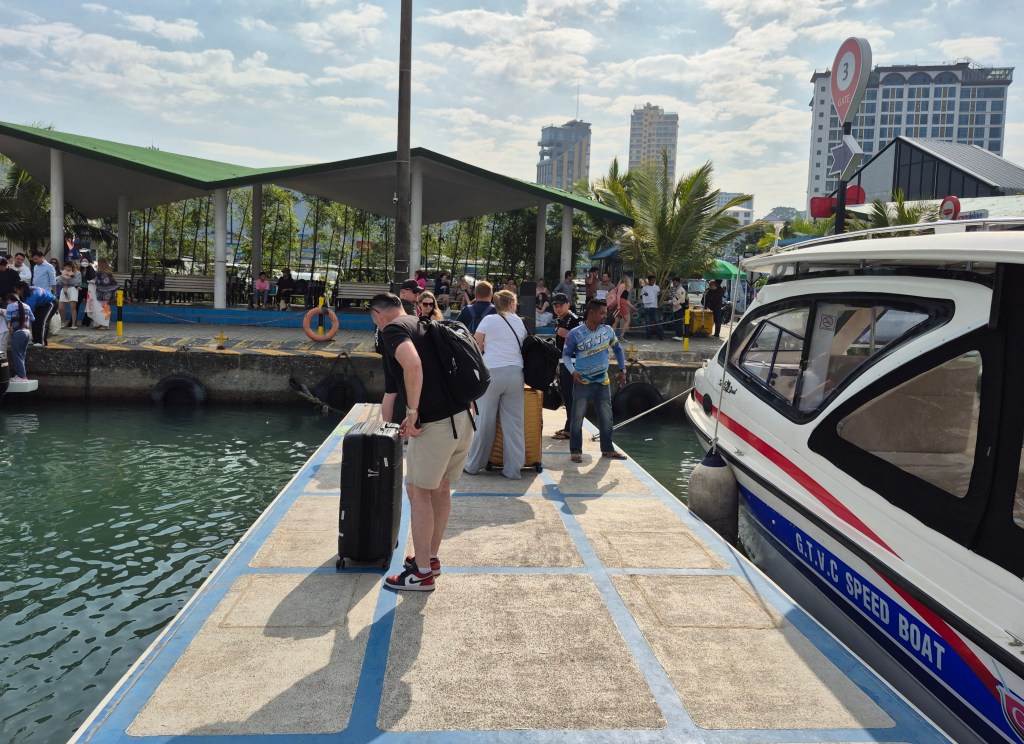
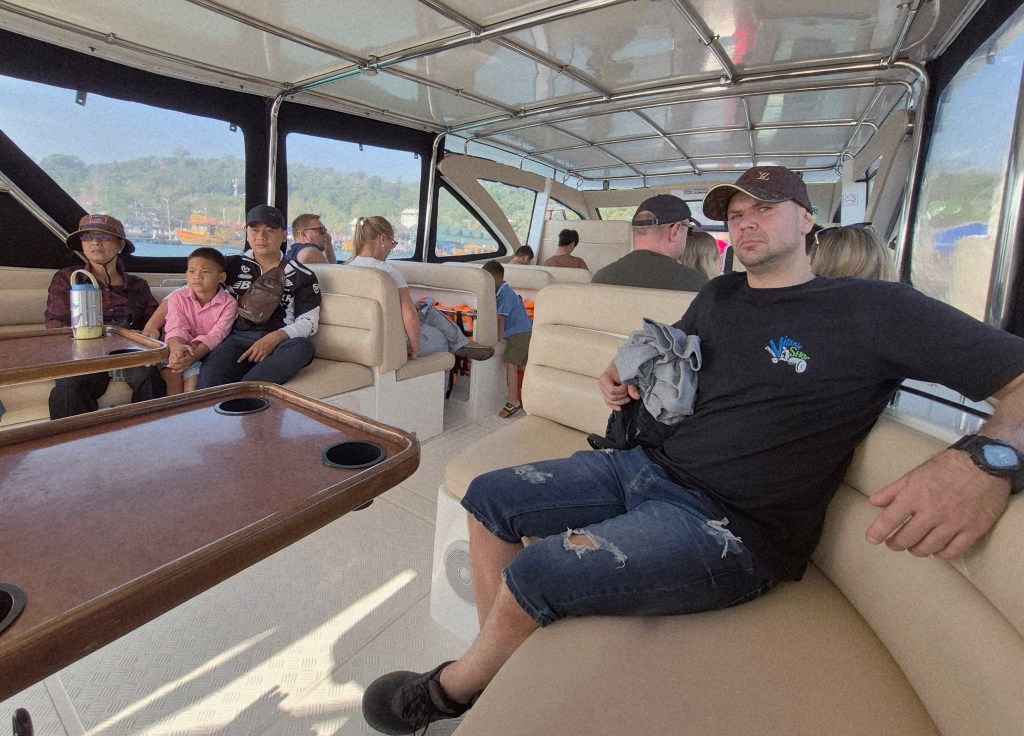
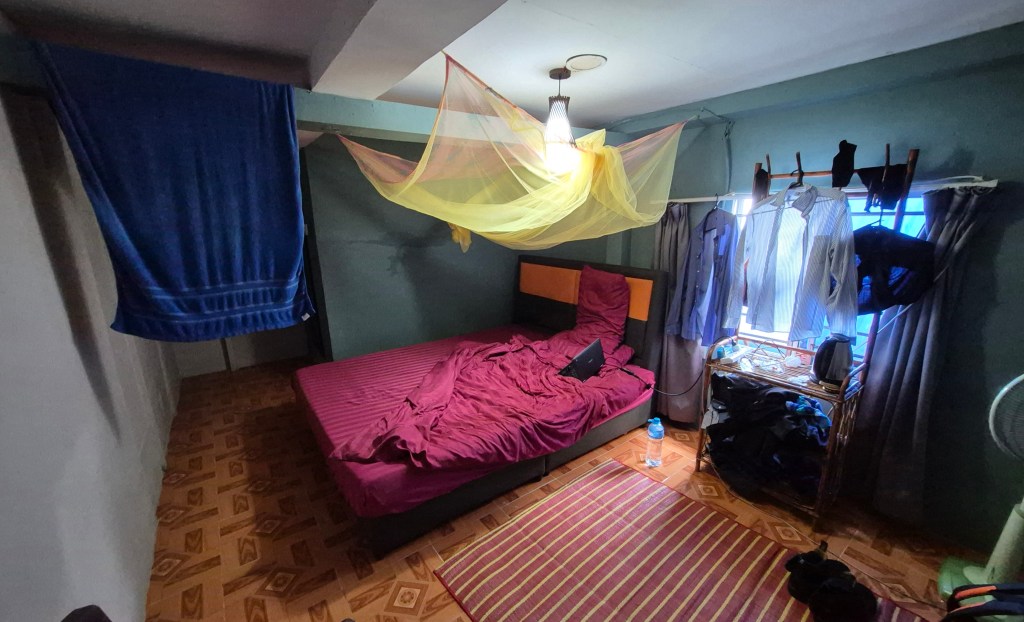
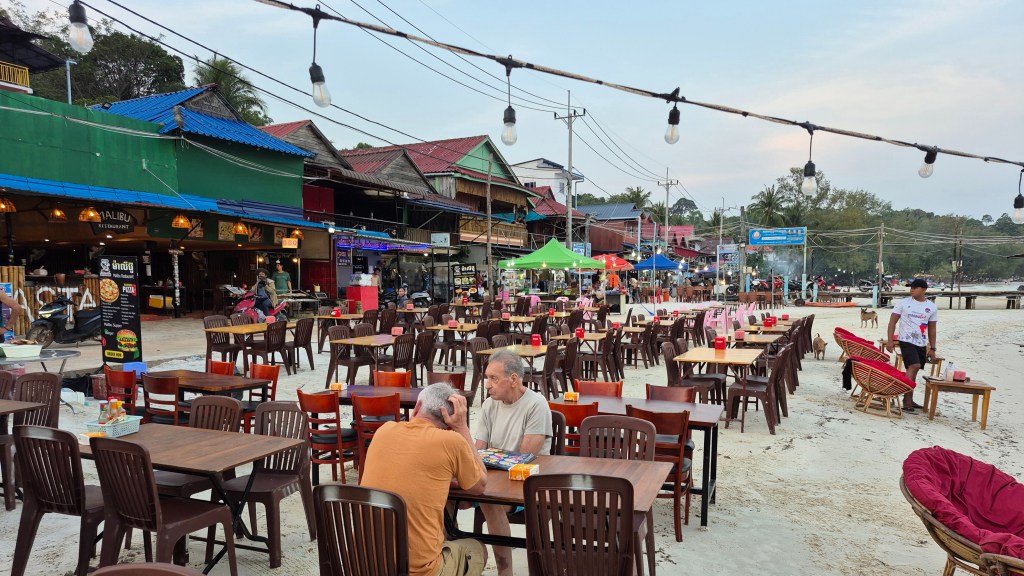
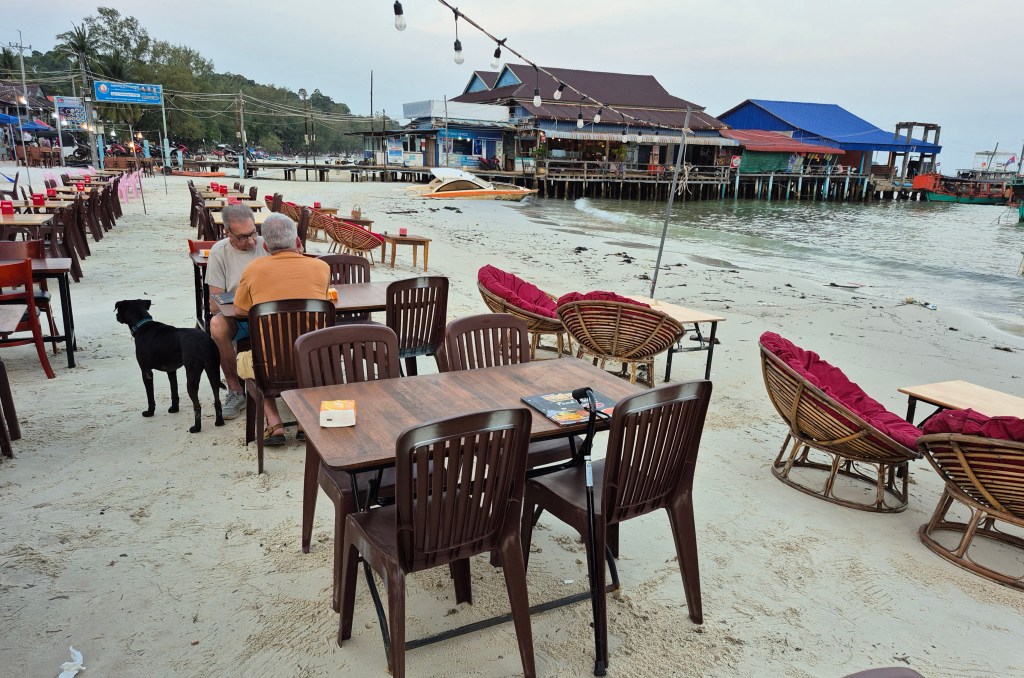
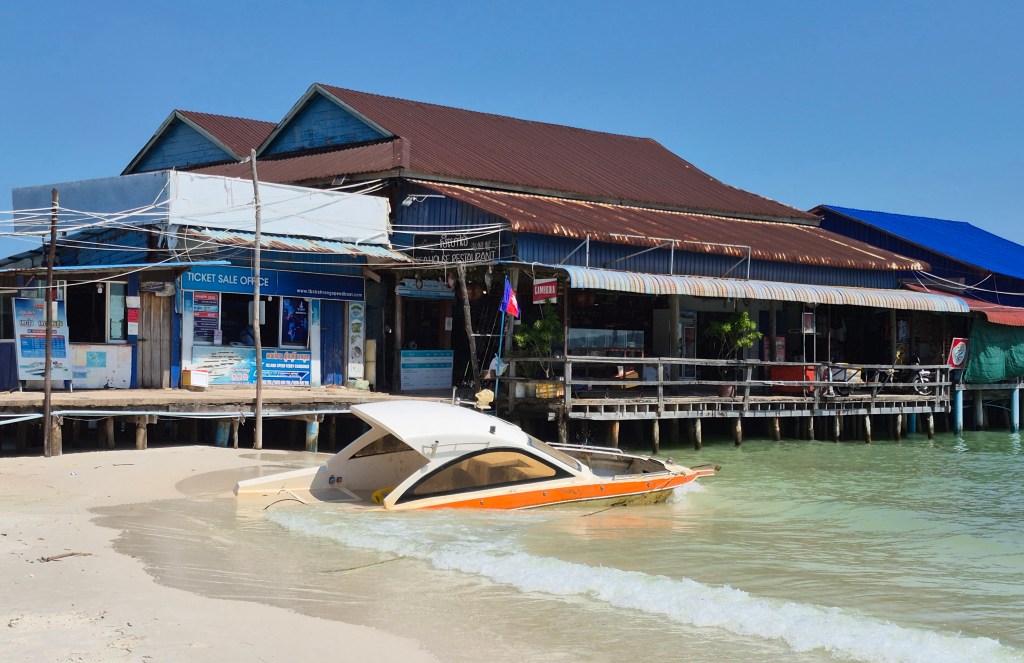
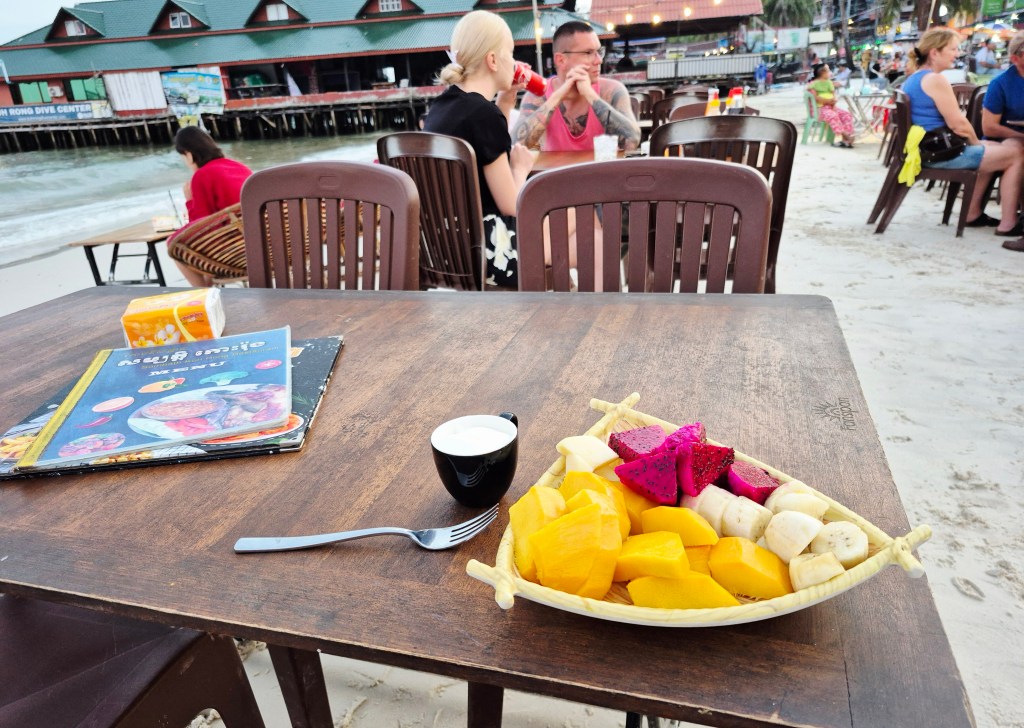
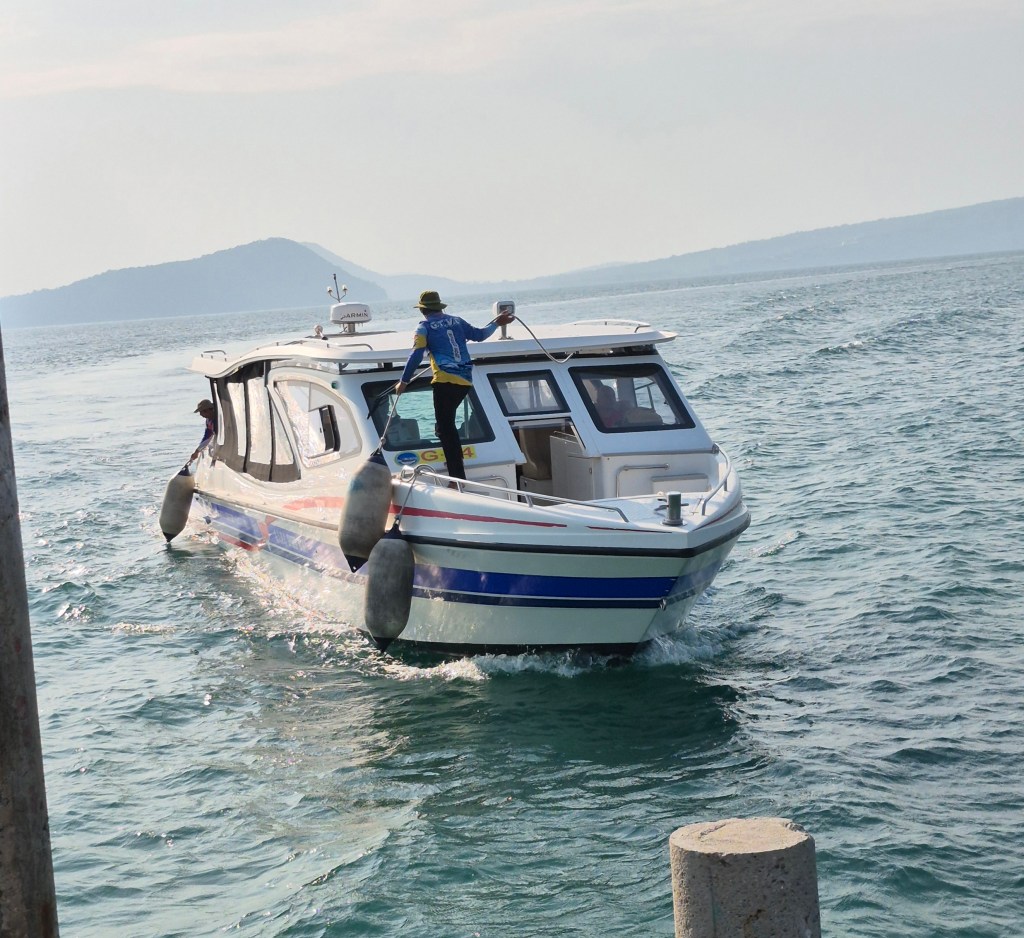
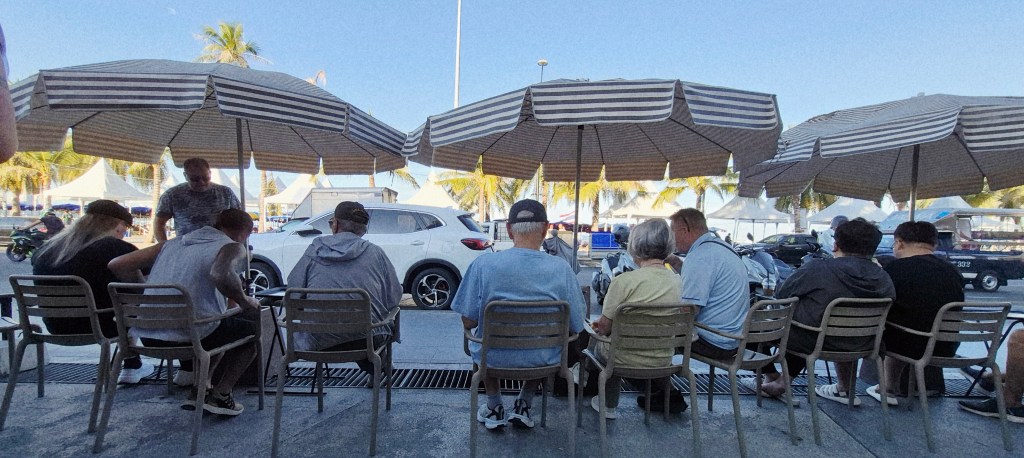
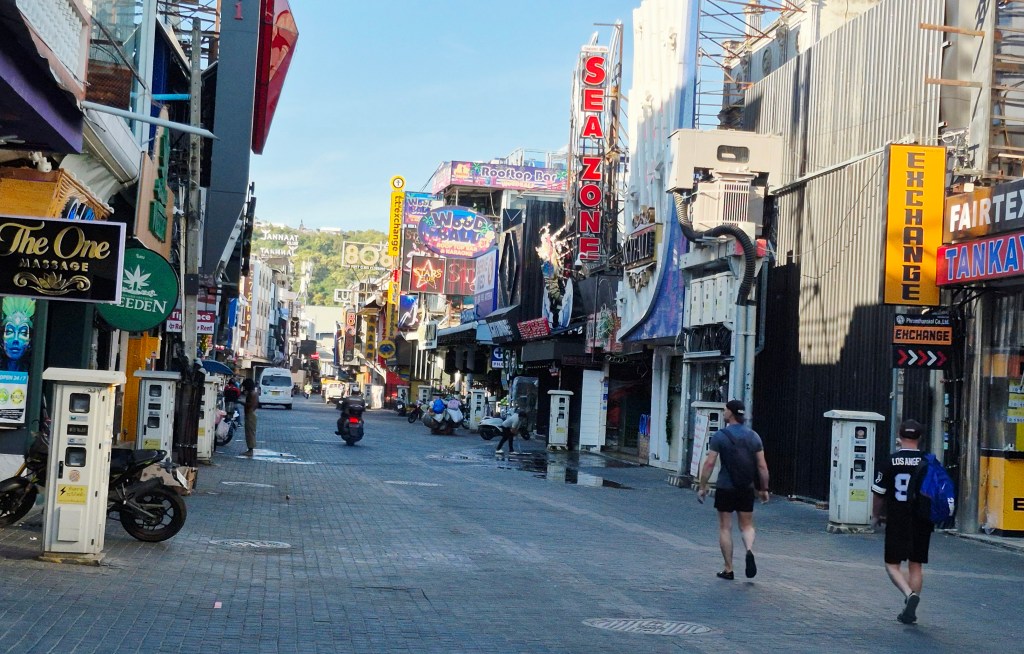
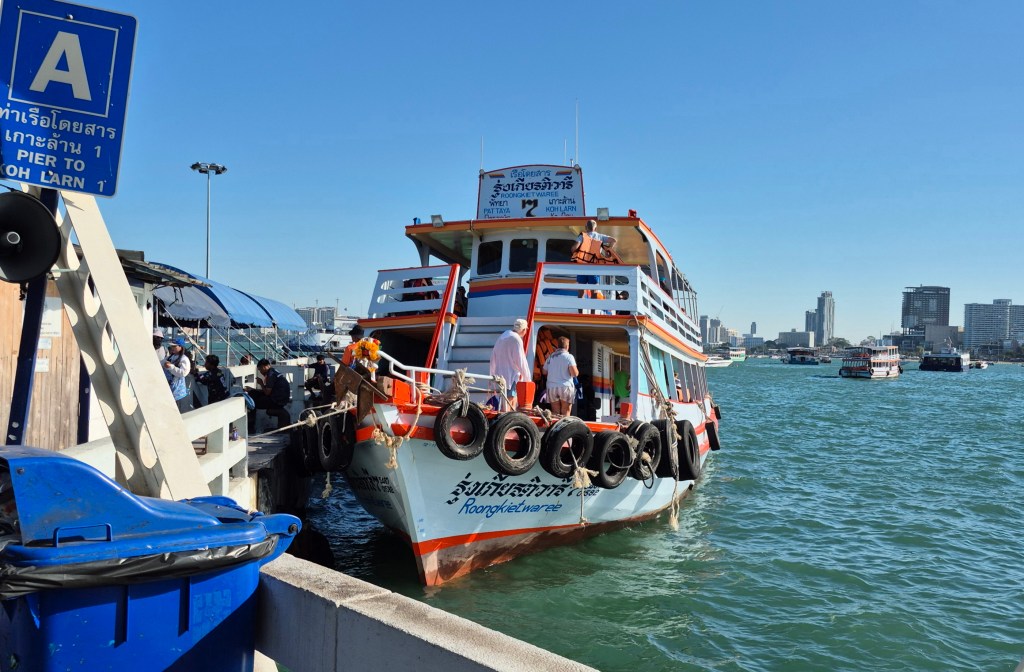
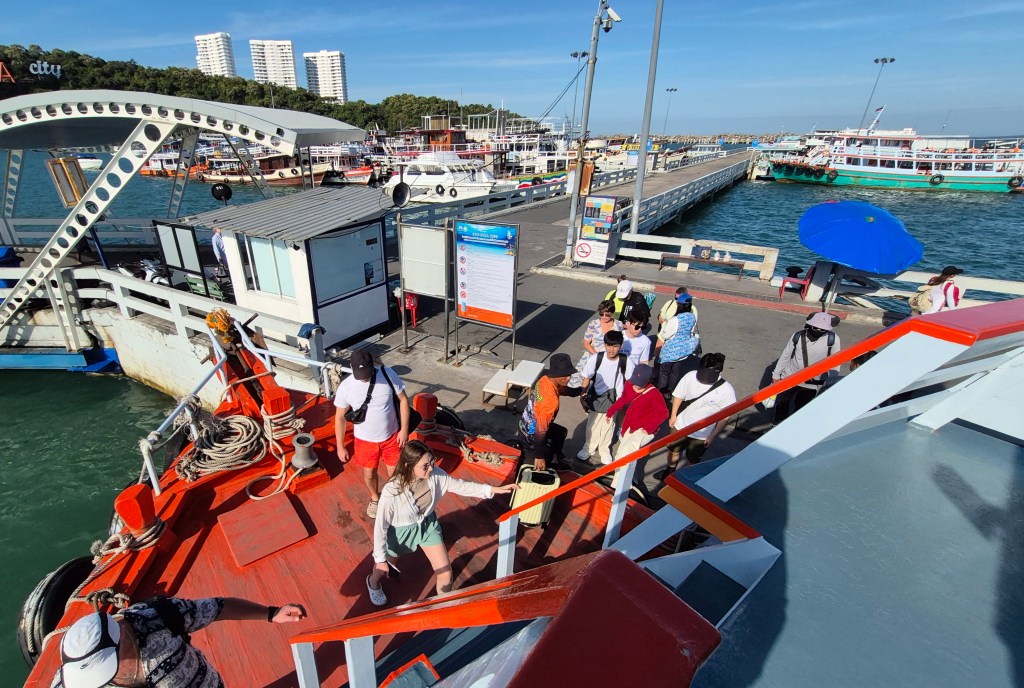
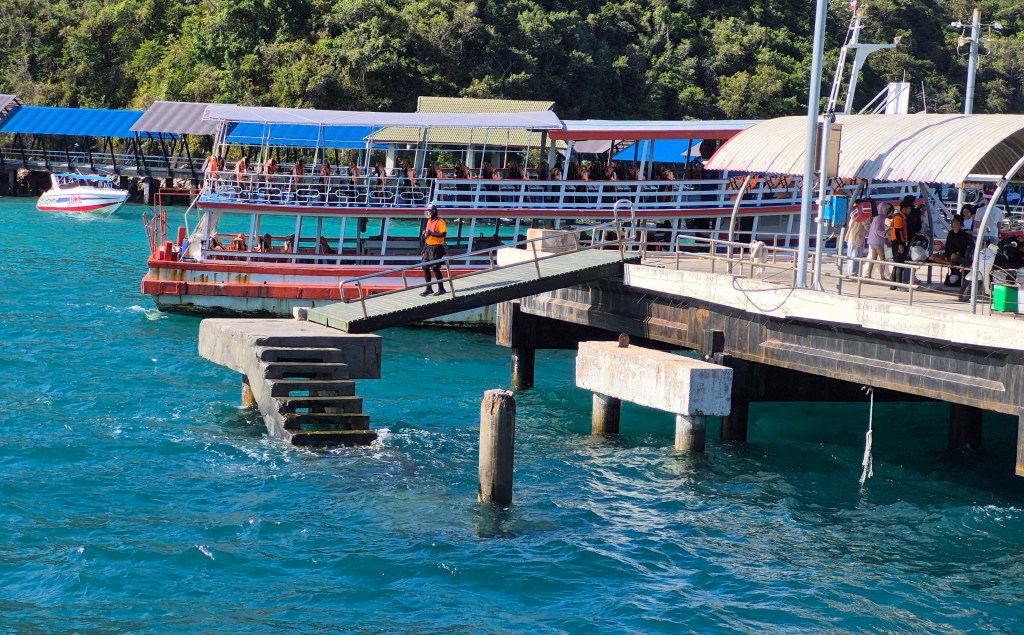
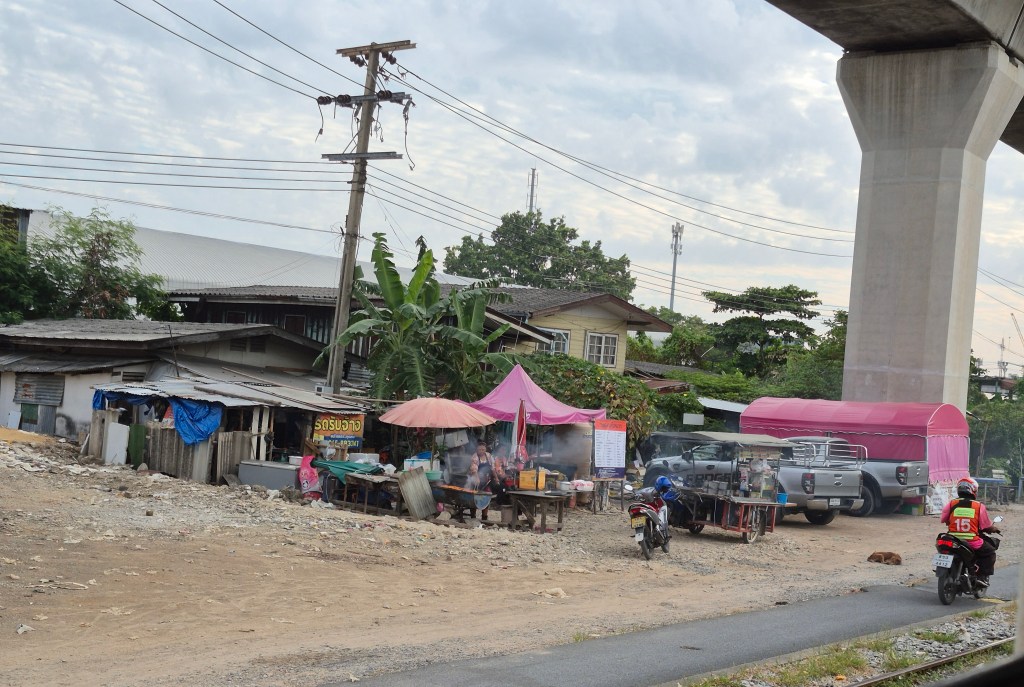
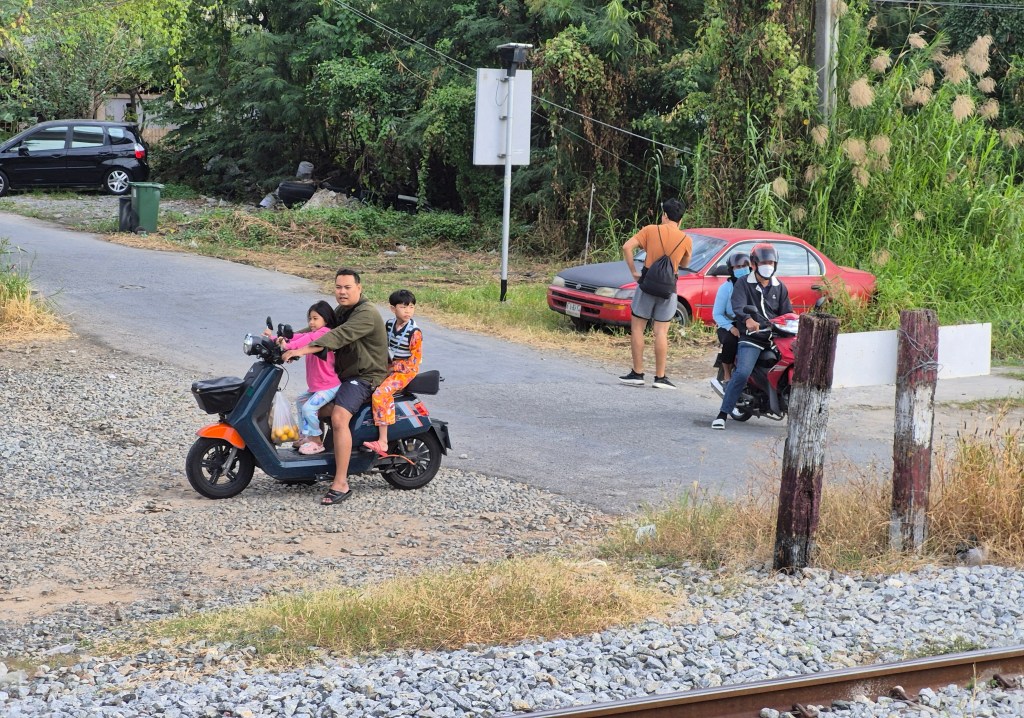
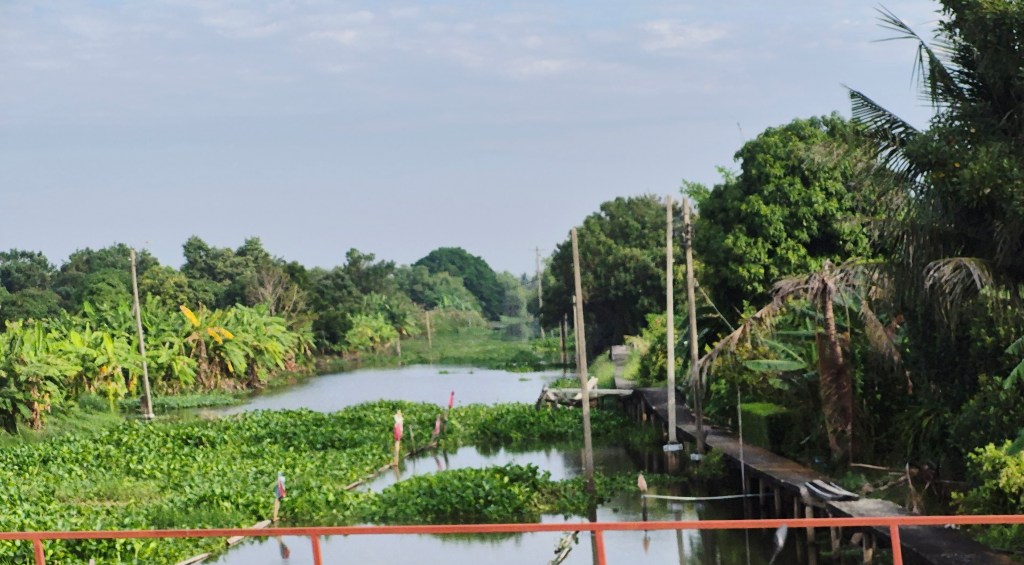
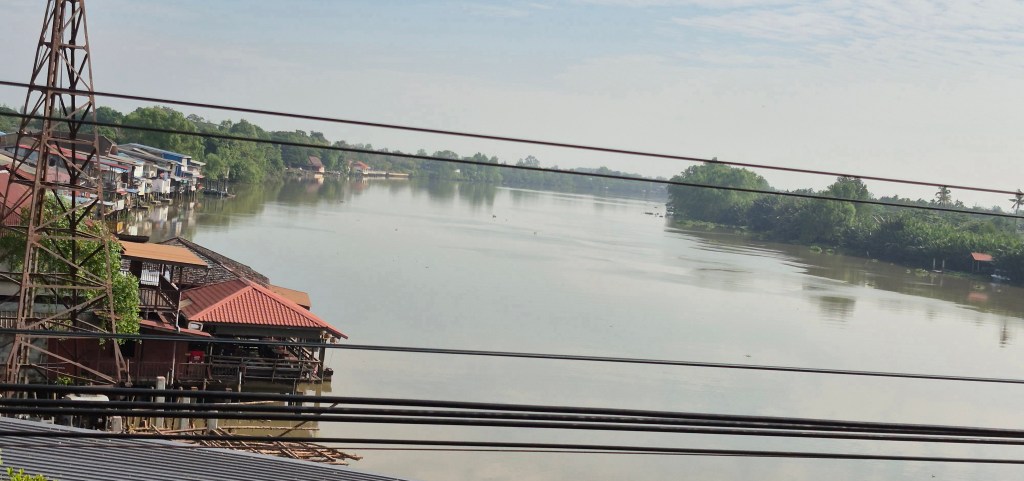
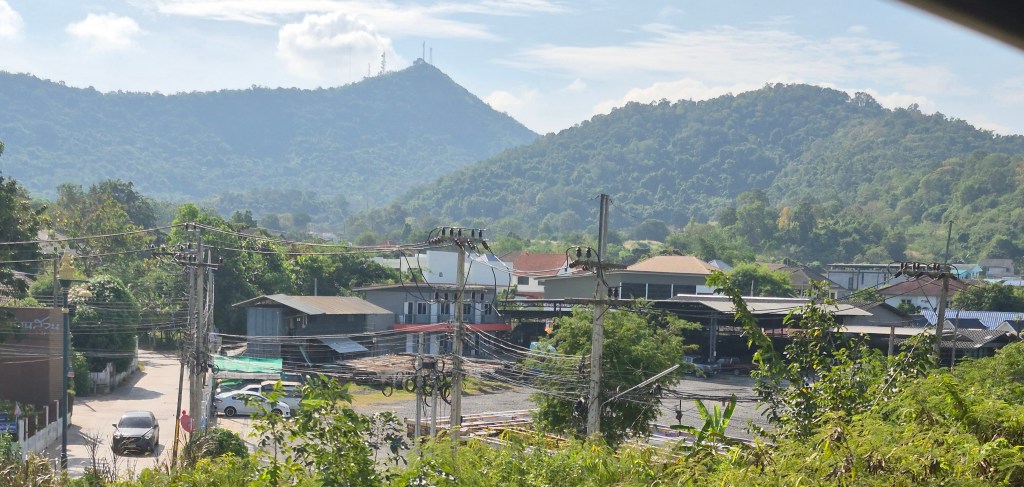
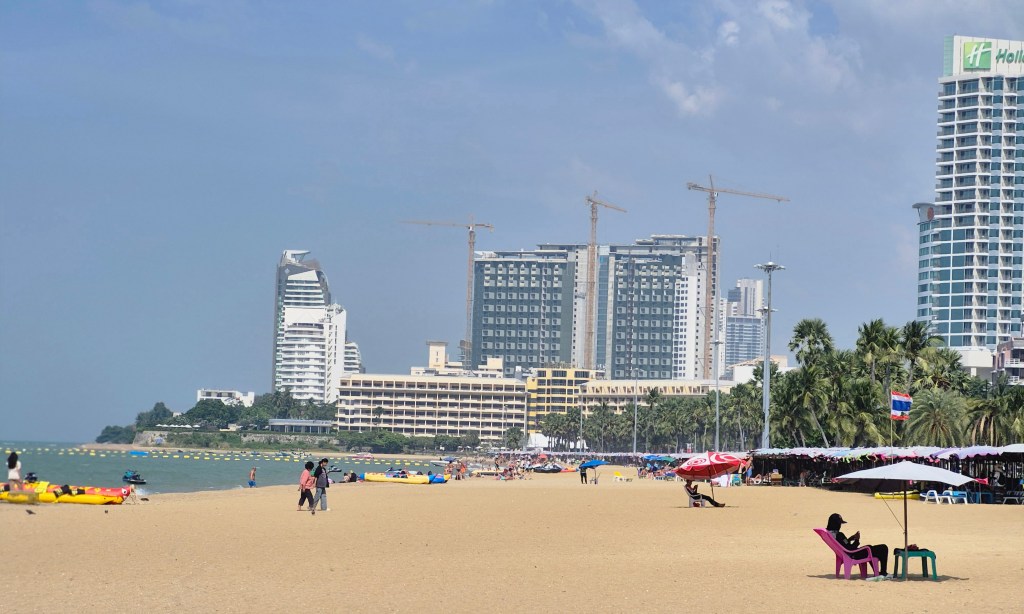
Koh Laan, Thailand

December 18, 2025

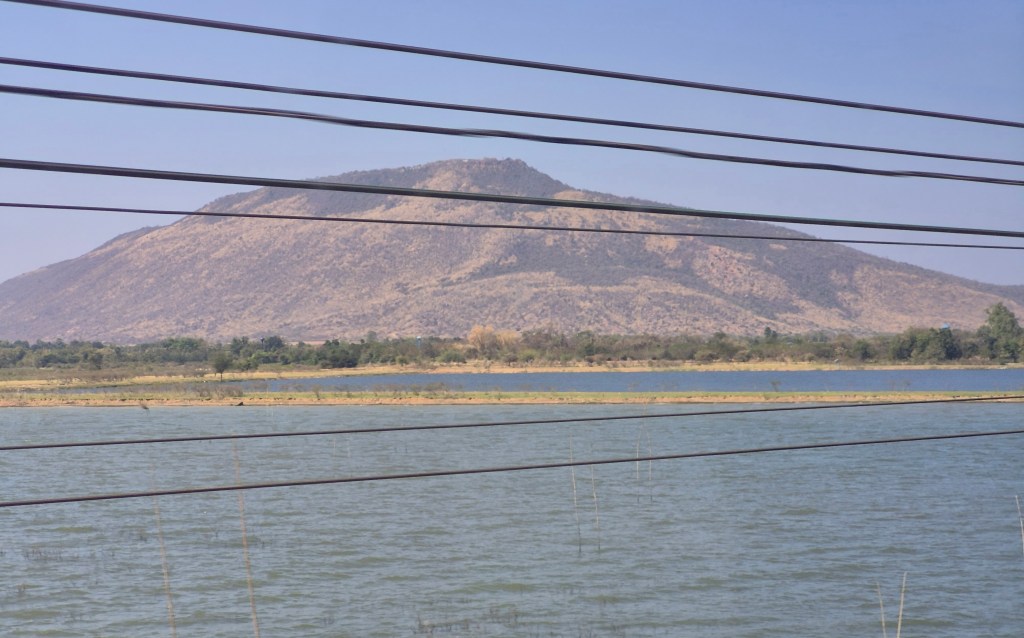
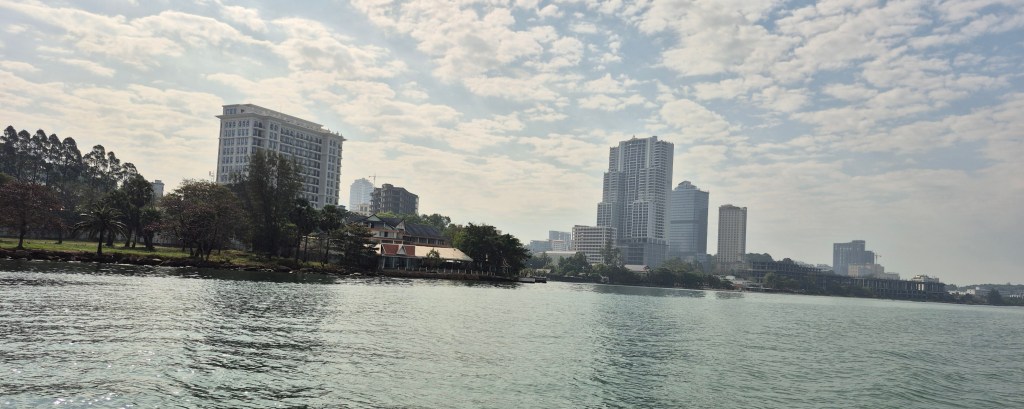
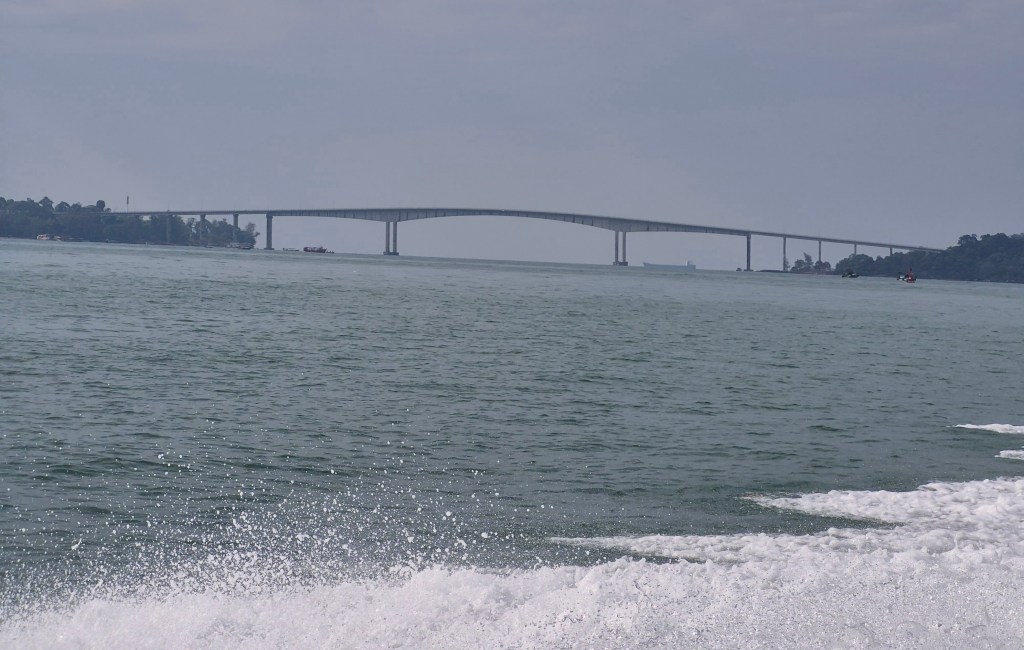
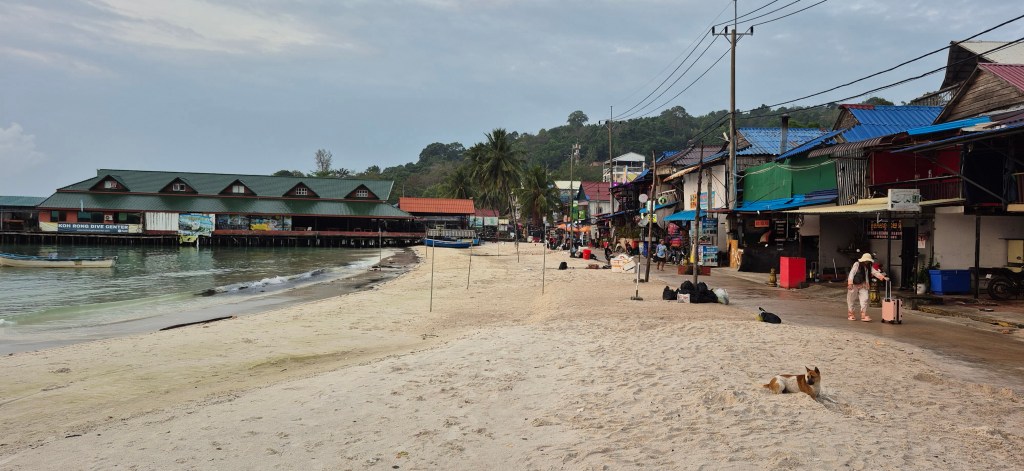
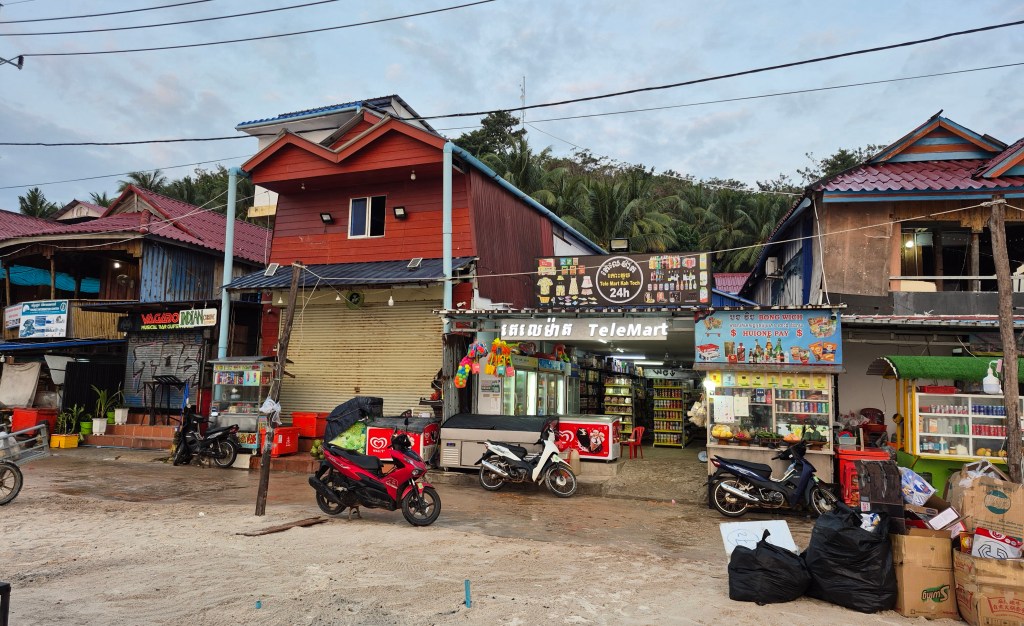
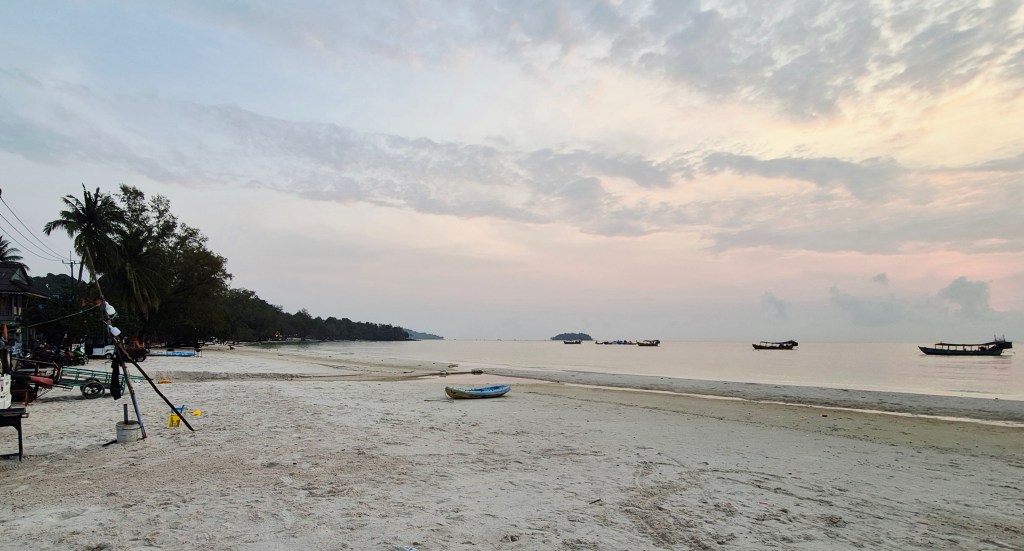
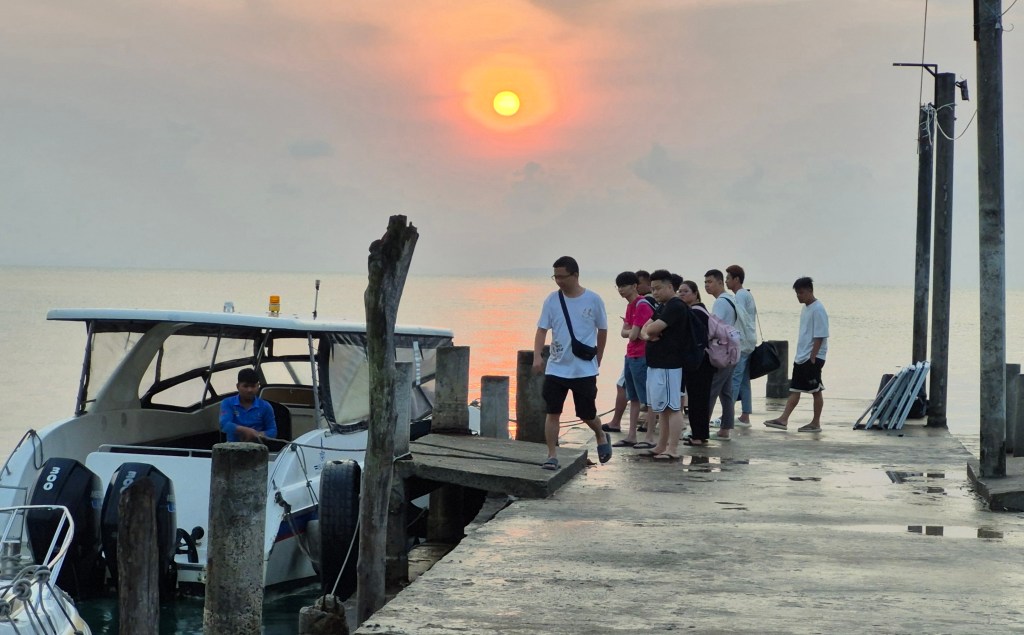
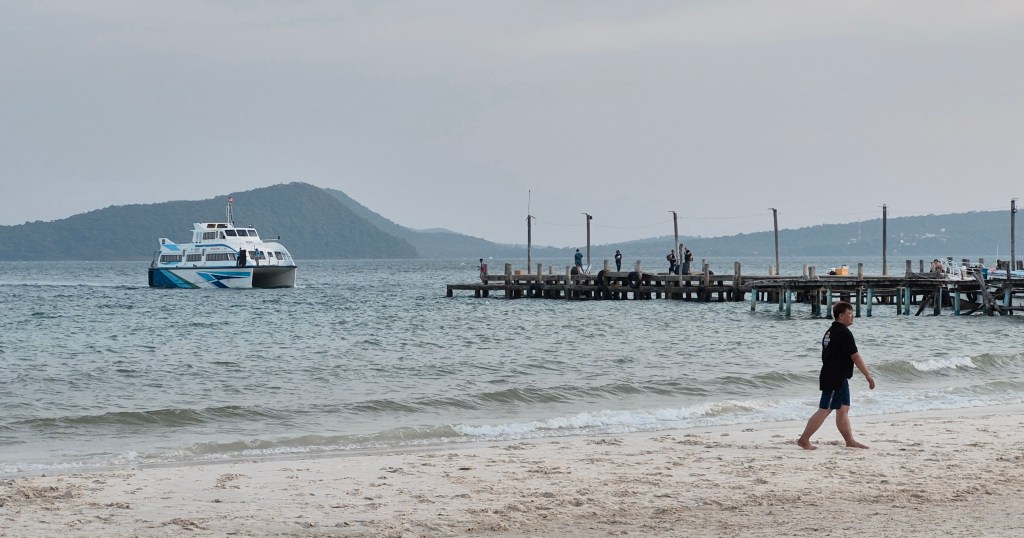
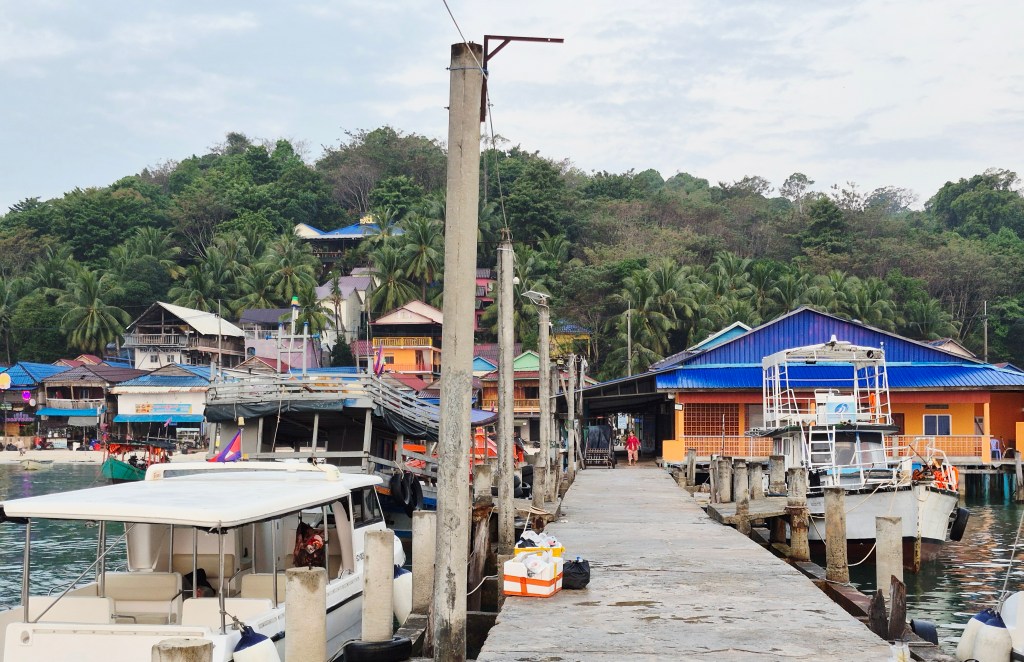
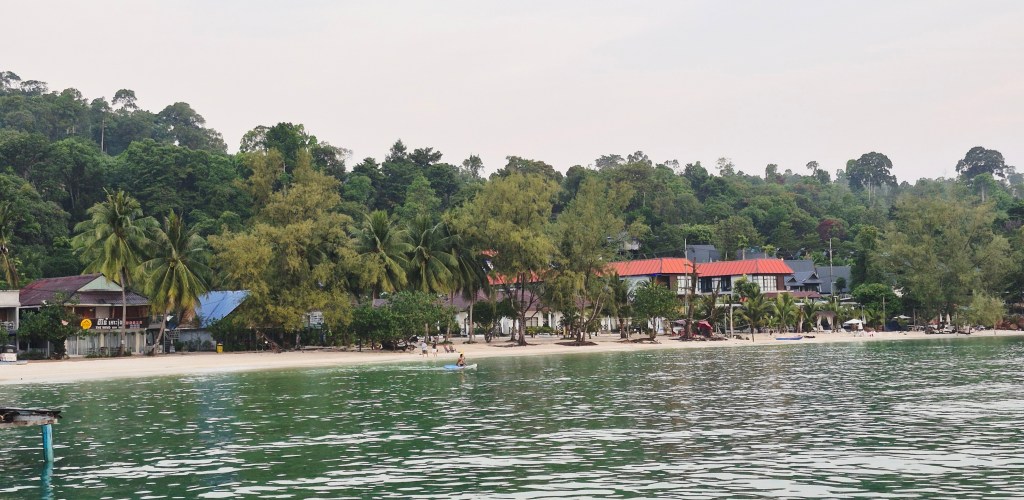
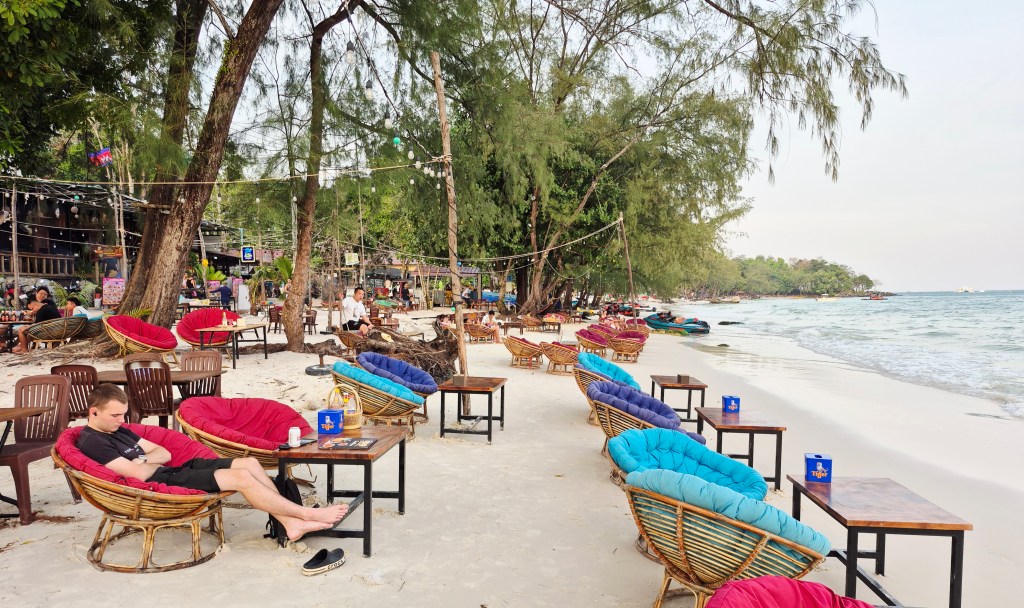
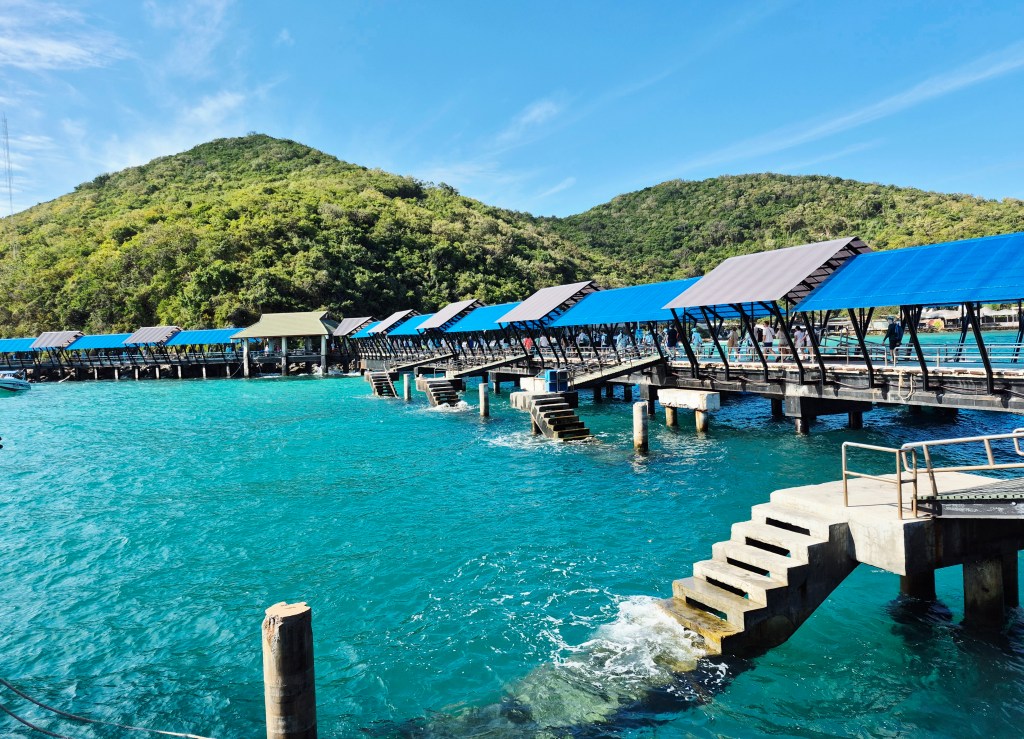
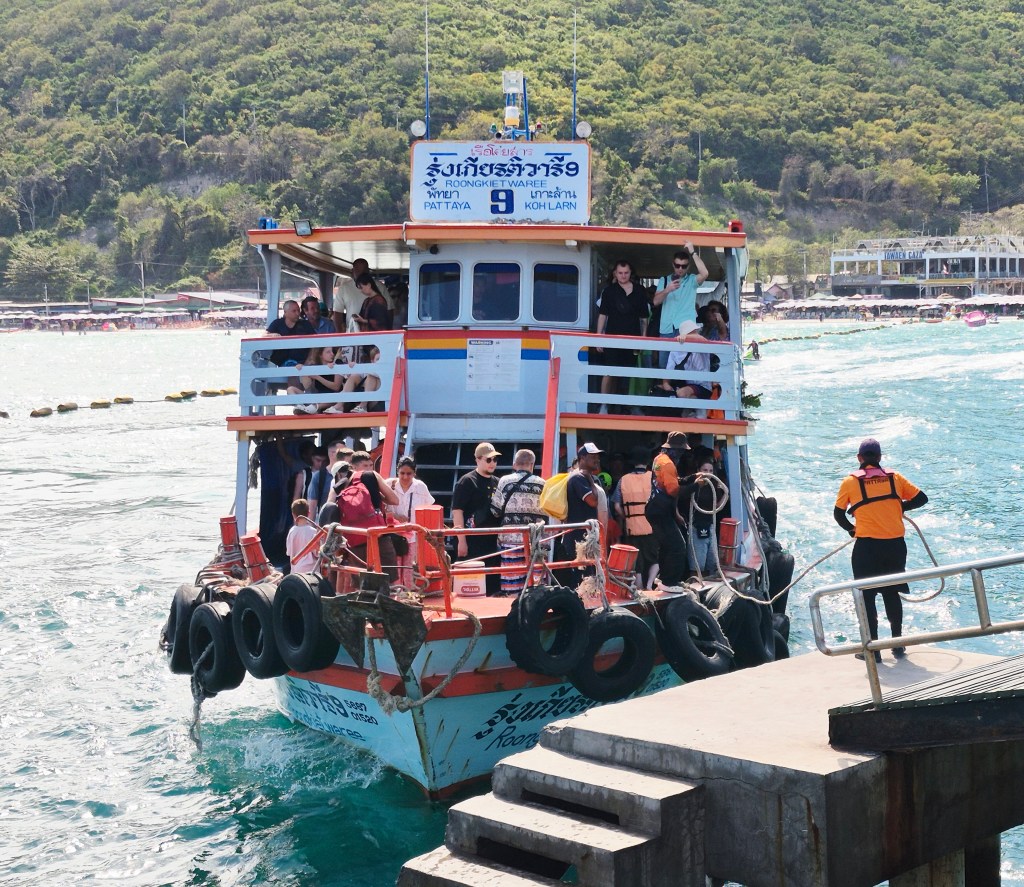
I went to Koh Laan (above) on a day trip.

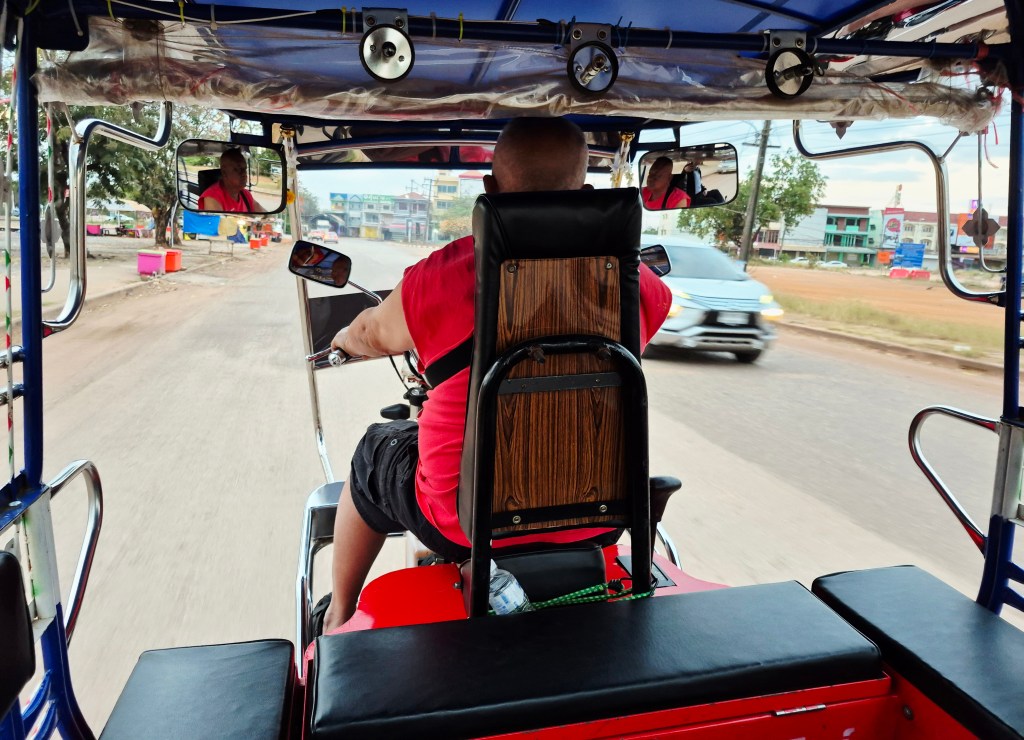
On that day I caught a sawngthaew (สองแถว) from my hotel near the Runway Market to Bali Hai wharf, then a boat to Tawaen beach on Koh Laan, and then returned the way I came.

At the coffeeshop near my hotel, about 8:30am. The temperature was in the mid-20s; it’s the coolest time of the year, and the dry season. There were a few coffeeshops together, but tourists always gathered at one coffeeshop – I don’t know why. The tourists preferred fresh coffee, delicious but expensive, about THB 60 ($AUD 3, NTD 60).

However, most of the Thais preferred ancient coffee (Thai:กาแฟ โบราณ), “which is in general not to the taste of westerners. It is brewed coffee with sweet condensed milk. The preparation of this ‘ancient coffee’ is interesting. It is brewed coffee that they pour through something that looks like a giant, brown old sock.” It is about half the price.

After breakfast – fresh iced coffee and an omelette without rice, about THB 100 ($AUD 5, NTD 100) – I looked for a songthaew. The songthaews have fixed loops, some travelling south down Beach Road until Walking Street, then back north again one street over.

A note about names transliterated from Thai. when I use a Thai word like “สองแถว”, I could transliterate it “songthaew”, or “sawngthaeo”, or “sawngthaew”. The English spelling is different, even though the Thai word is the same. There is a system for rendering Thai words in the Latin alphabet, the Royal Thai General System of Transcription, “the closest method to a standard of transcription for Thai, but its use, even by the government, is inconsistent.”

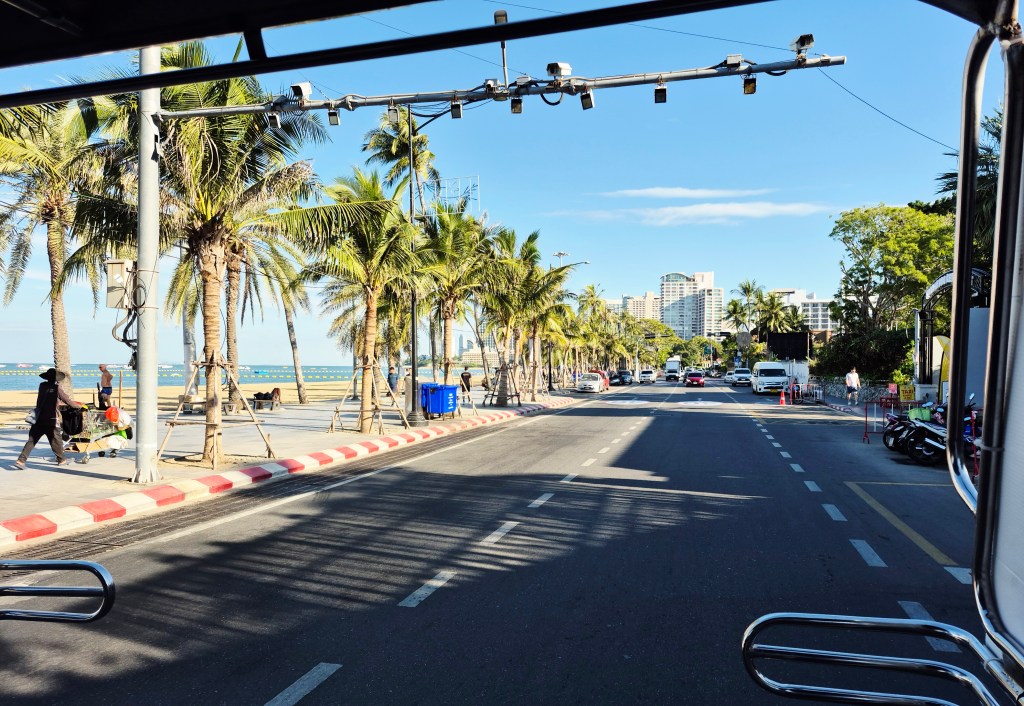
The above picture is looking out the back of a songthaew.

I believe the procedure for traveling by songthaew is as follows. You stand by the side of the road, and when the songthaew comes (above) you signal towards it by scooping horizontally with your hand. The songthaew stops, and you go immediately to the back of the songthaew and climb up without speaking to the driver. The songthaew then starts moving. When you want to get off, there are buzzers in the back which you press. The songthaew then stops, and you get out the back, walk to the front passenger’s side, and pay THB 10 ($AUD 0.50, NTD 10).

I got off at the northern end of Walking Street.

“Stretching from Pattaya Beach Road to Bali Hai Plaza, Walking Street is the epicenter of Pattaya’s notorious red-light district, with pubs, nightclubs, and go-go bars galore. Experience the electric atmosphere, catch a free Muay Thai match, and enjoy the live bands and cabarets. When the sensory overload gets too much, take a breather at Pattaya Pier—an iconic landmark in the city. Food-wise, there are a plethora of stalls, casual eateries, and restaurants that stay open to accommodate late-night revelers. Stay safe, and if you feel uncomfortable, look for tourist police stationed in the area.”

Unfortunately, the nightlife is absent at 9am.

But I did find a moto-sai driver (above). He whisked me to Bali Hai for THB 60 ($AUD 3, NTD 60). I disregarded a helmet, and then had a vision of a newspaper recording my death in a traffic accident.

In front of Bali Hai. In the photo there is a sign advertising island tours for several thousand baht (centre right), but I ignored that.

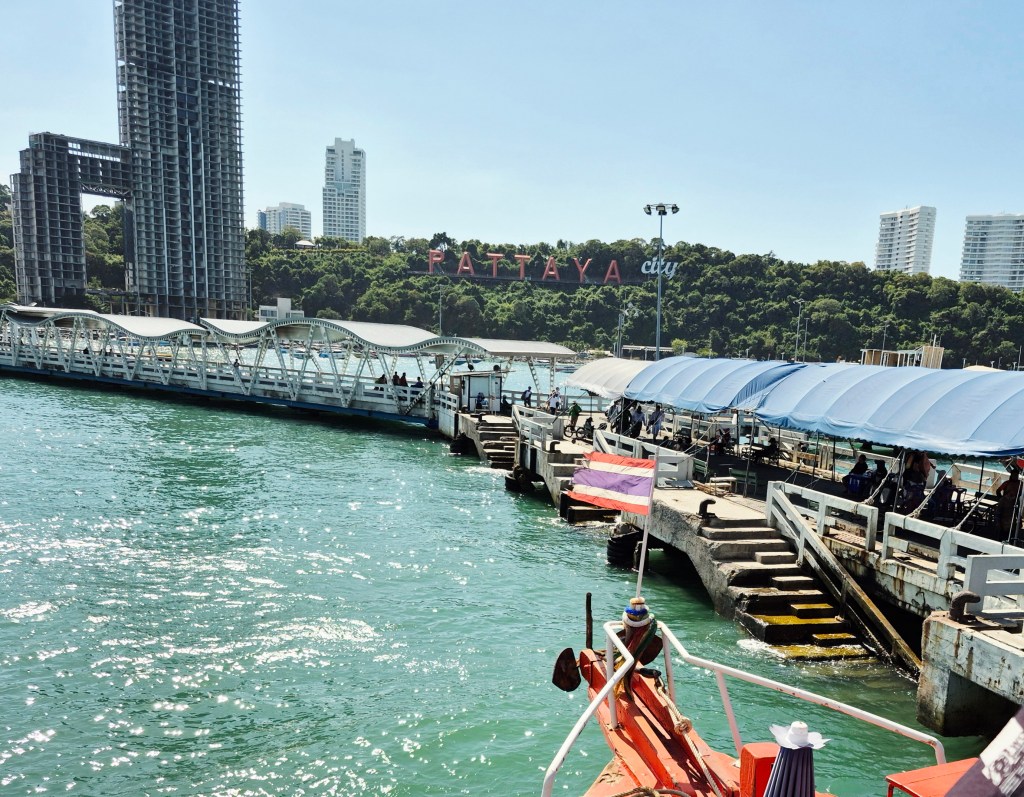
This is just below the famous PATTAYA CITY sign, which is visible for kilometers.

I walked up a passageway filled with tourists.

Then I looked for the boat (above).

A close-up look. I paid THB 30 ($AUD 1.50, NTD 30) for passage; the server took my cash and waved me onwards.

At the entrance to the boat. The boat was resting on old tires at the edge of the pier; no gangway, you scrambled aboard. It’s not apparent in the photo, but the gunwale is maybe a meter high. By holding on to that knob in the lower left in the photo I managed to lift my legs over that obstruction and got onboard, helped by the boatman.

I climbed up the stairs and took this photo of passengers still boarding.

Under weigh at last.

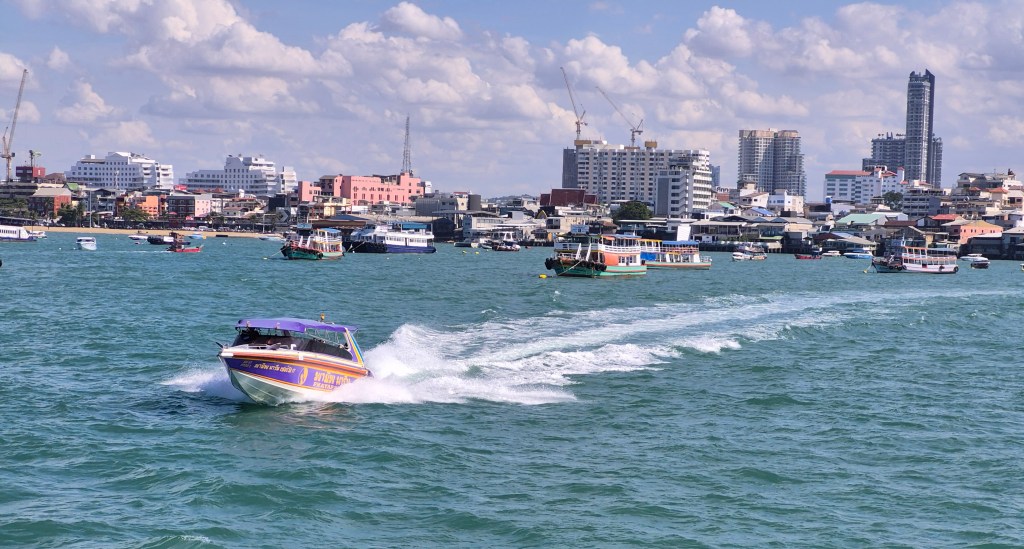
Nice view of the harbour.

The boat passed a similar boat .

Wikipedia says “Ko Lan lies 7.5 km from the nearest shore, Pattaya. ‘Ko Lan’ is the name of the island in the Royal Thai General System of Transcription. It is also known as ‘Koh Larn’ and ‘Ko Laan’. … About four kilometres long and two kilometres wide … It is an island of hills covered with low tropical forest. A Buddhist shrine is located at its highest point, 180 metres above sea level.” It is also called Coral Island.

The boat curved around the northernmost point of the island and headed south.

Pretty soon we were heading towards Tawaen Beach (above centre on the shore) and the ferry wharf.

Coming in to dock.

There were a few ferries, all doing the run from Pattaya to Tawaen Beach.

The passengers get off.

A view of the walkway.

Moving along the walkway.

There was a portrait of King Rama X set up prominently at the entrance.

According to a TripAdvisor review, Tawaen Beach is “very scenic. Blue water and white sand. !! It’s like a giant swimming pool. And the boat ride itself is worth it. Only the locals need to be more tourist friendly”. On the other hand, another review stated “Dirty water, overcrowded, hundreds of the speed boats and water scooters make air unbreathable and create unbearable noise. Food and services are overpriced comparing to other places in Thailand. Try going to the Monkey beach, same island.”

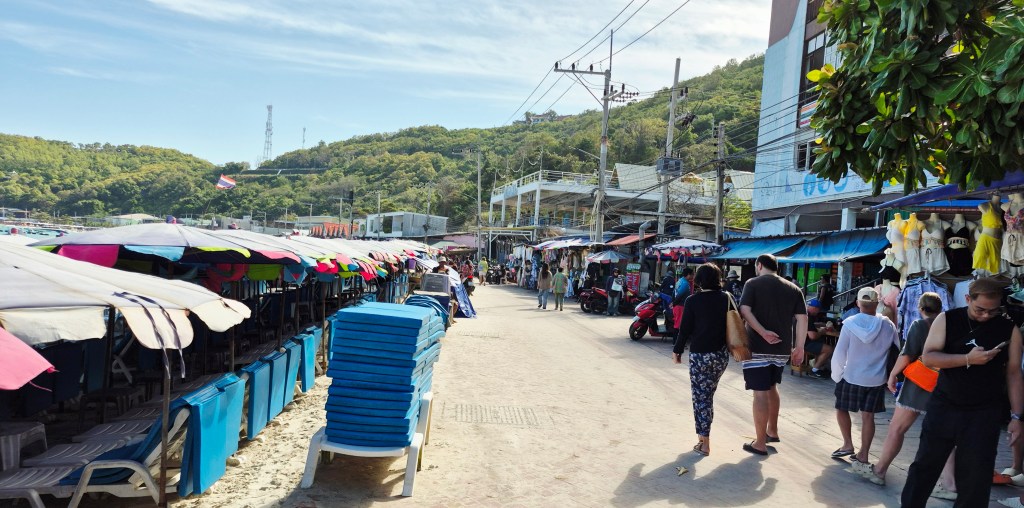
I bought some food from the 7-11, then suddenly had to use the bathroom. Fortunately there was one close by, though I had to pay THB 20 ($AUD 1, NTD 20).

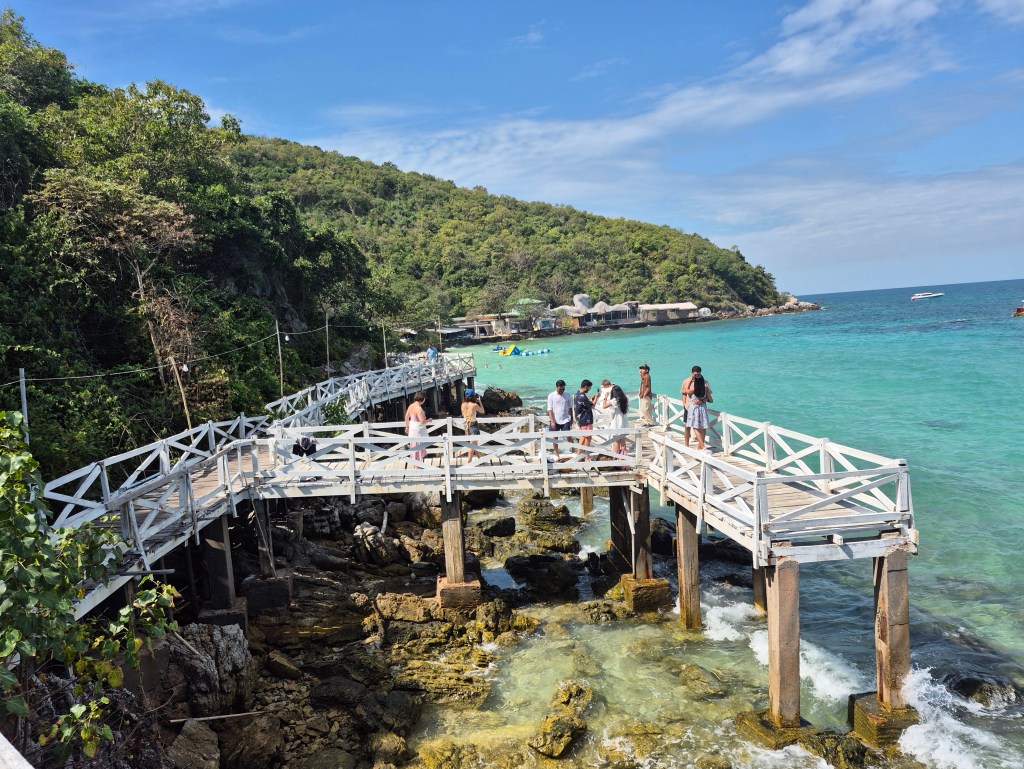
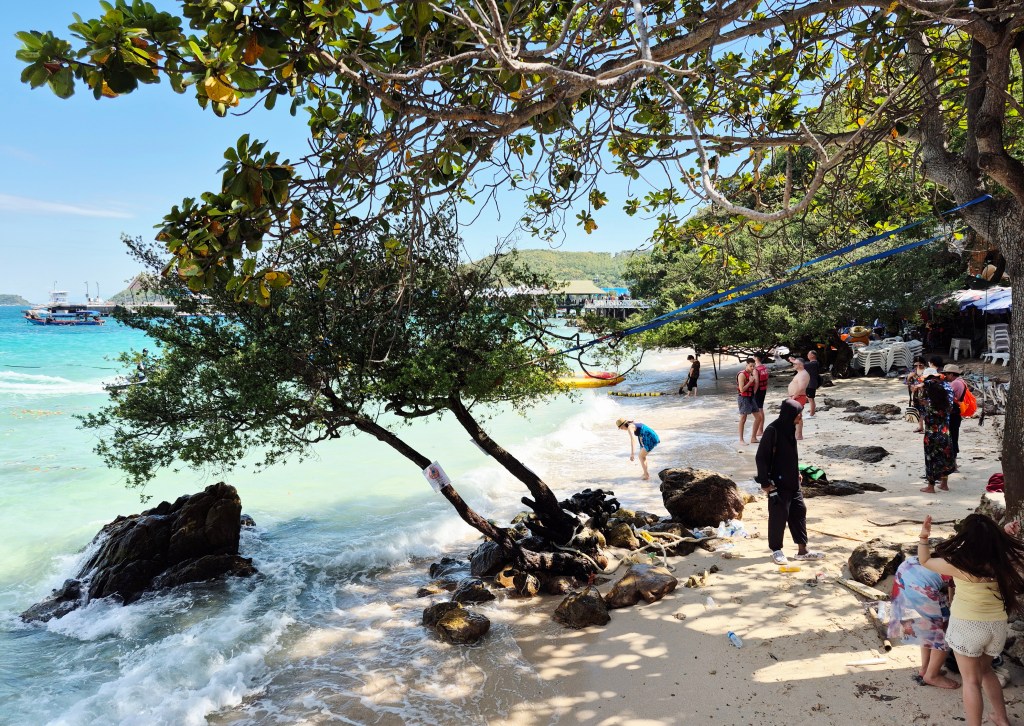
There was another beach just to the south of Tawaen Beach.

This was more photogenic.

There were many Chinese tourists here on an organized tour. I heard snatches of Chinese.

I found a webpage, Notes on Koh Larn, one traveler’s opinion. “Koh Larn was a surprise for me. It has a nice beach and I liked the town vibe. It’s just too bad it is too small and too close to Bangkok and Pattaya. If it was anywhere else in Thailand it would probably be famous as an island with few visitors.”

Back on Tawaen wharf, watching another boat pull up.

The crew were securing the lines…

… then helping passengers on to the wharf.

This was the boat I took.

Off we go!

I got a beautiful view of Pattaya.

Getting close now.

Back to where we docked before, with the PATTAYA CITY sign in the background. I waited until all the passengers had disembarked, then tried to get over the gunwale. But I couldn’t do it! I was stuck, hanging on precariously; I could see the sea way down below my feet. Then a boatman reached up, lifted me clear, and set me down on the pier.

I walked a long way to the northern entrance to Walking Street, reflecting that it was a good thing finding the motor-sai guy before. After that it was a short songthaew ride to my hotel.

Train to Pattaya

December 13, 2025

I’m in Thailand.

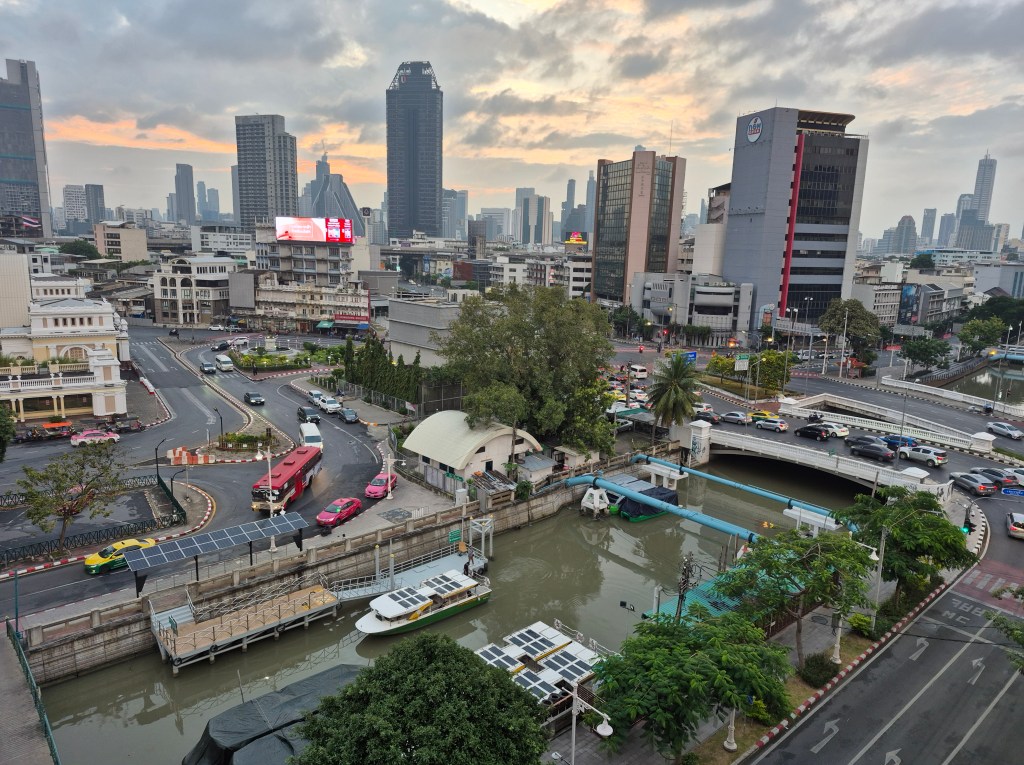
Above is my view from my balcony on the 7th floor of the Krungkasem Srikrung Hotel, around 7am. The Bangkok (Hua Lamphong) railway station is on the extreme left.

Another view of the canal, the Khlong Phadung Krung Kasem. According to Wikipedia in order to serve as a new outer moat for the growing city, the canal was excavated in 1851.

The Hua Lamphong Train Station. It is the “former central passenger terminal in Bangkok and the former railway hub of Thailand. … Long distance trains moved to the new central station at Krung Thep Aphiwat Central Terminal in 2023.” The railway station opened in 1916.

My room in the Krungkasem Srikrung Hotel, at $AUD 50 (NTD 1000) a night including a substantial breakfast.

I decided months ago to take the train from Bangkok to Pattaya.

There is a third-class train leaving at 6:55am. The distance is around 150 kilometers, but the train takes around 4 hours.

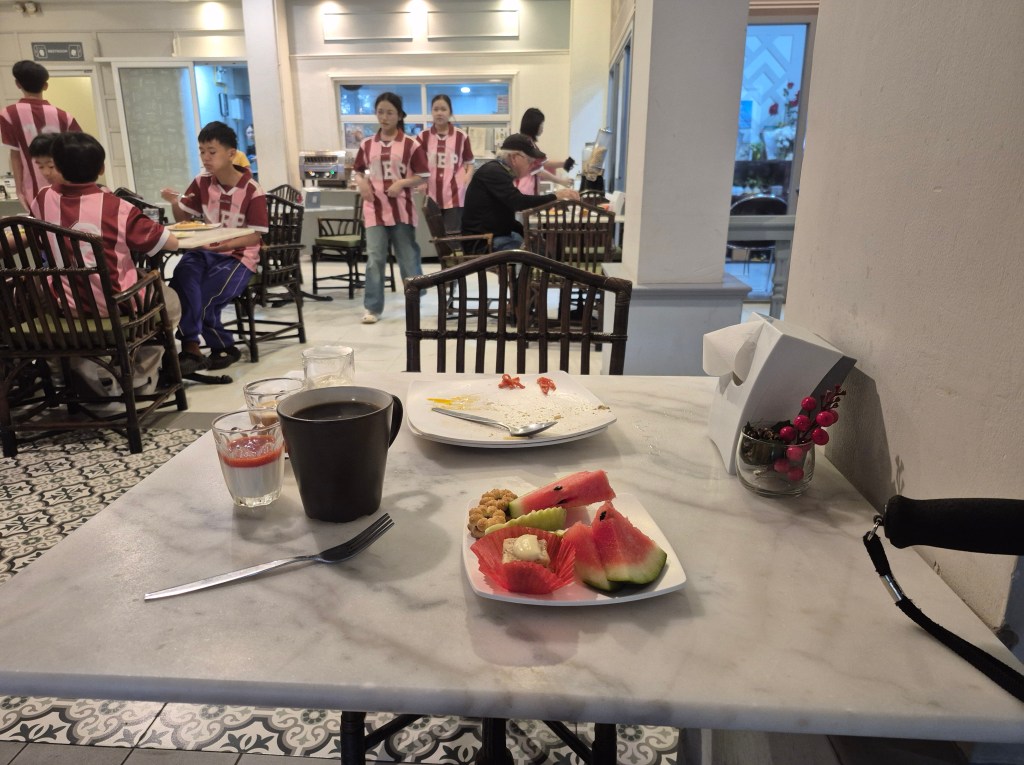
The hotel buffet opens at 6:30am, just enough for me to scoff enough food. The photo above is of a different day, where I took a leisurely breakfast of salad, red curry, fruit, and hot coffee.

I dashed across the road to the train station, passing tuk-tuks. “The humble Thai tuk tuk is an icon of Thailand … There’s something about the buzz of spinning around Bangkok in one of these open-air, three-wheeled vehicles. … Tuk Tuks are unmetered, so the key is to always agree the price of your ride before you get in. The driver will likely quote an initially overpriced fare, anticipating that you will knock him or her down to at least some degree. In general, will be a little more expensive than a taxi.”

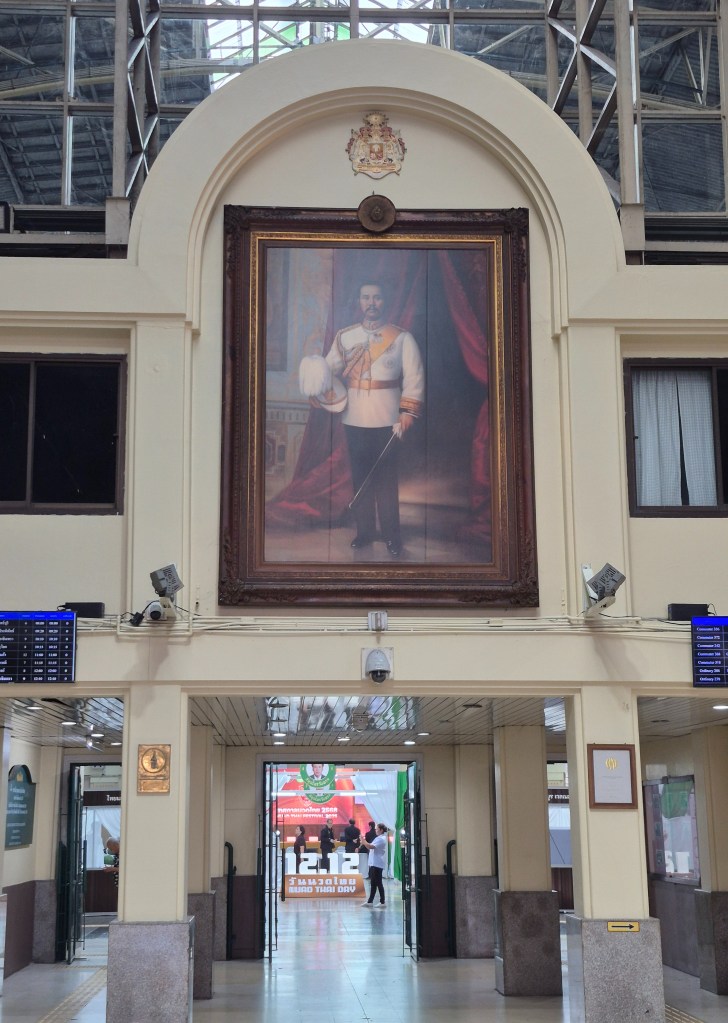
There is a portrait of King Rama V (I checked in Google Gemini) above the entrance-way to the platforms.

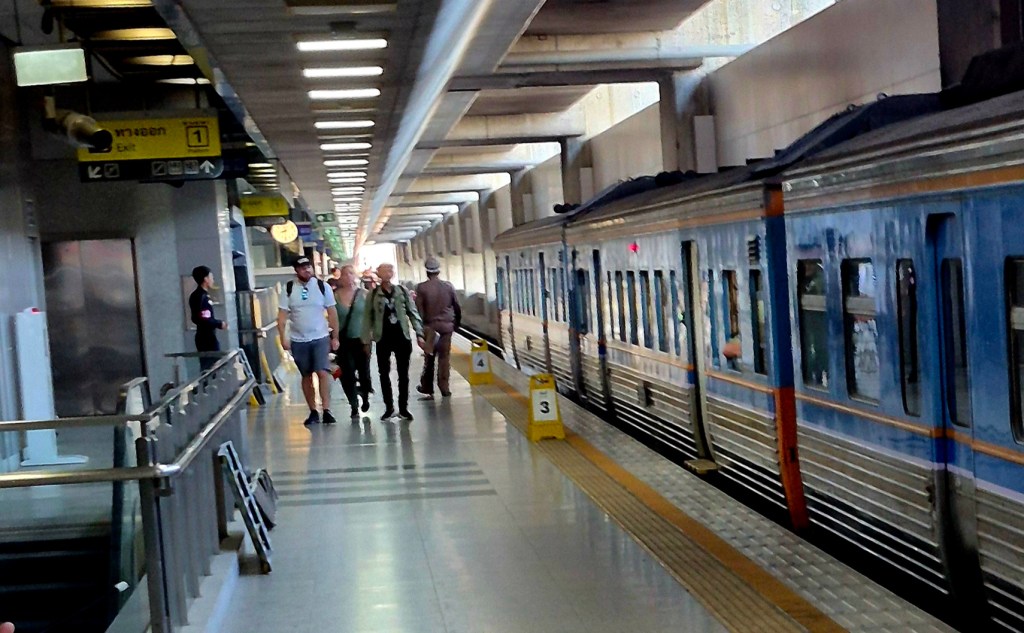
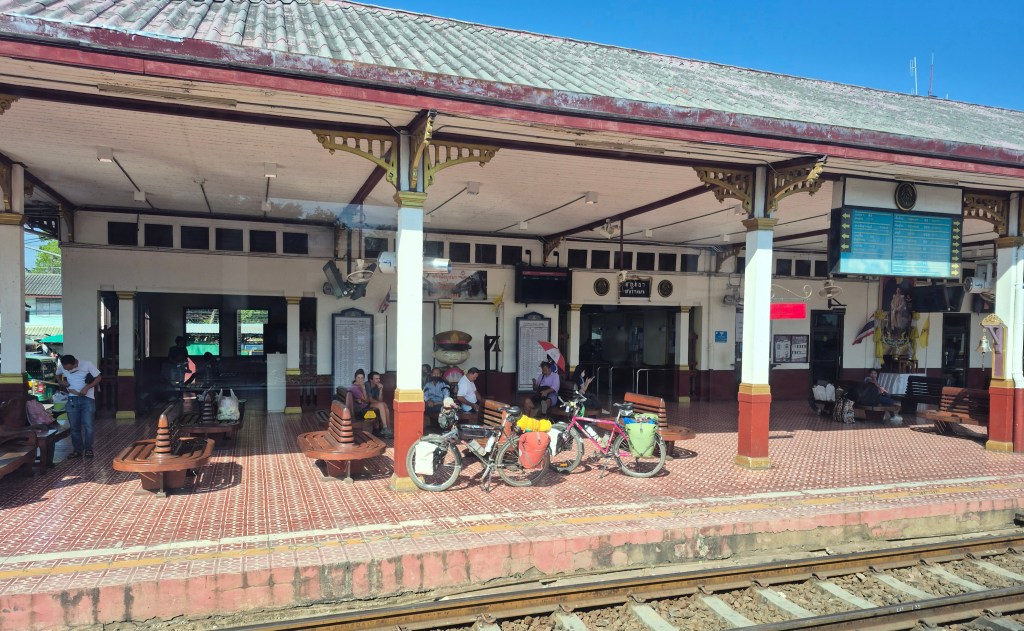
The platforms. I was running late, but fortunately I snapped the above photo the day before.

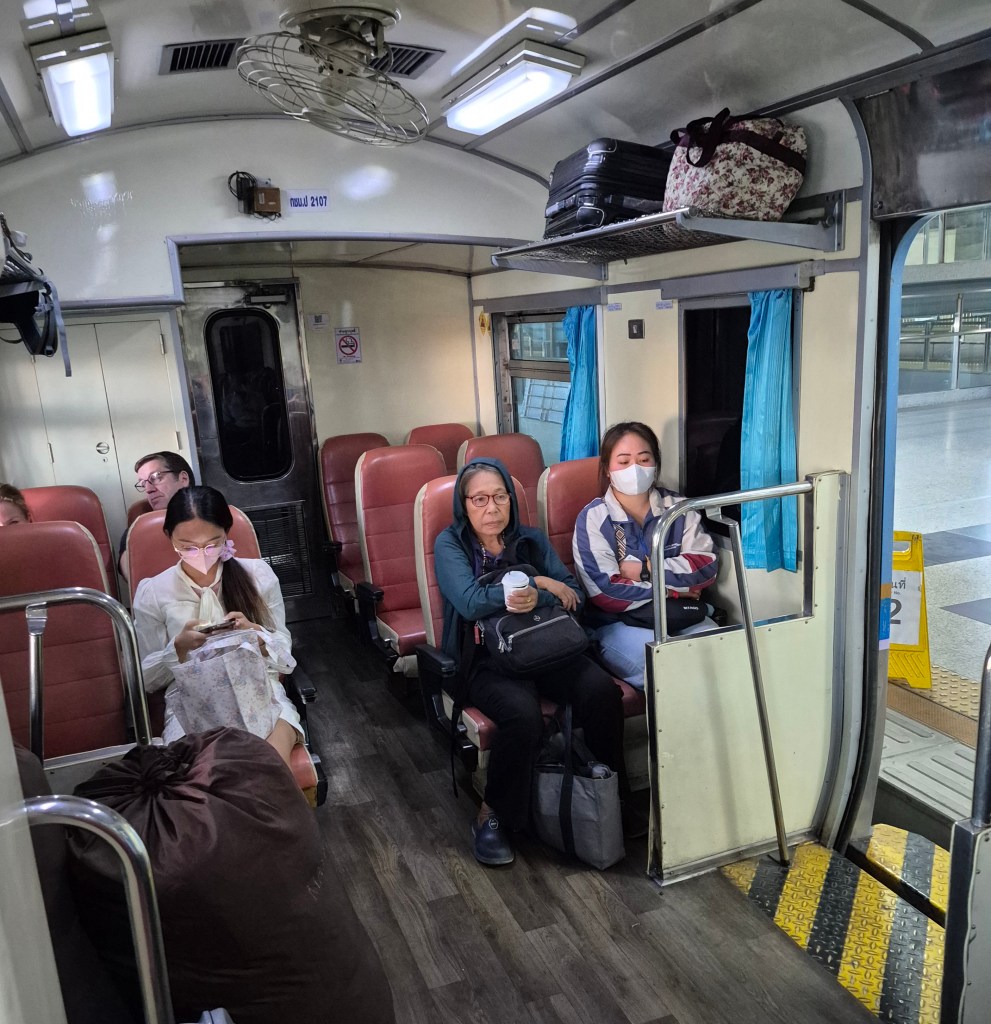
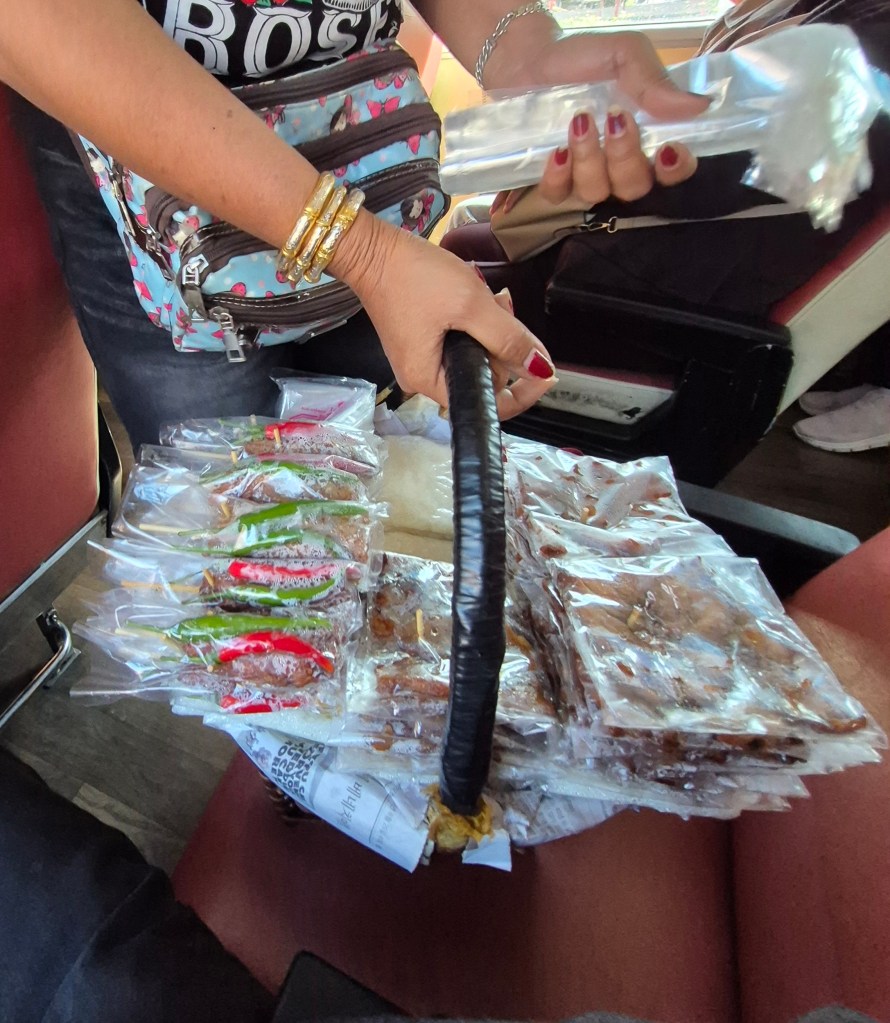
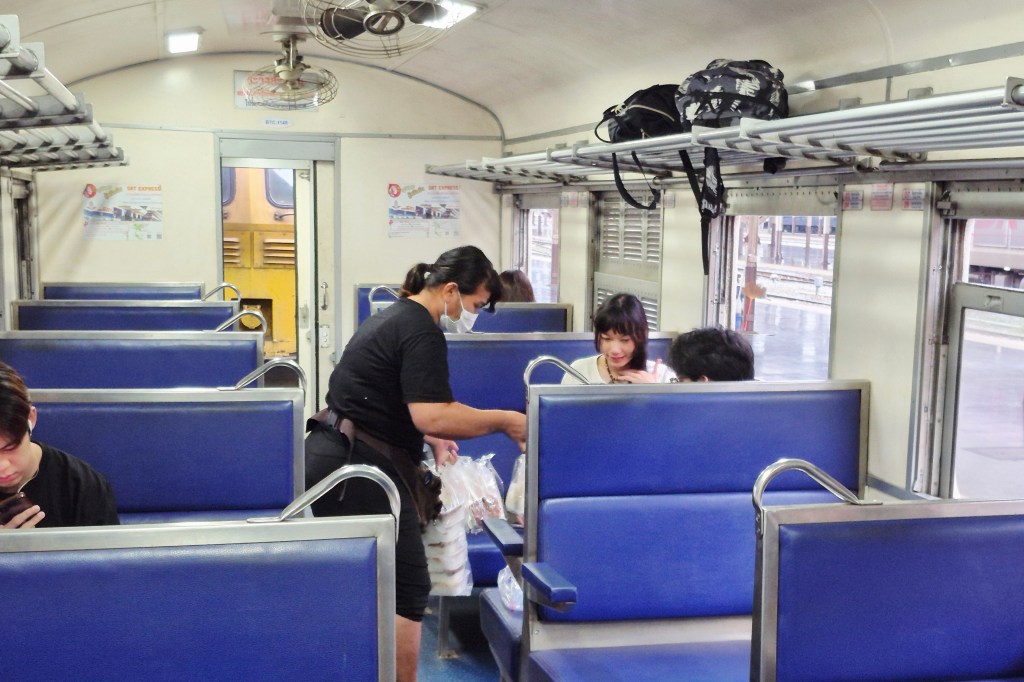
I took my seat on the blue-covered benches, and soon the train was moving slowly out of the station. The photo above is of a roving vendor selling food to some passengers.

The above is a Dancing Bacon clip. where they eat snacks on a train going from Bangkok (sadly, not to Pattaya). The content creator lives in Singapore, but regularly travels to neighbouring countries, in this case Thailand, to eat.

We trundled gently though Bangkok.

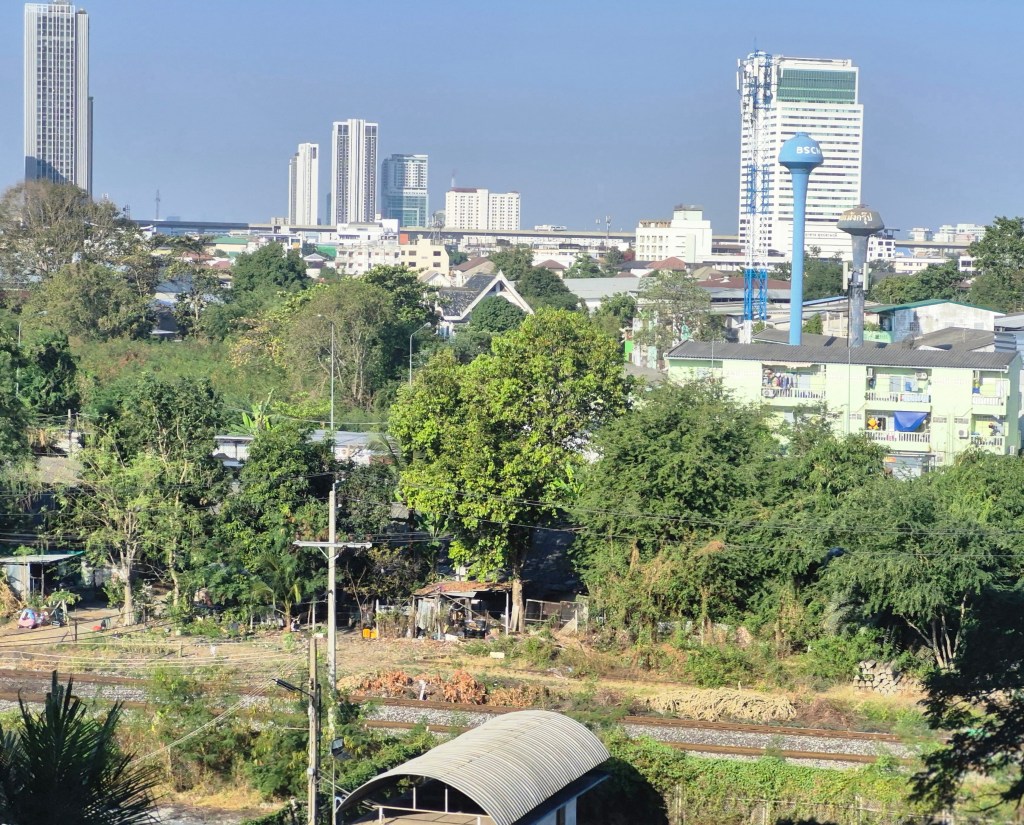
This was a contrast with the shabby low-rise buildings by the side of the tracks and the smart skyscrapers in the background.

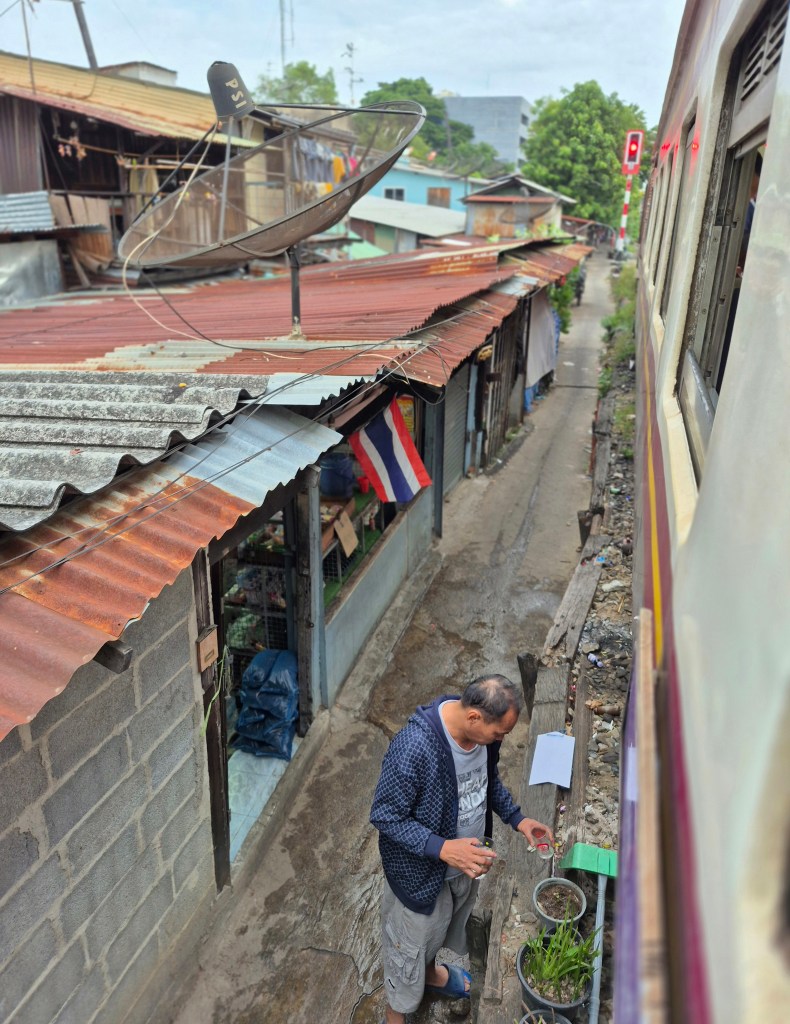
The train went through some slums (above) close to the railway line. The building with the Thai flag is a little shop; outside there is a man standing on a small path inches away from the train.

The train went through a level crossing (above).

At Khlong Tan train station.

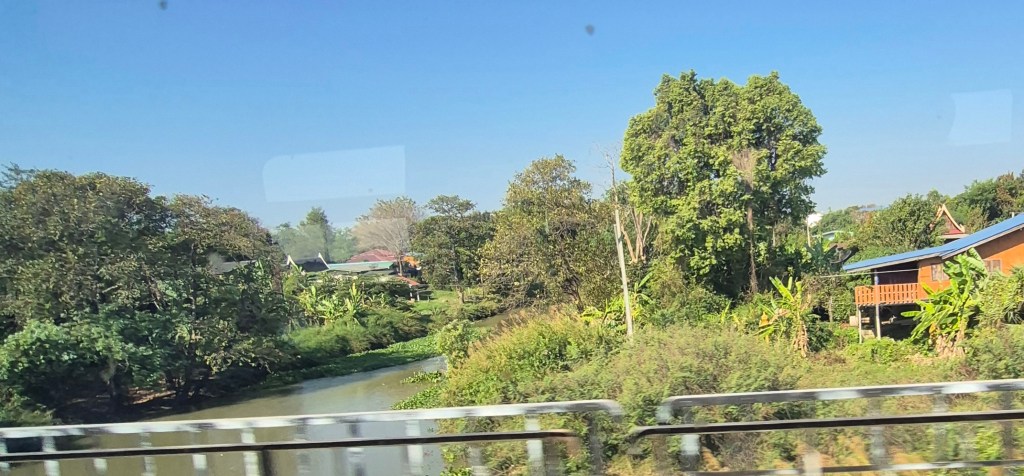
The train passed over the Khlong Saen Saep. “Did you know that Bangkok was once known as the ‘Venice of the East’? With over 1,500 kilometers of canals crisscrossing the city, These waterways tell a story that’s often overlooked by the average visitor. … These waterways offer a unique perspective, allowing you to travel through the city and avoid traffic, while observing the communities that live along its banks.” When I lived in Bangkok I used to take the rapid canal-boat every weekday morning on my way to lectures.

The train entered the outskirts of Bangkok. The above photo is of a little restaurant by the side of the tracks.

Some people watching the train go by.

At a stop I saw some people stepping over the railway and along the path.

Now the train was in the countryside.

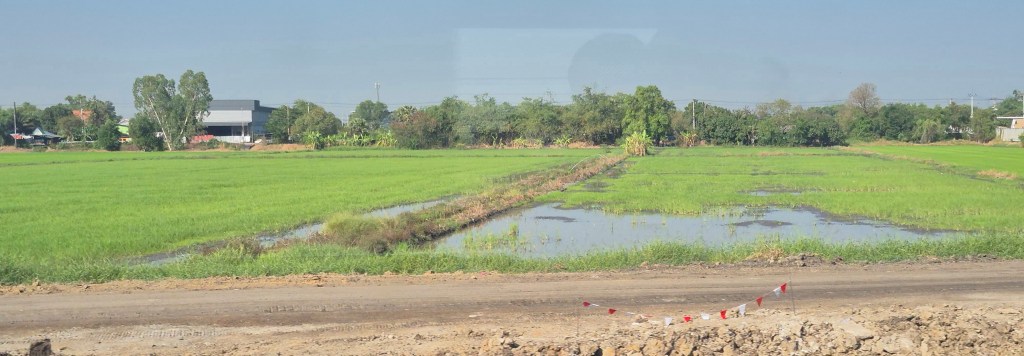
There were many rice-fields (above)…

…and little stations.

Now the train was close to Chachoengsao.

The terminus of the Khlong Saen Saep.

The train went over the Bang Pakong River. According to Wikipedia, there are alternate theories for the name of this river, but these solely are concerned with fishing, whether catfish, prawn, or barramundi.

The train turned southwards. The above photo is of mountains rising abruptly from the plain.

Pattaya, at last.

A view of passengers disembarking…

… and boarding a couple of red songthaews. “Songthaews are covered pickup trucks with rows of seats in the back that transport people along set routes in Thailand, and they are a common way to get around. The word ‘songthaew’ literally means ‘two rows’ in Thai. You’ll see songthaews in almost all urban areas and lots of beach areas, too. Once you know their routes and how to pay for the ride, you will likely find them to be a convenient way to reach your destination. They are popular among locals as well as travelers and typically are the cheapest kind of transportation available, except for using your own two feet.”

I didn’t catch a songthaew, instead hopping on a motosai. “One of the unique experiences in Bangkok is hopping on the back of a motorcycle taxi – called moto-sai by Thais. Motorcycle taxis are useful for short trips; you know – a distance that is too long to walk in the Bangkok heat, but too short to bother with a taxi or risk getting stuck in traffic. The moto-sai is convenient because the driver can weave in & out of traffic, unaffected by gridlock, and deliver you to your destination in a matter of minutes.” Cost was THB 100 ($AUD 5, NTD 100). The motosai dropped me across the road from the street where I was staying (above).

I walked a short distance down the street to my hotel, the Queen Victoria Inn (above). The cost is approximately again $AUD 500 (NTD 1000) per night.

There was a motorcycle cart in front of the hotel. Google Gemini says the motorcycle carts are in effect mobile kitchens on a motorbike, offering low-cost food and drink, everywhere from city streets to rural areas – an authentic slice of Thai life. 

Inside the Queen Victoria Inn. The hotel looked as if somehow transported from southern England, complete with obese older English men propping up the bar.

One word of warning – the Queen Victoria Inn is right in the heart of a red-light district; it is very blatant. Women especially should be wary of the road outside the hotel, especially at night.

At the end of the street is Pattaya Beach. Photo facing northwards…

… and southwards.

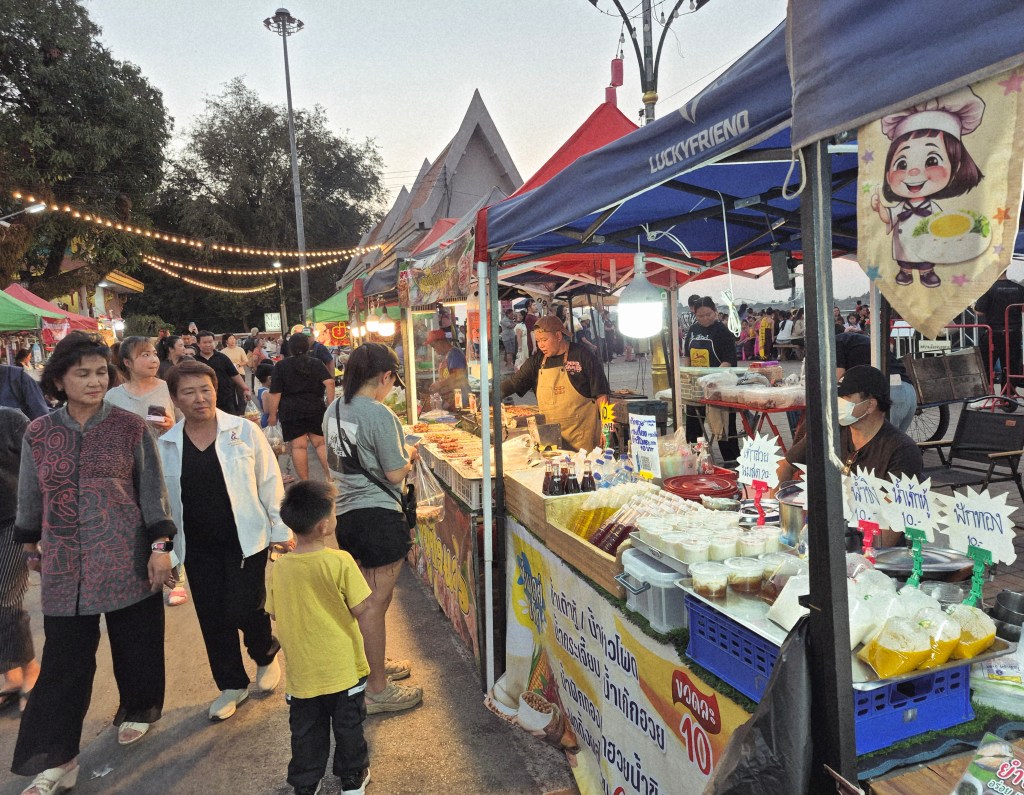
There was a tourist market, the Runway Market.

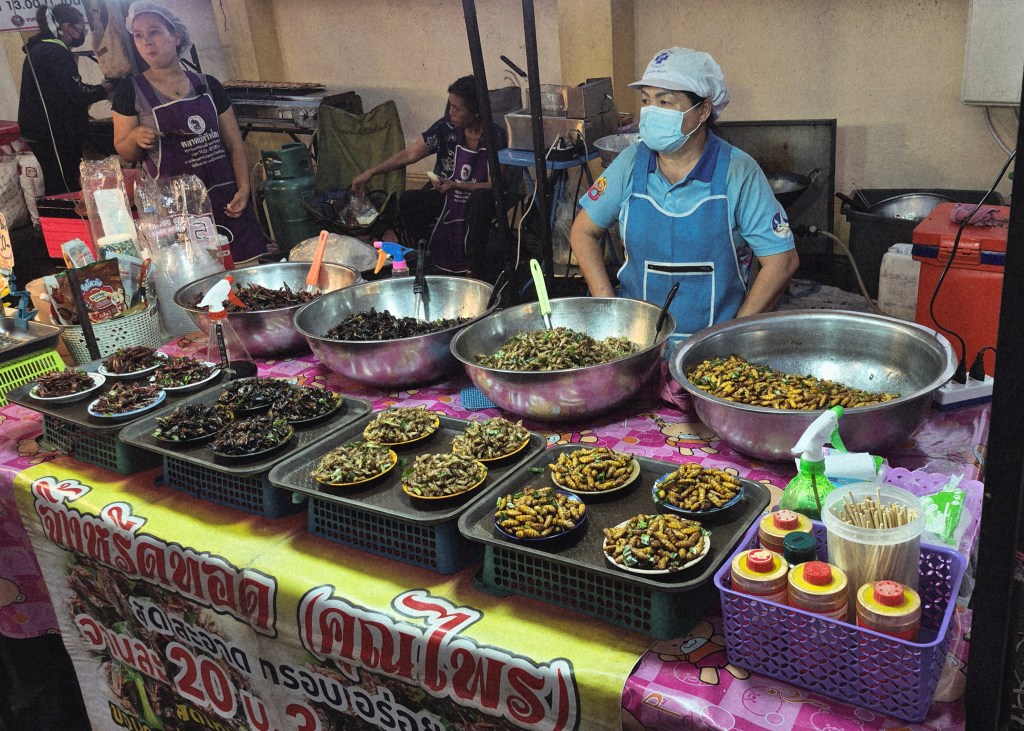
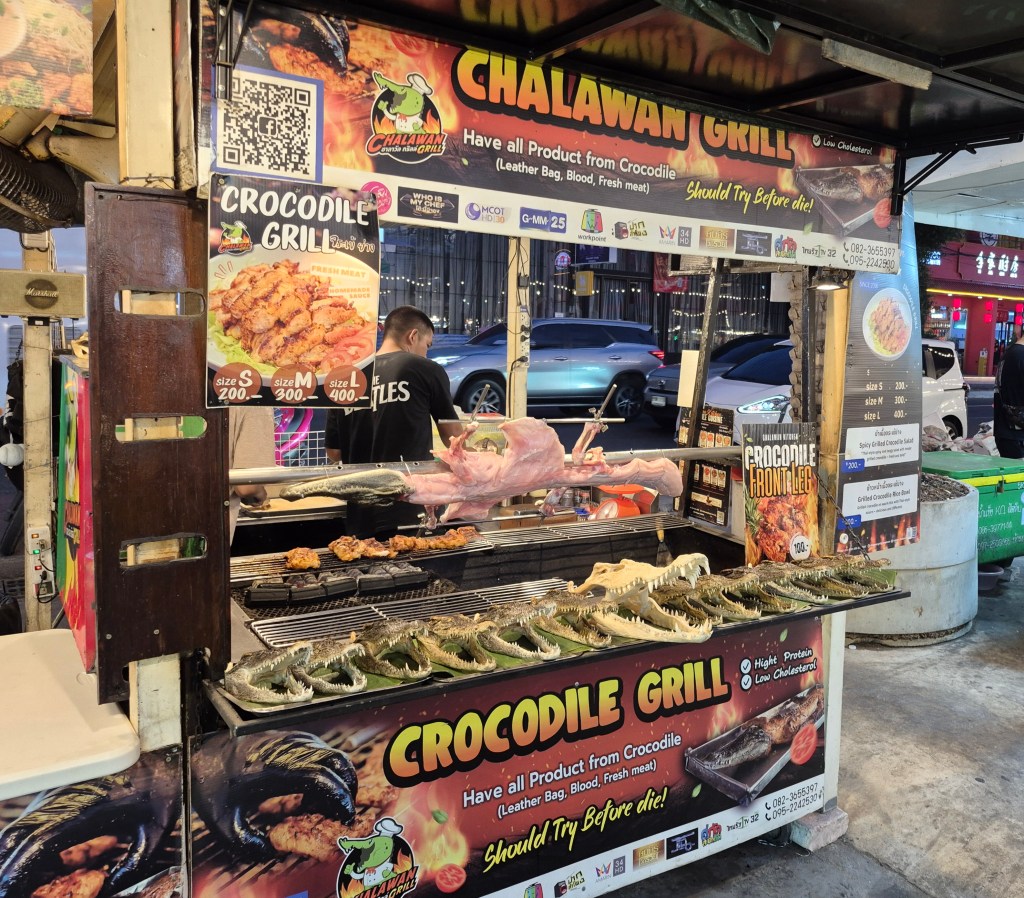
Among the stalls there was a booth selling crocodile meat. That’s part of a crocodile revolving slowly on a horizontal spit in the above photo. Apparently there is a stall selling insects, a common sight in Thailand, but I didn’t see it.

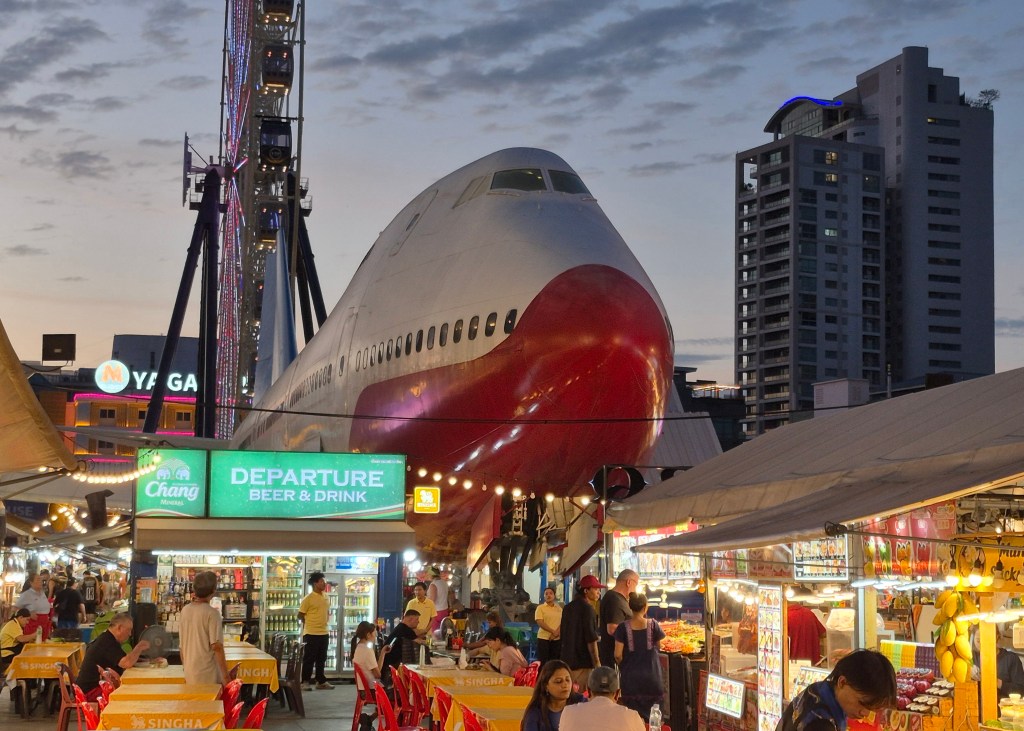
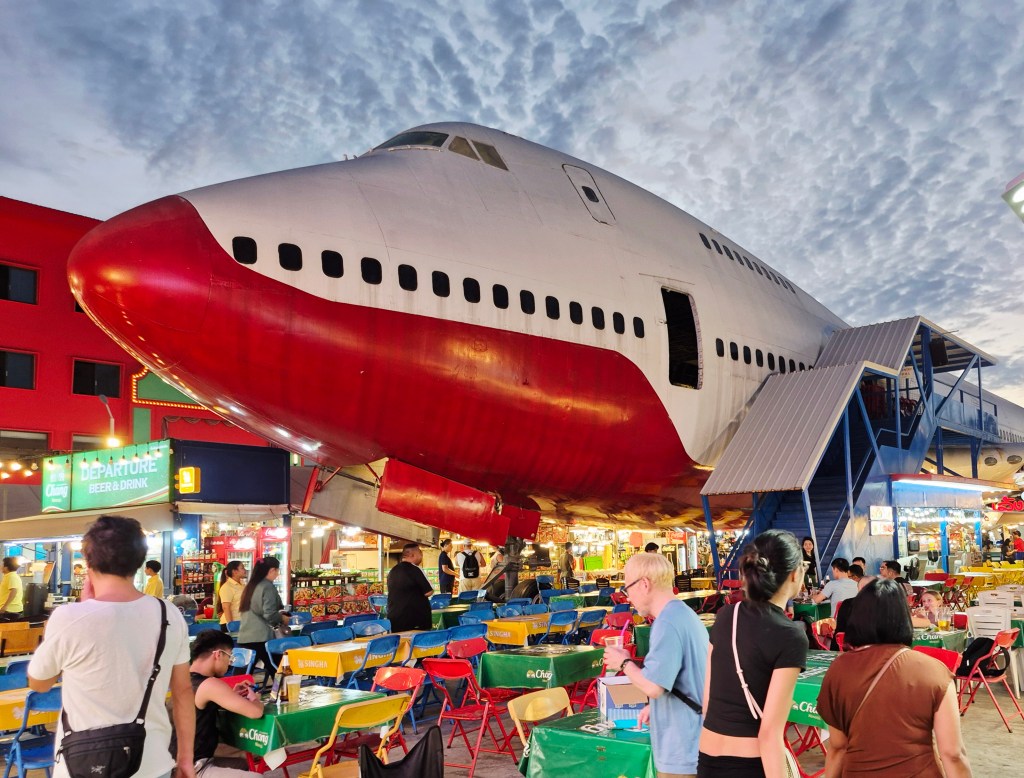
Towering over the market is a Boeing 747!

It’s quite a sight. That aircraft is massive. Jet Photos says the Boeing 747-200B was in service with CP Air, PIA and Orange Air.

There are tables under the aircraft. I ate dinner there directly under the Boeing 747.

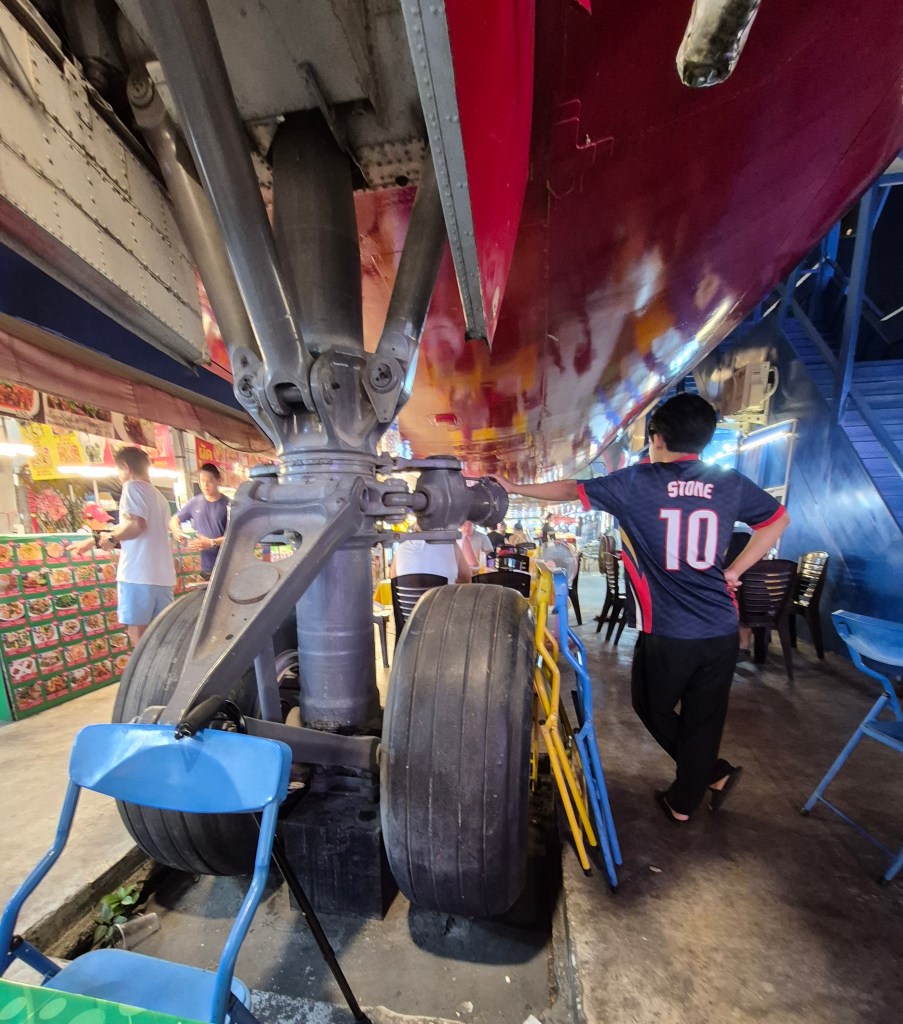
A close-up view of the nose-wheel. My walking-stick is propped against the landing gear.

More to come.

Sydney Fish Markets

December 7, 2025

On Sunday, I made a last-minute decision to visit the Sydney Fish Markets, as part of my plan to go to sites very popular with tourists.

The itinerary is superimposed over the Google Map above. From Circular Quay, I took the ferry to Pyrmont Bay wharf; caught the light rail to the Fish Markets; then walked to the city to catch the bus home.
At Circular Quay. The previous day was a scorcher, 38 degrees, though very dry. In contrast this day was relatively cool, around 20 degrees. The clouds helped.

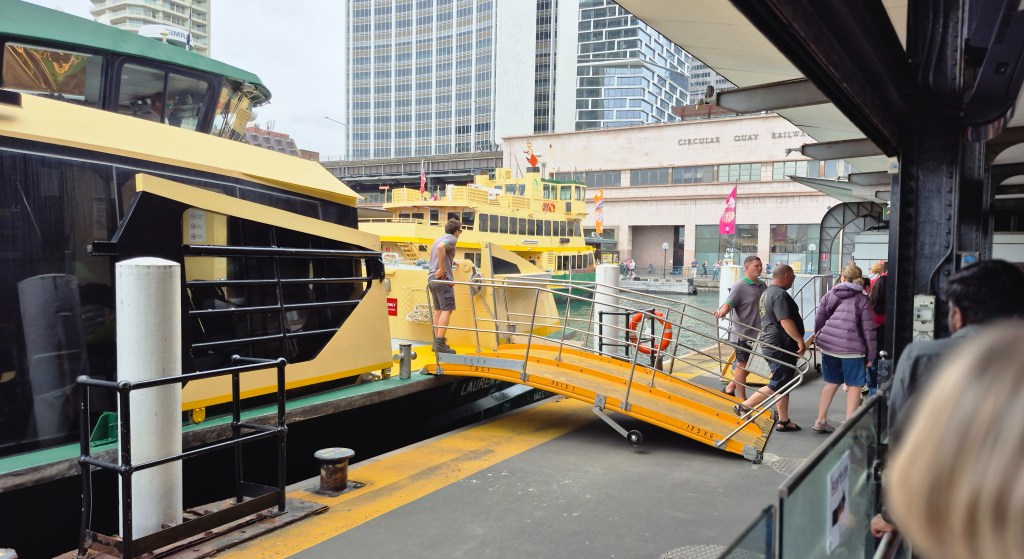
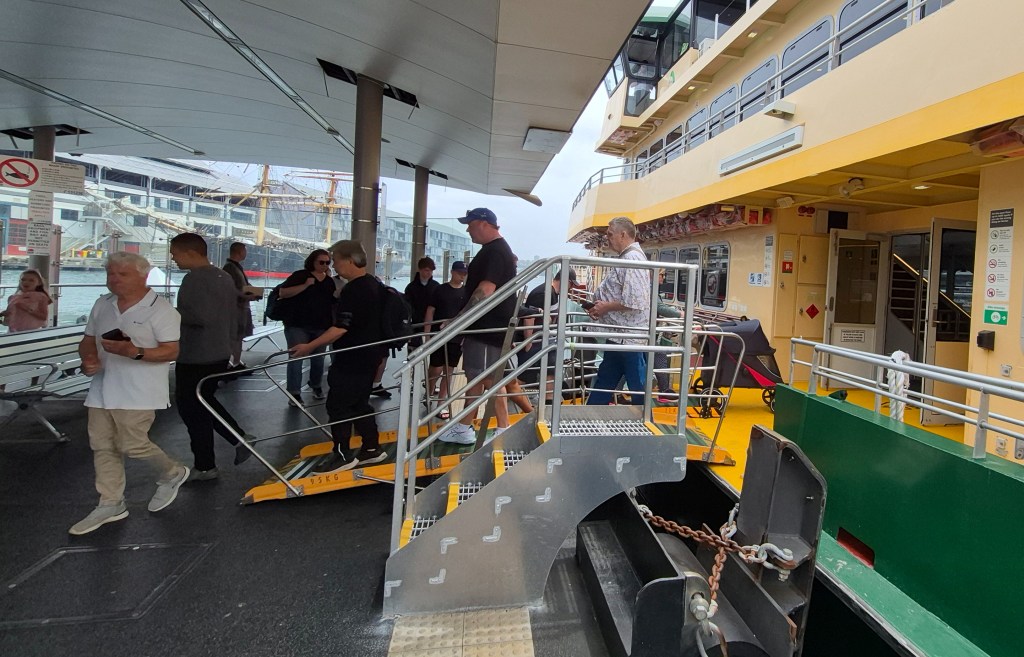
Passengers getting off our ferry.

Our ferry reversed giving me a look at the wharf.

There were many ferries in Circular Quay.

There is docking for cruise liners right next door.

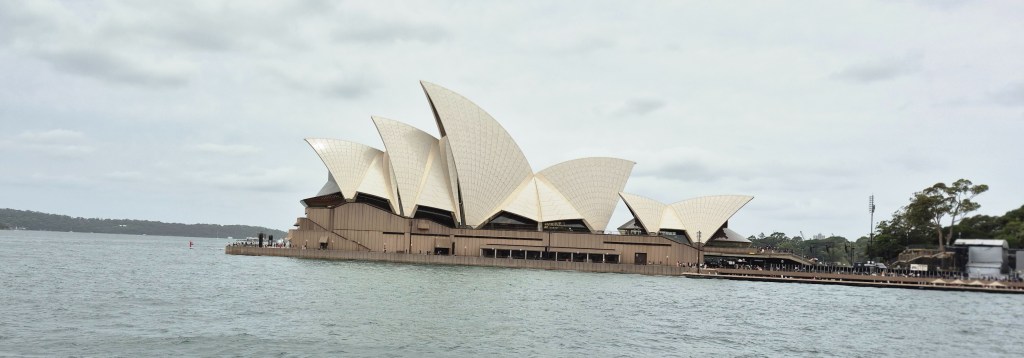
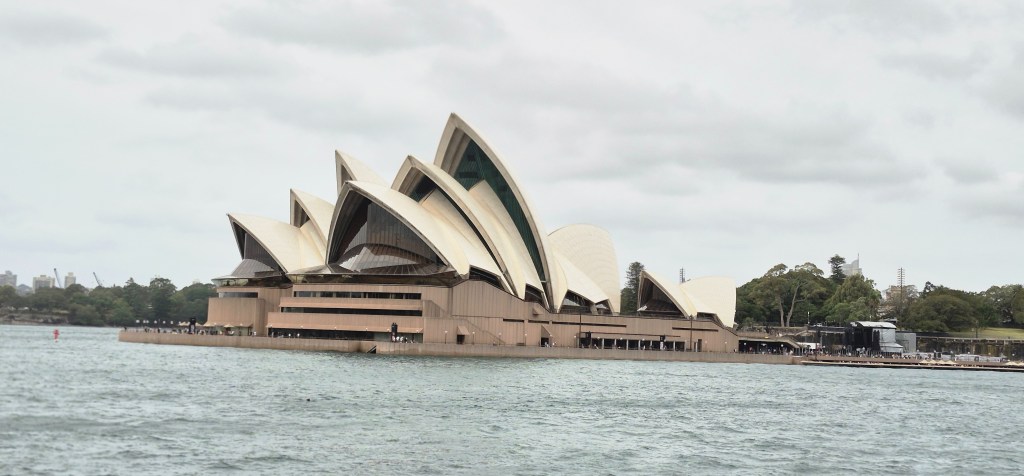
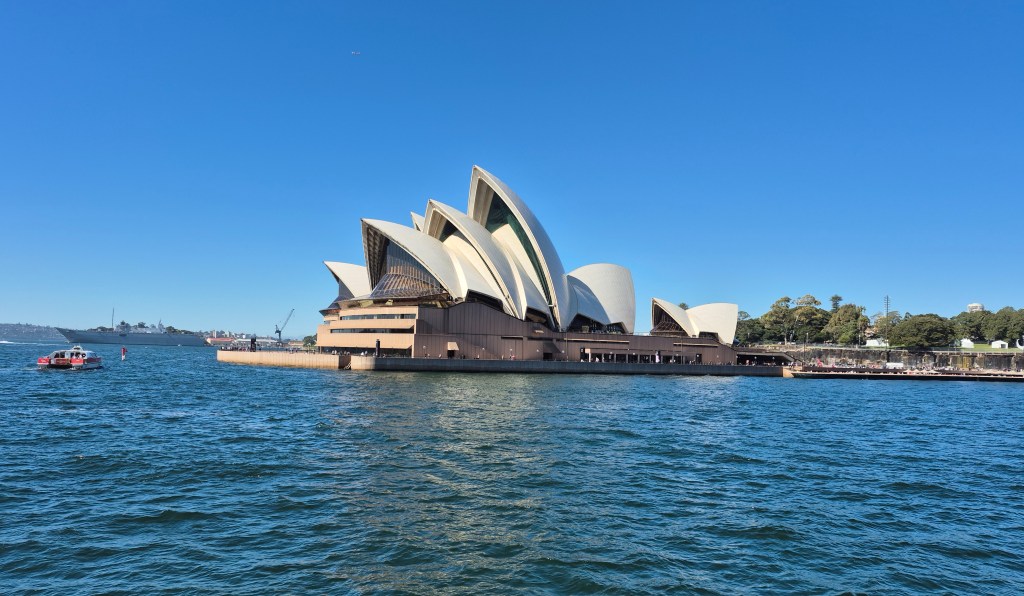
The Sydney Opera House. I went there.

Another view of the Sydney Opera House.

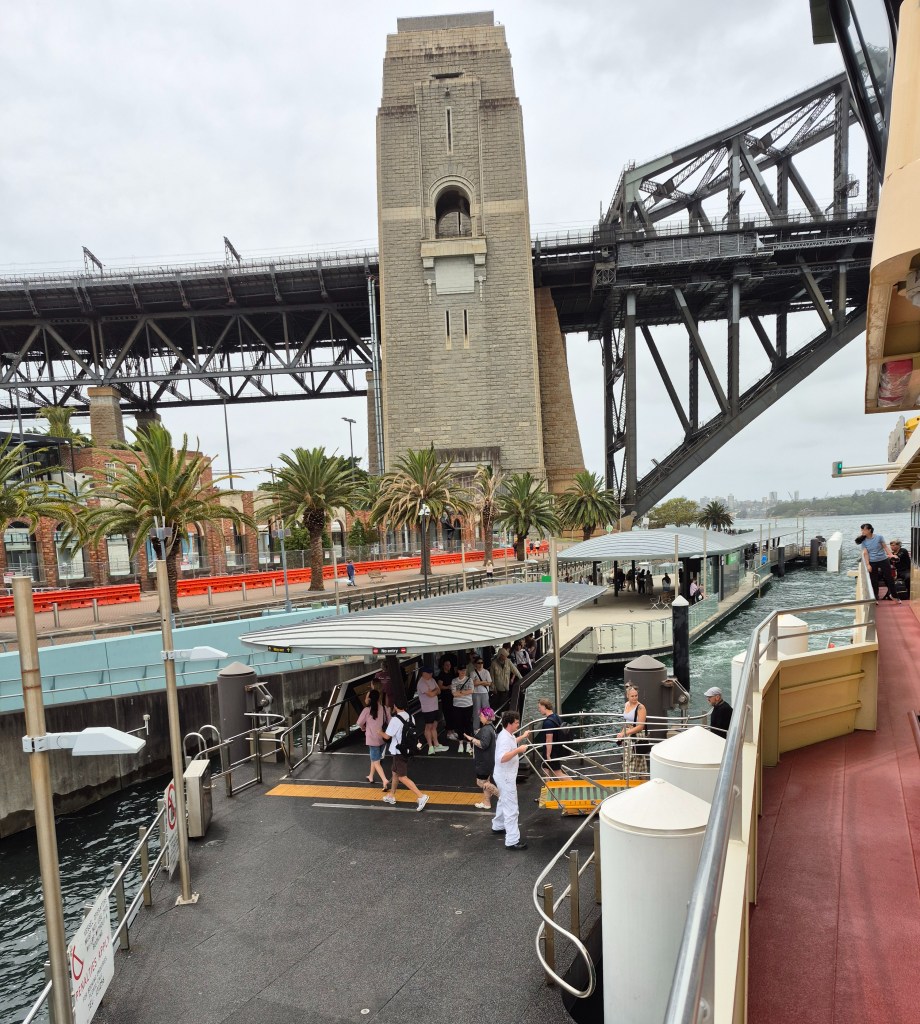
The Sydney Harbour Bridge. I also commented on this.

Close-up of the north side.

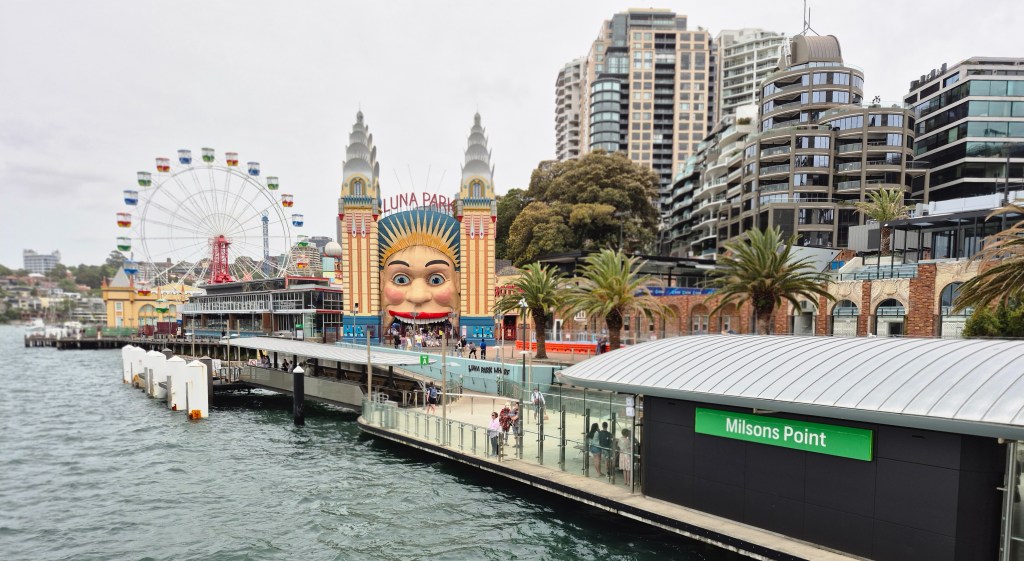
Milson’s Point Wharf, with Luna Park beyond.

“Built in the 1930s, Luna Park is a harbour-side amusement park that still contains traditional midway games and rides.” (TripAdvisor)

Passengers disembarking, the Sydney Harbour Bridge in the background.

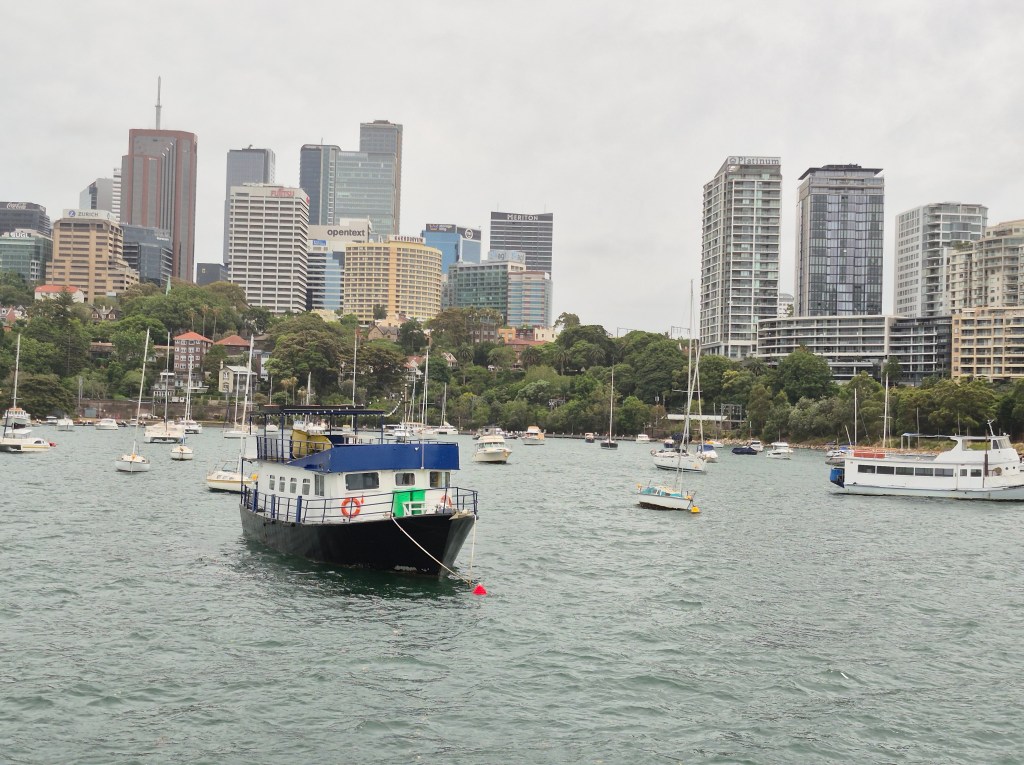
That’s Lavender Bay.

A close-up.

This is Blues Point. The previous ferry was just leaving.

That ferry crossed our bows.

Wikipedia says “Blues Point was named after Billy Blue, a convict who arrived in Sydney on the Minorca on 14 December 1801, transported for stealing a bag of sugar…. Physically imposing, he was described as a ‘strapping Jamaican Negro ‘a very Hercules in proportion’ with a bright eye and a jocular wit’…. He claimed to have served with the British Army in the American War of Independence. When he arrived in 1801 he only had two years of his sentence left and he was soon working on the harbour with boats and selling oysters. His friendly manner and humorous conversation made him popular and he became a notable local character. He married English-born convict Elizabeth Williams in 1805, and in 1807, was the only person licensed to ply a ferry across the harbour. Governor Macquarie named him “The Old Commodore” and he ran his ferry dressed in a blue naval officers coat and top hat. His ferry service grew to a fleet of 11 vessels, and in 1817, Governor Macquarie granted Billy Blue 80 acres (320,000 m2) at what is now Blues Point. He died in 1834 at his North Sydney home.” My ancestors knew Billy Blue.

Blues Point Reserve, on the tip of Blues Point.

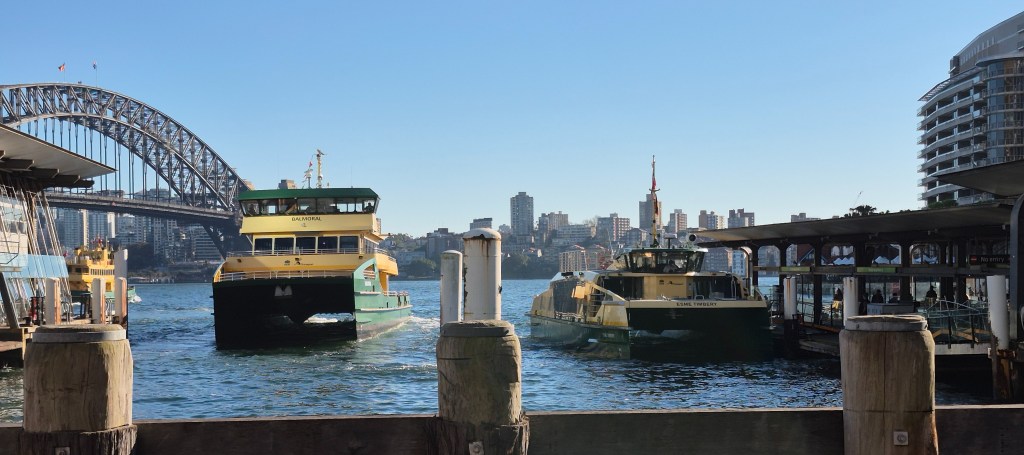
Heading for Balmain East Wharf (on left), the Central Business District (known as the CBD) of Sydney on the far right.

Balmain, seen from Balmain East Wharf.

“Traditionally blue collar, Balmain was where the industrial roots of the trade unionist movement began. It has become established in Australian working-class culture and history, due to being the place where the Australian Labor Party formed in 1891 and its social history and status is of high cultural significance to both Sydney and New South Wales. … In the 21st century however, Balmain is often considered to be an affluent area. … a 2021 article on the Domain website described Balmain as a Harbourside version and cheaper version of Eastern Suburb Paddington” (Wikipedia)

Crown Sydney, the tallest building in Sydney, contains a hotel.

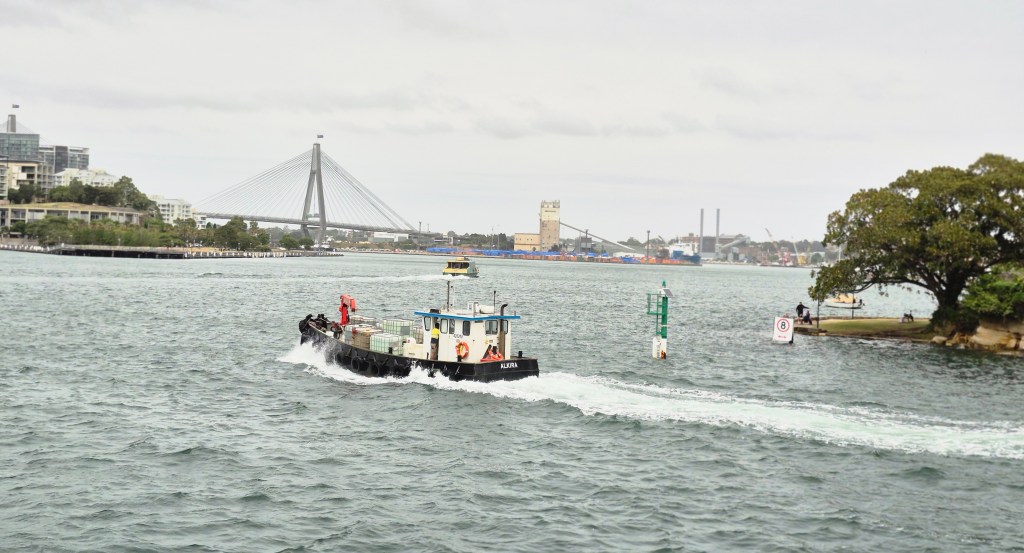
The same boat as in the last photo. In the distance you can see the Anzac Bridge.

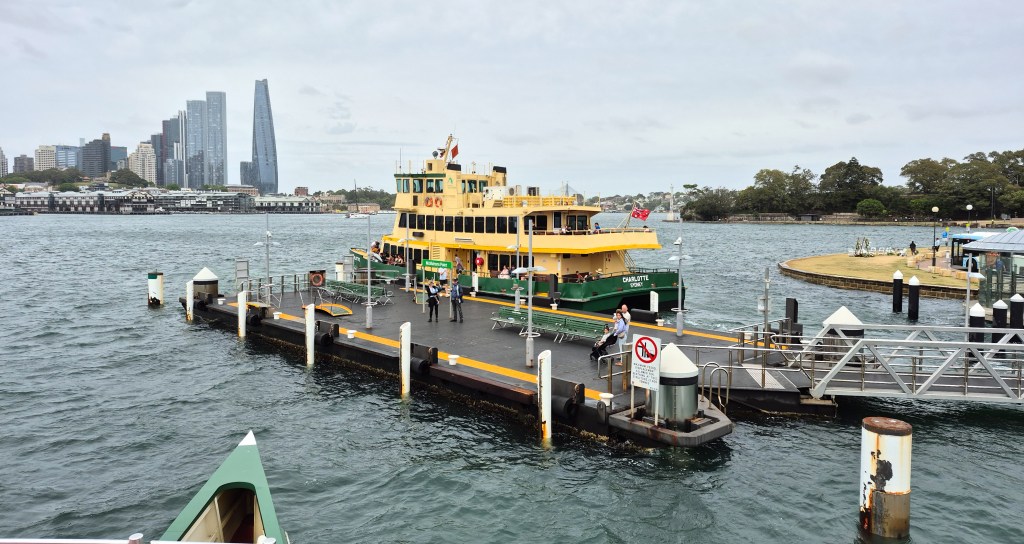
Barangaroo Wharf, under the curved roof next to the ferry, dwarfed by the International Towers. Next to it is the Crown Sydney Hotel.

Passengers getting off the ferry at Barangaroo Wharf.

The Barangaroo website says “Barangaroo, the Cammeraygal woman from whom Barangaroo the place takes its name, was a considerable influence in the days of the early European colony. From the Eora language group, she was one of the Cammeraygal clan who lived in and around the north harbour and Manly. Independent and strong, she had her own way of dealing with the early settlers.”

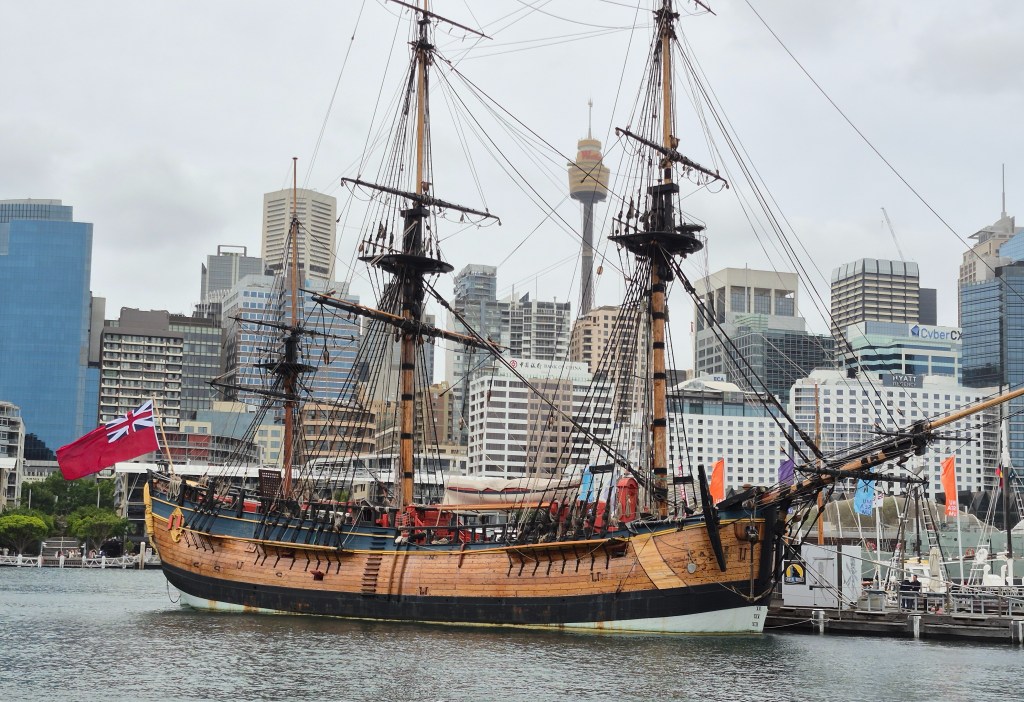
Approaching the National Maritime Museum. The antiquated ship on the left of the above photo is actually a modern replica of the HMV Endeavour.

“The Endeavour’s voyage was the first British scientific expedition to the Pacific. … When the ship left England in 1768 under James Cook’s command, the Endeavour carried 94 people, including 71 officers and crew and 12 marines. Also on board were Joseph Banks and his party of scientists and artists, including fellow botanist Daniel Solander … They lived alongside each other for nearly three years. When the ship returned to England in 1771, the products of the voyagers’ work — maps, art, specimens, artefacts — captivated Europe’s imagination and changed scientific knowledge.” (National Museum Australia)

The National Maritime Museum says “HMAS Vampire [centre of photo], Australia’s largest museum vessel, is the last of the country’s big gun ships. After this, Australia’s fighting ships were equipped with missile weaponry. The Daring class were the largest destroyers built in Australia. Their strong, light construction combined high speed with maximum armament. Vampire served in the Royal Australian Navy from 1959 to 1986.”

I put this photo here even though chronologically I took it while walking back up on the Pyrmont Bridge.

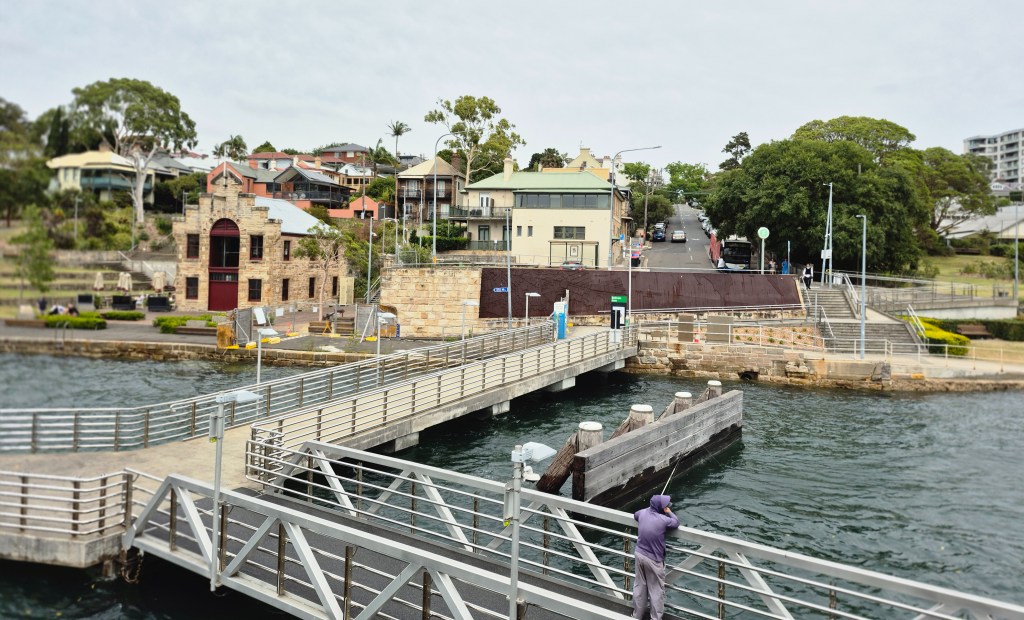
I disembarked at Pyrmont Bay Wharf, along with most of the passengers (above).

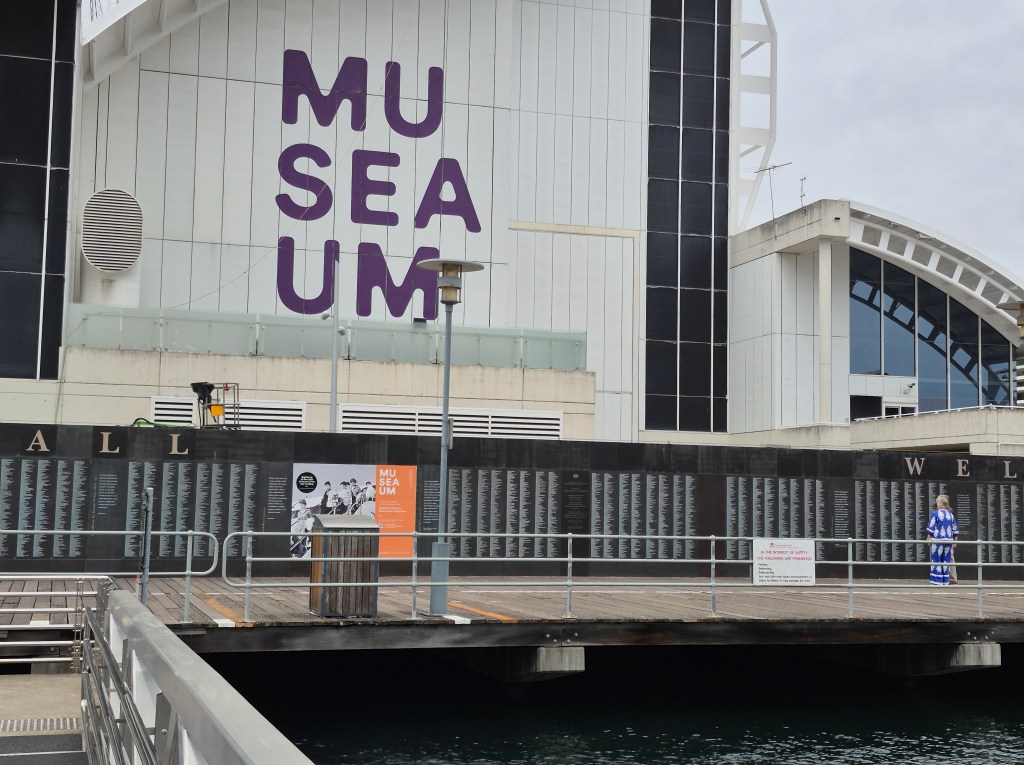
Out the front of the museum is the Welcome Wall, officially known as the National Monument to Migration: “Today’s Australia has been shaped by migration. We’ve come from all the lands on earth to build this great country.  The museum collects the stories of migrants to Australia, and the National Monument is one of our most important and visible ways of recognising the people behind these stories. ” (National Maritime Museum)

Examples of migrants on the Welcome Wall.

I walked around the corner to the light rail stop.

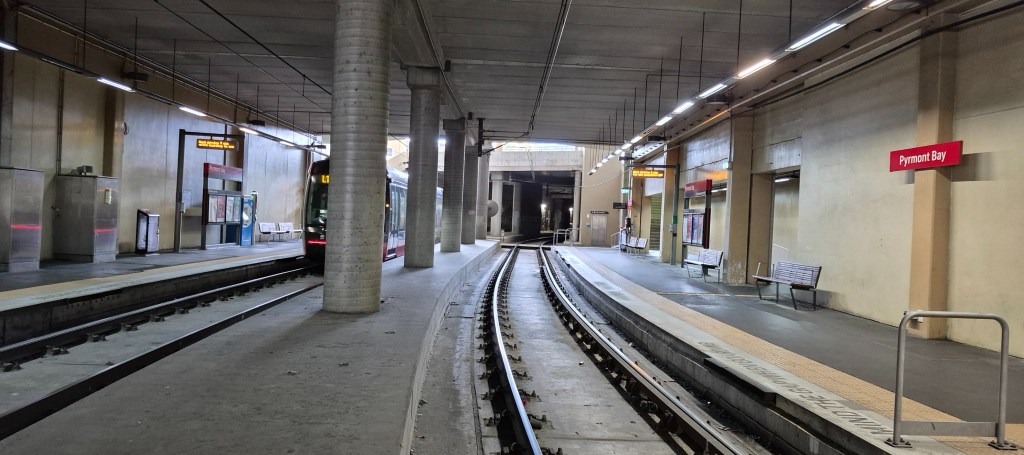
The Pyrmont Bay light rail stop, on the Dulwich Hill Line. The stop is under a building. A tram is at the left of the photo, partially hidden behind some columns.

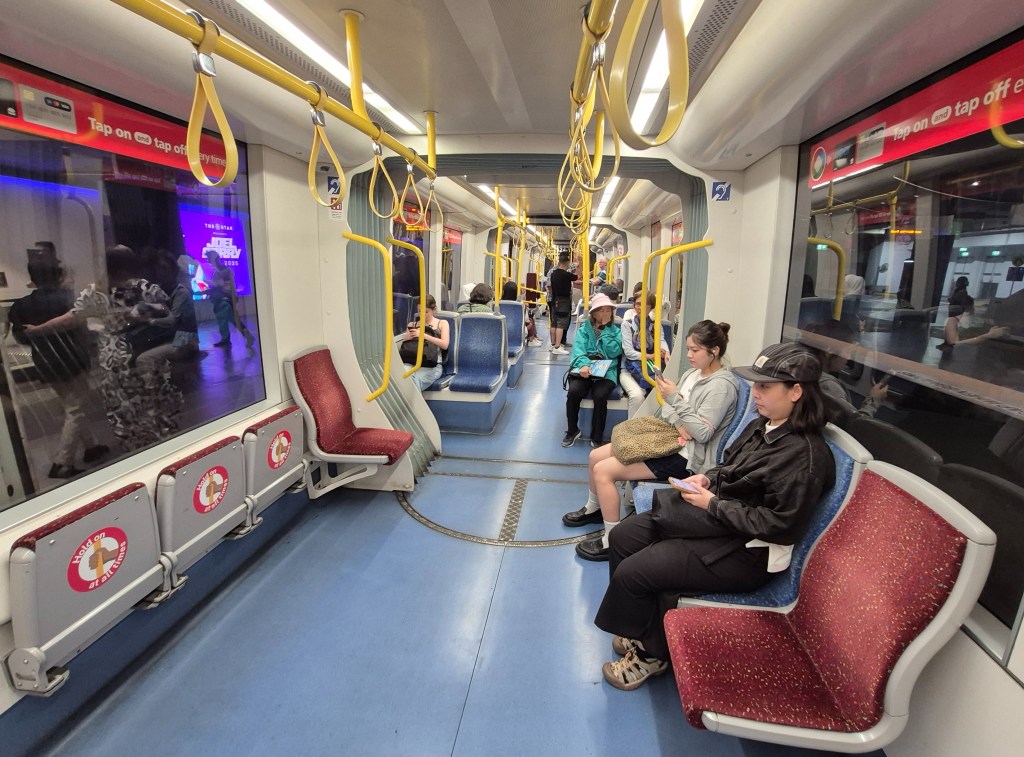
A photo of the inside of the light rail carriage.

The light rail tracks were in cuttings and tunnels the whole way to the Fish Markets. Wikipedia says “Most of the alignment of the Dulwich Hill Line had its origins as the Rozelle–Darling Harbour Goods Line. … This line was extended to Dulwich Hill via the John Street tunnel, the Glebe tunnel, and Lilyfield in 1922. …With widespread use as a freight line throughout the early 20th century, the use of containers and the decentralisation of freight terminals in Sydney to places such as Port Botany and Chullora, Darling Harbour traffic was reduced considerably. The port closed and the area was redeveloped in the 1980s.”

I got off at Fish Market light rail stop (above).

There was only a short walk to the Sydney Fish Markets, through a car park (above).

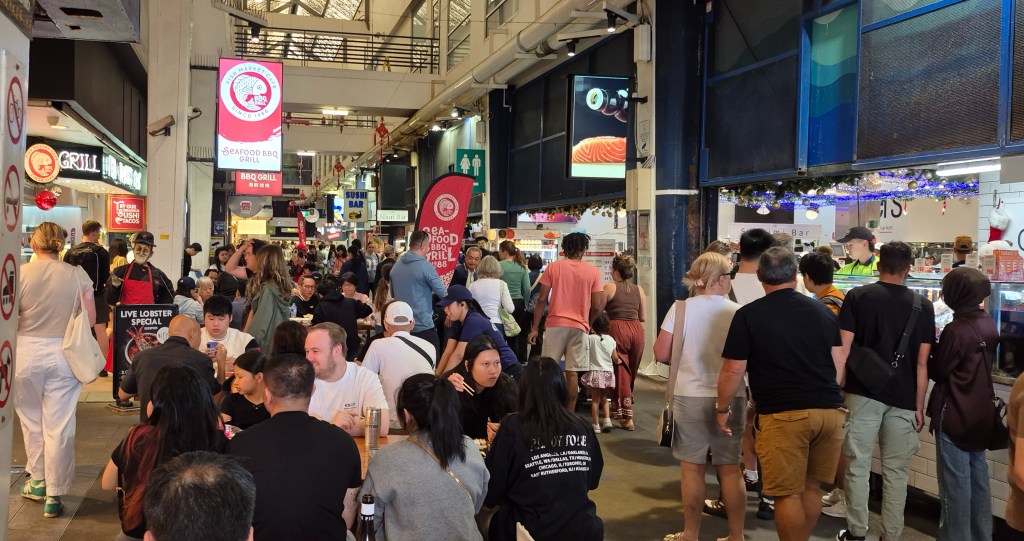
The entrance to the Sydney Fish Markets. In 1966, “Sydney Fish Market was built as a wholesale fish market, operated by the Fish Marketing Authority.  Sydney Fish Market moved from the Haymarket area of Sydney to its current location at Blackwattle Bay, Pyrmont.” The auctions were held in the early morning. By the time I visited, the auctions were over, and multitudes of tourists had arrived.

It was Sunday, so the place was very busy.

Pyrmont History Group says “Sydney Fish Market attracts more tourists than any other Sydney site except the Opera House. It is the largest market of its kind in the southern hemisphere and trades over 13,500 tonnes of seafood annually. The Authority organises the weekday wholesale auctions when 1,000 crates or 20,000 kg of seafood are sold every hour. It has also operated the Sydney Seafood School since 1989. The market accommodates six seafood retailers, and several other shops and restaurants.”

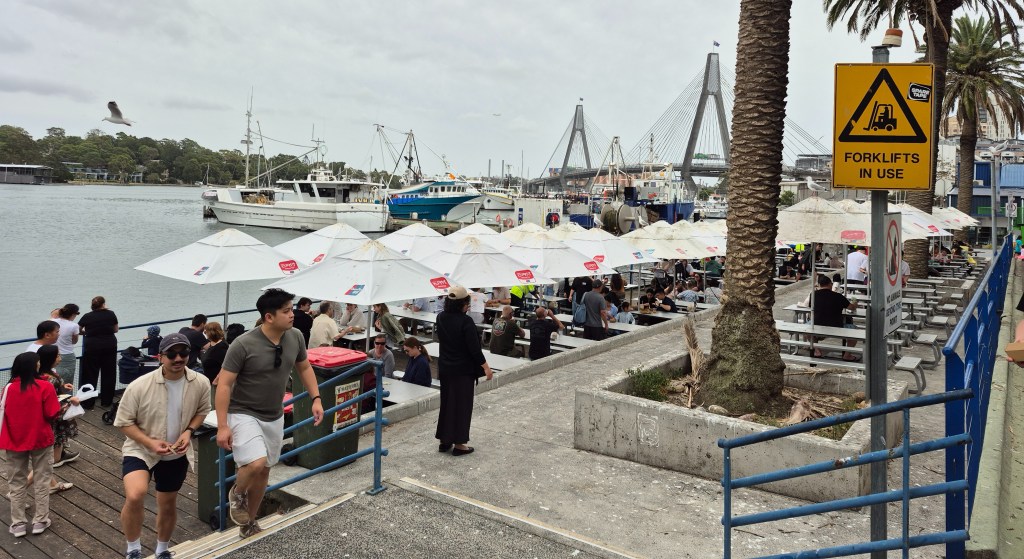
It was too crowded in the Fish Market building, so I came outside. The Fish Market was right near the water (above).

Of course, there were ibis. I’ve written about ibis before.

An ibis making a move.

There was another species of bird…

A pelican!

The Australian Museum says they are the “Australian Pelican. Scientific name: Pelecanus conspicillatus. The most characteristic feature of pelicans is the elongated bill with its massive throat pouch. The Australian Pelican’s bill is 40 cm – 50 cm long and is larger in males than females. … Pelicans mainly eat fish, but they are opportunistic feeders and eat a variety of aquatic animals including crustaceans, tadpoles and turtles. They readily accept ‘handouts’ from humans, and a number of unusual items have been recorded in their diet. During periods of starvation, pelicans have been reported capturing and eating seagulls and ducklings. The gulls are held under water and drowned before being eaten head first.”

Google AI says pelicans are ubiquitous at the Sydney Fish Market, begging for scraps and sneaking into buildings, but you don’t want to feed them as they are wild animals.

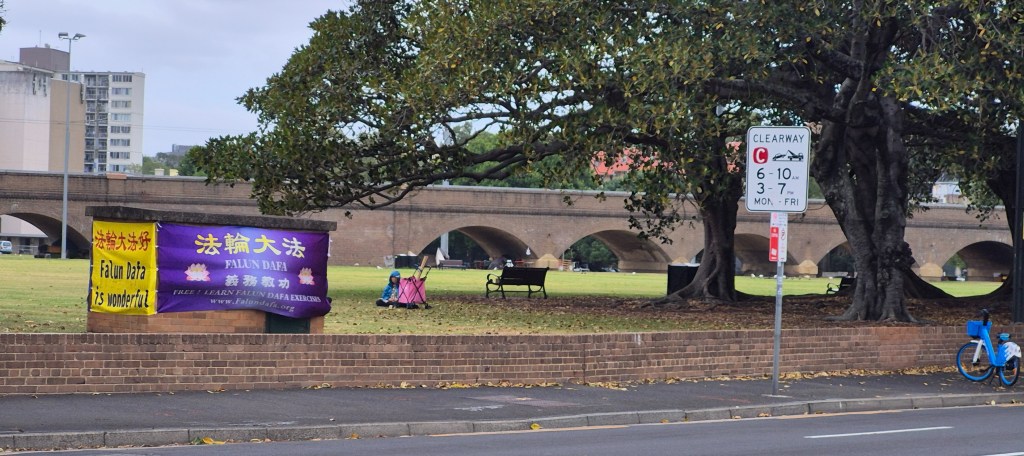
Outside the Sydney Fish Markets there is Wentworth Park (above), with an elevated light rail running across it. There are also some banners put there by Fǎlún dàfǎ (法輪大法). One of their operations is the famous dance troup Shen YunWikipedia says “They are known for their opposition to the ruling Chinese Communist Party (CCP), espousing anti-evolutionary views, opposition to homosexuality and feminism, and rejection of modern medicine, among other views described as ‘ultra-conservative’”.

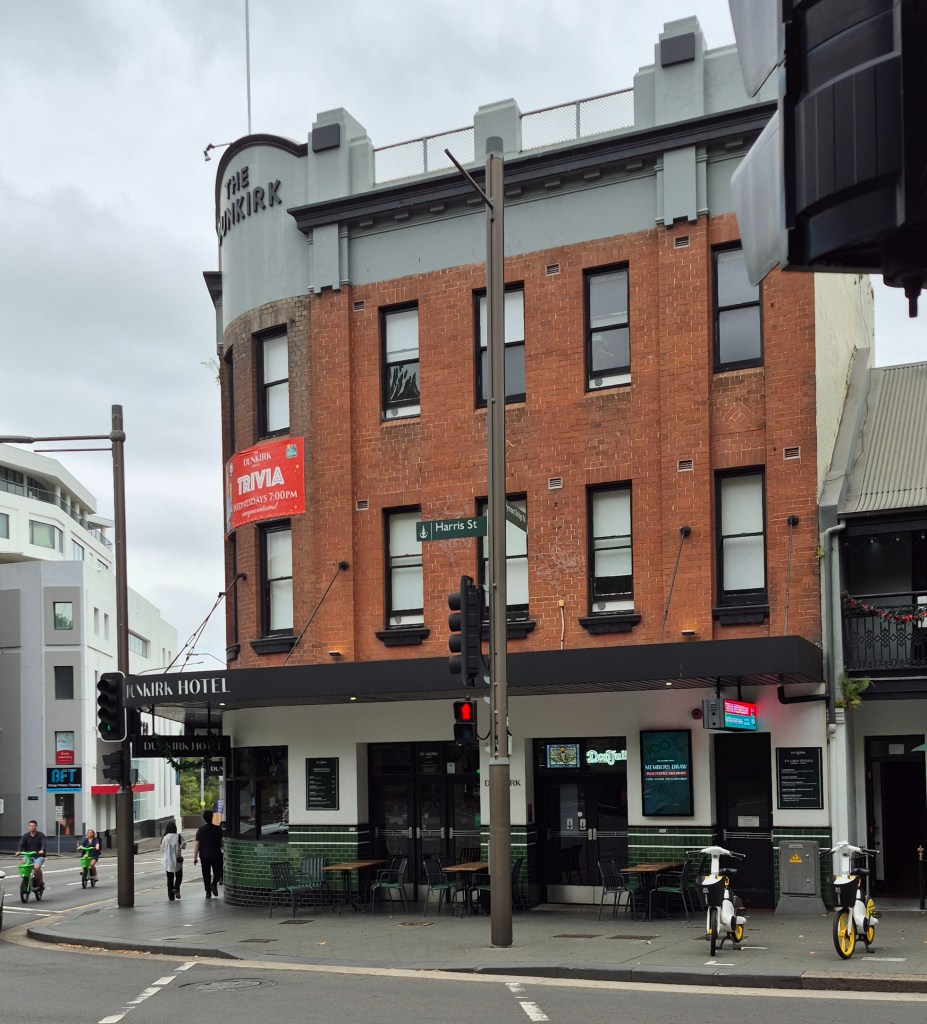
I felt hungry, but the Sydney Fish Markets were so crowded. So I walked along Pyrmont Bridge Road to Harris Street and went into a grand pub, The Dunkirk (above).

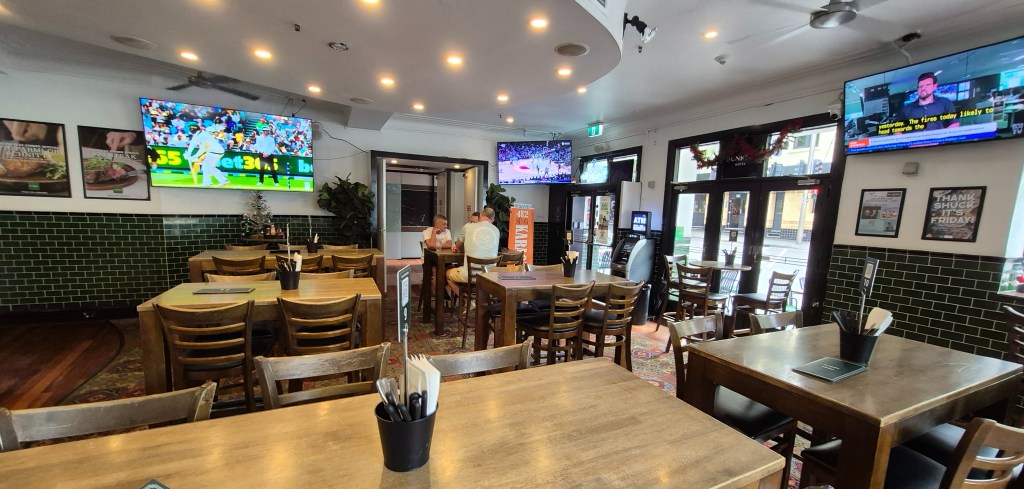
The interior of the pub: dark, a bar along one side, and overhead televisions tuned to different sports channels.

I ordered Chicken Parmigiana. Despite its Italian name it’s an Australian dish. I paid just under $AUD 30, a bit expensive.

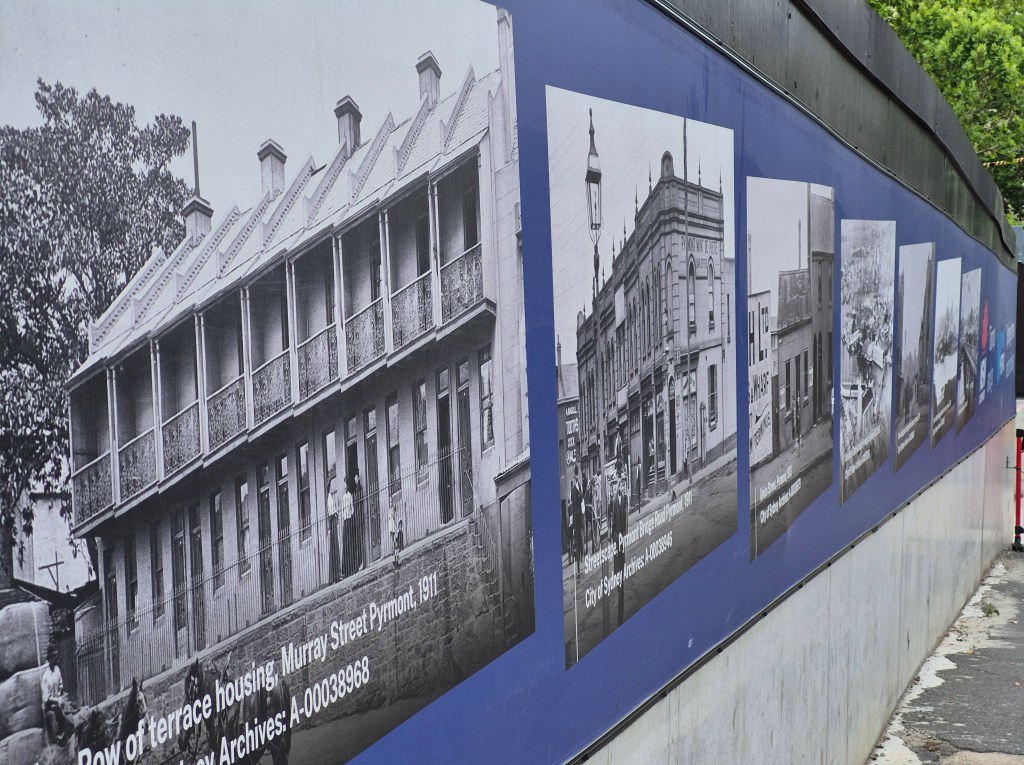
Resuming my journey, I came across these placards memorializing old Sydney (above). My father used to work at the Government Printers office just down the road, and remembers Pyrmont as lively with the nearby port and railways.

I was going to take the light rail again, but I discovered Pyrmont Bridge (above), which is a short-cut to the city, so I took that.

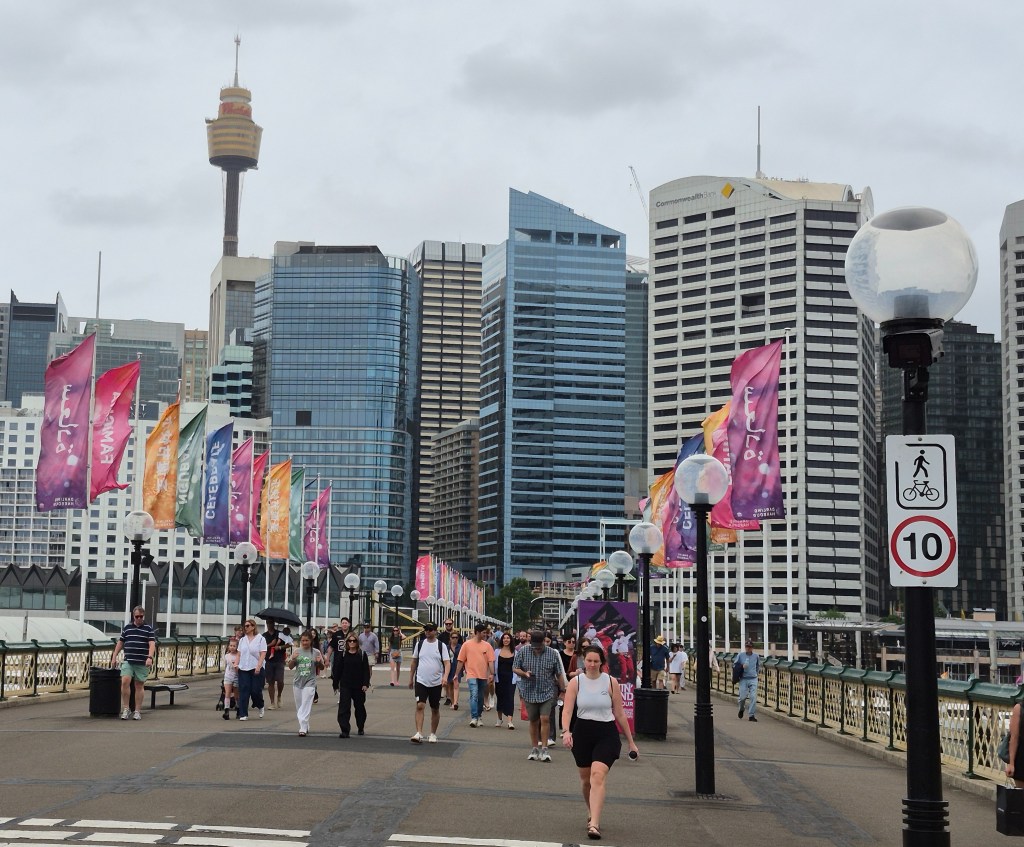
On Pyrmont Bridge.

The Pyrmont History Group says “Pyrmont Bridge is one of the world’s oldest surviving electrically operated swingspan bridges. It cost £112,500 to build, and opened in 1902, replacing the first bridge (that had been carrying traffic since 1857), allowing tall vessels to access southern Darling Harbour. … Almost all previous swingspan bridges were operated by winches, steam or hydraulic power. In this case Ultimo Power House was nearby, and modified tram motors drove the swingspan. This innovation won acclaim as a marvel of modern engineering at the international conference of the Institution of Civil Engineers (London) in 1907. As container ships came to dominate trade, freight moved to Botany Bay, the railway goods yards closed and in 1981 Pyrmont Bridge closed to traffic. When Darling Harbour was redeveloped, the swingspan was restored and a monorail built. The monorail was dismantled in 2013 but the bridge still opens for demonstrations on weekends and public holidays, and whenever a tall vessel needs to pass through.”

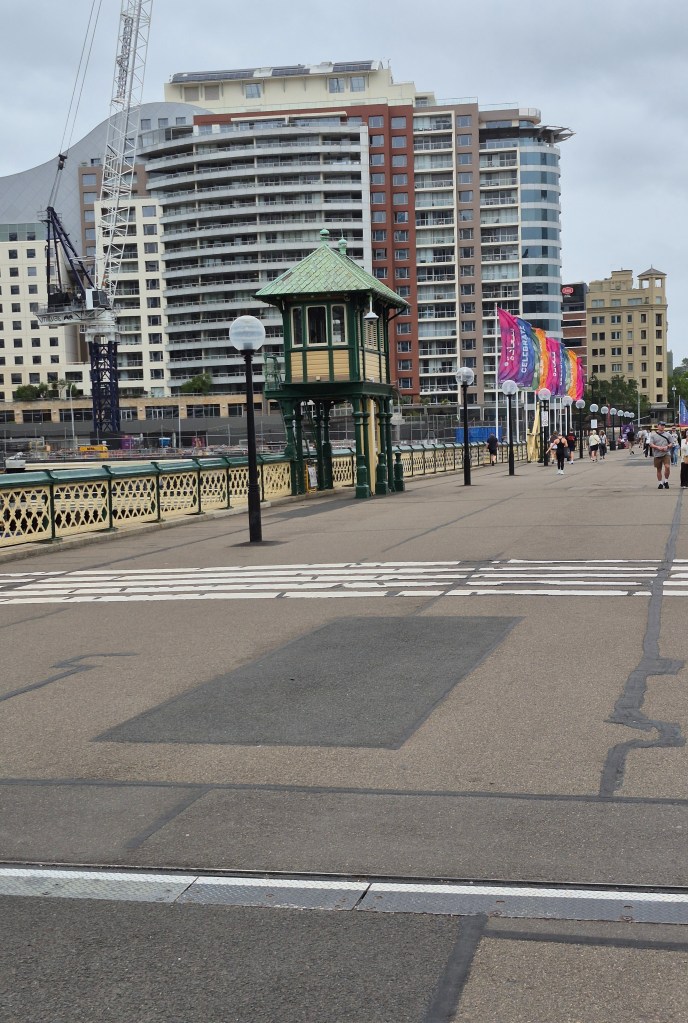
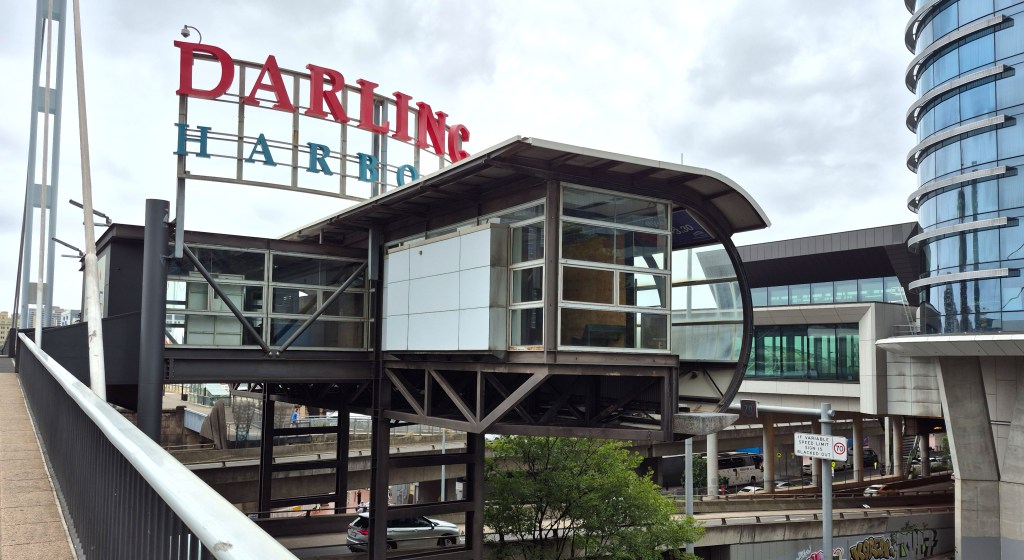
The control cabin (above) over Pyrmont Bridge. The swingspan extended to the metal line in the foreground.

The Pyrmont History Group article mentioned a monorail; this was a station on said monorail.

The Sydney monorail was very controversial. The Dictionary of Sydney says “Apart from being considered a general eyesore and an intrusion on heritage and architectural values of the CBD streetscape, the Monorail was impractical because it didn’t actually connect with any of the major transport hubs in the city. Nor did the investment make economic sense, critics pointed out the construction of Light rail would have been $20 million cheaper to build, service more passengers per hour and cost 40% less for a ticket.”

The bus was only a short distance from Pyrmont Bridge; I didn’t have long to wait.

Bathurst, Australia

November 26, 2025

I’m back in Sydney. My 2-year visa had expired, and the Mandarin Training Center refused to give me another. However, I discovered that I can go back to Taiwan without a visa and study Chinese, though I have to depart in 90 days. I’ll be doing this for, hopefully, some years.

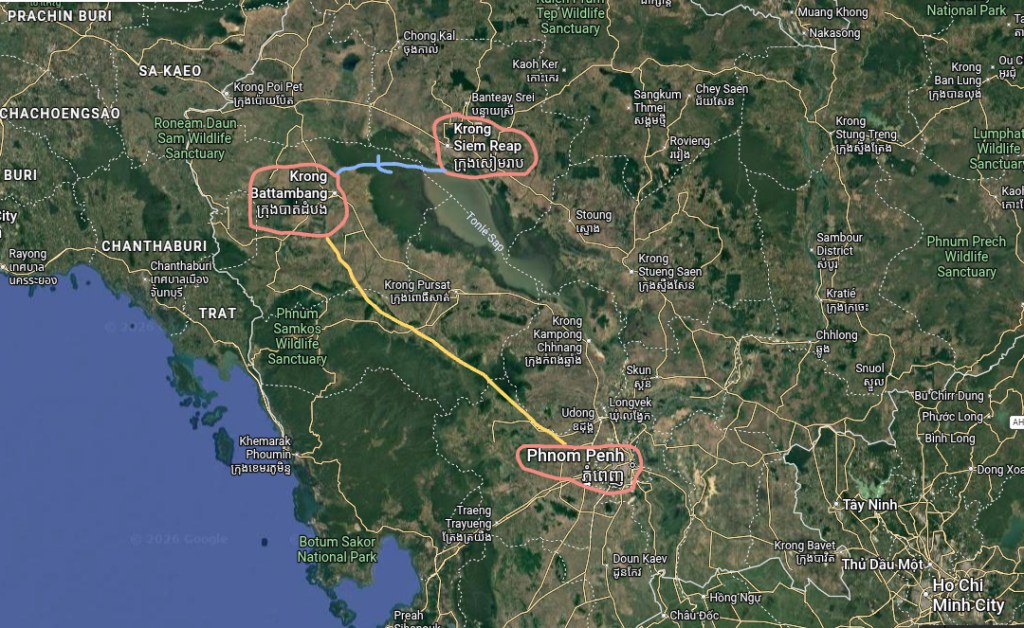
But for you, my audience, if you wondered if you can go to South-East Asia with me, I urge you to do it. A friend has already met me in Taipei, and another friend will be travelling with me in Cambodia in January. Come to South-East Asia with me!

My mother suggested I travel with her by train to Bathurst, where we will meet with my aunt and uncle-in-law who live there, coming back the next day. After exploring options, it turned out that we had to go the next day. My aunt encouraged us, naming two hotels that we could stay at. The first hotel was booked out, but the second (Victoria Hotel) was available. I quickly booked that and the train tickets online.

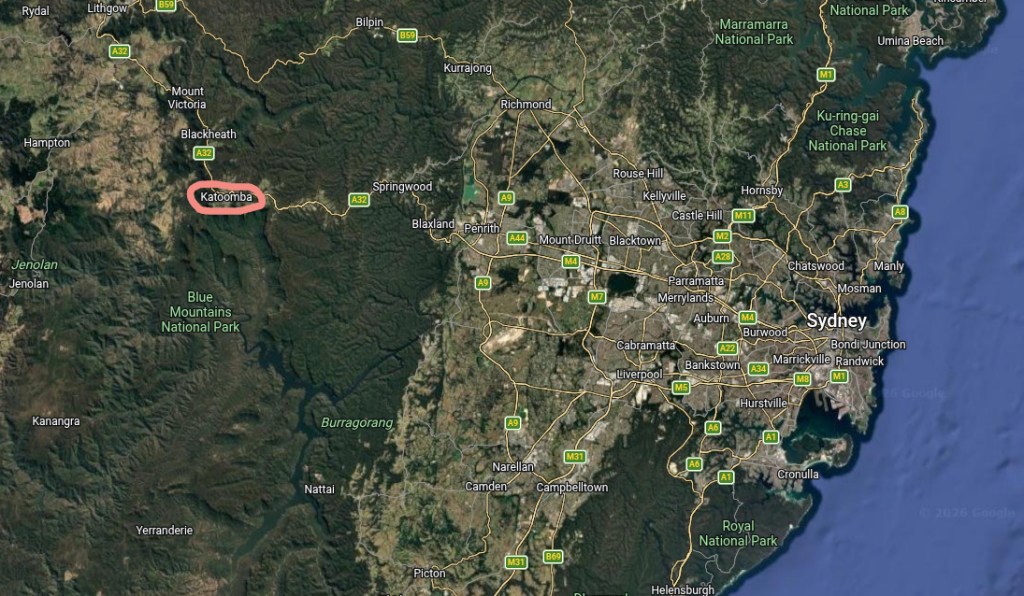
Above is the map. According to 12Go, “Travelling by train, the distance from Bathurst to Sydney is 109 miles” or 175 kilometers. Going by train takes 3 1/2 hours. First we go through Sydney to Penrith, then go up over the Blue Mountains to Lithgow, then finally go through the Western tablelands to Bathurst.

My mother and I set off from Northbridge at around 6am. The sun was just over the horizon, and the air was refreshingly cool, temperature around the high teens.

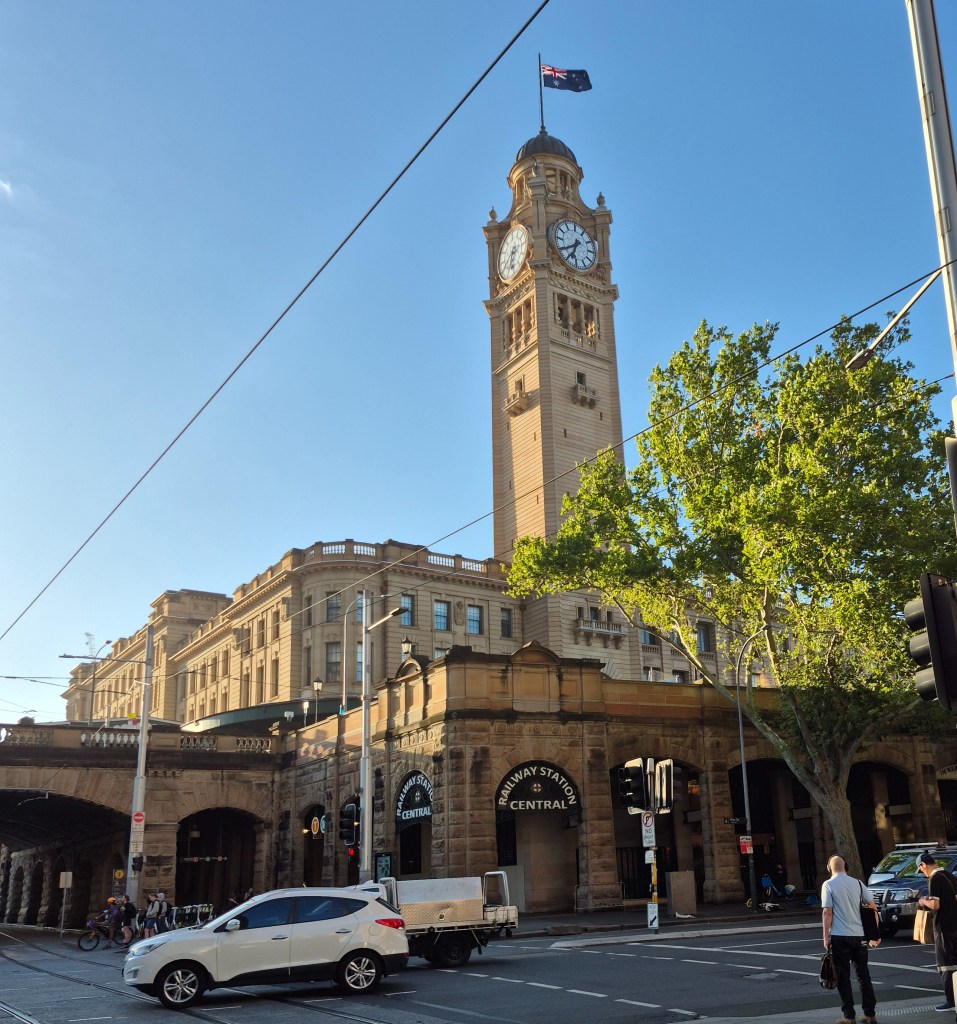
Central Station. Wikipedia said “The station is Australia’s largest and busiest railway station, and is a major transport interchange for NSW TrainLink inter-city rail services, Sydney Trains commuter rail services, Sydney Metro services, Sydney Light Rail services, bus services, and private coach transport services. The station is also known as Sydney Terminal (Platforms 1 to 12). The property was added to the New South Wales State Heritage Register on 2 April 1999. … It recorded 85.4 million passenger movements in 2018 and serves over 250,000 people daily.”

A foundation stone. According to the Dictionary of Sydney, “The first stage of the new station was opened in August 1906… The position of the station at the southern end of the city and its scale made it an instant landmark, with the clock in the tower being used by surrounding neighbourhoods as well as commuters. The station remains the gateway to the Sydney and regional rail system.”

A view under Eddy Avenue, showing the stonework. The escalator to the first floor is just visible to the right.

One level up via the escalator. The entrance to Central Station is the ornate entrance-way to the right. We arrived as a tram (technically, light rail) was just departing.

“The Sydney light rail network … has four passenger routes, the L1 Dulwich Hill, L2 Randwick, L3 Kingsford and L4 Westmead & Carlingford lines. It comprises 58 stops and a system length of approximately 36.7 km (22.8 mi), making it the second largest light rail network in Australia behind the tram system in Melbourne, Victoria.” (Wikipedia)

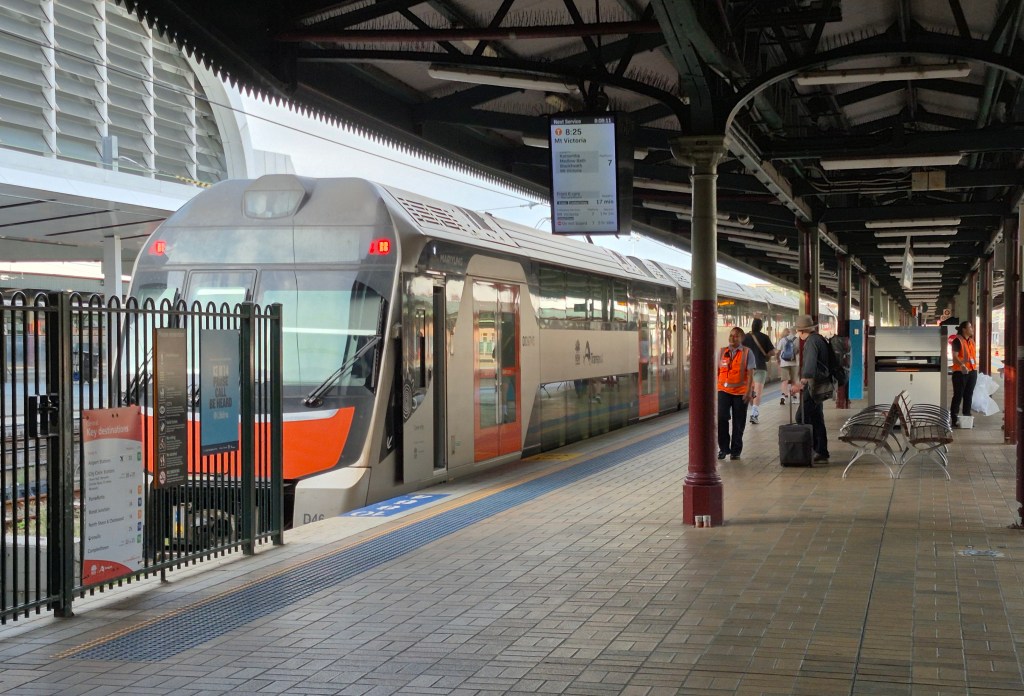
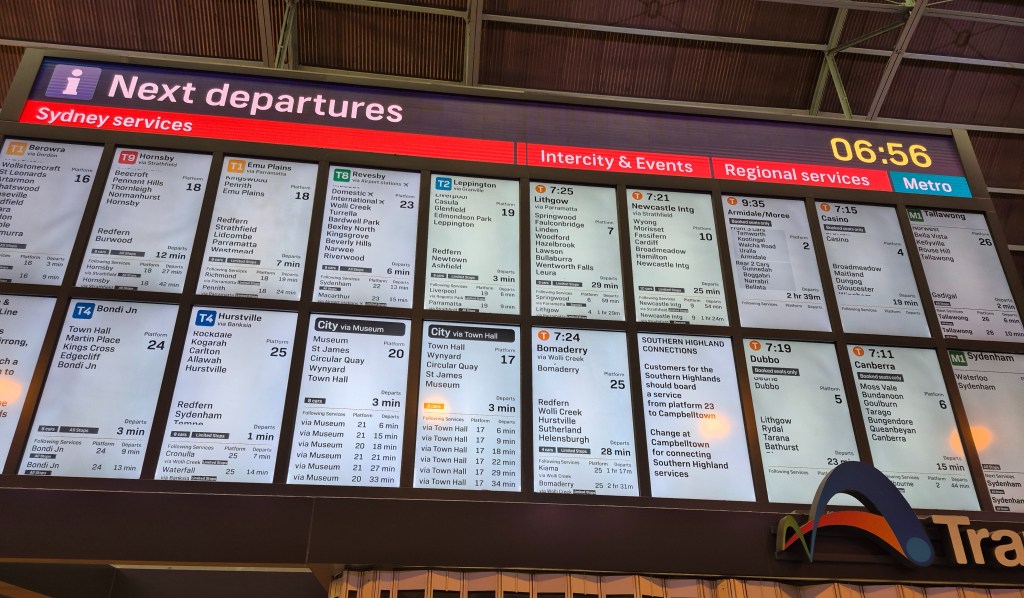
In the station. The departures noticeboard is centre right. Wikipedia notes “The train shed roof was to be designed to have a central span of 198 ft (60 m) with two sides spans of 78 ft (24 m)…. The roof was to be continuous. This truss and roof configuration was to be based on that of the Union Station, St Louis, visited by Deane in 1894. Such a roof would have rivalled those of the major metropolitan termini in Europe and America. “

A close-up view of the departures noticeboard. Our train was scheduled to depart at 7:19am, terminating at Dubbo (lower screens, three from right).

There was a memorial to John Witton.

“Upon his arrival to Sydney and appointment as Engineer-in-Chief of NSW Railways in 1856, English railway engineer John Whitton was effectively handed the responsibility of taking a NSW rail network in its infancy and expanding it across NSW. It was Whitton who first conceived of the idea of the Eveleigh Railway Workshops in the 1870s as the centre for the construction and development of the NSW railway system. Despite constant issues with government committees throughout his 35-year career with NSW railways (1856-1890), Whitton successfully implemented several significant and fundamental elements to the expansion and improvement of the NSW rail network and administration, earning him the place in NSW rail memory as the ‘Father of NSW Railways’. Under Whitton’s tenure, the NSW rail network expanded from 37km of track in 1856, to over 3500km by his retirement in 1890. Whitton was also responsible for adoption of a uniform railway track gauge throughout NSW, conversion of locomotive fuel from wood fire to coal to reduce emissions that damaged passenger clothing and property along the rail line, construction of the Blue Mountains line and the Zig Zag Railway at Lithgow, and expansion of the NSW rail to the Queensland and Victorian borders.” (South Everleigh)

Some people sleeping in the station. Guardian Australia has an article on rough sleepers who use Central Station; they are mostly women, as its CCTV cameras and public position means the location is safer than usual.

My mother bought some coffee and snacks from the coffee stall, while I bought it from a shop in the station. She said the coffee was not bad, while mine was too bitter.

An artistic shot from the buffers. Our train, an XPT, was to the left.

From Wikipedia, “New South Wales XPT (short for eXpress Passenger Train)… Based on the British Rail-designed High Speed Train, each XPT set comprises two XP power cars in a push-pull configuration and, between them, from four to seven passenger carriages. … The XPT was procured … in March 1980. The design of the InterCity 125 was substantially modified.  … The XPTs are operated under NSW TrainLink, running on long-distance regional and interstate North Coast, Main Western and Main Southern line services throughout New South Wales and interstate into Victoria and Queensland.”

We paid $AUS 22 from Sydney to Bathurst, travelling 2nd class, and concession due to my mother’s age and my disability.

The above clip is a train trip from Sydney to Dubbo, past Bathurst. I recommend you stop viewing the clip when you get to Bathurst, about two-thirds of the way through.

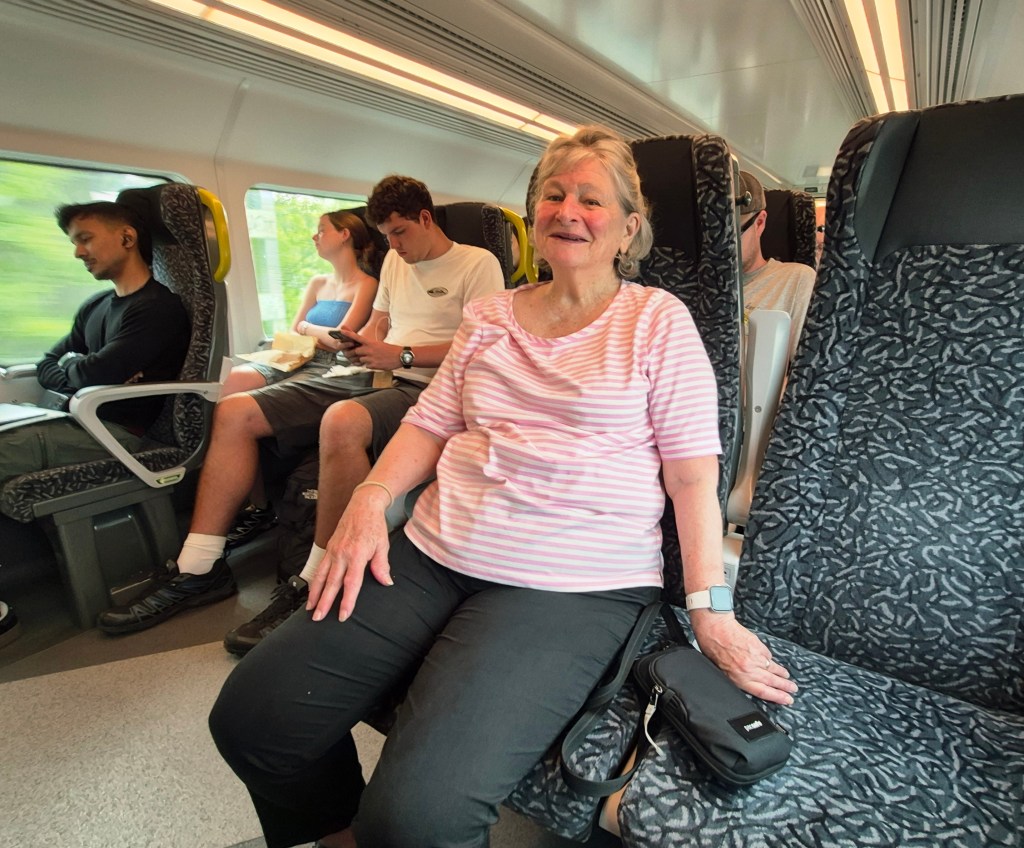
Our train left on time. Here is a photo of Strathfield Station shortly after departing. I photographed the scene sitting at my seat from inside a window, hence the reflection on the glass.

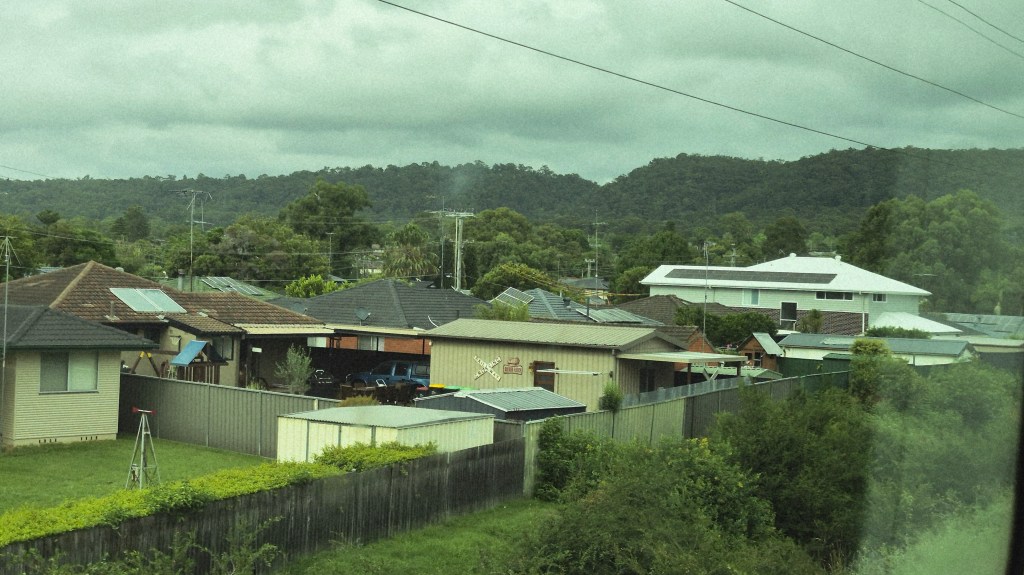
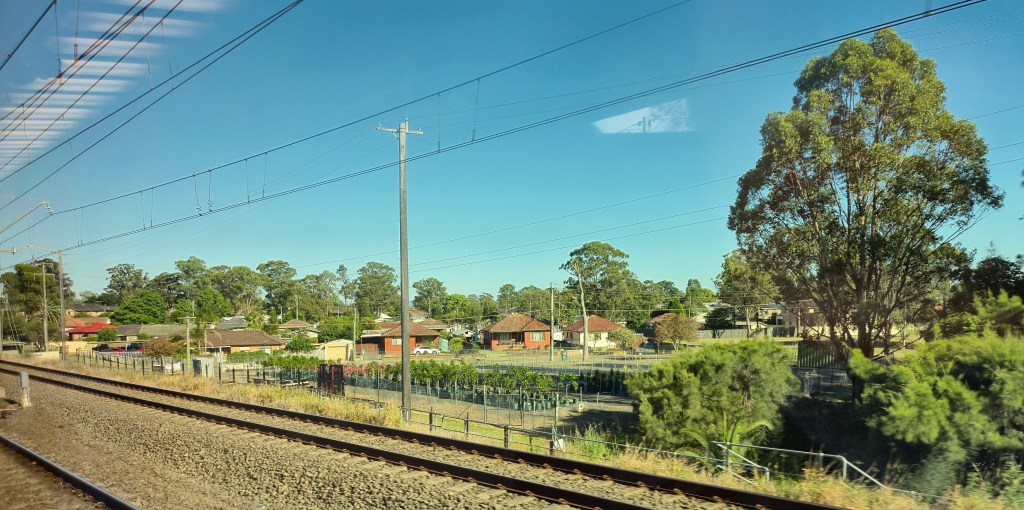
The train went rumbling west, through suburb after suburb, under an immense cloudless sky.

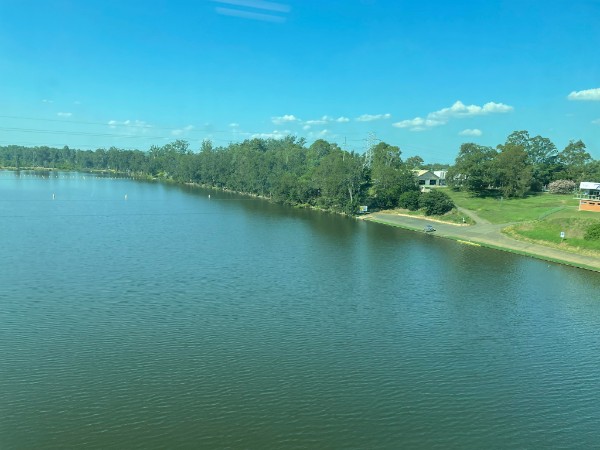
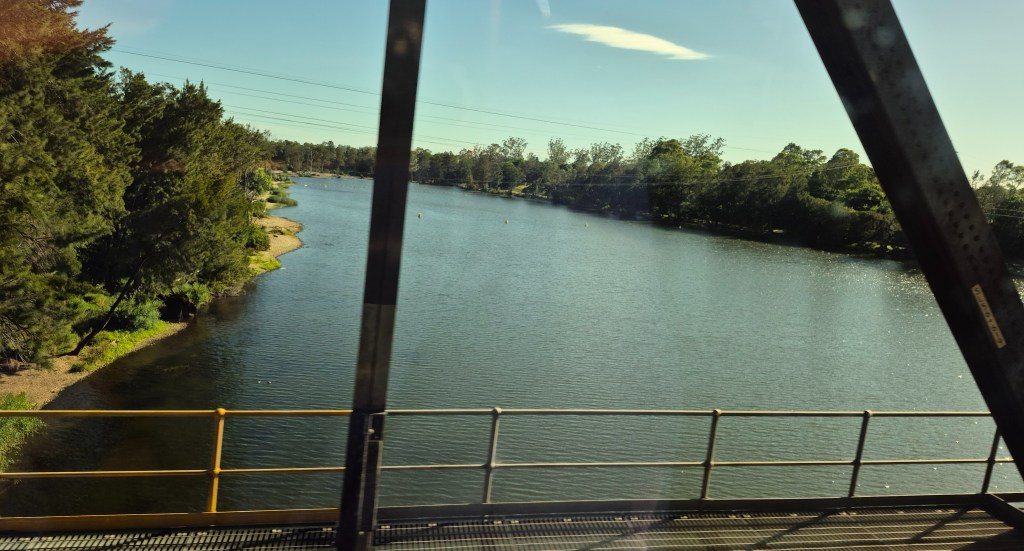
After an hour and a half we crossed the Nepean River at Penrith. The Aboriginal name is Yandhai – I had to look it up.

The river changes its name to the Hawkesbury downstream of the confluence of the Grose River because “When the British colony was established at Sydney in 1788, the Governor, Captain Arthur Phillip, charted the coast 50 km north to the mouth of the Hawkesbury and around 32 km upstream till they were stopped by a waterfall, most likely at Hawkesbury Heights. Phillip named the river after Lord Hawkesbury. ..Meanwhile, Lieutenant Watkin Tench set off to walk inland, west of Sydney. About 60 kilometres (37 mi) inland, at the foot of the Blue Mountains, he discovered a large river which he named Nepean … It took about three years to realise that the Nepean flowed into the Hawkesbury.” (Wikipedia)

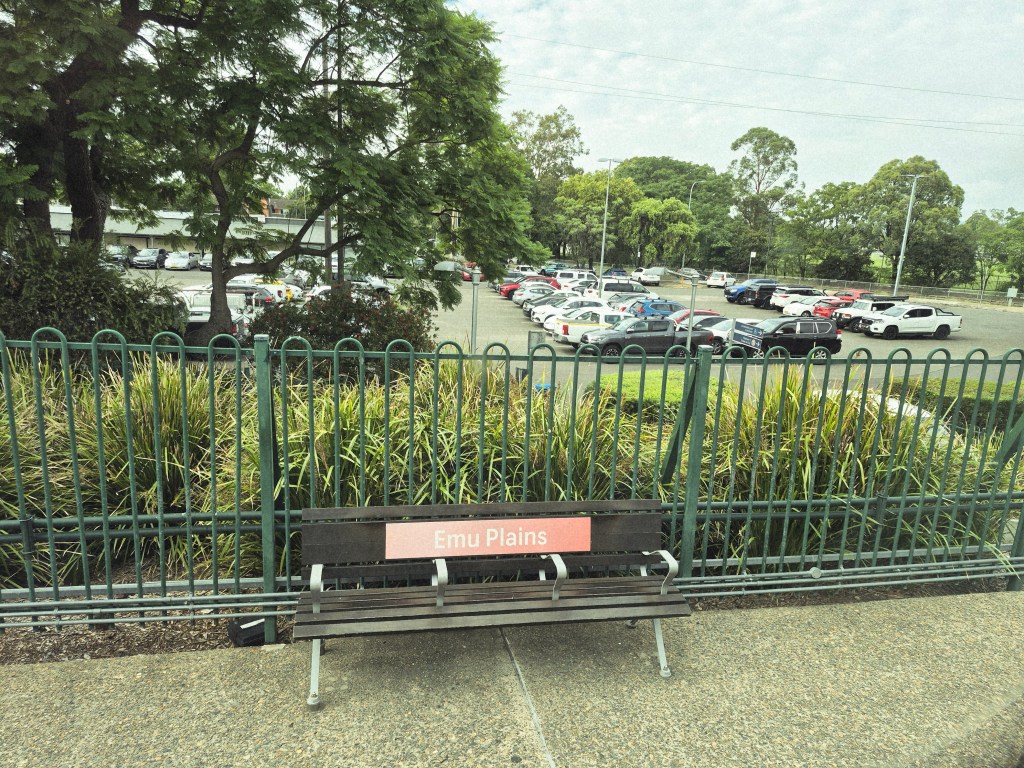
Getting close to the Sydney border. The photo was taken around Emu Plains.

According to Wikipedia, “Near Penrith, since 1971 numerous Aboriginal stone tools were found in Cranebrook Terraces gravel sediments deposited by the Nepean River 40,000 to 50,000 years ago, according to repeated, revised and corroborated radiocarbon and thermoluminescence dating. At first when these results were new they were controversial. More recently in 1987 and 2003 dating of the same sediments strata has revised and corroborated these dates”.

We could see the Blue Mountains as a barrier (above). My father told me this is the Lapstone Monocline.

“During the construction of the Great Western Railway it appeared almost impossible to construct a railway line over the Blue Mountains. It was eventually achieved by constructing a line with gradients as steep as 1 in 30 (3.33%), with curves of 8 chain (160 m) radius and the use of a zig-zag at Lapstone.” (Valley Heighs Railway Museum)

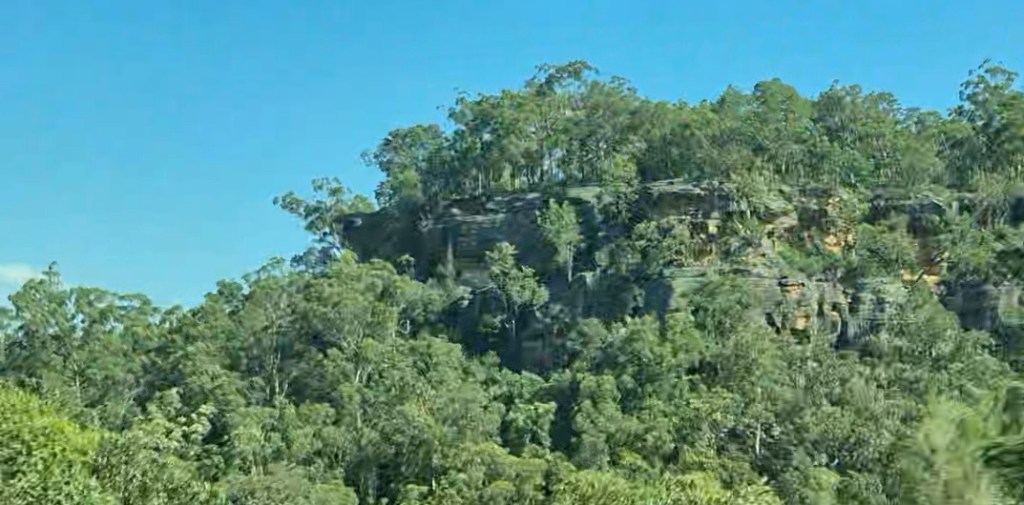
The landscape changed to thick bush (above). The trees are mostly eucalyptus, with a dense understorey.

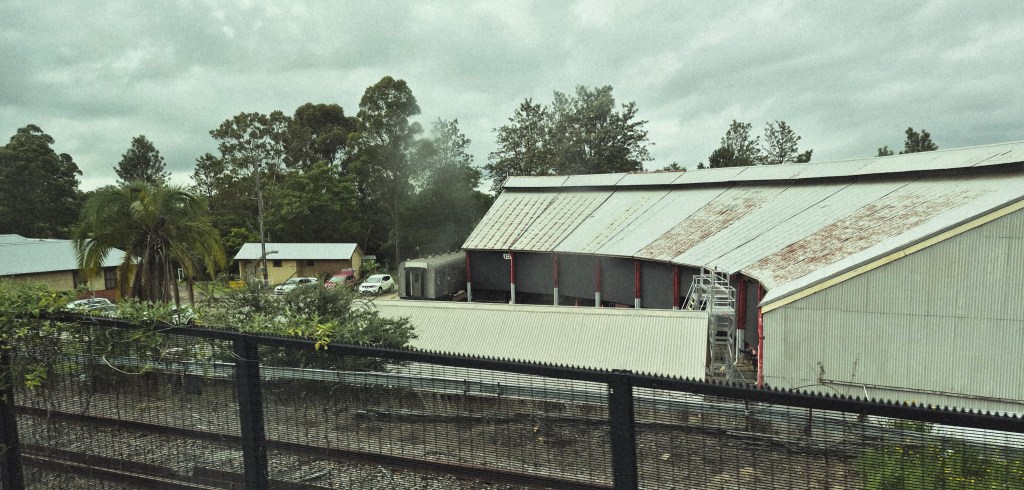
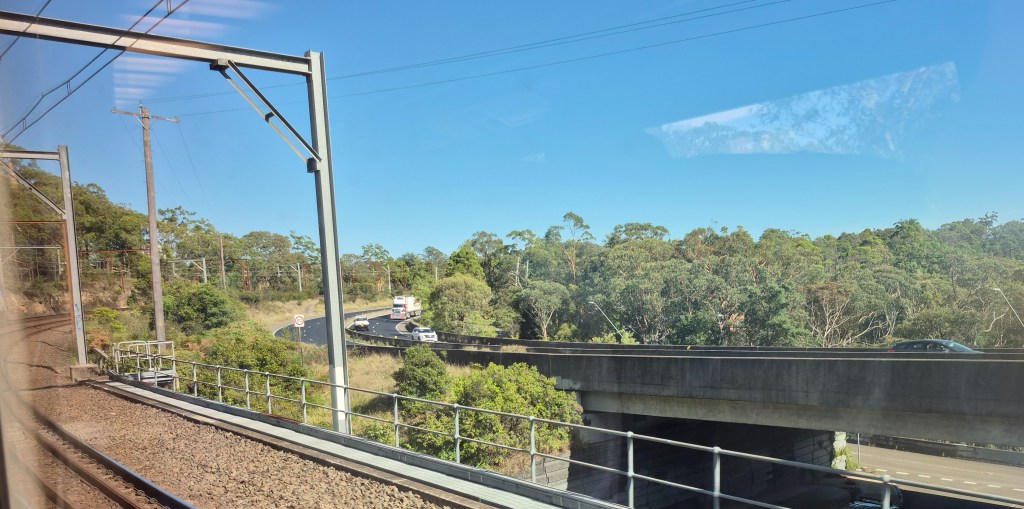
We went through a series of cuttings (above) and tunnels.

The railway and the motorway, the Great Western Highway, runs parallel through this stretch of the Blue Mountains.

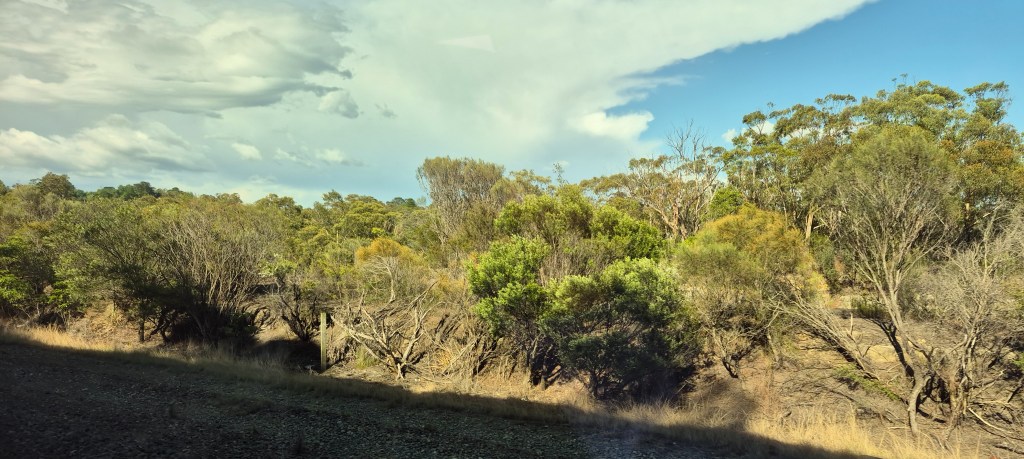
The vegetation changed as we ascended. This was taken near 1000 meters in altitude.

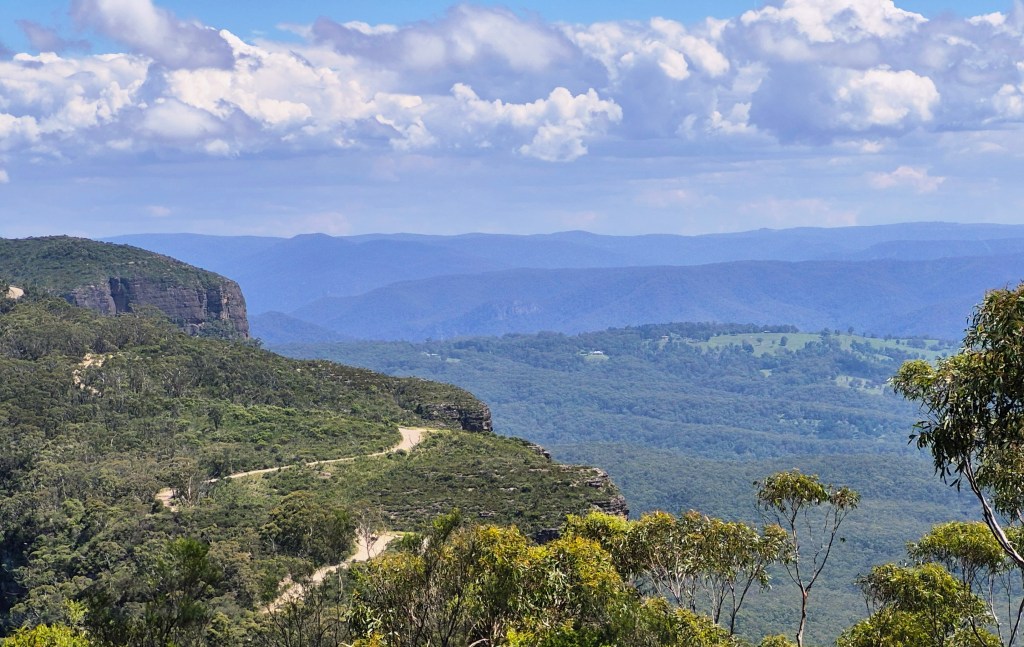
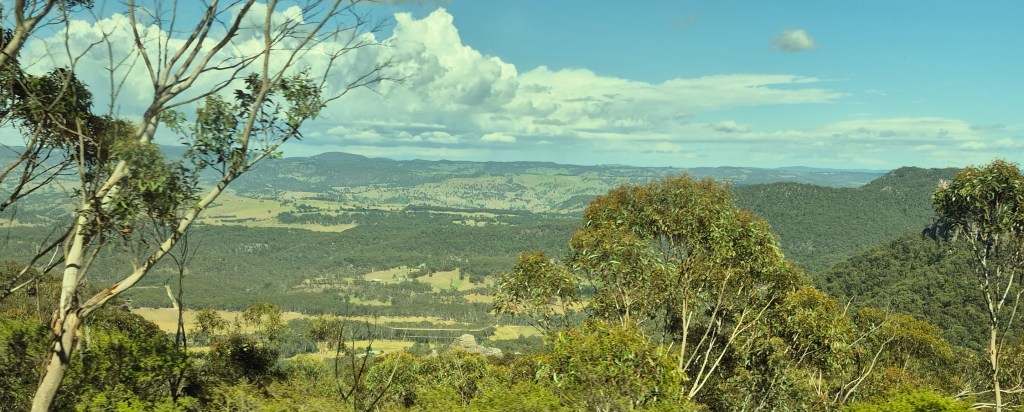
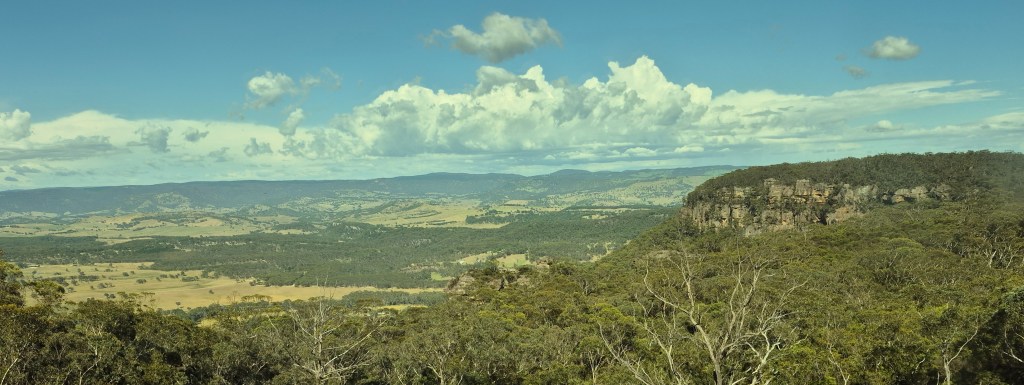
A fine view outside the windows. I think this was the Megalong Valley.

And this maybe is the view towards Little Hartley?

I don’t know what view this is – except it’s majestic.

Coming off the western edge of the Blue Mountains, we went through ten tunnels and numerous defiles, like the one above.

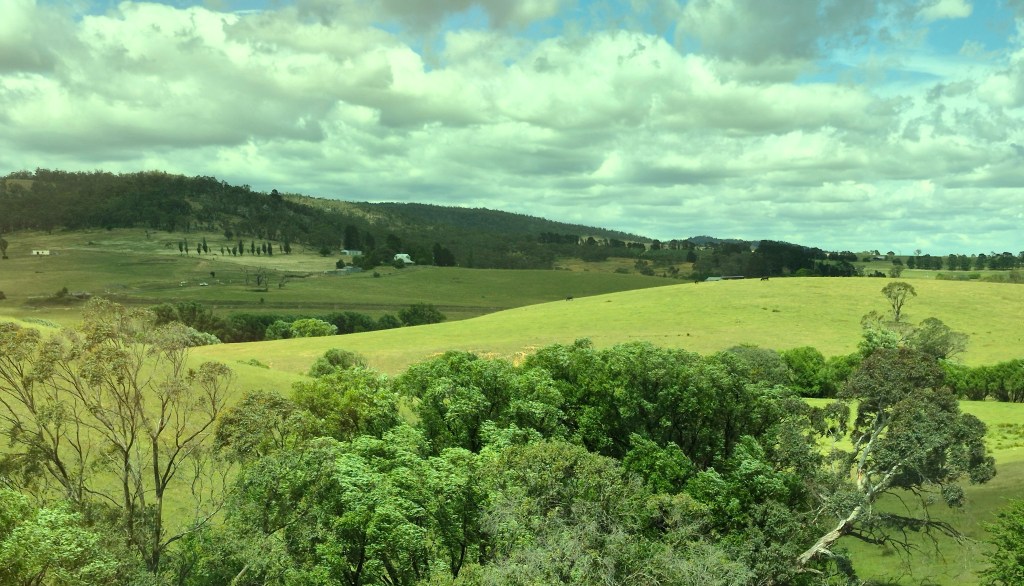
We passed through Lithgow, and the country opened up to hills and rolling plains (above). We were in the western tablelands.

Beautiful scenery in this part of the trip.

This was a photographer’s delight.

I was reminded of a painting I saw in my parents’ home in Sydney, drawing from life.

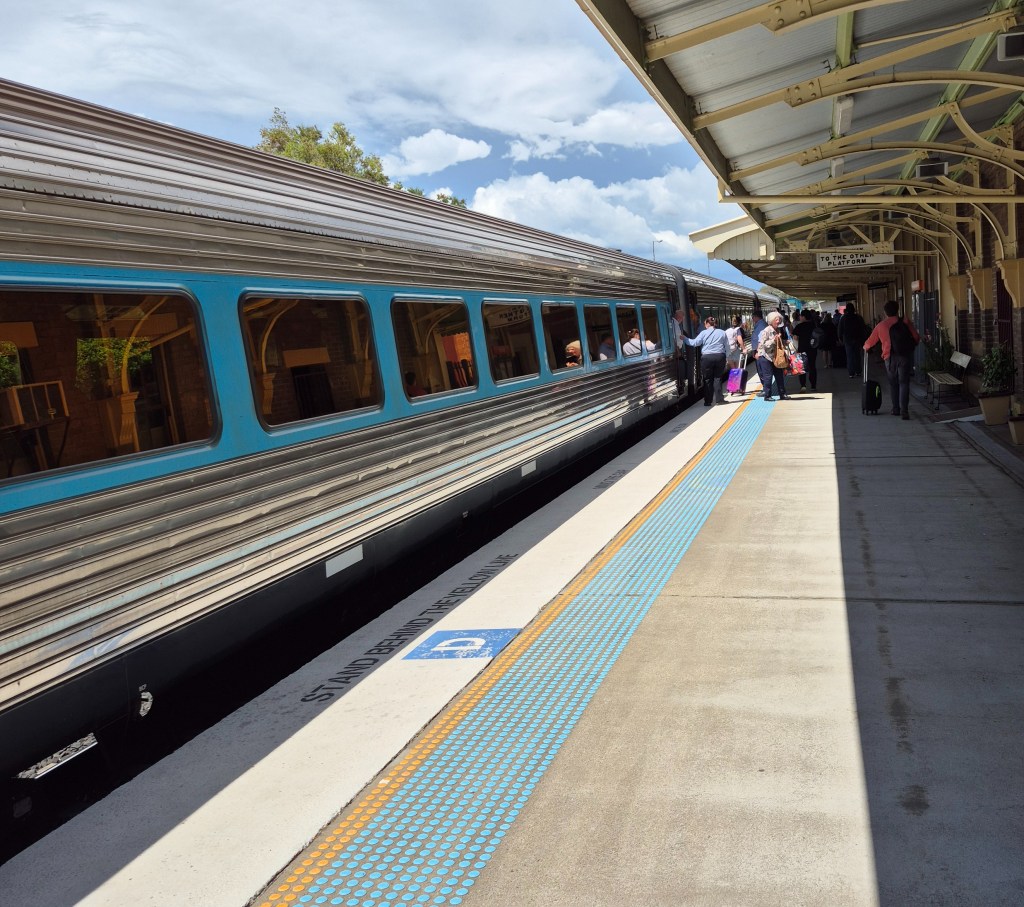
At last, Bathurst Railway Station.

A photo from outside Bathurst Railway Station.

“On 7 May 1815, Governor Macquarie at the terminus of Cox’s Road raised the flag, ordered a ceremonial volley to be fired and proclaimed and named the future town of Bathurst after the Secretary of State for War and the Colonies, Henry Bathurst, 3rd Earl Bathurst. This made Bathurst the first inland settlement in colonial Australia.” (Bathurst Region)

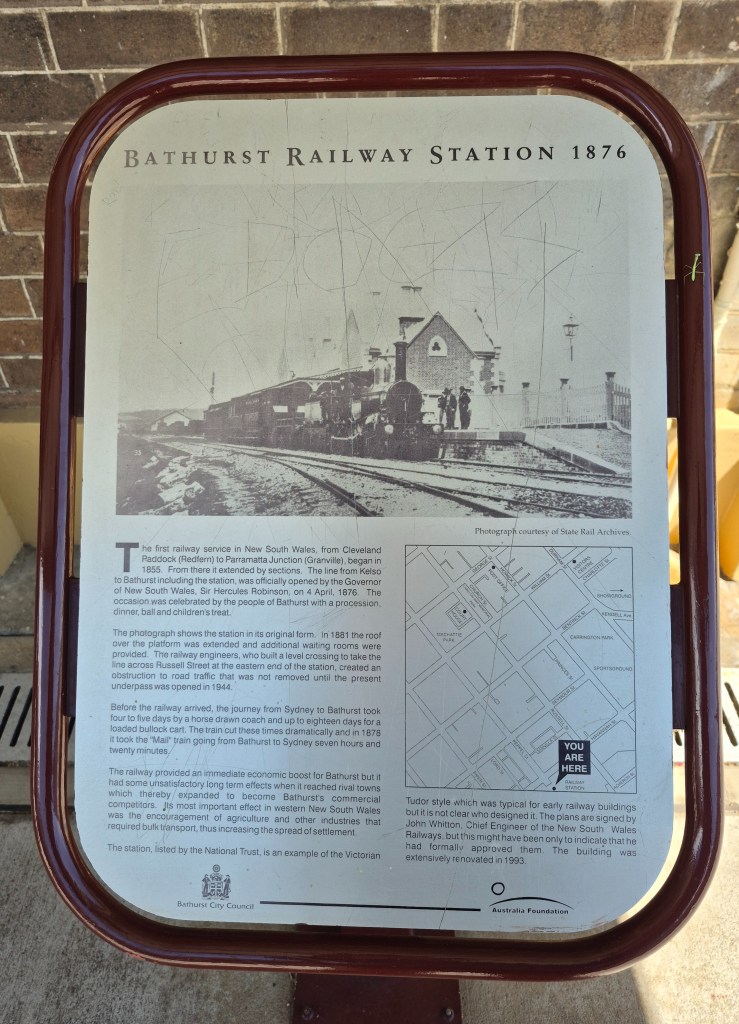
A plaque in Bathurst Railway Station. It reads in part, “The line from Kelso to Bathurst including the station, was officially opened by the Governor of New South Wales, Sir Hercules Robinson, on 4 April, 1876. The occasion was celebrated by the people of Bathurst with a procession, dinner, ball and children’s treat.” At that time, New South Wales was a colony of Britain, not yet a State in the future Australia.

In an open-sided pergola there was a steam train.

A grain mill next to the station.

According to the National Museum Australia, “Bathurst was initially planned as an administrative centre for government officials, soldiers and convicts stationed on the plains west of the Blue Mountains, and as a service centre for the colony’s growing pastoral enterprises. However, as news of the quality of the land spread in Sydney, pastoralists flooded inland and for the next decade a state of armed conflict existed in the region as the Wiradjuri people, led by the warrior Windradyne, resisted the loss of their lands to the settlers. The steady growth of the town was given a tremendous boost in the 1850s when gold was discovered 20 kilometres away at Ophir. The discovery began the Australian gold rushes and Bathurst prospered in the following decades. Today it is still one of the most important inland cities in New South Wales, famous for motor racing, agriculture and as the birthplace of one of Australia’s greatest prime ministers Ben Chifley.”

My mother walking towards the Victoria Hotel, just visible above her, behind the coach.

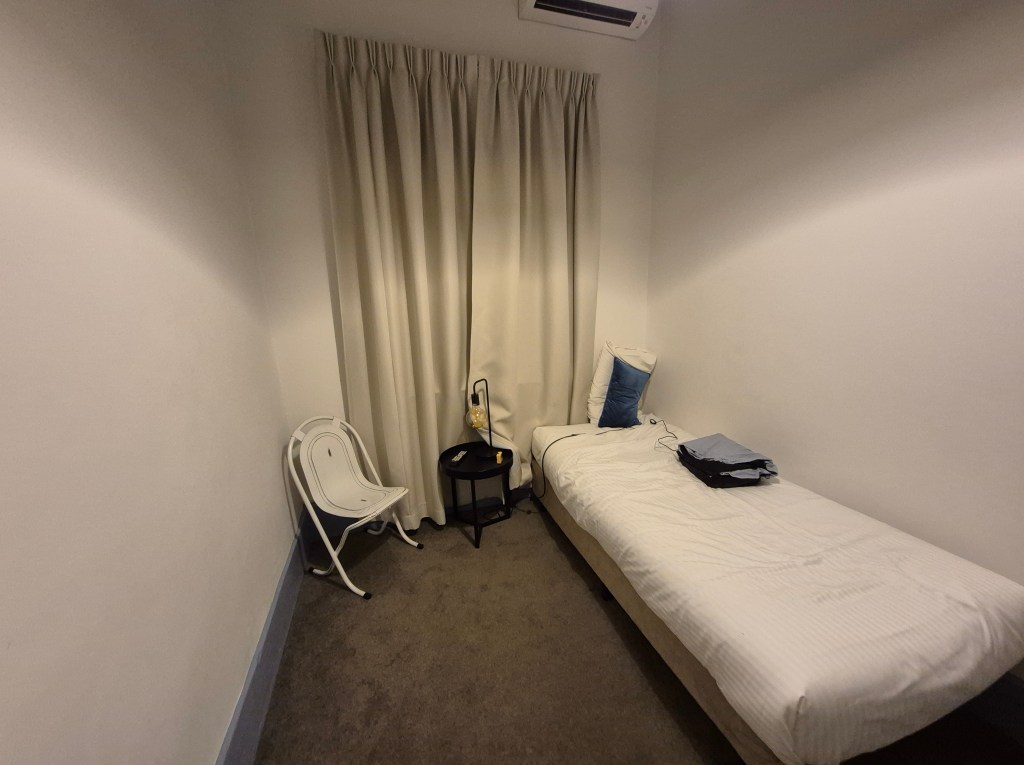
My room at the Victoria Hotel, photographed with my back against the door. The bathrooms were down the hall. My mother had an identical room. At first I considered my room only a bare step up from a prison cell, but the bed was snug, the air-con worked, the station was convenient, and it was only $AUS 87 a night. I think I would stay there again if I had to do something early in the morning.

We met my aunt and uncle-in-law, and went to their house, which is a lovely single-story terrace over a large block. This house, the wide streets, and the setting of the town, created a favourable impression on me. Bathurst has a population of around 45,000 people, but it has a university (Charles Sturt University), Mount Panorama motor racing circuit, and is a regional centre for health, as well as agriculture.

My uncle-in-law took me briefly to see Mount Panorama. On the way we passed an entrance to Charles Sturt University (above).

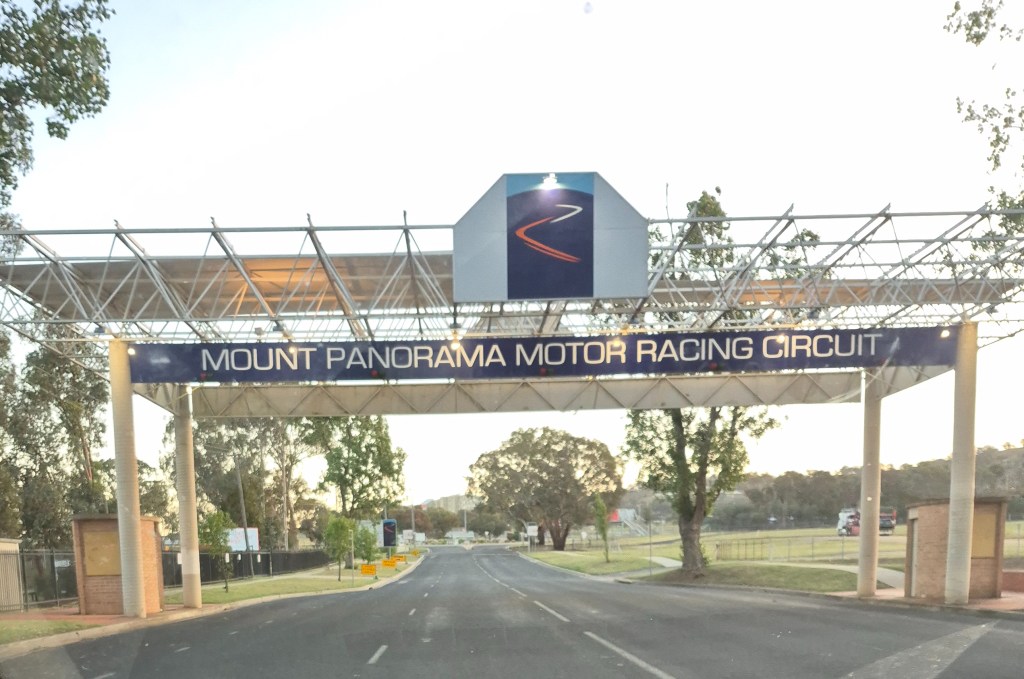
Then we drove under the Mount Panorama motor racing circuit. Bathurst Region stated, “It is situated on a hill with the dual official names of Mount Panorama and Wahluu and is best known as the home of the Bathurst 1000 motor race held each October, and the Bathurst 12 Hour event held each February.”

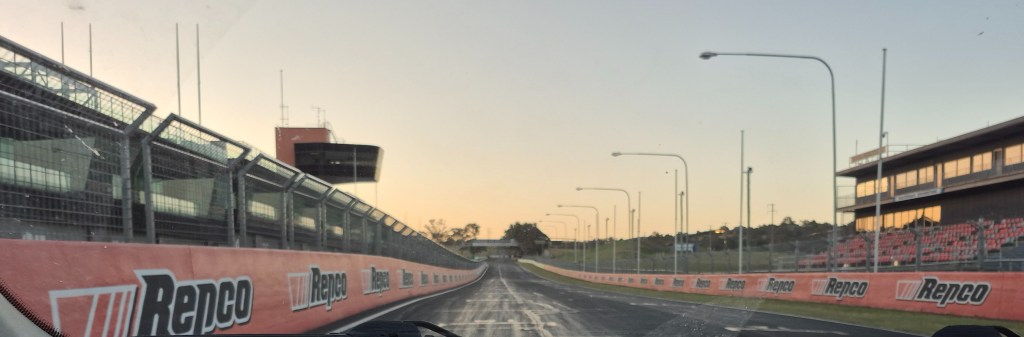
We actually went on the motor racing track!

Unfortunately, an official stopped us from going around the entire track, but I took a great photo including the marvellous view from Mount Panorama, and the caravan park in the foreground.

After spending a night in the Victoria Hotel, which wasn’t as bad as I anticipated, and spending an agreeable day with my aunt and uncle-in-law, we caught the train back to Sydney. I paid for my 2nd-class tickets, though – there was an Aboriginal man sitting a few seats away cursing almost the entire trip.

Manly, Australia

August 26, 2025

I’m in Sydney for a week, in between my MTC classes. I’ve been doing the classic tourist sightseeing in Sydney. This journey I decided to go to Manly.

I started at Circular Quay (pronounced “Key’) in the Central Business District, took a ferry to Manly Wharf on the harbour side of Manly, then walked to Manly beach.

Tuesday was a brilliant day: clear sky, a little cold in the morning (16 degrees Centigrade) but warming up to the low 20’s. It felt like spring, even though we were in the last week of winter. (A few days later, it was back to winter again, with big falls of snow in the Snowy Mountains.)

Circular Quay, the walking-only promenade next to the harbour. In the above photo the Quay actually juts out into the harbour – beneath those people is deep water. To the left, a restaurant with sky-high prices (but it’s on Circular Quay!)

A close-up of some ferries.

Another view of some ferries. Incidently, why is it called “Circular Quay”? Wikipedia says “The harbour was originally known as ‘Semi-Circular Quay’, this being the actual shape of the quay. The name was shortened for convenience.”

The Sydney Harbour Bridge. I did a post covering this.

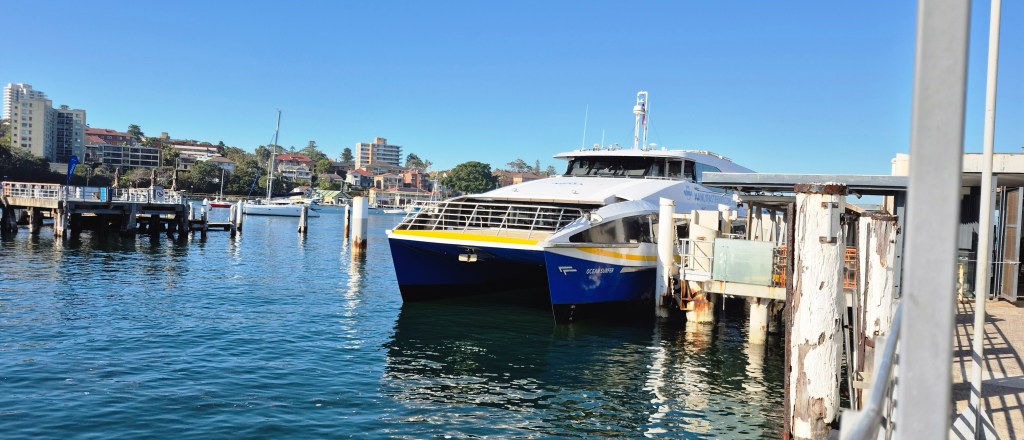
The Sydney Fast Ferry was leaving in a few minutes. I just had time to snap a picture above.

We’re off! Well, no – this photo was taken coming back to Circular Quay after visiting Manly, but I didn’t have a photo capturing this period going out.

It’s a beautiful day, the air is fresh and clear, Sydney sparkles.

The Sydney Opera House. I did a post on this. Actually when I took this photo I was on my way back to Circular Quay.

Here is a photo when I was going out to Manly.

A fine view of the Sydney Opera House and the Sydney Harbour Bridge in bright sunlight.

Admiralty House ” is the Sydney residence of the Governor-General and one of the most historic and important residences on Sydney Harbour. The iconic property is used by the Governor-General as both a residence (when they are not at Government House, Canberra) and to host thousands of people every year … It was renamed Admiralty House in 1885 when the colonial government purchased it as a residence for the Admiral of the Royal Navy’s Australian Squadron. … Admiralty House was handed to the Commonwealth Government in October 1913 and became the official residence of the Governor-General.”

There were other people snapping photos as well.

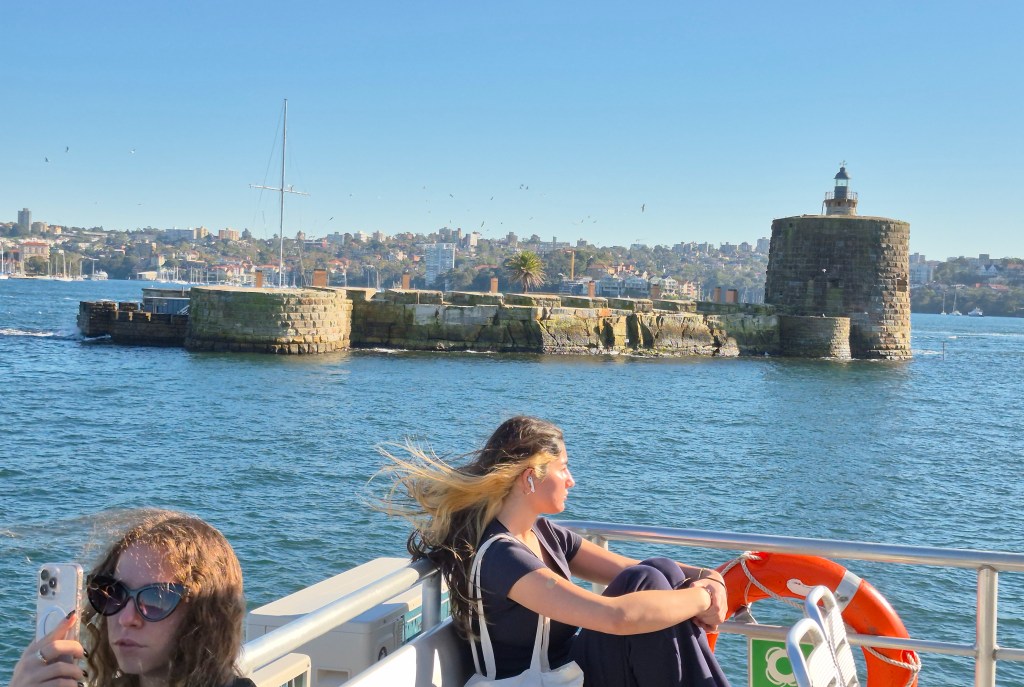
Fort Denison. I wrote about it on this page.

A fine view of the foreshore.

Shark Island, “an attractive and picturesque island of shady trees, sandstone grottoes, grassy slopes and small sandy beaches. It gets its name from the fact that its outline is vaguely similar to that of a shark. ‘Boambilly’ was its Aboriginal name. … With views stretching towards the Harbour Bridge and the white sails of the Opera House in one direction, and over to Manly and the Heads in the other, Shark Island is quite possibly the most precious jewel in the crown of the harbour.”

The ferry turned to head north, and the headland cut off my view of Sydney.

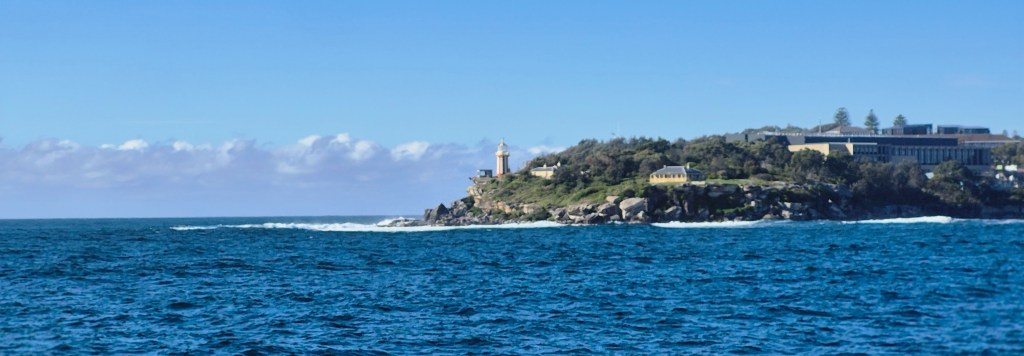
South Head. Beyond is the Pacific Ocean, until South America.

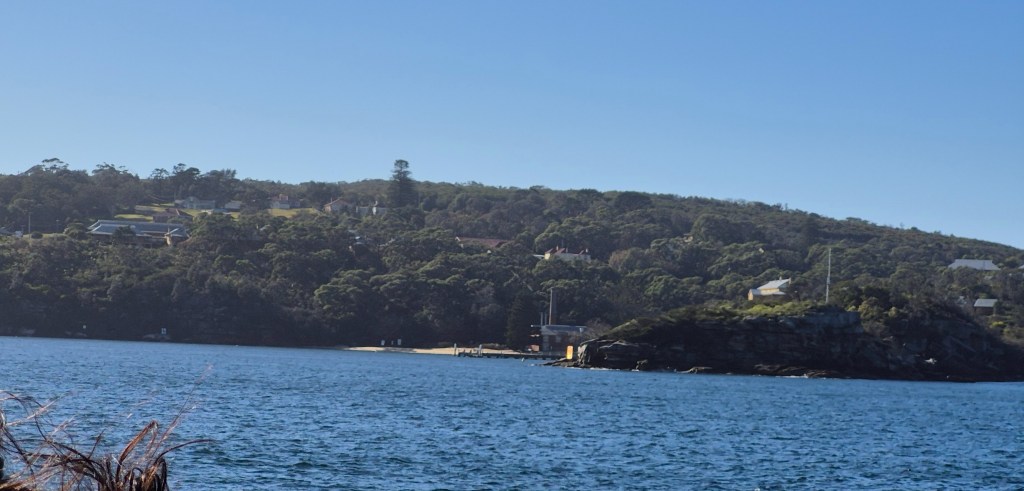
On the other shore it’s all wild bush. Google says “Residential development has impacted a significant amount of the harbour foreshores over many years. Much of what remained was preserved partly due to the presence of military bases, and partly because of the work of conservationists … The Sydney Harbour National Park was finally gazetted in 1975 … the historically important quarantine station at Manly was added in 1984.”

The Quarantine Station. “Between the 1830s and 1984 every migrant ship entering Sydney Harbour was required to be cleared of infectious diseases before the passengers were able to land. If disease was suspected on board both the sick and the healthy were sent to the quarantine station. Some … spent only a few days there, some spent many months and others, more than 500 in all, died. They died of terrible diseases, the mere names of which conjure up images of suffering and desolation – diseases such as smallpox, bubonic plague, typhus and Spanish flu. The healthy were segregated from the sick which meant that those who died often did so alone without the comfort of family or friends. … Q Station has a reputation as the most haunted place in Sydney.”

Coming into Manly.

Almost at Manly Wharf.

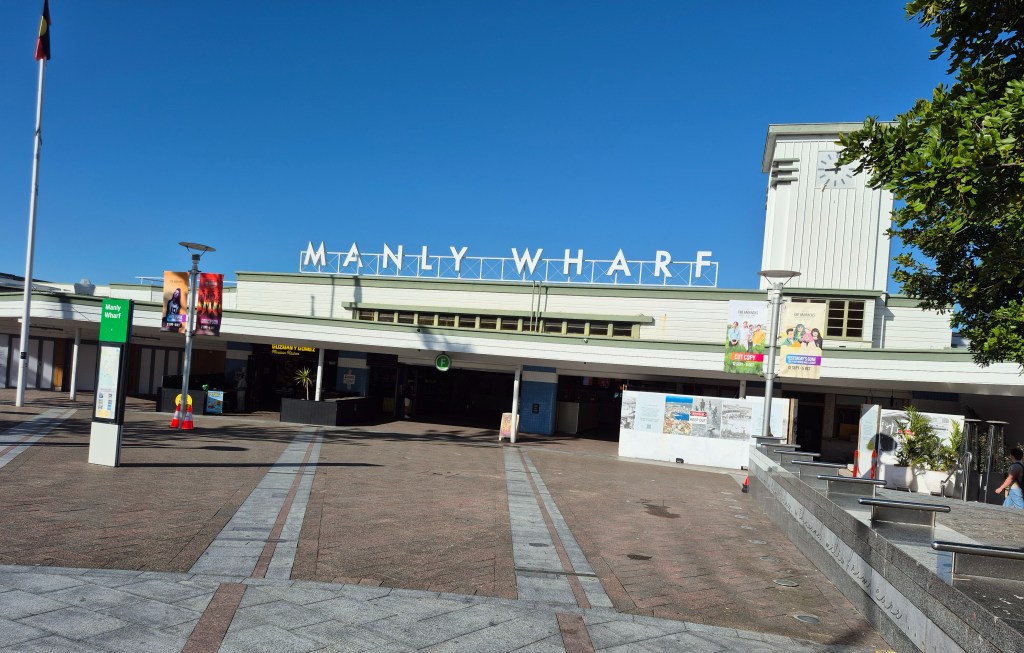
Manly Wharf.

People walking off the ferry, including a cyclist

Manly Wharf is built out over the harbour (as is Circular Quay). The photo above looks down into the green murky waters.

I rushed to get on the Manly Fast Ferry so I didn’t have a photograph. Here’s one as I was leaving.

The entrance to Manly Wharf.

There are many, many clips on YouTube about the Circular Quay – Manly route, but there are not many clips that don’t show the influencers. Here is one.

Outside Manly Wharf there was quite a pretty view.

Not far away is Manly Beach (600 meters according to Google Maps) along the Corso.

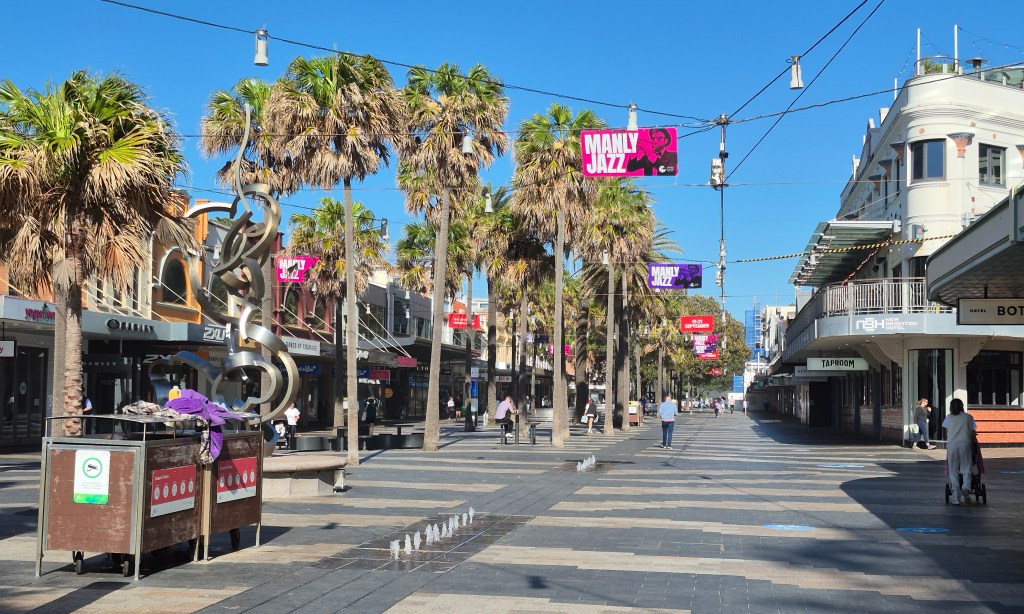
This section of the Corso is partly pedestrianized. There is a huge fig (above) which spreads out above filling the road.

ManlyAustralia.com says “The Manly Corso was laid out in 1854-55 by Henry Gilbert Smith, originally built as a boardwalk for early tourists across Manly’s sand spit between the harbour pier and the beach. The Corso remains the focal point of Manly as a part-pedestrian mall lined with popular surf shops, pubs, cafes, galleries, and street entertainment. Most of this street has no vehicular traffic making it a broad pedestrian precinct for shoppers and visitors and the quickest route from the Manly Ferry to Manly Beach.”

The Vietnamese bánh mì, Sydney’s unofficial favourite meal.

The easternmost end of the Corso.

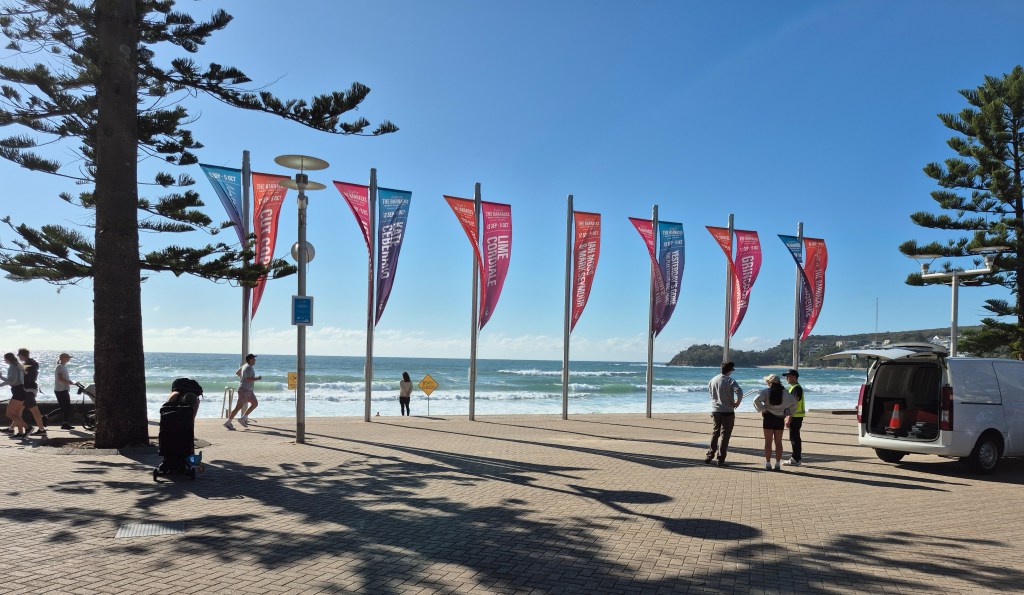
Manly Beach.

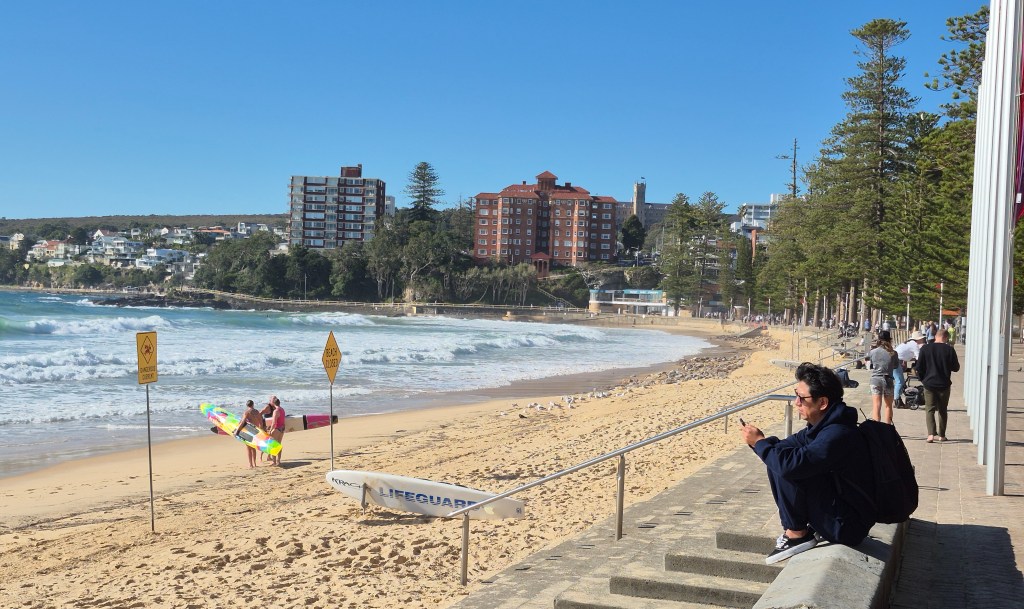
Looking to the right on Manly Beach. Those signs say “Beach Closed”, due to the heavy waves, but two female surfers are heading out regardless. In the upper left of the photo is Cabbage Tree Bay and Shelly Beach.

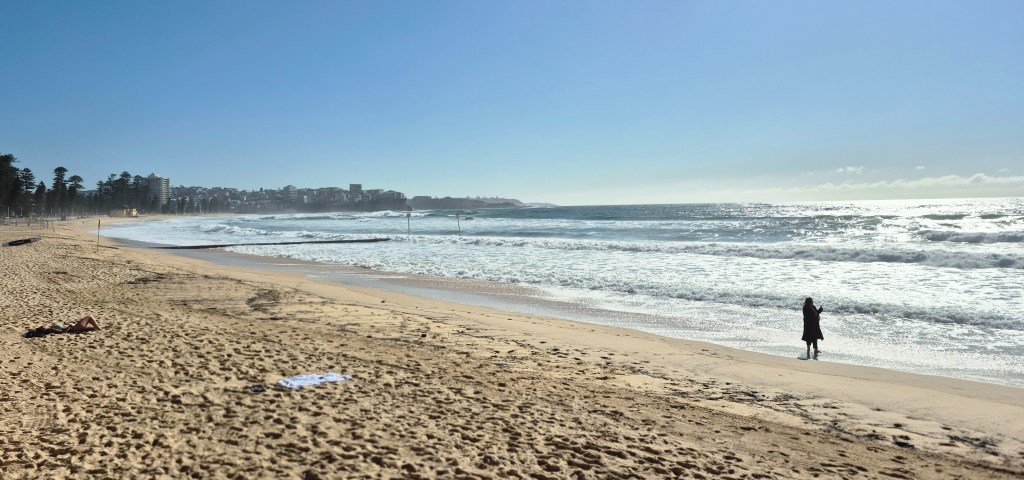
Looking to the left. It’s all beach to the headland, then beaches and beaches for thousands of kilometers.

I ate at a nearby hotel, full English breakfast for $AUS 35 (NTD 700). Sydney may be gorgeous, but it’s also expensive. Then I took the ferry back to Circular Quay.

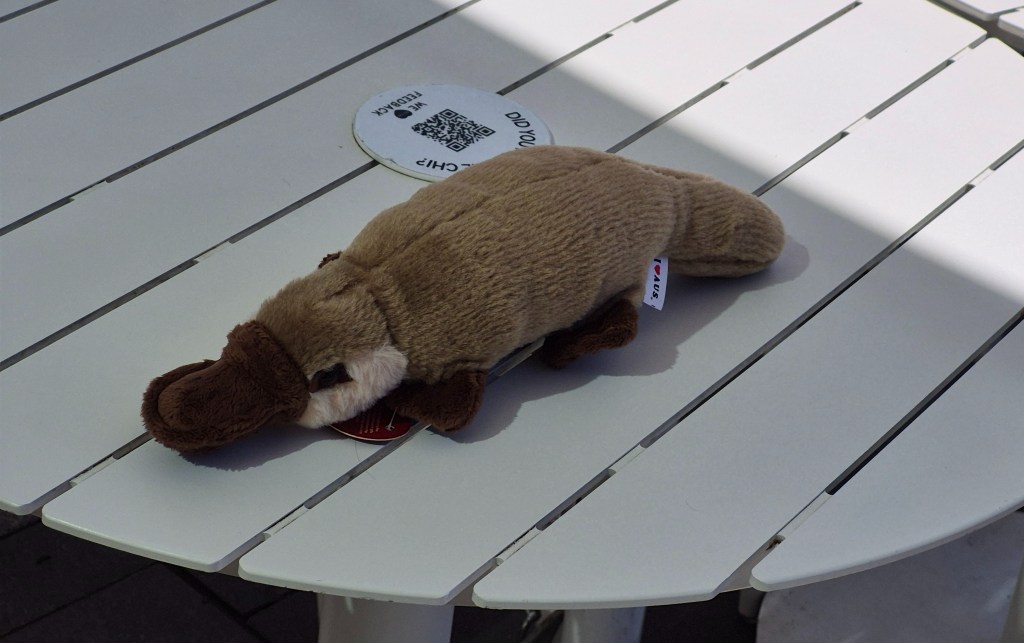
For Yíyún (宜芸) from a tourist shop in Circular Quay I bought a plushy platypus, “a small amphibious Australian mammal noted for its odd combination of primitive features and special adaptations, especially the flat, almost comical bill that early observers thought was that of a duck sewn onto the body of a mammal.” I’m told that in London a preserved platypus has incisions around its bill – a scientist was trying to find the stitches.

While waiting for my bus back to Northbridge I had a quick snack at a cafe in Clarence St in the CBD. While waiting for my meal I watched as an ibis fished out a paper bag using its beak (above). An alternative name for the ibis is “bin chicken”, quite appropriate.

My meal, a chicken sandwich and a long black coffee. Total cost $AUD 20 (NTD 400), cheap for Sydney.

Datong District, Taipei

Note: I will be travelling to Thailand and Cambodia in February 2026. If you are interested in meeting there, even if only for a week or two, respond in the comments below.

August 10, 2025

Jenny is coming to Taipei.

I met Jenny 35 years ago, when we were both undergraduates at Sydney University. She is the sister of Danny, of the Pathologically Polymathic website.

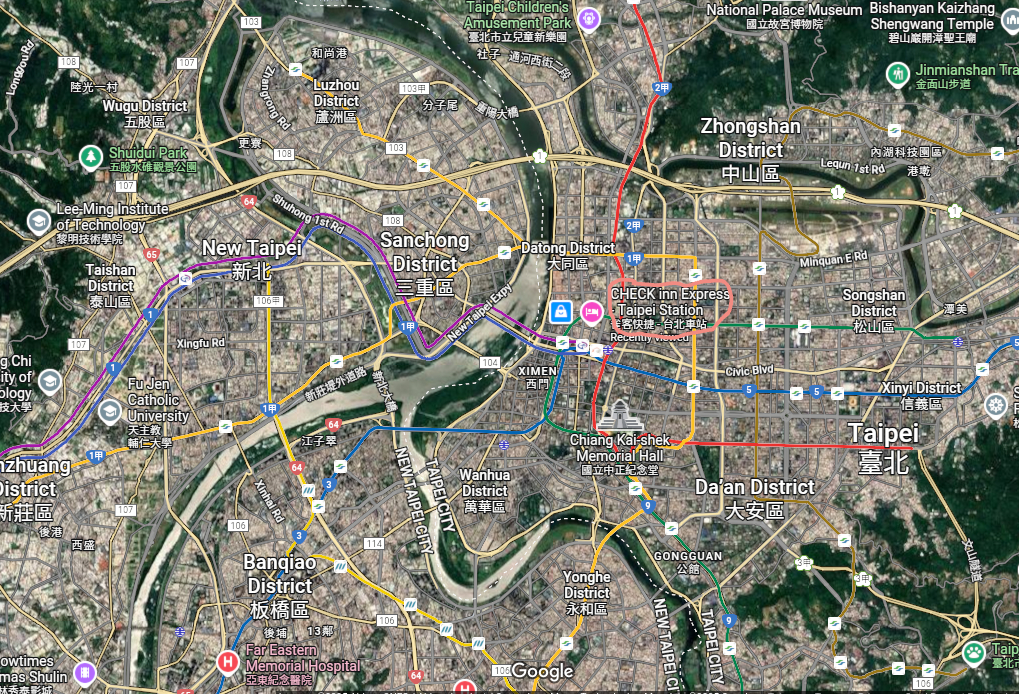
She will be staying in Datong, just north of the terminus of the Airport Line (above), beyond the northern edge of the old city walls. I’ve never explored that area, so I wanted to check it out.

Above is a Google Maps plan of the area. Starting from the Airport Line gates, I planned to walk north to find Jenny’s hotel, “CHECK inn Express – Taipei Station” (雀客快捷 – 台北車站). I was interested to find a market, Jiancheng Market (建成市場) just near the hotel, so I planned to check that out. Google Maps recommended a vegetarian restaurant, 珍巧麻辣臭豆腐(素食 (no English name) which serves stinky tofu, so I wanted to eat that as well.

On Sunday I heard there was a typhoon approaching, but there’s no evidence of it. This morning there were blue skies turning cloudy, temperature in the high 20s Celsuis, increasing to low 30’s as the morning progressed, and quite humid; there would be a shower in the late afternoon.

Eating my breakfast from the 7-11 in a bus shelter outside the Qizhang MRT station (above). I ate strong Americano coffee (the closest I could come to a long black) in my reusable plastic bottle, a minced fish sandwich, and a mixed salad with nuts.

I took the MRT from Qizhang to Beimen MRT stations. Beimen means “north gate”, and nearby there’s the original North Gate still standing in a traffic circle.

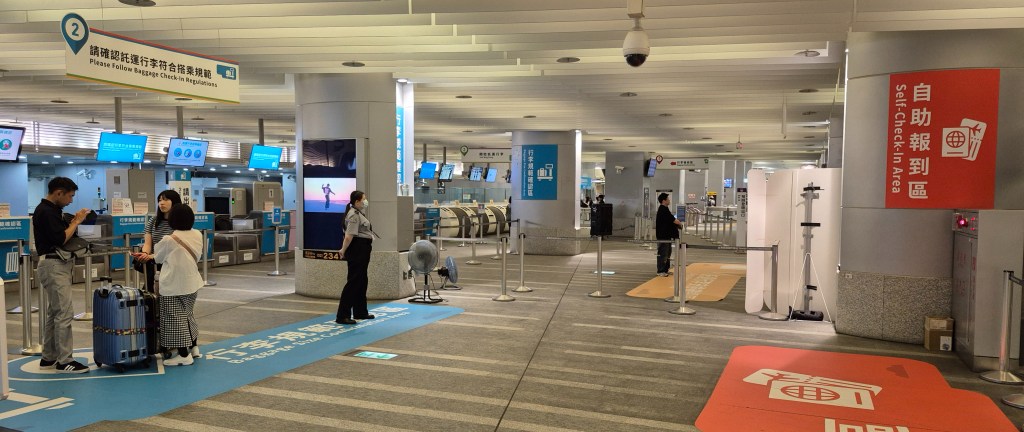
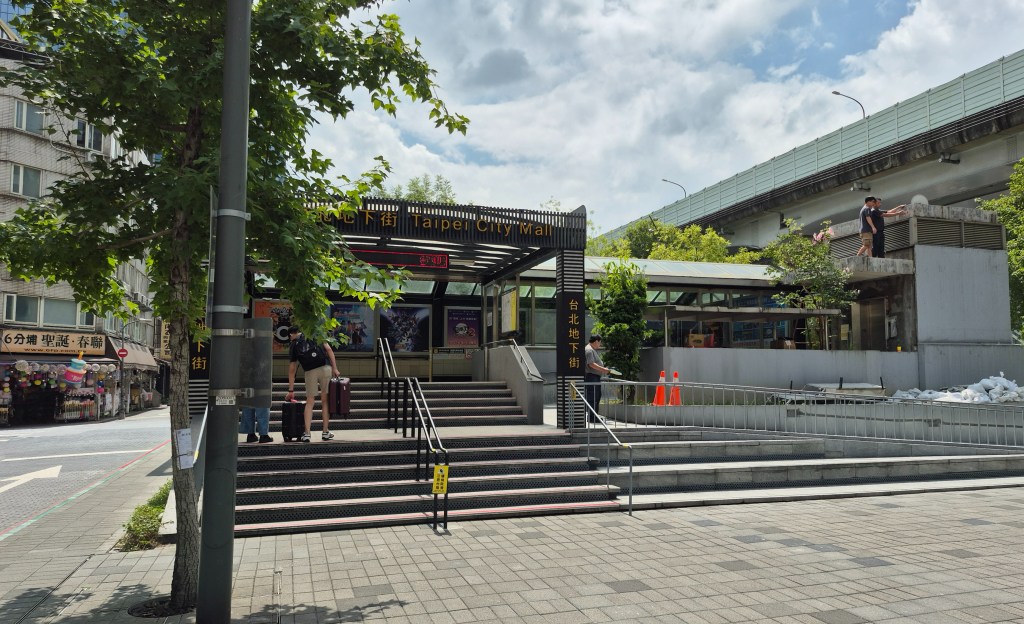
From the Beimen MRT station I walked eastwards around 500 meters underground, paralleling the Taipei City Mall. I came to some check-in desks for some of the airlines at Taoyuan Airport (above). The airlines let you check in here rather than the airport.

There was a large screen showing the departure and arrival times of the aircraft.

Across the concourse there was a taxi rank, convenient for anyone emerging from the Airport Line.

Passengers arriving on the Airport Line in the basement can come up the lift or the escalators (upper far left in the photo above), pass the gates (lower far left) leading out of the Airport Line, and turn left into the Taipei City Mall (far right).

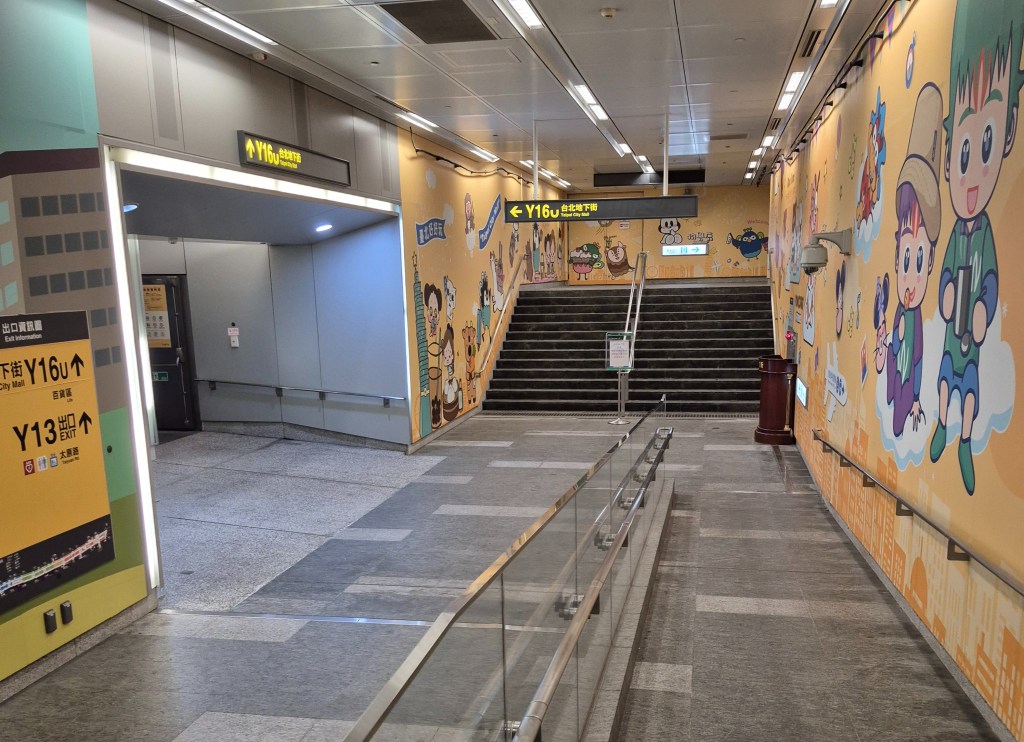
They then walk down this long corridor above, and turn left where the “Y16” arrow is.

They then walk down another passage and exit through Y16.

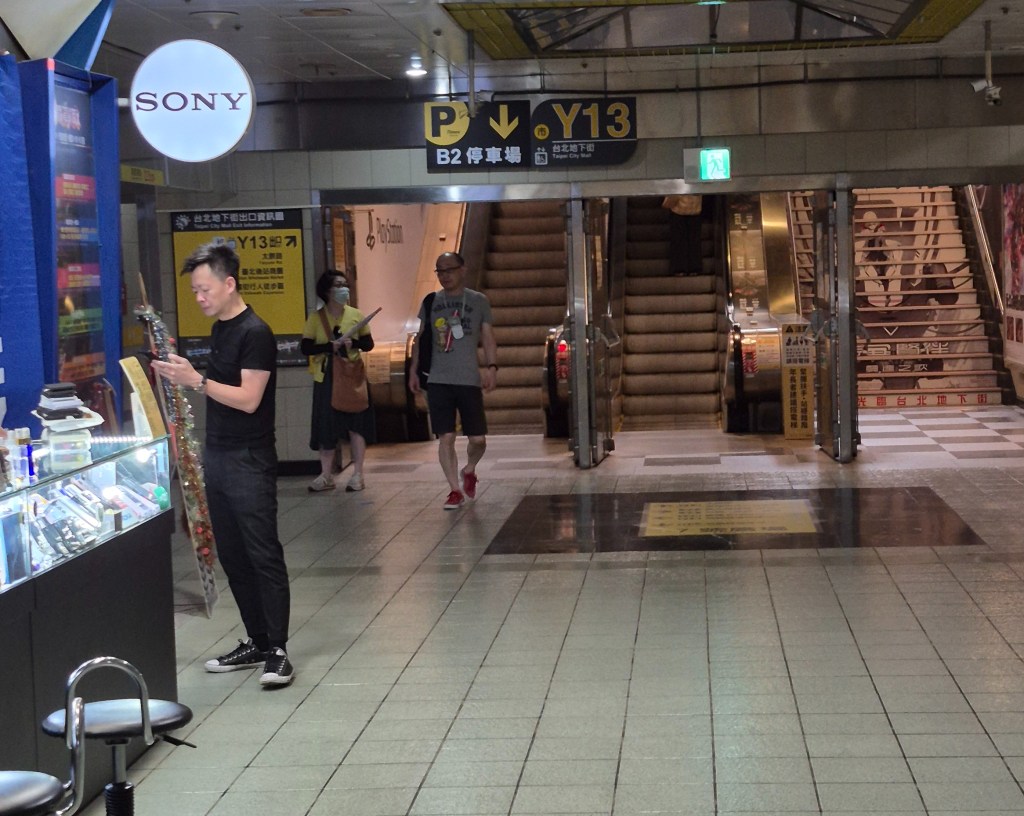
They cross a long corridor with shops to the Y13 exit with escalators.

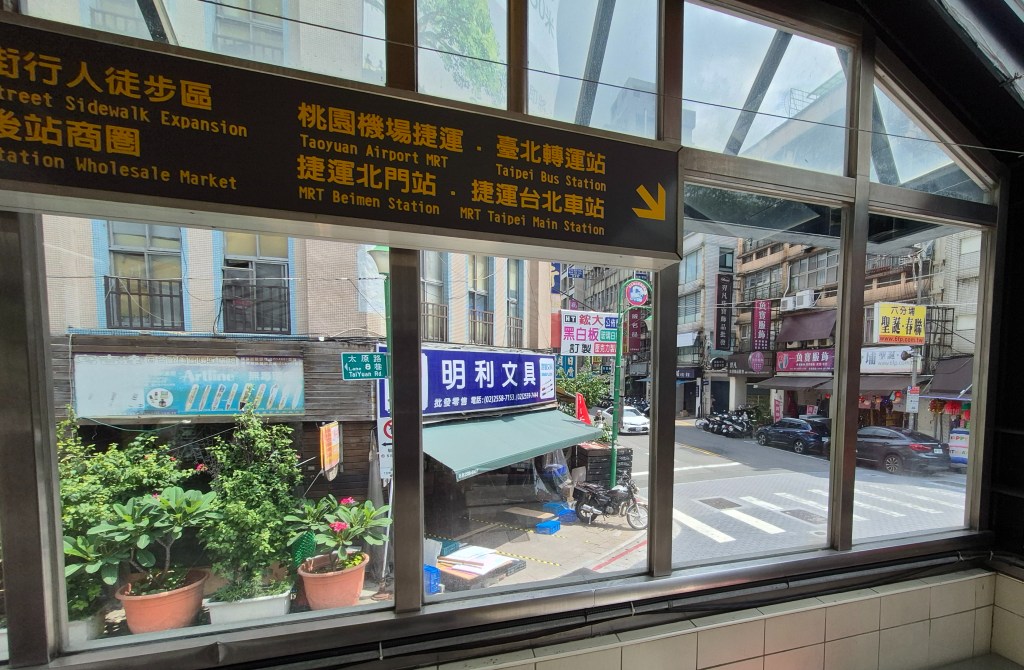
Riding the escalators brings them to the Y13 exit above. The street through the windows is Taiyuan Road (太原路).

They walk down the stairs, or in the case of someone with luggage, the sloped path.

Taiyuan Road (太原路)- the hotel is a few hundred meters away, on the left.

They walk through the colonnaded shops, cross a large intersection…

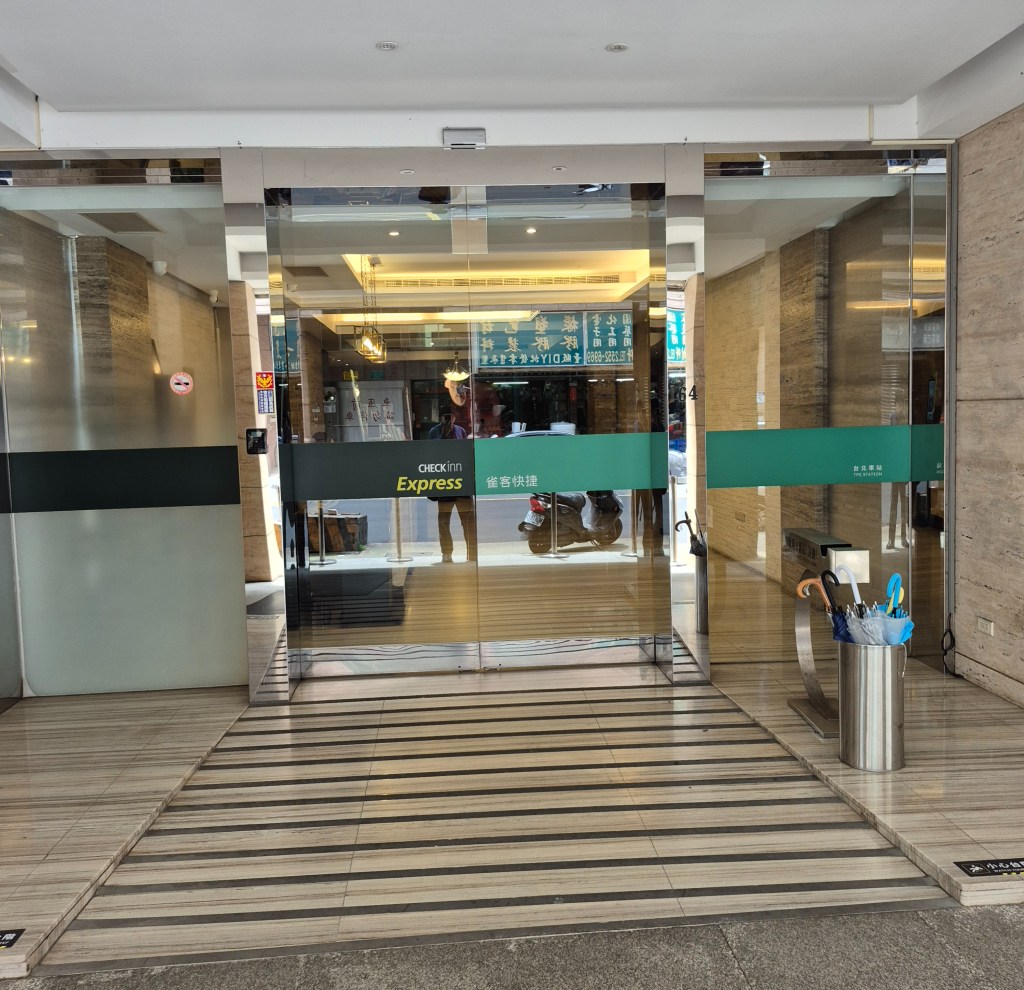
… and the hotel (above) is only a few meters along. There is a reception area by the front door. The total distance is 530 meters.

Another view of the Check-inn Express hotel, by Google Maps. The rooms look very small and there’s no attached restaurant, but it’s got good reviews, and it’s cheap – about 1350元 / $AUD68 / GPB34.

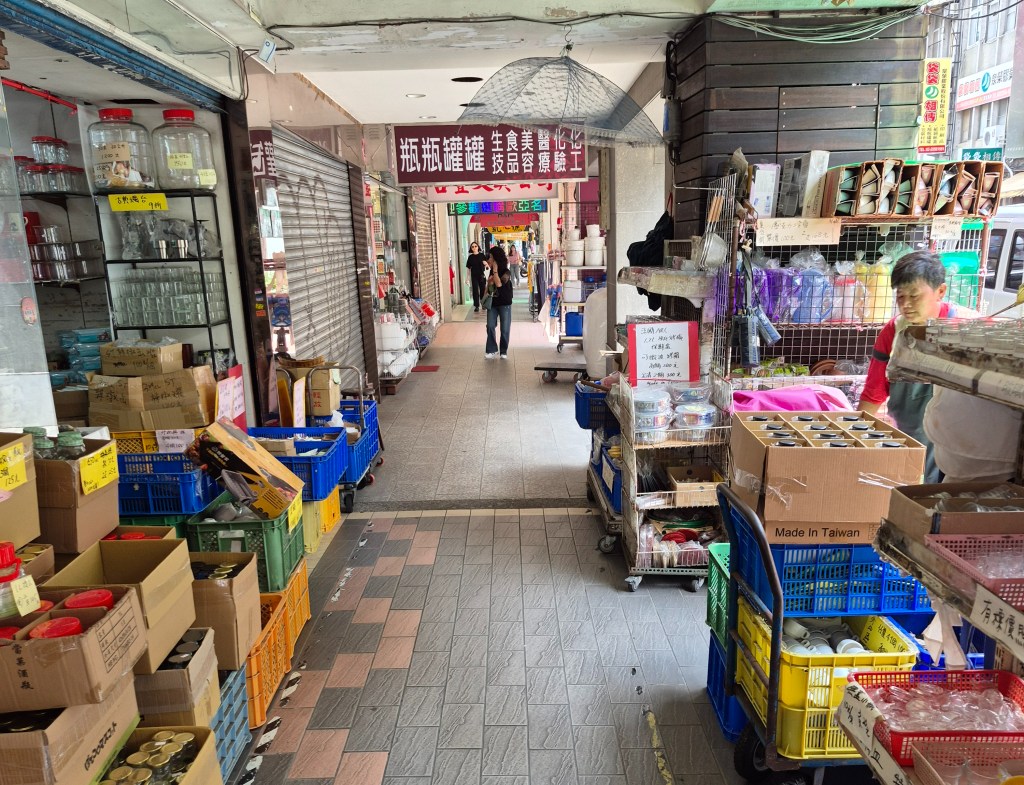
I wanted to check out Jiancheng Market (建成市場) close by. I walked the short distance to the cross-street and turned right. The market is in the centre of the photo, almost hidden.

This is the market. It’s in the narrow lane running parallel to Taiyuan Road, but the market goes quite a long way back.

A different photo showing the narrow path. Only a few shops were open. Where is everybody? I expected the market to be bustling. Google says it’s a morning market, and these photos were taken around 10:30am on a Sunday, but it’s very quiet.

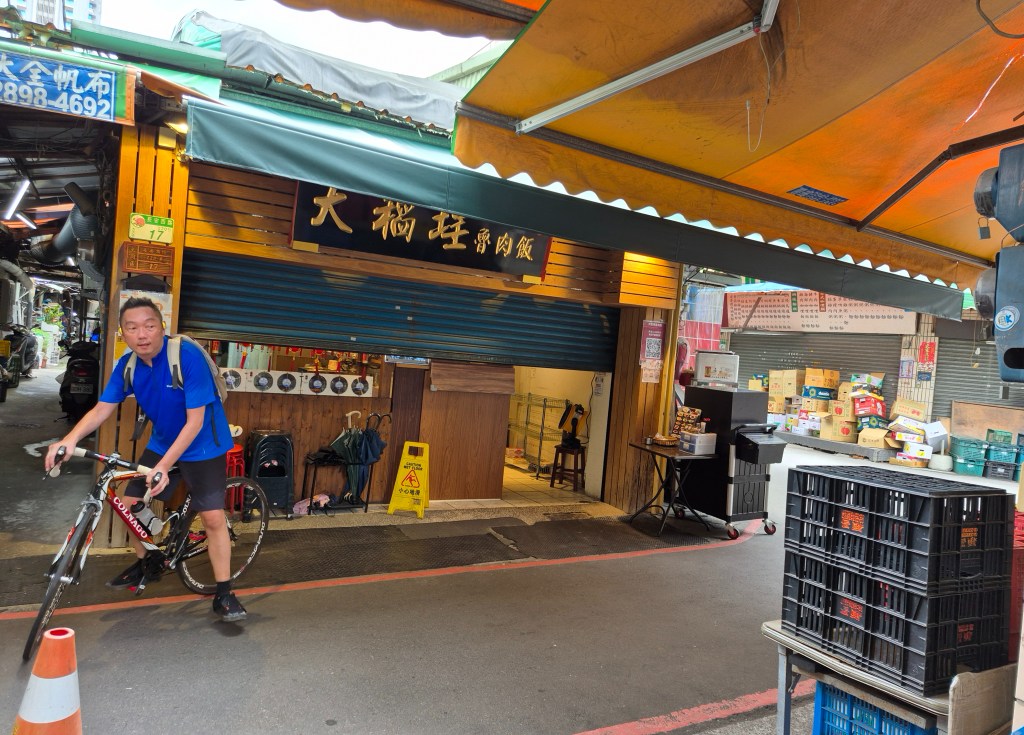
The few shops that were open looked appetising, like this one…

…and this one.

I went to YouTube to find a clip of Jiancheng Market, but I found only this clip above. It’s all in Chinese. It looks like a segment of a TV show, primarily concerned with dish after dish of delicious food. Maybe readers could enlighten us further.

From the Jiancheng Market I walked along Chang’an West Road to the intersection of Chengde Road. I was looking forward to stinky tofu.

“Legend has it that a failed scholar from Anhui province invented stinky tofu by accident in Beijing. One day, the tofu vendor had some leftovers. After storing the pieces of tofu in an earthen jar, he found that they had gone bad but tasted strangely delicious. The dish caught on and even made its way into the Qing dynasty court. Over time, it spread to different corners of China. Eventually, migrants from Fujian province brought stinky tofu to Taiwan, where it remains very popular to this day. …  [One version] is the deep-fried variety. …After being fried to perfection, they’ll typically be served in a paper bowl with a splash of sauce and topped with Taiwanese pickled vegetables (mostly cabbage and a bit of carrot).”

I walked up Chengde Road, looking for Lane 77. The restaurant was number 23 in the narrow lane above, amid bars and other restaurants. Unfortunately the restaurant was closed – what a pity.

There was one interesting old building, Rixin Elementary School (in Chinese):

“Over a hundred years ago, the current site of Rixin Elementary School in Dadaocheng, Taipei, was a low-lying swampland. During the rainy season, the pond often overflowed. In 1917, the Japanese colonial government reclaimed the paddy fields and part of the swampland to create a school, named ‘Dadaocheng Second Public School.’ … In 1945, it was renamed ‘Taipei Rixin Elementary School.’” … The Red Building, the founding commemorative building of Rissin Elementary School, is constructed primarily of red brick. At the time, the school enrolled Taiwanese students. While its scale and grandeur are not as impressive as those of Jiancheng Elementary School, which primarily enrolled Japanese students, the rustic red bricks and arched corridors, set against the elegant lines of the building, imbue the school with a humanistic and classical atmosphere. … The Red Building is an irreplaceable cultural asset and historical building for [Rixin] Elementary School. Constructed of lime, sandstone, and red brick, it has been meticulously maintained, making it a rare sight among Taipei school buildings. In 1999, during the devastating 921 earthquake in Taiwan, the Red Building, a major concern for everyone, remained unscathed, a testament to its structural strength.”

By this time I was starving, so I found a Louisa cafe near Zhongshan MRT station and had lunch there, before going home.
Coogee Beach, Sydney

May 30, 2025

I’m back in Sydney for a week to see my mother. While in the Central Business District in the center of Sydney, on a whim, I decided to visit Coogee Beach.

The route, courtesy of Google Maps, goes by light rail (tram) to Randwick where the tram lines end. Then I would switch to a bus (and a color on the map) to get to Coogee Beach.

The light rail (tram) service, outside the Queen Victoria Building on George Street. I estimated the temperature was in the high teens (18 – 19 degrees), warming up to 20 – 21 degrees. George Street used to be full of traffic and noise, with the roar of engines and blare of horns; now it’s quiet and almost serene with the low rumbling of the tram wheels.

On the tram, looking back. Sydney has a growing light rail network; there is a map here.

We went through the center of the city, past Central train station (the photographs weren’t usable) and then Surrey Hills. Above is a row of late 19th century terrace housing, quite common in a ring around the city. I lived in quite a few of these terrace houses during my time at Sydney University.

I changed trams at Moore Park (above), convenient for the Sydney Cricket Ground, out of sight beyond the trees.

Across Anzac Parade there are Sydney Girls’ and Sydney Boys’ High, both selective schools. The enormous trees are Moreton Bay figs:

Ficus macrophylla, commonly known as the Moreton Bay fig … native to eastern Australia … called a strangler fig because seed germination usually takes place in the canopy of a host tree, where the seedling lives as an epiphyte until its roots establish contact with the ground, when it enlarges and strangles its host, eventually becoming a freestanding tree by itself.”

I boarded a different tram and took it past the vast Royal Randwick racecourse, just visible in the distance, overlooked by the member’s stands. The school-aged boys in the foreground are from some private school.

The tram passed the University of New South Wales (above). I spent almost seven years there, studying for a Masters by research. It should only take two years, but I was disabled from the stroke. UNSW is part of the prestigious “Group of Eight” research universities in Australia.

Another view, this time coming back from Coogee Beach.

We rumbled along past the Prince of Wales Hospital:

“The Prince of Wales Hospital is a 440-bed major public teaching hospital located in Sydney’s eastern suburb of Randwick, providing a full range of hospital services to the people of New South Wales, Australia. The hospital has strong ties to the adjacent University of New South Wales. The Prince of Wales Hospital shares the Randwick Hospitals’ Campus site with the Sydney Children’s Hospital and the Royal Hospital for Women, as well as the Prince of Wales Private Hospital”

Shortly we were at the Randwick terminus at Five Ways intersection.

Getting off I noticed an advertisement for China Airlines, the same airline that I had been using to get directly to Taipei. Of course, people would assume it is a Chinese airline – it’s in the name! In fact China Airlines is a Taiwanese airline, the flag carrier for Taiwan, and not a Chinese airline at all. There is a totally different airline called Air China that is not associated with China Airlines at all.

A view of Randwick from the station looking north.

I walked a hundred meters and saw a bus stop – and a view of the sea!

The 370 bus came in a few minutes. This is a photograph from my seat.

Quite a nice view out the windows.

The 370 bus deposited me only a hundred meters from Coogee Beach. What a view! This was taken looking south.

And this photo was taken looking north at around the same spot.

Next stop: South America.

Another view of the beach. I went a little crazy with my photography – but with these views, who could blame me?

A close-up of some seagulls.

There was a Aboriginal fair on, with amplified voices in the distance.

A man with a didgeridoo!

“The didgeridoo … also spelt didjeridu, among other variants, is a wind instrument, played with vibrating lips to produce a continuous drone while using a special breathing technique called circular breathing. The didgeridoo was developed by Aboriginal peoples of northern Australia at least 1,000 years ago, and is now in use around the world, though still most strongly associated with Indigenous Australian music.”

Here is a YouTube clip of a didgeridoo being played. In the early 90’s I used to own a didgeridoo, and patiently developed the knack of circular breathing.

In the center of this photo are tall (3 meters) curved pipes in a ring. When you get out of the sea, you are all salty, so the purpose of the pipes is to wash yourself off.

I ate at Chish n Fips, less than 100 meters from the beach, a casual place with cheap food. I naturally ordered fish and chips with a side salad; it came to $AUD17.50 – about 350元. Unfortunately my photograph of my meal was unusable.

Afterwards I headed to the headland north of Coogee Beach. On the way I took this photo of some sunbathers.

There was a woman using a metal detector on the beach, systematically swinging it from side to side as she walked along.

On my way up I passed this little site, sacred to the Virgin Mary – presumably a Catholic religious site. It’s been there for years, since I first came.
Up on the headland there is a memorial to the 2002 Bali bombings. A plaque recounts the horror, followed by a list by name of those in the local area who perished.

This photo is a neat juxtaposition, contrasting the danger sign with the two (presumably) tourists perched high on the rocks, well outside the safe zone, with nothing but a vertical drop separating the two from the crashing waves.

The view from the headland is even greater than the view from the beach. In this photo I’m looking at the headlands south of Sydney.

And this is a photo looking north, to Gordon’s Bay and Clovelly. What a view!

A photo of Coogee Beach from up on the headland.

Coming down off the headland and walking to the bus to take me home, I saw the Mad Monkey Hostel.

I idly thought, What if I spent a few nights in the Mad Monkey Hostel, swimming at the beach and lazing around the cafes? So I looked at Mad Monkey Hostel online. It’s about $AUS65 per night for a four-bed dormitory in low season – a little expensive, about the same price as the hostels in the city center. Accommodation in Sydney is not cheap, especially when next to a beach.
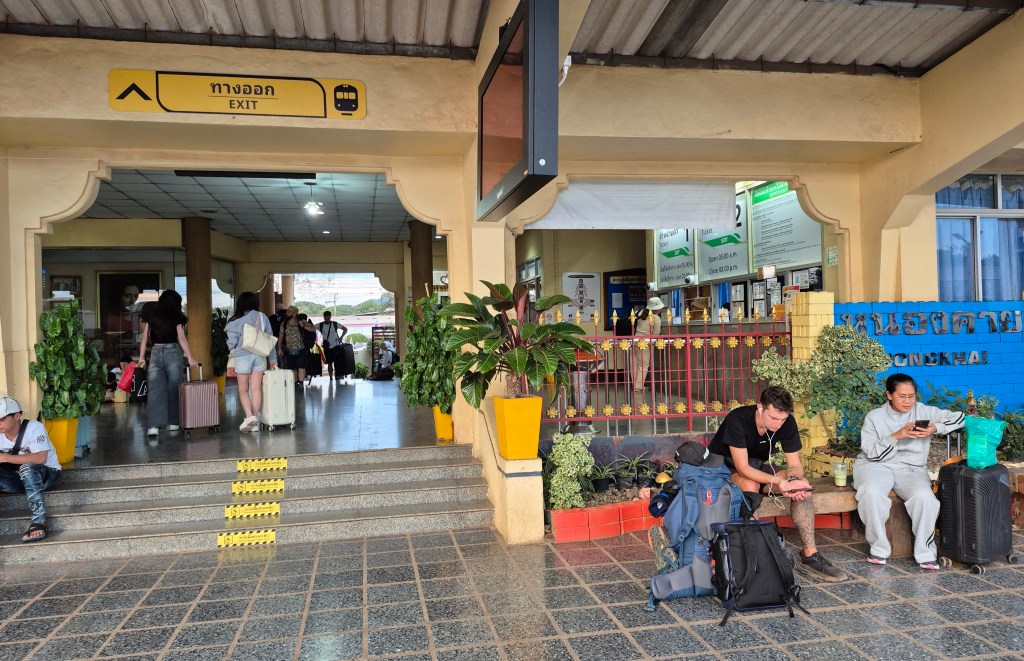
I rushed to catch the 370 bus. This photo was taken as we left the Coogee shopping center.

On the tram back in central Sydney, atop a white building, I snapped these flags, and below them Chinese characters. That’s the home of the Chinese Nationalist Party of Australasia, a Taiwanese outpost. I covered this in a webpage.

Then I went back to Northbridge to write up my day.

Want to go to Thailand or Cambodia?

From December 2025 to February 2026, I will be in Thailand and Cambodia.

The reason is that I will reach the end of the Taiwanese government’s two-year Chinese language qualification in December. So, I will take a three-month holiday in South-East Asia, then in February come back to Taiwan and re-enroll at the same Chinese language course I am now on.

If you are interested in going to Thailand or Cambodia at that time, please contact me. I could adjust my route to meet you for a few weeks. If you want to see the ‘lost’ city of Angkor, or the charming riverside of Phnom Penh, or the street food of Bangkok, give me a call. I have been to most places in those two countries, and enjoy showing them to travelers.
I will keep posting on Wandering Richard in the three months I will be in Thailand and Cambodia.

Dajia Mazu

April 5, 2025

While I was shopping at Huì Guó Market, someone mentioned the Mazu pilgrimage, a huge festival down south near Taichung. I was unenthusiastic, but I said to myself, in a few years I’ll be glad to have gone. So I looked up the temple and found a “Dajia Mazu Pilgrimage Day Tour from Taipei” – the tour was cheap, so I booked it.
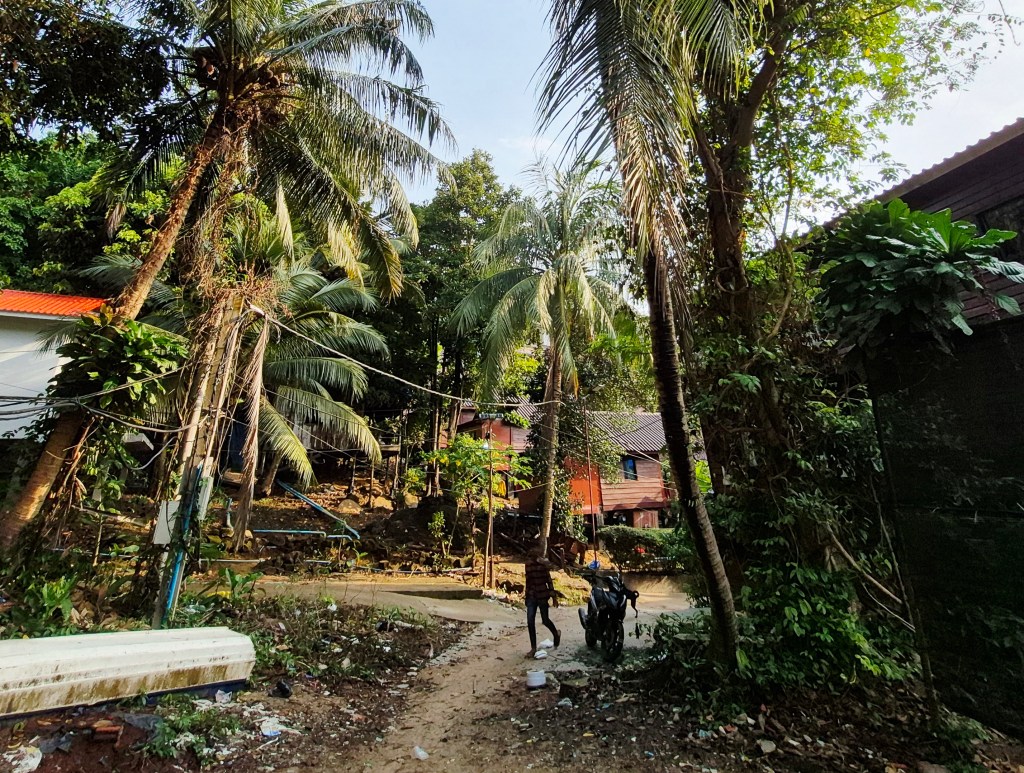
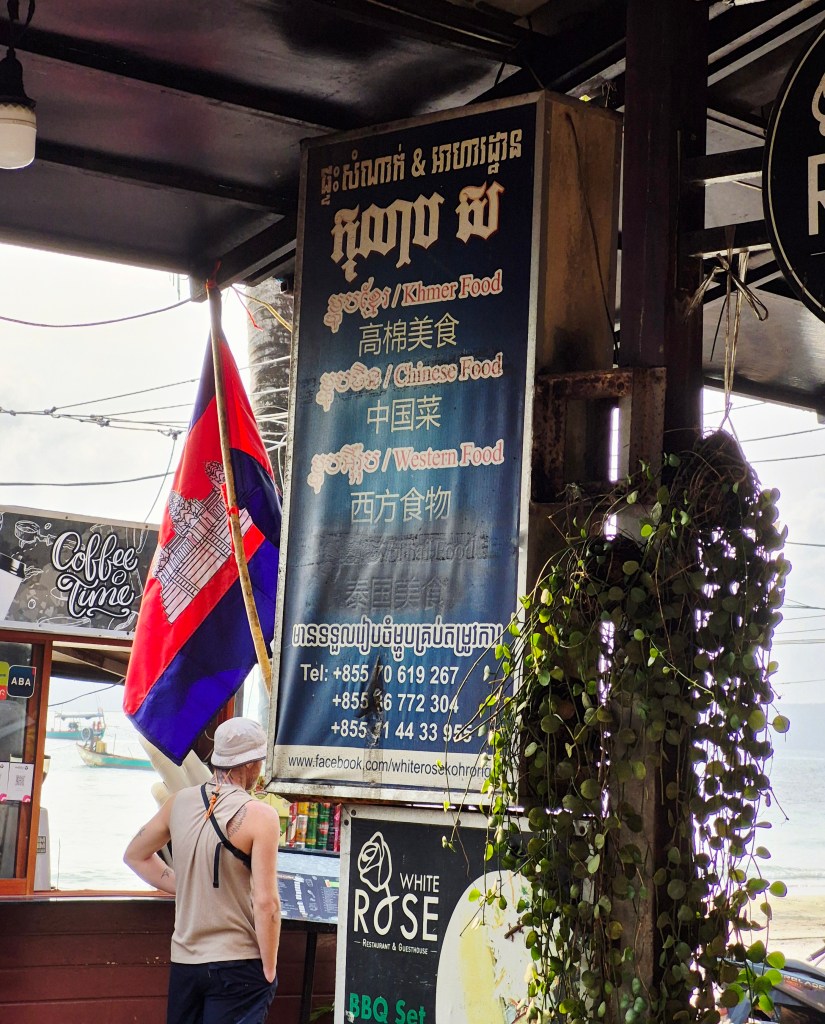
Wikipedia says “The Dajia Mazu Pilgrimage is an annual celebration of the Taoist sea goddess Mazu held in Taiwan. During the festival, a statue of Mazu is placed in a litter and carried by foot on a round-trip journey from Jenn Lann Temple in Dajia, Taichung to Fengtian Temple in Xingang, Chiayi, stopping at many more temples along the way. The festival lasts for nine days and attracts large crowds of pilgrims.” We were only going to participate in the first day.

The day, April 5, was grey and gloomy, threatening rain; the temperature was around 18 degrees. The tour began at 7:30am in the park next to Zhongxiao Xinsheng MRT Station. The above photo was taken on the MRT station steps.

It ended up being two groups, the English and the Chinese languages combined, for 6 people; an extra person was added at Taichung. Above you can see the whole group, minus the tour group leader, at Jenn Lann Temple in Dajia.

We set off for central Taiwan. The rain began as we left. The trip took around 2 hours, not including stopping at a roadside service centre on the way there.

A photo of the mountains from the national highway. As we went south the weather improved slightly; it was no longer raining.

The high-rise buildings of Taichung. We went right into downtown to pick up our last passenger.

Then we left Taichung heading north-west, climbing to a ridge then down a great slope almost to the ocean. The scenery became almost rural (above).

A close-up of the rice-plants.

The bus let us off near the pilgrimage route (above), and we walked to the pilgrimage route.

Wikipedia says “Before the procession departs, a ceremony known as jiaogao (筊筶) is held at Jenn Lann Temple, where the pilgrimage’s start date through poe divination. Afterwards, the procession’s Head Banner is tied onto the left dragon pillar of the temple, rectangular pieces of paper known as a xiangtiao (香條) are passed along the route to notify people about the upcoming pilgrimage, and subordinate temples decide among themselves which order to travel inside the procession.”

I could see a great many people lining the pilgrimage route (above, with a canal).

The pilgrimage route. There were a lot of people, thousands upon thousands, but very orderly for a large crowd. There was a large police presence. To my surprise, Wikipedia says “Since Dajia Mazu is considered to be very powerful, temples along the route would often try to ‘steal’ some of Mazu’s power, which is believed to be inside the incense that is carried. Spiritual power may be ‘stolen’ by others if the incense is surrounded by foreign banners and magical writing. In early pilgrimages, there was a twelve-person convoy holding an incense carrier who travelled in secret to avoid losing the spiritual power in the crowd. However, in 1987, the convoy was intercepted by a temple in Qingshui who tried to redirect them to their temple, so Jenn Lann Temple abolished the convoy in later pilgrimages….In modern times, temples that Mazu doesn’t visit will sometimes send people to surround the litter and forcefully ask them to make a detour to their temple. In most cases, the litter bearers concede to these requests in order to avoid conflicts. However, violent brawls do occur if the two sides do not come to an agreement. Therefore, the procession is often accompanied by a large police presence to discourage litter stealing.”

It was very organised, with regular booths at intervals, like the above. Wikipedia says “Pilgrims often follow a vegetarian diet for the duration of the pilgrimage, and food is provided for passing pilgrims by the villages along the way.”

Burning hell money. “The term refers to imitation money, made of paper, in the Chinese world for burning to the ancestors. The act of burning it serves as the means of conveying the value to the other world for use there.”

A photo of an offering; note the hell money to the right.

A photo of a float. The tour guide said the palanquin containing Mazu’s image was still a mile away.

There were these people dressed alike holding replica halberds. Sorry about this out-of-focus photo.

At last – the palanquin! It’s on the left hardly in view; that circular arrangement you can see is a foretaste. The smoke is from fireworks set off down the road.

The palanquin, surrounded by a jostling, camera-wielding crowd.

You can’t really see it, but the palanquin is moving over the top of the crouching people. Wikipedia says “The kneeling ritual (Chinese: 鑽轎腳…) is a common practice among Mazu processions. Worshipers may either kneel on the ground for the litter to travel over them or crawl underneath a stationary litter. Originally used to show gratitude towards Mazu, worshippers may also kneel to ask for protection and good luck.”

A TV report from last year. That temple is where we’re going next.

In the wake of the palanquin we joined the procession, and walked for several kilometers amongst the crowd. I chatted with an American woman, who asked what I thought of President Trump’s antics.

Eventually we reboarded the bus and travelled a short distance to Dajia. There I briefly left the tour because I was very hungry. I ate at the above restaurant.

My meal, on a paper plate: cabbage, greens, eggplant, and fish, for NTD 90 ($AUD 4.50). It was delicious.

Just up the road was the Jenn Lann Temple. Round Taiwan Round writes “Dajia Jenn Lann Temple (大甲鎮瀾宮) in Dajia District is one of the most well-known Mazu temples in Taiwan, dedicated to Mazu, the guardian goddess of the Taiwan coast. The temple attracts a large number of worshippers throughout the year.”

A different view of the entrance-way. According to Wikipedia, the temple originated in 1730 as a small temple.

The entrance-way. Wikipedia says “The day before the pilgrimage, a ceremony known as qi’an (祈安) is held at Jenn Lann Temple to ask for a safe journey, and Mazu is invited to board the litter. The litter contains three statues of Mazu: zhengluma (正爐媽), fuluma (副爐媽), and meizhouma (湄洲媽). During the pilgrimage, Mazu litter is carried by eight men and travels near the end of the procession, behind the crier, flag bearers, musicians, and convoys from other temples.”

Detail of the carving.

The temple still had a bustling air.

A different angle.

Round Taiwan Round writes “There are also many must-try local snacks near the temple entrance, such as crispy taro balls from Wujia Land and Ji Jia Le Taiwanese meatball. The adjacent Jiang Road Tourism Night Market, which has developed alongside Dajia Jenn Lann Temple (大甲鎮瀾宮), is also a highly recommended place to visit.”

Then we reboarded the bus and travelled the 2 hours back to Taipei.

Sydney Opera House – from Wandering Richard (http://wanderingrichard.com)

February 28, 2025

I’m back in Sydney for a week, between MTC Chinese courses. I’m staying with my parents. My mother has just finished the initial period of chemotherapy; I went with her to her last session.

I thought I’d see Sydney as a visitor would see it. Being born in Sydney, I didn’t get to do any of Sydney’s attractions. In particular, I’ve never gone on a tour of the Sydney Opera House. My mother bought me a fancy mobile ‘phone, so this was an opportunity to learn its functionality.

The above is a detail from Google Maps, showing the Opera House (in a pink circle) on the northern tip of the Sydney Central Business District, across from the Sydney Harbour Bridge.

Above is the Sydney Opera House, as I walked north. It’s in a ridiculously pretty location, with Sydney Harbour on three sides.

The Opera House is on Bennelong Point.

The white “sails” of the Sydney Opera House. It’s a striking modern building, even though it was begun in the 1950’s.

A nod to the traditional owners of the land on which the Opera House sits.

At the foot of the monumental stairs.

Standing at the top of the stairs, looking south to the Sydney skyline. Circular Quay (pronounced “key”) is in the middle of the photo, along with a yellow and green Sydney ferry tied up alongside the wharf. A new cruise ship, the Queen Anne, is to the right.

A view of the Sydney Harbour Bridge.

I experimented with my camera on my mobile ‘phone, capturing a wide-angle view (3x larger) of the Opera House and the Bridge together.

Likewise, I took a wide-angle view towards the east. That land across the bay is Garden Island, a military base; tied up is a warship.

“Garden Island … has been associated with the defence of Sydney and eventually Australia, since the first fleet of convicts arrived in 1788. … possibly its best kept secret is its spectacular 360 degree view of Sydney from the top of the old signal station… Access to Garden Island is restricted, due to it being a military base.”

You can go in the Sydney Opera House quite easily. I became a little lost going along the various levels. I came across Jørn Utzon‘s sketches for the Opera House (above).

At last I found the departure point for the guided tours. The English guided tour were all booked out that day, but fortunateIy I booked a few days’ previously.

The attendant printed out a physical ticket. I selected a “concession” ticket but they didn’t seem to check – but maybe it was obvious to them, since I needed a cane to get around.

I was more than an hour early, so I ate something while looking at the view.

Above is a YouTube clip giving the true story of the building of the Sydney Opera House.

As recounted in this BBC article, “The idea to build an opera house for the city had been proposed in the late 1940s by an acclaimed English conductor, Sir Eugene Goossens. At the time, Goossens was something of a celebrity in the classical music world, having carved out a successful career in the UK and the US… Throughout the 1950s, Goossens lobbied hard, trying to turn his dream into a reality. … Goossens convinced the Premier of New South Wales, Joseph Cahill, that an opera house would reshape the world’s view of Australia, that he had found the perfect site for it, and that they should launch [an architectural competition] … [But] Goossens himself would not get to see his ambition realised. In 1956, having just picked up his knighthood in the UK, he was detained upon his entry back into Australia, where his bags were searched and found to contain, among other things, smuggled pornography, compromising photographs and rubber masks. The resulting scandal … completely scuppered the conductor’s career in Sydney. He fled the country for Rome … never to return.”

The tour group waiting area. The tour groups were classified according to language: the above pillar marked “1” is where the English language tour groups started from. Just beyond is the pillar, obscured by patrons, marking the French, German and other European languages’ tour groups. Further away is the pillar marking the (simplified) Chinese-language groups, and a different pillar marks the Japanese and Korean tour groups. We were warned that photographs would be prohibited inside certain rooms.

We collected round our pillar, were given a headset, and followed the tour leader (above). I estimated there were approximately 30 people on the tour.

As this BBC article continues, “a panel of judges evaluat[ed] some 233 submitted entries. At the start 1957, the government announced that a largely unknown Danish architect, Utzon, was the unexpected winner. Part of the surprise at Utzon’s success was that his entry had largely consisted of preliminary sketches and concept drawings.” Sydneysiders called it the Danish pastry. “Premier Cahill, worried that the project might be derailed by adverse public opinion or political opposition, pushed for construction work to start early. This was despite the fact that Utzon was still finalising the building’s actual design, and had yet to resolve critical structural issues. … The initial estimate of the final cost of the Sydney Opera House was put at A£3.5m or A$7m”.

The inside of the shells were oddly cramped, justified in that the passages and steps were shoehorned into any available space between the halls and the shells (above).

As this BBC article goes on, “the first of the project’s delays and eye-watering extra costs” was lack of a strong foundation. “Nobody had also fully understood the scale of the engineering challenge that the Opera House’s daring curved roof surfaces presented.” Delays and costs mounted; “the project was dogged by labour disputes, design changes and rising material costs, making its budget balloon and its potential completion date disappear into the distance.”

There were opportunities to photograph the view (above).

As the BBC article said, “Robert Askin, who had vocally opposed the project, was elected the New South Wales Premier. He appointed Davis Hughes as the new Minister for Public Works, who clashed repeatedly with Utzon. Hughes, determined to rein in spending, began to challenge the architect’s costs and schedules, demanding a full set of working drawings for the interiors – the next stage of the project. … Hughes refused the payments demanded by the construction team, which left Utzon unable to pay his staff. In 1966, the Danish architect resigned from the project and left Australia, never returning to see his Opera House completed.”

A different view of outside.

As this BBC reports, “Hughes appointed a new panel of Australian architects to complete the interior as well as the glass walls. But if Hughes thought this would reduce costs and speed up the project, he was very much mistaken. The new team scrapped most of Utzon’s plans for the interior and radically redesigned it. … The Sydney Opera House’s spiralling bill was pushed even higher when a labour dispute by union workers, over the dismissal of a worker and demands for better wages, culminated in a sit-in strike at the site in 1972. … But the following year, the monumental undertaking that was the construction of the Sydney Opera House was finally completed. Ten years late and 14 times over its initial budget, it came in at a cost of A$102m (£51m). It was formally opened by Queen Elizabeth II on 20 October 1973. … Utzon declined to attend its opening”. 

Dresses from a production, located in an awkward location near one of the shells.

As this BBC article said, “In the years since its completion, acclaim for Sydney Opera House’s visionary architecture has only grown. Its distinctive sculptural form has made it one of the most immediately recognisable buildings in the world. More than 10.9m people visit it annually, and it has come to epitomise the Australian national identity, its soaring roof a celebration of creativity, culture and ambition in the face of seemingly insurmountable odds. … In 2007, the building that had been brought about by a combination of art, engineering and sheer bloody-minded perseverance was formally recognised as a World Heritage Site by Unesco.”

Unfortunately photography was forbidden in the main opera hall, though not the recital hall (above). Very impressive for a 50-year-old chamber!

The group tour lasted about an hour. I was impressed by the mobile ‘phone’s new cameras; no blurring or out-of-focus images at the sides. Selecting one of the three cameras made it more easy to take photos. I went home impressed with my mobile ‘phone’s capabilities, but even more affected by the Sydney Opera House.